


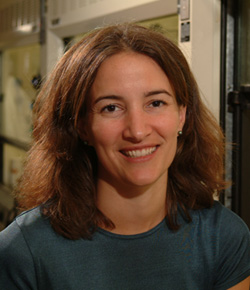
 Heather D. Maynard received a B.S. with Honors in Chemistry from the University of North Carolina at Chapel Hill and a M.S. in Materials Science from the University of California, Santa Barbara. Her Ph.D. from the California Institute of Technology was awarded in the summer of 2000 for research in the group of Nobel Prize winner Robert Grubbs. She then moved to the laboratory of Jeffrey Hubbell at the Swiss Federal Institute of Technology in Zurich (ETH), where from 2000-2002 she was an American Cancer Society Postdoctoral Fellow. Dr. Maynard joined the UCLA faculty as an Assistant Professor in August 2002 as the first Howard Reiss Career Development Chair in the Department of Chemistry and Biochemistry and as a member of the California NanoSystems Institute. She is now an Associate Professor. Maynard’s research interests include polymer synthesis, biohybrid materials, surface modification, and nanomedicine.
Please follow the link to get more information about Heather’s group and her recent paper in Polymer Chemistry.
What was your inspiration in becoming a chemist?
I have always been curious about how things work and like solving puzzles. In junior high I took a science class with a terrific teacher that covered physics, chemistry, and biology. Although I enjoyed all of them, it was chemistry that really sparked my interest. Even then the idea that I could come to understand the world around me at a molecular level and could create new materials enthralled me. At the age of twelve I decided to be a chemistry professor.
What was the motivation behind the research in your recent Polymer Chemistry paper? (DOI: 10.1039/C1PY00034A)
One of my main research interests is the synthesis and application of protein-polymer conjugates. These conjugates are utilized as therapeutics to treat a range of human diseases, so we considered the synthesis and mode of action of known protein therapeutics. The paper summarizes all of the FDA approved protein-polymer conjugates. We teamed up with a medical doctor at UCLA to write this review, which describes the synthesis of these materials, as well as the biological activity, administration, and where possible the half-life information. Since there are many polymer chemists interested in bioconjugates, we anticipated that a concise review of currently used therapeutics would be useful to the community.
Why did you choose Polymer Chemistry to publish your work?
Polymer Chemistry is an exciting new journal by the RSC, and we were pleased to be invited to take part in a themed issue on Polymer Bioconjugates.
In which upcoming conferences may our readers meet you?
I will attend the International Conference on Materials for Advanced Technologies in Singapore in June and the American Chemical Society Fall National Meeting in Denver.
How do you spend your spare time?
I enjoy spending time with my family and also like to mountain bike.
Which profession would you choose if you were not a scientist?
That is a hard question to answer as it is very difficult to imagine myself not a scientist. Perhaps I would enjoy being an astronaut.




 Brent Sumerlin is Harold Jeskey Trustee Associate Professor in Department of Chemistry at Southern Methodist University. His research group focuses on well-defined polymeric materials with selected functionality, composition, and molecular architecture. Their particular interest is on polymers that are water-soluble and stimuli-responsive. Such “smart” polymers have the ability to self-assemble or dissociate in solution in response to changes in their surroundings. Potential target applications include controlled and targeted drug delivery, surface modification, and the synthesis of self-healing materials.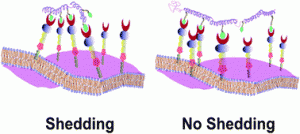


 Dr. Cyrille Boyer received his PhD in polymer chemistry in 2005 from the University of Montpellier II. His PhD was in collaboration with Solvay-Solexis and devoted to the synthesis of new graft copolymers using grafting “onto” under the supervision of Prof. B. Boutevin and Prof. J.J. Robin. In 2005, he undertook an engineer position with Dupont Performance and Elastomers dealing with the synthesis of original fluorinated elastomers using controlled radical polymerization (e.g., iodine transfer polymerization). In October 2006, he joined the Centre for Advanced Macromolecular Design (CAMD) as a senior research fellow under the direction of Prof. Tom Davis. In 2009, he got an Australian Post-Doctoral Fellowship from the Australian Research Council (ARC). Recently, Dr. Cyrille Boyer has been appointed as a Nanomedicine Lecturer at the University of New South Wales. His research interests mainly cover the preparation of well-defined polymers for drug delivery and imaging applications, protein-polymer conjugates and hybrid organic-inorganic nanoparticles using controlled radical polymerization. He is also working on the preparation of new systems for energy storage using hybrid organic/inorganic nanomaterials. He has co-authored over 70 peer-reviewed research papers, including two book chapters and two international patents.
 Didier Gigmes got his education in chemistry at the University Paul Cezanne (Marseille, France). In 1998, he received his PhD in organic chemistry under the guidance of Prof. Paul Tordo (Marseille, France). He completed a first postdoctoral fellowship at Elf-Atochem, North America in Pennsylvania (USA) under the supervision of Dr. Gary Silverman. Then, he came back to France to work as a postdoctoral fellow under the supervision of Prof. Paul Tordo in Marseille. In 2001 he obtained a position of researcher at CNRS to develop nitroxide-mediated polymerization (NMP). In 2008 he defended his Habilitation at the University of Provence and became a group leader in June 2008. In October 2010, he was appointed Research Director at CNRS. During the past few years he has been working on the development of NMP and particularly the design of a highly efficient SG1-based alkoxyamine. After a significant contribution to the understanding of the mechanisms involved in NMP, one of his main concerns is now to promote NMP in material science for various applications such as biomaterials, environment and energy.