Archive for April, 2020

Paper of the month: A polymerization-induced self-assembly process for all-styrenic nano-objects using the living anionic polymerization mechanism

Wang and co-workers report an anionic polymerization combined with polymerization-induced self-assembly.
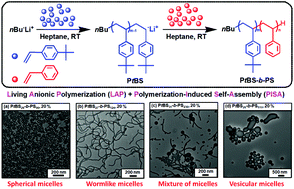
Schematic of LAP PISA process based on these all styrenic diblock copolymers and example TEM images on nano-objects

Polymerization-induced self-assembly (PISA) is arguably one of the most versatile and robust self-assembly methodologies and has been extensively evolved over the last decade to produce nanomaterials of various shapes. However, the vast majority of reported PISA methods employ a controlled radical polymerization strategy such as reversible addition–fragmentation chain transfer (RAFT) polymerization while low activated monomers such as styrenics are not frequently utilized. In this work, Wang and co-workers elegantly combine living anionic polymerization (LAP) with PISA to afford the facile and quantitative synthesis of spherical and worm-like nanoparticles. In particular, poly(p-tert-butylstyrene)-b-polystyrene was used as a model diblock copolymer and the polymerization was performed in heptane, a good solvent for the first block and a poorer solvent for the polystyrene segment. This formulation allowed the first monomer to polymerize in a homogenous system while the formation of the second block was performed under heterogeneous conditions. Importantly, all diblock copolymers synthesized exhibited narrow molecular weight distributions thus demonstrating excellent control over the polymerization. By adjusting the solid content and the molecular weight of each block, the authors were able to attain spheres, vesicles and worms at relatively high purity. To increase reproducibility, the authors also constructed a detailed phase diagram, where the exact location of each morphology was shown. Overall, it was demonstrated that LAP can be successfully combined with PISA therefore expanding PISA formulations beyond controlled radical polymerization.

Tips/comments directly from the authors:

  1. All-styrenic monomers with relatively low activity were firstly introduced into the PISA system and can be completely converted in the LAP PISA system with a rapid polymerization rate.
  2. The typical self-assembled morphologies, such as the spherical, worm-like and vesicular micelles, can also be captured in the LAP PISA system.
  3. Due to the excellent control on the molecular weight and structure of polymers in the LAP process, the nano-objects formed in the LAP PISA process were featuring with uniform sizes and morphologies.
  4. The molecular weights of each block and solids content have important influence on the LAP PISA process.
  5. The LAP PISA process can be performed in a large scale, and the potential industrial application is hoped to be explored for some novel nanomaterials in the future.

Read this article for FREE until 11th June!

Citation to the paper: A polymerization-induced self-assembly process for all-styrenic nano-objects using the living anionic polymerization mechanism, Polym. Chem., 2020, 11, 2635-2639, DOI: 10.1039/d0py00296h

Link to the paper:

https://pubs.rsc.org/en/content/articlepdf/2020/py/d0py00296h

About the web writer

Athina AnastasakiDr. Athina Anastasaki is an Editorial Board Member and a Web Writer for Polymer Chemistry. Since January 2019, she joined the Materials Department of ETH Zurich as an Assistant Professor to establish her independent research group.

Digg This
Reddit This
Stumble Now!
Share on Facebook
Bookmark this on Delicious
Share on LinkedIn
Bookmark this on Technorati
Post on Twitter
Google Buzz (aka. Google Reader)

Paper of the month: Organocatalyzed atom transfer radical polymerization (ATRP) using triarylsulfonium hexafluorophosphate salt (THS) as a photocatalyst

Lei and co-workers report an inexpensive organocatalyzed atom transfer radical polymerization.

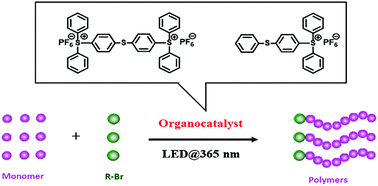
Organocatalyzed atom transfer radical polymerization (ATRP), also referred to as metal-free ATRP, has emerged over the last few years as an alternative to copper mediated ATRP in order to address the issue of metal contamination on the final polymers. In their current contribution, Lei and co-workers introduce triarylsulfonium hexafluorophosphate salt (THS) as an organic and inexpensive photocatalyst for ATRP of methacrylic monomers. The authors demonstrate exceptional temporal control with the polymerization completely stopping during the dark periods. Importantly, by adding sodium hydroxide, a significant acceleration over the polymerization rate was observed reaching relatively high conversions and narrow molecular weight distributions (Đ = 1.26–1.32). Block-copolymers were also possible, thus demonstrating high end-group fidelity. Last but not least, polymer brushes could also be prepared in an efficient manner on silicon wafer by utilizing surface-initiated ATRP in the presence of THS as a photocatalyst. Overall, the presented strategy is particularly attractive owing to the use of inexpensive compounds, the absence of metals and the mild temperatures employed. As the authors remark in the conclusions, such metal-free polymers may find interesting applications in the pharmaceutical, biomedical and food industries.

Tips/comments directly from the authors:

  1. This organocatalyzed-ATRP system is easy to operate. It does not need to undergo freeze-pump-thaw cycles.
  2. Temperature is an important factor for this organocatalyzed-ATRP system. Polymerization rate will be higher in summer and lower in winter unless you use an oil bath to have the temperature fixed.
  3. Due to the poor solubility of THS in water, aqueous media cannot be used as a solvent for this organocatalyzed-ATRP.
  4. When polymers with high molecular weights were synthesized by this system, the molecular weights were often lower than the theoretic values.
  5. In order to more effectively neutralize the free H+ generated by the rearrangement of triarylsulfonium hexafluorophosphate salt (THS), the use of powdered sodium hydroxide (NaOH) is a good choice.

Read this article for FREE until 12th May!

Citation to the paper: Organocatalyzed atom transfer radical polymerization (ATRP) using triarylsulfonium hexafluorophosphate salt (THS) as a photocatalyst, Polym. Chem., 2020, 11, 2222-2229, DOI: 10.1039/c9py01742a

Link to the paper:

https://pubs.rsc.org/en/content/articlepdf/2020/py/c9py01742a

About the web writer

Professor Athina AnastasakiDr. Athina Anastasaki is an Editorial Board Member and a Web Writer for Polymer Chemistry. Since January 2019, she joined the Materials Department of ETH Zurich as an Assistant Professor to establish her independent research group.

Digg This
Reddit This
Stumble Now!
Share on Facebook
Bookmark this on Delicious
Share on LinkedIn
Bookmark this on Technorati
Post on Twitter
Google Buzz (aka. Google Reader)