

Archive for March, 2023

Paper of the Month: Aqueous seeded RAFT polymerization for the preparation of self-assemblies containing nucleobase analogues

Abad et al. develop formulations of self-assemblies containing nucleobase analogues via seeded RAFT in water.
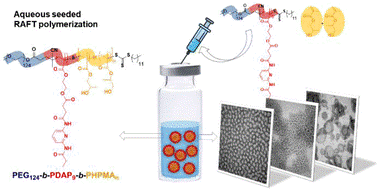


Polymer chemists have long exploited the specific hydrogen bonding interactions between nucleobase pairs to control polymer structure or sequence, to template polymerizations or drive self-assembly. Although several approaches have been employed for the synthesis of nucleobase containing polymers, the poor solubility of nucleobase-containing monomers has hampered their polymerization in water.

To address this, Blasco, Piñol and collaborators synthesized a diblock copolymer containing poly(ethylene glycol) (PEG) and 2,6-diacylaminopyridine (DAP)  polymethacrylate via RAFT. Upon dispersing in water this macro-CTA agent was used for the aqueous seeded RAFT polymerization of 2-hydroxypropyl methacrylate (HPMA). Furthermore, a phase diagram that correlates the degree of polymerization and solid concentration with the morphologies of the resulting self-assemblies was constructed. Through this systematic study, low to high order morphologies (from spherical micelles to worms and to vesicles) could be observed. Interestingly all morphologies proved to be stable for extended periods of time with the exception of worms found to turn into spherical micelles after few weeks. To exploit the ability to functionalize the DAP moieties through H-bonding during aqueous seeded RAFT polymerization, a cross-linker bearing four thymine terminal groups was used. Finally, the higher stability of the assemblies produced via supramolecular cross-linking was studied via encapsulation and subsequent release of the hydrophobic probe Nile Red.

In summary, this study provides a metal-free methodology to produce self-assemblies containing nucleobase analogues in high concentrations via aqueous seeded RAFT polymerization.  The ability to control assembly, functionalize via exploiting supramolecular interactions and load with cargo, enhances their potential use as nanocarriers.


Tips/comments directly from the authors:

  • This new strategy integrating non-water soluble groups, such as DAP units, into a BC enabled the preparation of highly concentrated aqueous self-assembly dispersions using the PISA methodology.
  • The DAP units were further exploited for supramolecular H-bonding functionalization with cross-linker containing complementary thymine groups.
  • Previous work on amphiphilic block copolymers having DAP units has proved their potential to prepare stimuli-responsive self-assemblies of interest in nanomedicine by nanoprecipitation or microfluidic. This article takes an important step forward since the potential of the polymers is upgraded with the processing of highly concentrated dispersions by this new straightforward strategy.
  • This paper is the result of a collaborative effort between the groups at University of Zaragoza (Spain) and Heidelberg University (Germany)


Citation of the paper: Aqueous seeded RAFT polymerization for the preparation of self-assemblies containing nucleobase analogues, Polym. Chem., 2023,14, 71-80.

Link to the paper: https://pubs.rsc.org/en/content/articlelanding/2023/py/d2py01250b

Link to authors website (or social media)

https://liquidcrystals.unizar.es/  @clip_group_lab (Twitter)

https://www.imseam.uni-heidelberg.de/blasco @EvaBlascoPo (Twitter)

 

Dr. Kelly Velonia is an Advisory Board Member and a Web Writer for Polymer Chemistry. She joined the Department of Materials Science and Technology at the University of Crete in 2007. Research in her group focuses on the synthesis and applications of bioconjugates and biopolymers. You can follow Kelly on twitter @KellyVelonia.


Digg This
Reddit This
Stumble Now!
Share on Facebook
Bookmark this on Delicious
Share on LinkedIn
Bookmark this on Technorati
Post on Twitter
Google Buzz (aka. Google Reader)

Emerging Investigator Series – Ignazio Roppolo

Ignazio Roppolo is actually assistant professor in Experimental Physics of Matter at Department of Applied Science and Technology- Politecnico di Torino (Turin, Italy). Since his bachelor degree (in 2006), he was involved in photopolymerization field and in photoactivated chemistry. After achieving his PhD in Materials Science and Technology (2012), he moved to Istituto Italiano di Tecnologia (IIT) as a post-doc researcher, where he started to work on the development of photocurable organic electronics. In 2015, still in IIT, he moved his interests towards new photocurable materials for 3D printing. In 2017 he moved to Politecnico di Torino, establishing a laboratory dedicated to 3D printing, specifically focused on light activated technologies, which goals spans over different application fields: from biomedical to energy, from sensors to microreactors. The underlying idea carried out in his laboratory is to control chemical and physical properties of the materials and to play with design properties, to achieve synergistic effects in functional devices, thanks to 3D printing. He is also research fellow at University of Warwick (Coventry, UK) and Italian Institute of Technology (IIT).

Read Ignazio’s Emerging Investigator article, “Colorimetric 3D printable base-detectors exploiting halocromic core-substituted naphthalenediimides“, DOI 10.1039/D2PY01593E.


Check out our interview with Ignazio interview below:

How do you feel about Polymer Chemistry as a place to publish research on this topic?

Polymer Chemistry is an amazing forum for the publication of advancements in polymer science, since it merges a rigorous approach to the field with the interest towards cutting-edges applications and innovations. In this case, I’m delighted to have the chance to show novel uses for 3D printable polymers.


What aspect of your work are you most excited about at the moment and what do you find most challenging about your research?

Light-induced 3D printing is really exploding now. When I started to work on this topic (2015), there were few groups that were trying to add material and chemical knowledges in 3D printing, while now there are hundreds of papers every year. Nonetheless, there are still many rooms for research, aiming at fulfilling the premises that 3D printing is promising. This is contemporarily the most exciting and the most challenging aspect of the investigations: on the one hand there are the endless new findings that can be discovered, on the other hand the necessity to translate those in something that can be applied in everyday life, beyond scientific curiosity.


In your opinion, what are the most important questions to be asked/answered in this field of research?

I believe that the most important question that has to be done when approaching this type of 3D printing technologies is “ How can I integrate design and materials’ properties? What should I do to achieve some synergistic effect?”. In my opinion, in forefront research in this topic, devices’ architecture and characteristics should be designed together. Conversely, we will keep on missing the real potentialities of 3D printing.


Can you share one piece of career-related advice or wisdom with other early career scientists?

I see in my young collaborators and students a lot of stress, which is related to the pressure that they feel, especially for what regards “scientific metrics” (impact factors, number of publications, citations,…). I believe that the only stress that, as scientists, we should feel, especially in the early-stages of a career, is to produce “good science”, rigorous but at the same time with creativity. When good science is achieved, benefits will arrive: for the self-esteem, for the career, for the scientific community and finally for the society.

Digg This
Reddit This
Stumble Now!
Share on Facebook
Bookmark this on Delicious
Share on LinkedIn
Bookmark this on Technorati
Post on Twitter
Google Buzz (aka. Google Reader)