ISACS 2 takes Budapest by storm

ISACS 2 is continuing where ISACS 1 left off – more world-class scientists discussing the very best in cutting edge chemistry. This time it’s the turn of physical chemistry and nanoscience, set in the beautiful city of Budapest.     
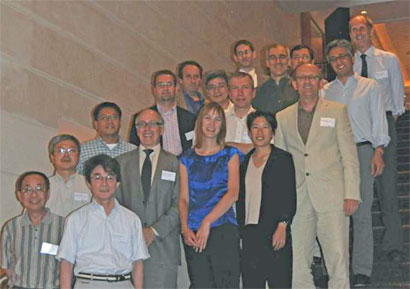


Joanne Thomson, Philip Earis and the ISACS 2 speakers

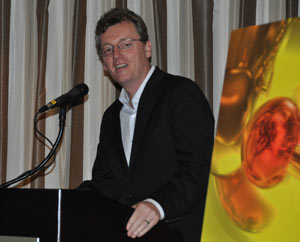
Moungi Bawendi opened the meeting with a fascinating talk on the science and technology of semiconductor nanocrystals, revealing that ‘it is all about the excitons.’ Hongkun Park then discussed his strategy for engineering light-matter interactions using nanoscale plasmonic and optoelectronic interfaces. Photochemistry was up next, with talks on methanol photodissociation on TiO2 surfaces and pi-sigma* excited states from Xueming Yang and Mike Ashfold. The afternoon talks covered electron transfer across interfaces (Martin Wolf), nanopatterning with molecules at interfaces (Steven De Feyter) and last but by no means least, nanoscale spectroscopy with optical antenna (Lukas Novotny). The day finished with a lively poster session and a members’ reception, where we welcomed many new members to the RSC.     
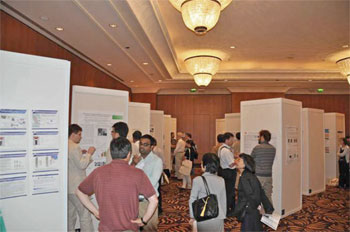


Day two has been another jammed-packed event, with the morning covering single molecule optics for probing dynamics (Michel Orrit), single nano-objects spectroscopy (Vahid Sandoghdar), reactions of vibrationally excited molecules (Kopin Liu) and energy transfer at interfaces (Alec Wodtke). The afternoon session started on a more biophysical angle, with Toshio Yanagida discussing single molecule nanobioscience and Haw Yang talking about quantum dots as nanoscale local temperature sensors for measuring the temperature inside cells. The focus then switched to femto- and attosecond photoelectron experiments (Daniel Neumark) before David Clary closed the day’s session with his general procedure for predicting the kinetics and dynamics of polyatomic molecules. 

ISACS 3 is due to take place next week, 20th – 23rd July, in the spectacular venue of Hong Kong and will take a look at the challenges in inorganic and materials chemistry


Digg This
Reddit This
Stumble Now!
Share on Facebook
Bookmark this on Delicious
Share on LinkedIn
Bookmark this on Technorati
Post on Twitter
Google Buzz (aka. Google Reader)

ISACS kicks off in style

The First International Symposium on Advancing the Chemical Sciences kicked off on Wednesday, focusing on challenges in organic chemistry and chemical biology. Set in the grand Fairment Hotel in central San Francisco, around 200 delegates were treated to a spectacular line up of plenary speakers covering a broad range of organic chemistry and chemical biology. Day one saw outstanding talks covering hydrogen-bonded catalysis (Jacobsen), iridium-catalysed asymmetric hydrogenation (Pfaltz), C-H oxidation (White), carbohydrate chemistry and biology (Seeberger, Hsieh-Wilson), rapid formation of molecular complexity (Sorensen) and the use of transition metal catalysis for the formation of pharmaceutically interesting compounds (Buchwald).
ISACS 1 Speakers
Robert Eagling, Editor, Chemical Science, and James Milne, Editorial Director, join the ISACS 1 speakers

Day two continued in an equally impressive fashion with further insights into new concepts in organocatalysis (MacMillan, Maruoka). After the break, the focus moved to chemical biology, with talks on activity-based proteomics (Cravatt) and reprogramming the code of life (Chin). There was a further shift in subject after lunch with molecular switches, motors and molecular recognition all covered (Feringa, Hunter). The second day ended with talks on new synthetic methods to lactones (Dong) and the latest developments in gold catalysis (Toste). 

David MacMillan

David MacMillan

Jason Chin discusses reprogramming the code of life

Jason Chin discusses reprogramming the code of life

There was plenty of high quality science on the final day, with cutting edge catalysis (Ooi) backed up by high quality chemical biology (Du Bois, Bertozzi).

The vibe at the conference was one of excitement and positivity. The Fairment hotel is a stunning venue and acted as the perfect back drop to the outstanding scientific talks. The new ISACS conferences have certainly arrived with a bang. Next stop Budapest

Digg This
Reddit This
Stumble Now!
Share on Facebook
Bookmark this on Delicious
Share on LinkedIn
Bookmark this on Technorati
Post on Twitter
Google Buzz (aka. Google Reader)