Archive for August, 2013

HOT Chemical Science articles for August

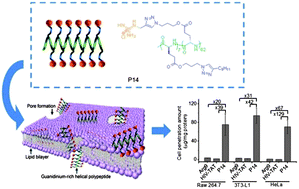
Helical poly(arginine) mimics with superior cell-penetrating and molecular transporting properties
Haoyu Tang, Lichen Yin, Kyung Hoon Kim and Jianjun Cheng
Chem. Sci., 2013, Advance Article
DOI: 10.1039/C3SC51328A, Edge Article
Free to access until 29th September 2013


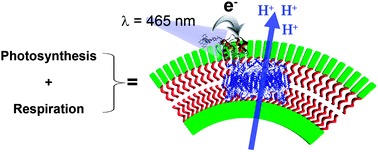
Self-assembled light-driven photosynthetic-respiratory electron transport chain hybrid proton pump
David Hvasanov, Joshua R. Peterson and Pall Thordarson
Chem. Sci., 2013, Advance Article
DOI: 10.1039/C3SC51780B, Edge Article
Free to access until 29th September 2013


3D optical imaging of multiple SERS nanotags in cells
Sarah McAughtrie, Katherine Lau, Karen Faulds and Duncan Graham
Chem. Sci., 2013,4, 3566-3572
DOI: 10.1039/C3SC51437D, Edge Article

Free to access until 29th September 2013


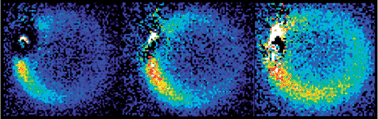
Rotationally inelastic scattering of CD3 and CH3 with He: comparison of velocity map-imaging data with quantum scattering calculations
Ondřej Tkáč, Alan G. Sage, Stuart J. Greaves, Andrew J. Orr-Ewing, Paul J. Dagdigian, Qianli Ma and Millard H. Alexander
Chem. Sci., 2013, Advance Article
DOI: 10.1039/C3SC52002A, Edge Article
Free to access until 29th September 2013


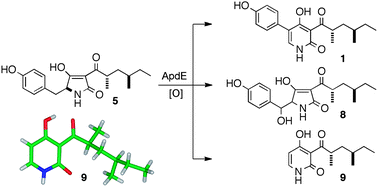
One pathway, many compounds: heterologous expression of a fungal biosynthetic pathway reveals its intrinsic potential for diversity
Zahida Wasil, Khomaizon A. K. Pahirulzaman, Craig Butts, Thomas J. Simpson, Colin M. Lazarus and Russell J. Cox
Chem. Sci., 2013, Advance Article
DOI: 10.1039/C3SC51785C, Edge Article
Free to access until 29th September 2013


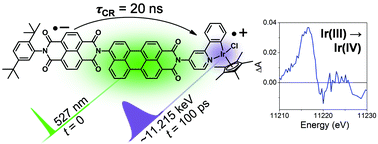
Interrogating the photogenerated Ir(IV) state of a water oxidation catalyst using ultrafast optical and X-ray absorption spectroscopy
Michael T. Vagnini, Michael W. Mara, Michael R. Harpham, Jier Huang, Megan L. Shelby, Lin X. Chen and Michael R. Wasielewski
Chem. Sci., 2013, Advance Article
DOI: 10.1039/C3SC51511G, Edge Article
Free to access until 29th September 2013

Digg This
Reddit This
Stumble Now!
Share on Facebook
Bookmark this on Delicious
Share on LinkedIn
Bookmark this on Technorati
Post on Twitter
Google Buzz (aka. Google Reader)

Seeding removes barrier to curious cocrystal

After seven years of work, a team of chemists based in four labs across the globe has successfully prepared a cocrystal previously believed to be unobtainable.

Cocrystals are crystalline materials composed of two or more molecules held together within the same crystal lattice. Cocrystallisation is significant in the pharmaceutical industry, where drug molecules are screened for cocrystal formation in order to improve their solubility, stability and bioavailability. This has the added advantage of increasing the number of crystal forms that can be considered for drug formulation while simultaneously maximising patent protection.

Despite a computational study suggesting a stable cocrystal should form between caffeine and benzoic acid, all previous attempts over the last 60 years have failed. ‘When a cocrystal doesn’t form, we like to understand why that is – patients could miss out on better medical treatment if we miss out on crystal forms,’ says Dejan-Krešimir Bučar at the University of Cambridge in the UK, who led the study. ‘We hypothesised that a kinetic barrier hindered cocrystal formation, so our idea was to add a molecular species similar to that found in the nucleus of the caffeine·benzoic acid cocrystal as a seed to facilitate crystallisation.

Read the full article in Chemistry World»

Read the original journal article in Chemical Science:
The curious case of (caffeine)⋅(benzoic acid): How heteronuclear seeding allowed the formation of an elusive cocrystal
Dejan-Kresimir Bucar, Graeme Matthew Day, Ivan Halasz, Geoff G. Z. Zhang, John R. G. Sander, David G Reid, Leonard R. G. MacGillivray, M J Duer and William Jones  
Chem. Sci., 2013, Accepted Manuscript, DOI: 10.1039/C3SC51419F

Digg This
Reddit This
Stumble Now!
Share on Facebook
Bookmark this on Delicious
Share on LinkedIn
Bookmark this on Technorati
Post on Twitter
Google Buzz (aka. Google Reader)

Nowhere for hydrazine to hide

Scientists from the US and South Korea have developed a probe that can detect the highly toxic chemical hydrazine in a variety of different environments, including living cells.

Hydrazine plays an important role in a number of industrial processes. It’s used in pesticides, in nuclear and conventional electric power plants to reduce corrosion, and as a gas-forming agent in air bags. It’s even found in rocket fuel.

Although contact with small amounts of hydrazine is unlikely to cause harm, long term exposure can damage the liver, kidneys and central nervous system. Hydrazine has also been classified by the US Environmental Protection Agency (EPA) as a probable carcinogen.

Accidental leakage of hydrazine into the environment is rare and as hydrazine breaks down rapidly in oxygen, finding high levels of hydrazine in the environment is unlikely. However, hydrazine exposure in the workplace can be a real danger for individuals who come into contact with it. This makes the development of hydrazine sensors an important area of research.

The probe reacts with hydrazine to make a five-membered ring, resulting in a fluorescent response and a visible colour change

Read the full article in Chemistry World»

Read the original journal article in ChemComm:
Naphthalimide trifluoroacetyl acetonate: a hydrazine-selective chemodosimetric sensor
Min Hee Lee, Byungkwon Yoon, Jong Seung Kim and Jonathan L. Sessler  
Chem. Sci., 2013, Advance Article, DOI: 10.1039/C3SC51813B

Digg This
Reddit This
Stumble Now!
Share on Facebook
Bookmark this on Delicious
Share on LinkedIn
Bookmark this on Technorati
Post on Twitter
Google Buzz (aka. Google Reader)

Destroying stable foam on demand

The first example of stable and environmentally friendly foam that can be broken down by any one of three external stimuli has been developed by an international team of scientists.

From left to right: foam before and after an increase in temperature, UV irradiation and exposure to a magnetic field

Foams are commonly applied in the clean-up of chemical spills, where they are sprayed over large areas to prevent evaporation of volatile and harmful organic materials. While this demands stability, the foam then needs to be destabilised for transport due to its voluminous nature, often accomplished by the addition of an anti-foaming agent. The resulting liquid mixture can then be removed and the components recovered. Recent studies have tried to create stable foams which can be destabilised by external stimuli to remove the need for the addition of extra chemicals.

Orlin Velev and Stephanie Lam of North Carolina State University have collaborated with Anne-Laure Fameau from the French National Institute for Agricultural Research, to pool their multidisciplinary backgrounds in foams and emulsions, and colloids.

Read the full article in Chemistry World»

Read the original journal article in Chemical Science:
Multi-stimuli responsive foams combining particles and self-assembling fatty acids
Anne-Laure Fameau, Stephanie Lam and Orlin D. Velev  
Chem. Sci., 2013, Advance Article, DOI: 10.1039/C3SC51774H

Digg This
Reddit This
Stumble Now!
Share on Facebook
Bookmark this on Delicious
Share on LinkedIn
Bookmark this on Technorati
Post on Twitter
Google Buzz (aka. Google Reader)

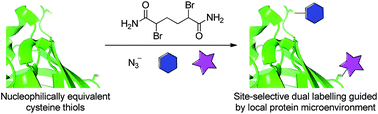
I challenge thee to a dual labelling

Lift your right foot off the floor and make clockwise circles with it. Managing comfortably? Now draw a ‘6’ in the air with your right hand – what’s happened to your foot? It’s all gone a bit wrong, hasn’t it? See, it isn’t that easy to do two different things at once. Another example of this is the dual labelling of proteins; however, Stephen Caddick and colleagues appear to have got on top of this, as reported in their recent paper in Chemical Science.

The dual labelling of proteins has the potential to enable studies of protein structures and the construction of theranostics, for example; however, proteins can be complex and modifications are often restricted to the N- and C-termini, limiting their usefulness. Modification of non-terminal positions is tricky and can be slow, expensive and unrewarding. Caddick and colleagues demonstrate a novel approach to site-selective labelling of proteins, which yields a dual-labelled product by the introduction of two cysteine mutants into the sequence, which are converted by a single chemical reagent into two distinct products for modification. One residue, with an accessible alpha-proton, readily forms dehydroalanine, and the other residue persists, by shielding, as a sulfonium that undergoes chemoselective ring opening by reaction with an azide group. Both groups can then be further labelled orthogonally by the desired molecules.

GA?id=C3SC51333E

The group demonstrated their technique by modifying GFP (green fluorescent protein). After incorporation of the cysteine mutants and treatment with a chemical reagent (2, 5-dibromohexanediamide), further treatment with sodium azide generated dual modified GFP. Further reaction with an alkyne modified dye and mercaptoethanol yielded a rhodamine dye and thiol-labelled protein.

The researchers have demonstrated a site- and chemoselective method, which they say offers a facile and generally accessible technique for dual labelling. And now they’ve got to grips with that, I pose the ultimate test: to come up with a facile method for standing on one leg and drawing a ‘6’ – trying to do that and type this blog has also been pretty challenging.

Once you’ve tried out some one-legged multi-tasking, sit back down and read this Open Access Edge Article to see what Sarah’s talking about:

A novel approach to the site-selective dual labelling of a protein via chemoselective cysteine modification
Ramiz I. Nathani, Paul Moody, Vijay Chudasama, Mark E. B. Smith, Richard J. Fitzmaurice and  Stephen Caddick
Chem. Sci., 2013, 4, 3455-3458
DOI: 10.1039/C3SC51333E

Sarah Brown is a guest web-writer for Chemical Science.  Sarah hung up her lab coat after finishing her PhD and post-doctorate in nanotechnology for diagnostics and therapeutics and now works in scientific publishing. When not trying to explain science through ridiculous analogies, you can often find her crocheting, baking or climbing, but not all at once. All views are her own.

Digg This
Reddit This
Stumble Now!
Share on Facebook
Bookmark this on Delicious
Share on LinkedIn
Bookmark this on Technorati
Post on Twitter
Google Buzz (aka. Google Reader)