Archive for September, 2025

Chemical Science Reviewer Spotlight – September 2025

To further thank and recognise the support from our excellent reviewer community, we are highlighting reviewers who have provided exceptional support to the journal over the past year.

This month, we’ll be highlighting Professor Mercedes Taylor, Professor Renana Gershoni-Poranne, Professor Dan Li and Professor Nick Le Brun. We asked our reviewers a few questions about what they enjoy about reviewing, and their thoughts on how to provide a useful review.

Professor Mercedes Taylor, University of Maryland. Mercedes Taylor’s lab uses supramolecular assembly and reticular chemistry to design robust organic materials for challenging ion separations.

Professor Renana Gershoni-Poranne, Technion-Israel Institute of Technology. My group uses computational chemistry and data-driven approaches to understand and predict the chemical properties and reactivity of polycyclic aromatic systems. We then try to encapsulate these insights into conceptual frameworks to enable the design of molecules with tailored properties that can be used in various areas, such as organic semiconductors or ligands for catalysts. We’ve recently also started to employ machine- and deep-learning techniques for generative design of these molecules.

Professor Dan Li, Jinan University. My research focuses on designing and building complex molecules, combining different types of chemical bonds/weak interactions to create visually appealing shapes with exciting properties, aiming to develop sustainable materials.

Professor Nick Le Brun, University of East Anglia. My research is focused on understanding the roles of metals in life, how organisms minimise the toxicity of essential metals, and how they assemble complex metallocofactors.


What encouraged you to review for Chemical Science?

Professor Renana Gershoni-Poranne: Chemical Science is a leading journal that publishes innovative, high-quality work across all areas of chemistry. I was motivated to contribute to maintaining these standards and to support a journal that fosters scientific excellence and broad accessibility. I am particularly grateful that Chemical Science provides an important platform for aromaticity-related work, allowing the work of our community to reach broad audiences and have an impact.

Professor Dan Li: Chemical Science serves as an interdisciplinary platform for researchers across a wide range of fields. Reviewing for it offers a unique opportunity to engage with chemists from diverse backgrounds.

Professor Mercedes Taylor: I enjoy reading articles in Chemical Science because of their fundamental approach to broadly-relevant questions, so this enjoyment encouraged me to contribute as a reviewer.


What advice would you give a first-time author looking to maximise their chances of successful peer review?

Professor Nick Le Brun: Aside from the obvious things such as making sure that the main messages of the manuscript are well supported by the data (including the right controls), and that it’s been carefully proof read before submission, it’s important to capture the interest of the reader from the beginning – weave your findings into an engaging story that emphasises why the science is important.


What makes a paper truly stand out for you when reviewing a paper?

Professor Mercedes Taylor: I appreciate papers with thoughtful, unusual introductions. Occasionally authors will depart from the standard format of an introduction to offer more original musings on the state of the field, which sets the paper apart from the beginning.


What do you enjoy most about reviewing

Professor Renana Gershoni-Poranne: Getting to read manuscripts before they are published feels like getting a ‘sneak peek’ – which is always fun! I also enjoy the opportunity to contribute constructive feedback that strengthens the work, if I think I can. Reviewing also broadens my own perspective by exposing me to ideas and methods outside my immediate field. I always include something complimentary in each review, because I know that the students and postdocs who worked on the manuscript deserve encouragement, even if there are still some areas that can be improved. I like to think that this makes the reviewing process less stressful for them.

Professor Nick Le Brun: Reviewing a manuscript properly takes significant time, but can be very rewarding. Helping to get fascinating new science published is enjoyable, as is the opportunity to suggest ways to improve a manuscript.

Professor Dan Li: Reviewing embodies both a privilege and a solemn duty.


How did you prepare to write a review for Chemical Science?

Professor Mercedes Taylor: I prepare to write a review by reading the article through from start to finish; I try to resist the urge to make notes and form opinions until the second read. 


How do you find that Chemical Science has contributed to your research field?

Professor Nick Le Brun: Chemical Science, as the flagship journal of the RSC, is a leading broad remit chemistry journal, and as such publishes some of the best science in bioinorganic chemistry. It’s led the way in terms of making science accessible to all through its highly unusual and long-standing free-to-publish policy.

Professor Renana Gershoni-Poranne: As a computational chemist, I particularly appreciate that Chemical Science serves as an important venue for disseminating high-impact research in computational and theoretical chemistry, fields which have traditionally had a much harder time getting published in broader journals. As mentioned above, in recent years Chemical Science has also provided a platform for research in the area of aromaticity, which has been important for our community. 


Tune in soon to meet our next group of #ChemSciReviewers!


If you want to learn more about how we support our reviewers, check out our Reviewer Hub.

Interested in joining our ever-growing reviewer community? Apply here now!

Digg This
Reddit This
Stumble Now!
Share on Facebook
Bookmark this on Delicious
Share on LinkedIn
Bookmark this on Technorati
Post on Twitter
Google Buzz (aka. Google Reader)

Jinlong Gong selects his Editor’s Choice in catalysis

Headshot photo of Prof Gong inside a teal green circle swoosh.

Professor Jinlong Gong, Tianjin University

Professor Jinlong Gong’s Editor’s Choice

We are delighted to share with you our latest Editor’s Choice collection that presents a selection of notable research contributions in catalysis chemistry in Chemical Science from 2023 to 2024.

The featured articles selected by Chemical Science Associate Editor Jinlong demonstrate 21 cutting-edge papers at the forefront of catalysis, highlighting the diverse strategies and mechanistic insights driving progress in energy conversion, environmental remediation and sustainable chemical transformations via heterogeneous and homogeneous catalysis.

Covering photo- and electrocatalytic platforms, machine learning, and applications from carbon dioxide reduction to plastic upcycling, these studies showcase key interdisciplinary advances in catalysis published Chemical Science.


Professor Gong considers work at the forefront of heterogeneous catalysis, including small molecule conversion and the synthesis of new nanostructured catalytic materials. Submit your best manuscripts on these topics to Chemical Science for Professor Gong’s consideration.


We hope you enjoy reading this selection of articles chosen by Professor Jinlong Gong.

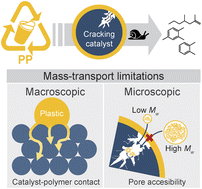
1 Transport limitations in polyolefin cracking at the single catalyst particle level

Sebastian Rejman, Ina Vollmer, Maximilian J. Werny, Eelco T. C. Vogt, Florian Meirer and Bert M. Weckhuysen

Chem. Sci., 2023, 14, 10068-10080

Graphical abstract: Transport limitations in polyolefin cracking at the single catalyst particle level
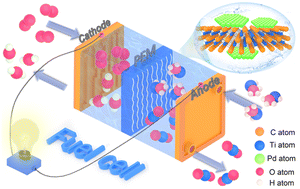
2 A 2D/2D heterojunction of ultrathin Pd nanosheet/MXene towards highly efficient methanol oxidation reaction: the significance of 2D material nanoarchitectonics

Huajie Huang, Di Xiao, Zihan Zhu, Chi Zhang, Lu Yang, Haiyan He, Jungmok You, Quanguo Jiang, Xingtao Xu and Yusuke Yamauchi

Chem. Sci., 2023, 14, 9854-9862

Graphical abstract: A 2D/2D heterojunction of ultrathin Pd nanosheet/MXene towards highly efficient methanol oxidation reaction: the significance of 2D material nanoarchitectonics
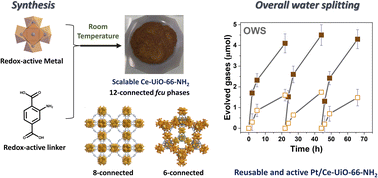
3 Room temperature design of Ce(IV)-MOFs: from photocatalytic HER and OER to overall water splitting under simulated sunlight irradiation

Shan Dai, Eva Montero-Lanzuela, Antoine Tissot, Herme G. Baldoví, Hermenegildo García, Sergio Navalón and Christian Serre

Chem. Sci., 2023, 14, 3451-3461

Graphical abstract: Room temperature design of Ce(iv)-MOFs: from photocatalytic HER and OER to overall water splitting under simulated sunlight irradiation

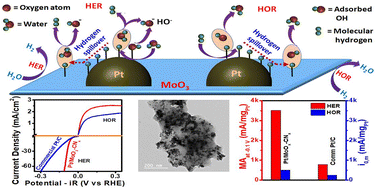
4

Hydrogen spillover enhances alkaline hydrogen electrocatalysis on interface-rich metallic Pt-supported MoO3

Chem. Sci., 2024, 15, 364-378

Graphical abstract: Hydrogen spillover enhances alkaline hydrogen electrocatalysis on interface-rich metallic Pt-supported MoO3

5

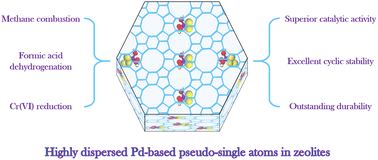
Highly dispersed Pd-based pseudo-single atoms in zeolites for hydrogen generation and pollutant disposal

Chem. Sci., 2024, 15, 379-388

Graphical abstract: Highly dispersed Pd-based pseudo-single atoms in zeolites for hydrogen generation and pollutant disposal

6

An optimal Fe–C coordination ensemble for hydrocarbon chain growth: a full Fischer–Tropsch synthesis mechanism from machine learning

Chem. Sci., 2023, 14, 9461-9475

Graphical abstract: An optimal Fe–C coordination ensemble for hydrocarbon chain growth: a full Fischer–Tropsch synthesis mechanism from machine learning

7

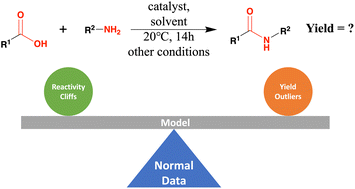
The challenge of balancing model sensitivity and robustness in predicting yields: a benchmarking study of amide coupling reactions

Chem. Sci., 2023, 14, 10835-10846

Graphical abstract: The challenge of balancing model sensitivity and robustness in predicting yields: a benchmarking study of amide coupling reactions

8

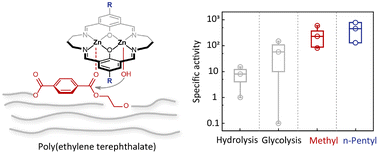
PET recycling under mild conditions via substituent-modulated intramolecular hydrolysis

Chem. Sci., 2023, 14, 6558-6563

Graphical abstract: PET recycling under mild conditions via substituent-modulated intramolecular hydrolysis

9

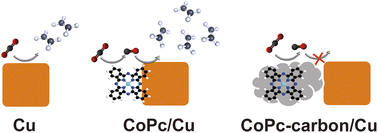
The spatial distribution of cobalt phthalocyanine and copper nanocubes controls the selectivity towards C2 products in tandem electrocatalytic CO2 reduction

Chem. Sci., 2023, 14, 1097-1104

Graphical abstract: The spatial distribution of cobalt phthalocyanine and copper nanocubes controls the selectivity towards C2 products in tandem electrocatalytic CO2 reduction

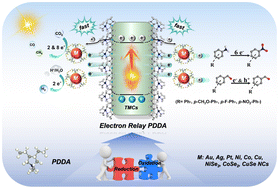
10

Customizing precise, tunable, and universal cascade charge transfer chains towards versatile photoredox catalysis

Chem. Sci., 2024, 15, 2898-2913

Graphical abstract: Customizing precise, tunable, and universal cascade charge transfer chains towards versatile photoredox catalysis

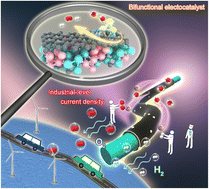
11

Manipulating electron redistribution between iridium and Co6Mo6C bridging with a carbon layer leads to a significantly enhanced overall water splitting performance at industrial-level current density

Chem. Sci., 2024, 15, 11890-11901

Graphical abstract: Manipulating electron redistribution between iridium and Co6Mo6C bridging with a carbon layer leads to a significantly enhanced overall water splitting performance at industrial-level current density

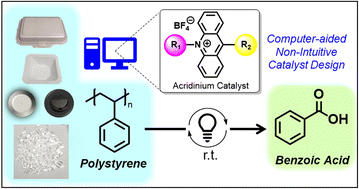
12

Enhancing the photocatalytic upcycling of polystyrene to benzoic acid: a combined computational-experimental approach for acridinium catalyst design

Chem. Sci., 2024, 15, 1061-1067

Graphical abstract: Enhancing the photocatalytic upcycling of polystyrene to benzoic acid: a combined computational-experimental approach for acridinium catalyst design

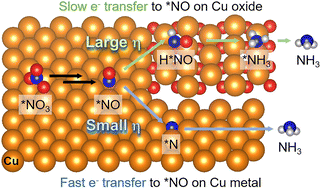
13

Identifying the active sites and intermediates on copper surfaces for electrochemical nitrate reduction to ammonia

Chem. Sci., 2024,15, 2578-2585

Graphical abstract: Identifying the active sites and intermediates on copper surfaces for electrochemical nitrate reduction to ammonia

14

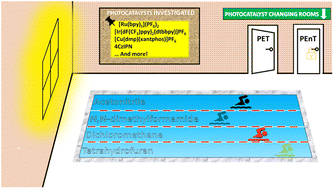
Lessons learnt in photocatalysis – the influence of solvent polarity and the photostability of the photocatalyst

Chem. Sci., 2024, 15, 3741-3757

Graphical abstract: Lessons learnt in photocatalysis – the influence of solvent polarity and the photostability of the photocatalyst

15

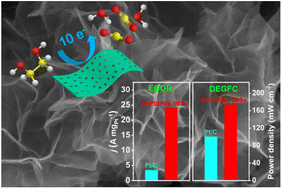
Mesoporous Mo-doped PtBi intermetallic metallene superstructures to enable the complete electrooxidation of ethylene glycol

Chem. Sci., 2024, 15, 4349-4357

Graphical abstract: Mesoporous Mo-doped PtBi intermetallic metallene superstructures to enable the complete electrooxidation of ethylene glycol

16

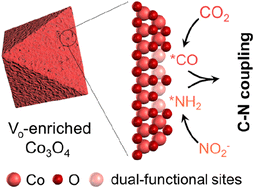
Efficient C–N coupling for urea electrosynthesis on defective Co3O4 with dual-functional sites

Chem. Sci., 2024, 15, 3233-3239

Graphical abstract: Efficient C–N coupling for urea electrosynthesis on defective Co3O4 with dual-functional sites

17

Alleviating the competitive adsorption of hydrogen and hydroxyl intermediates on Ru by d–p orbital hybridization for hydrogen electrooxidation

Chem. Sci., 2024,15, 2123-2132

Graphical abstract: Alleviating the competitive adsorption of hydrogen and hydroxyl intermediates on Ru by d–p orbital hybridization for hydrogen electrooxidation

18

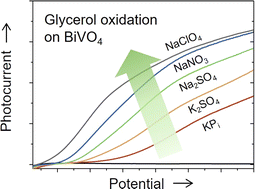
Electrolyte selection toward efficient photoelectrochemical glycerol oxidation on BiVO4

Chem. Sci., 2024, 15, 10425-10435

Graphical abstract: Electrolyte selection toward efficient photoelectrochemical glycerol oxidation on BiVO4

19

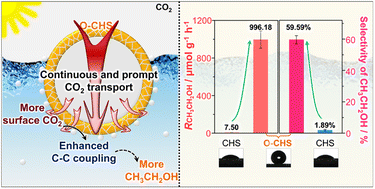
Solar-driven CO2-to-ethanol conversion enabled by continuous CO2 transport via a superhydrophobic Cu2O nano fence

Chem. Sci., 2024, 15, 1638-1647

Graphical abstract: Solar-driven CO2-to-ethanol conversion enabled by continuous CO2 transport via a superhydrophobic Cu2O nano fence

20

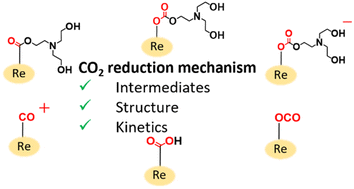
Overall reaction mechanism of photocatalytic CO2 reduction on a Re(I)-complex catalyst unit of a Ru(II)–Re(I) supramolecular photocatalyst

Chem. Sci., 2024, 15, 2074-2088

Graphical abstract: Overall reaction mechanism of photocatalytic CO2 reduction on a Re(i)-complex catalyst unit of a Ru(ii)–Re(i) supramolecular photocatalyst

21

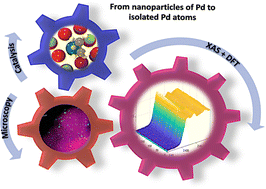
Dynamic structural evolution of MgO-supported palladium catalysts: from metal to metal oxide nanoparticles to surface then subsurface atomically dispersed cations

Chem. Sci., 2024, 15, 6454-6464

Graphical abstract: Dynamic structural evolution of MgO-supported palladium catalysts: from metal to metal oxide nanoparticles to surface then subsurface atomically dispersed cations


If you are interested in research in similar areas, explore our most popular 2024 catalysis articles collection in Chemical Science, as well as our special anniversary joint themed collection guest edited by Professor Jinlong Gong, Yingjin Yuan (Tianjin University, China), Shizhang Qiao (The University of Adelaide, Australia) and Naiqin Zhao (Tianjin University, China) in celebration of the 130th anniversary of Tianjin University.

Chemical Science is the flagship journal of the Royal Society of Chemistry, publishing exceptional research across the chemical sciences. As a diamond open access journal, all of our articles are free to read and free to publish – find out more and browse our latest articles on our webpage.

Keep up to date with our latest articles, reviews, collections & more by following us on Bluesky, LinkedIn or by signing up to our E-Alerts.

Digg This
Reddit This
Stumble Now!
Share on Facebook
Bookmark this on Delicious
Share on LinkedIn
Bookmark this on Technorati
Post on Twitter
Google Buzz (aka. Google Reader)