Archive for January, 2013

Nanoscience: Porous iron(III) nanoparticles show no signs of in vivo toxicity in rats

The in vivo toxicity of iron nanoparticles in rats has been tested by a group of French and Tunisian scientists, who found that the compounds are not metabolised by the animals and cause no toxic effects.

The group tested three different porous iron(III) metal-organic framework (MOF) nanoparticles, injecting them intravenously and studying their distribution, metabolism and excretion. The nanoparticles are rapidly sequestered by the liver and spleen and, after biodegradation, are directly excreted from the body through urine or faeces without metabolisation, substantial toxicity or affecting organ function.

There is currently much concern and debate over the safety and toxicity of nanoparticles, especially with regard to human health. This study shows that biodegradable non-toxic iron(III) carboxylate MOF nanoparticles could have real potential for future biomedical applications.

Read the ‘HOT’ Chemical Science article in full:

In depth analysis of the in vivo toxicity of nanoparticles of porous iron(III) metal-organic frameworks
Tarek Baati , Leila Njim , Fadoua Neffati , Abdelhamid Kerkeni , Muriel Bouttemi , Ruxandra Gref , Mohamed F Najjar , Abdelfateh Zakhama , Patrick Couvreur , Christian Serre and Patricia Horcajada
Chem. Sci., 2013, DOI: 10.1039/C3SC22116D

Digg This
Reddit This
Stumble Now!
Share on Facebook
Bookmark this on Delicious
Share on LinkedIn
Bookmark this on Technorati
Post on Twitter
Google Buzz (aka. Google Reader)

Van der Waals Interactions: Thermodynamics and Impact on Molecular Design

Geoff Nelson, our new guest web-writer for Chemical Science, blogs about recent findings on van der Waals interactions in non-polar liquids.  Read his first Chem Sci blog post below:

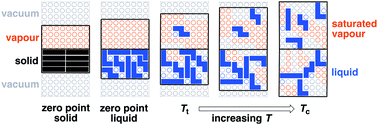
Professor Christopher Hunter, in his latest Edge article, notes that the thermodynamic properties of the van der Waals interactions between non-polar molecules can be predicted based on their calculated molecular surface areas (0.3 kJ mol-1 Å-2).  His findings help simplify computational approaches to the design of molecular binding sites or self-assembled molecules.

 http://pubs.rsc.org/services/images/RSCpubs.ePlatform.Service.FreeContent.ImageService.svc/ImageService/image/GA?id=C2SC21666C

Prof Hunter’s article includes a detailed model for the behaviour of the van der Waals interaction at liquid-vapor and liquid-liquid interfaces.  Each molecule has ‘surface contact points’ capable of van der Waals interactions with the external environment.  These contacts can be made and broken, depending on the space around the molecule.  The total number of contacts determines the total van der Waals contribution to free energy.  This model helps explain the physical basis of several thermodynamic events (e.g., melting).

The choice of non-polar liquids as the chemical system to study was ideal to isolate the van der Waals interaction, as other non-covalent interactions are minimised (e.g., electrostatic). 

Potent pharmaceuticals and stable self-assembled structures depend on effective binding between molecules.  Predicting the chemical structure necessary to promote such binding is now made easier by Professor Hunter’s research.

Read this Chemical Science Edge article in full:

van der Waals interactions in non-polar liquids

Christopher A. Hunter

Chem. Sci., 2013,4, 834-848

DOI: 10.1039/C2SC21666C

Geoff Nelson is a new guest web-writer for Chemical Science.  He currently works as a post-doctoral research associate in Dr David Payne’s research group in the Department of Materials at Imperial College, London.  Geoff’s current research concerns the synthesis and characterization of post-transition metal oxides for use in the energy sector.  His other research interests include carbon-based materials, biophysical chemistry, and surface science.

Digg This
Reddit This
Stumble Now!
Share on Facebook
Bookmark this on Delicious
Share on LinkedIn
Bookmark this on Technorati
Post on Twitter
Google Buzz (aka. Google Reader)

Robotic ribosome-mimicking rotaxanes featured on Chemistry World

Congratulations to our Chemical Science Associate Editor, Professor David A Leigh, for recently being featured on Chemistry World for his latest work in using artificial molecular machines to mimic ribosomes in assembling peptides.  These exciting new ‘robot ribosomes’ designed and studied by Dave’s research group have been gaining more and more attention, also having been highlighted in Chemistry and Engineering News (C&EN).

You can also read Dave’s latest Chem Soc Rev Tutorial Review on template synthesis of molecular knots, and his 2012 Chem Comm paper on half-rotation in a kinetically locked [2]catenane.

Dave is an expert in supramolecular chemistry, focussing on the development of new methods for the synthesis of catenanes and rotaxanes, and on experimental synthetic molecular machine design.

Are you working in supramolecular chemistry, experimental molecular machines, or related fields?  Submit your top-notch, high-impact articles to Dave’s Chemical Science editorial office today!

Digg This
Reddit This
Stumble Now!
Share on Facebook
Bookmark this on Delicious
Share on LinkedIn
Bookmark this on Technorati
Post on Twitter
Google Buzz (aka. Google Reader)

Harnessing thermal fluctuations for purposeful activities: the manipulation of single micro-swimmers by adaptive photon nudging

US scientists have found a way to control the direction of microscopic swimming robots using lasers. This is the first time that anyone has used a method like this to control a microscale particle in solution, they say.

Haw Yang at Princeton University and his colleagues used a polystyrene particle, with one half of its sphere coated in gold, as the swimmer. This type of particle is known as a Janus particle as it has two ‘faces’ that show different physical properties. The team used these properties to manipulate its direction. The Janus particle moves randomly in a liquid via Brownian motion, and when the particle is facing the right direction, the team uses a laser to give it a nudge forward.

Microswimmer

The microswimmer is nudged towards a target by laser when it's facing the right direction

The researchers found that the laser propels the Janus particle by heating up the gold half of the sphere, which propels it forward. The polystyrene half doesn’t react to the laser as the laser essentially passes through it. The team used short bursts of the laser, and if the particle went off target, they stopped nudging it until it came back round to the right position.

Read the full article in Chemistry World

Read the original journal article:
Harnessing thermal fluctuations for purposeful activities: the manipulation of single micro-swimmers by adaptive photon nudging
Bian Qian, Daniel Montiel, Andreas Bregulla, Frank Cichos and Haw Yang
Chem. Sci., 2013, Advance Article
DOI: 10.1039/C2SC21263C

Digg This
Reddit This
Stumble Now!
Share on Facebook
Bookmark this on Delicious
Share on LinkedIn
Bookmark this on Technorati
Post on Twitter
Google Buzz (aka. Google Reader)

New insights into f-element bonding trends

Scientists in the US have reported a new insight into the understanding of the bonding trends within, and the differences between, the 4f and 5f element series with soft donor atom ligands.

The coordination chemistry and differing bond lengths explain the covalency of different 4f and 5f elements, they say. The team studied a series of actinide versus lanthanide complexes.

This work is useful for the design and optimisation of actinide separation schemes (for nuclear fuel).

Read the Chemical Science article for free today:

Uncovering f-Element Bonding Differences and Electronic Structure in a Series of 1:3 and 1:4 Complexes with a Diselenophosphinate Ligand
M B Jones et al, Chem. Sci., 2012, DOI: 10.1039/c2sc21806b

Digg This
Reddit This
Stumble Now!
Share on Facebook
Bookmark this on Delicious
Share on LinkedIn
Bookmark this on Technorati
Post on Twitter
Google Buzz (aka. Google Reader)