Archive for July, 2019

Making Gyroid Polymer Films to Speed up Proton Conduction

Proton exchange membranes (PEMs) are essential to the functionality of fuel cells. They conduct protons in electrolytes and drive electricity generation by oxidizing fuels. Following the success of Nafion® –– a family of commercial proton-conductive fluoropolymers –– materials researchers around the globe are developing innovative PEMs with high proton conductivities and affordable prices.

A group of Japanese researchers has recently synthesized self-standing polymer films with a gyroid nanostructure. These films possess two unique characteristics that other PEMs rarely have: a high proton conductivity in the order of 10-1 S/cm and retention of the conductivity across a wide temperature range (20-120 °C). This finding has been published in Chem. Sci. (doi: 10.1039/C9SC00131J).

The authors used a tailor-made macromolecule, Diene-GZI (Figure 1a), as the building block. It had an amphipathic structure, with one end being a hydrophilic zwitterionic group and another end of a hydrophobic alkyl chain. When mixed with bis(trifluoromethanesulfonyl)imide and water, multiple Diene-GZI molecules could assemble together into a gyroid network –– an infinitely periodic minimal surface (Figure 1b). After the self-assembly, ultra-violet-irradiation-induced polymerization solidified the morphology of the gyroid nanostructure.
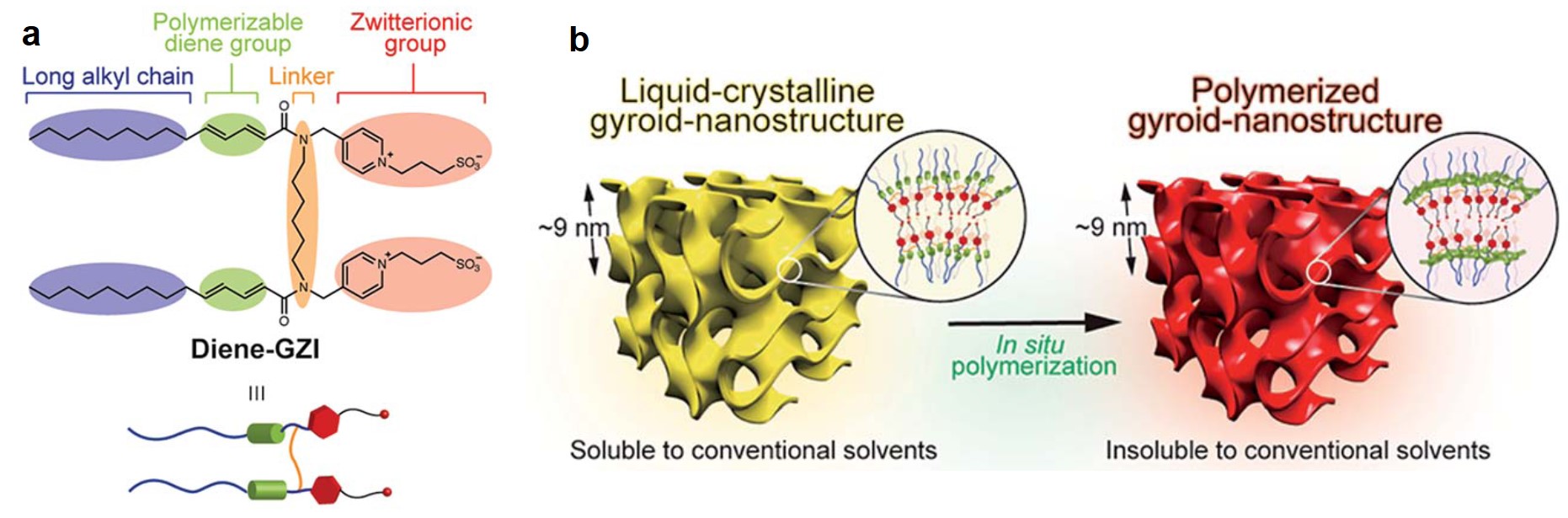
Figure 1. (a) The molecular structure of Diene-GZI. (b) Solidification of the self-assembled gyroid via polymerization.

The high proton conductivity of the polymer film originated from its three-dimensional gyroid structure. Since the gyroid surface was densely coated with the hydrophilic zwitterionic chains, the film could readily uptake as high as 15.6 wt.% of water at a relative humidity of 90%. The adsorbed water layers formed a three-dimensional continuous pathway along the gyroid surface, serving as proton-conduction expressways and resulting in a high conductivity in the order of 10-1 S/cm. Due to the strong binding force between water and the zwitterionic groups, heating the polymer film to 120 °C did not decrease the water content significantly, and thus, the proton conductivity remained high. Additionally, the control films with no gyroid structures were unable to compete with the gyroid film in terms of proton conductivities within the measured temperature range (Figure 2).
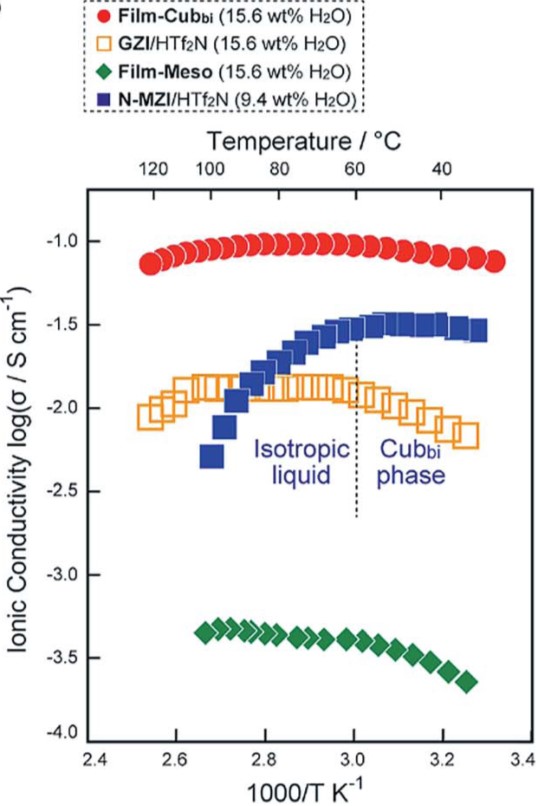
Figure 2. The dependence between proton conductivities and temperature. Legends: red solid circles – gyroid film; others – control samples without the gyroid nanostructure.

This work highlights the critical role of rational design of raw materials to augment the proton conductivities of PEMs. The advantage of the gyroid phase in speeding up ion diffusion could also inspire innovative materials in applications demanding ultrafast ion transport, e.g., supercapacitor electrodes.


To find out more, please read:

Gyroid Structured Aqua-Sheets with Sub-Nanometer Thickness Enabling 3D Fast Proton Relay Conduction

Tsubasa Kobayashi, Ya-xin Li, Ayaka Ono, Xiang-bing Zeng, and Takahiro Ichikawa

Chem. Sci., 2019, 10, 6245-6253

About the blogger:

Tianyu Liu obtained his Ph.D. (2017) in Chemistry from University of California, Santa Cruz in the United States. He is passionate about scientific communication to introduce cutting-edge research to both the general public and scientists with diverse research expertise. He is a blog writer for Chem. Commun. and Chem. Sci. More information about him can be found at http://liutianyuresearch.weebly.com/.

Digg This
Reddit This
Stumble Now!
Share on Facebook
Bookmark this on Delicious
Share on LinkedIn
Bookmark this on Technorati
Post on Twitter
Google Buzz (aka. Google Reader)

Tryptophan, Featuring BN/CC Isosterism

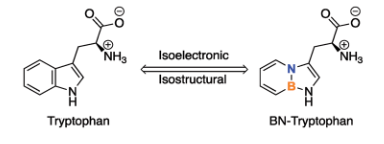
Ever wanted to find a way to replace a carbon-carbon (CC) double bond with another bond that will change the physical and chemical properties of a molecule without significantly altering its sterics? Look no further than a boron-nitrogen bond! BN/CC isosterism involves substituting a CC double bond with a BN bond, which can substantially change the electronic properties of a molecule while keeping it the same size. This isosterism could be a powerful tool in biomedical studies of biologically relevant arene-containing organic molecules, which are plentiful. However, few studies report on the differences in functions cause by substituting a BN bond into an arene. Initial results suggest that the BN compounds can have similar or increased activity and availability when compared to the natural, all carbon molecules.

Figure 1. Image of naturally occuring tryptophan and the BN-tryptophan analogue.

Researchers in the United States synthesized a BN-analogue of tryptophan (Figure 1) for use as an unnatural amino acid (UAA) to study and intentionally alter the properties of proteins. Tryptophan, in addition to making Americans sleepy at Thanksgiving, is relatively rare, but participates in pi system interactions and is the primary source of native protein fluorescence. This makes it an important target for UAA research. The researchers synthesized the sodium salt of BN-tryptophan in a 6-step process, which can be modified to resolve the two enantiomers by chiral HPLC. The BN-tryptophan exhibits noticeably red-shifted absorbance and emission spectra, with the fluorescence maximum shifted by almost 40 nm in the BN compound.

In order to test whether the BN-tryptophan could be incorporated into proteins, researchers incorporated it into media without tryptophan and monitored whether E. coli cells that lacked the ability to produce tryptophan would grow. They found that the cells grew when in the presence of BN-tryptophan, but to a significantly lesser degree than with an equivalent quantity of natural tryptophan. However, cell growth increased when the media contained both BN-tryptophan and natural tryptophan. This suggests that cells will accept BN-tryptophan as a tryptophan analogue, but they don’t tolerate full replacement well.

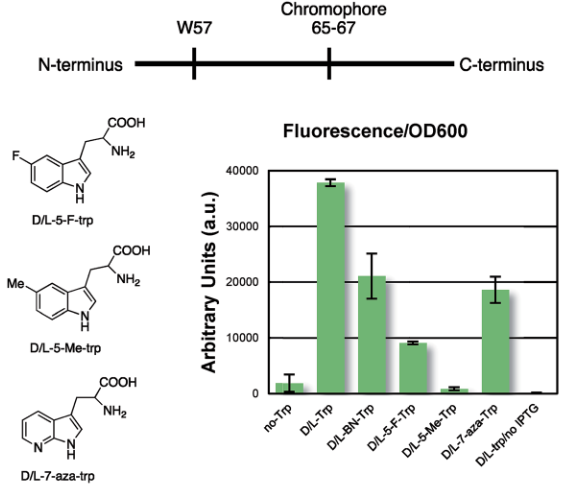
Figure 2. Representation of the protein sequence, structures of other tryptophan analogues, and fluorescence plot for the studied substrates.

Further studies incorporated BN-tryptophan and three other previously utilized tryptophan analogues into a green fluorescent protein (GFP). For fluorescence to be detected, the analogue must be incorporated into the protein and then accurately read by cells. The BN-tryptophan performs as well or better than the established tryptophan analogues, proving its functionality (Figure 2). The proteins with BN-tryptophan also demonstrate several different properties than those containing natural tryptophan; their fluorescence is red shifted and they are more susceptible to oxidation by hydrogen peroxide. These alterations in activity could prove useful in future studies.

To find out more please read:

Synthesis and characterization of an unnatural boron and nitrogen-containing tryptophan analogue and its incorporation into proteins

Katherine Boknevitz, James S. Italia, Bo Li, Abhishek Chatterjee and Shih-Yuan Liu

Chem. Sci., 2019, 10, 4994–4998.

About the blogger:

Beth Mundy is a PhD candidate in chemistry in the Cossairt lab at the University of Washington in Seattle, Washington. Her research focuses on developing new and better ways to synthesize nanomaterials for energy applications. She is often spotted knitting in seminars or with her nose in a good book. You can find her on Twitter at @BethMundySci.

Digg This
Reddit This
Stumble Now!
Share on Facebook
Bookmark this on Delicious
Share on LinkedIn
Bookmark this on Technorati
Post on Twitter
Google Buzz (aka. Google Reader)

2019 Alberta Nanosymposium

The 6th Alberta Nano Research Symposium was held earlier this year in May. The theme this year was NaNoTeCH: Celebrating the periodic table, with keynote speakers Dr Shirley Tang (University of Waterloo) and Dr Robert Carpick (University of Pennsylvania).

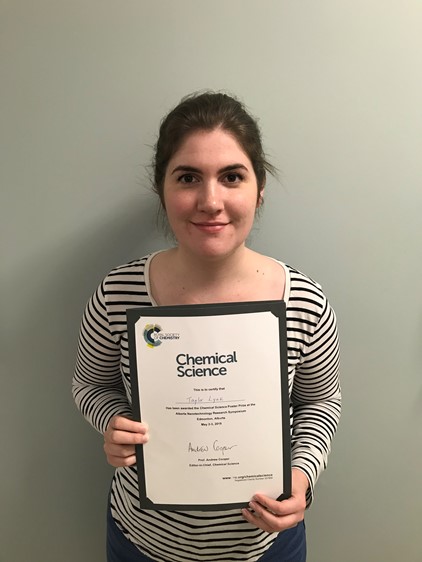
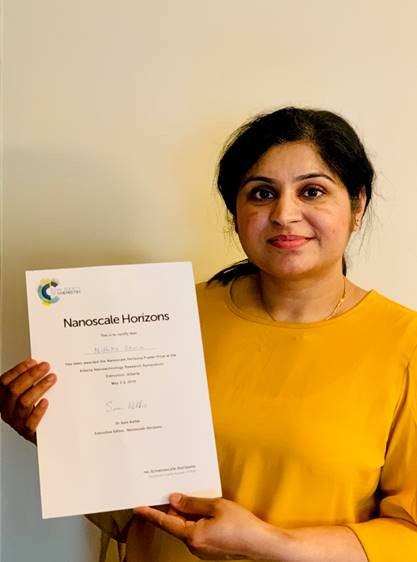
Chemical Science sponsored a poster prize, along with RSC journal Nanoscale Horizons. Congratulations to both of the prize winners from everyone at Chemical Science!

Taylor Lynk was awarded the Chemical Science Poster Prize

Nidhika Bhoria was awarded the Nanoscale Horizons Poster Prize

Digg This
Reddit This
Stumble Now!
Share on Facebook
Bookmark this on Delicious
Share on LinkedIn
Bookmark this on Technorati
Post on Twitter
Google Buzz (aka. Google Reader)

Charge & Substrate Transport in 3D Electrocatalytic Materials, ACS Fall Meeting

Chemical Science, along with RSC journals RSC AdvancesEnergy & Environmental ScienceSustainable Energy & Fuels and Nanoscale Advances are pleased to be sponsoring the Charge & Substrate Transport in 3D Electrocatalytic Materials symposium at the ACS Fall 2019 National Meeting and Exposition in San Diego this August. It will be held at 8:30 am on Tuesday 27th in the Marina Ballroom Salon G at Marriott Marquis San Diego Marina.

Organized by Anthony Hall, Charles McCrory and V. Sara Thoi as part of the Division of Inorganic Chemistry, this symposia will be presided by Charles McCrory (University of Michigan) and feature presentations from Shelley D Minteer (University of Utah), Daniel Esposito (Columbia University), Yogesh Surendranath (MIT), Joseph Thomas Hupp (Northwestern University), Casey R Wade (Ohio State University), Amanda J Morris (Virginia Tech) as well as Charles McCrory.


Digg This
Reddit This
Stumble Now!
Share on Facebook
Bookmark this on Delicious
Share on LinkedIn
Bookmark this on Technorati
Post on Twitter
Google Buzz (aka. Google Reader)

HOT Chemical Science articles for April

We are happy to present a selection of our HOT articles for April. To see all of our HOT referee-recommended articles from 2019, please find the collection here.

As always, Chemical Science articles are free to access.

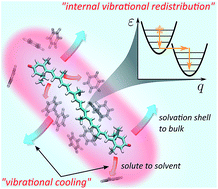
The full dynamics of energy relaxation in large organic molecules: from photo-excitation to solvent heating

Vytautas Balevičius Jr, Tiejun Wei, Devis Di Tommaso, Darius Abramavicius, Jürgen Hauer, Tomas Polívka and Christopher D. P. Duffy*

Chem. Sci., 2019, 10, 4792-4804

DOI
: 10.1039/C9SC00410F, Edge Article

______________________________________________________


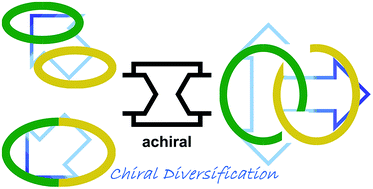
Chiral diversification through the assembly of achiral phenylacetylene macrocycles with a two-fold bridge

Ryo Katoono,* Keiichi Kusaka, Yuki Saito, Kazuki Sakamoto and Takanori Suzuki

Chem. Sci., 2019, 10, 4782-4791

DOI
: 10.1039/C9SC00972H, Edge Article

_________________________________________________


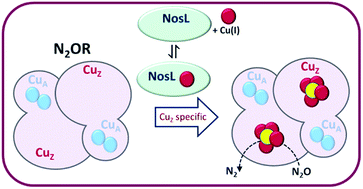
NosL is a dedicated copper chaperone for assembly of the CuZ center of nitrous oxide reductase

Sophie P. Bennett, Manuel J. Soriano-Laguna, Justin M. Bradley, Dimitri A. Svistunenko, David J. Richardson, Andrew J. Gates* and Nick E. Le Brun

Chem. Sci., 2019, 10, 4985-4993

DOI
: 10.1039/C9SC01053J, Edge Article

_________________________________________________


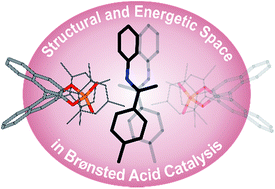
Brønsted acid catalysis – the effect of 3,3′-substituents on the structural space and the stabilization of imine/phosphoric acid complexes

Maxime Melikian, Johannes Gramüller, Johnny Hioe, Julian Greindl and Ruth M. Gschwind*

Chem. Sci., 2019, 10, 5226-5234

DOI
: 10.1039/C9SC01044K, Edge Article

______________________________________________________


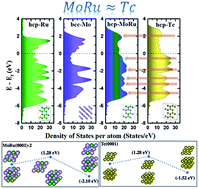
Theoretical design of a technetium-like alloy and its catalytic properties

Wei Xie* and Michihisa Koyama*

Chem. Sci., 2019, 10, 5461-5469

DOI
: 10.1039/C9SC00912D, Edge Article


______________________________________________________


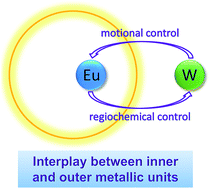
Highly regioselective complexation of tungsten with Eu@C82/Eu@C84: interplay between endohedral and exohedral metallic units induced by electron transfer

Lipiao Bao, Pengyuan Yu, Ying Li, Changwang Pan, Wangqiang Shen, Peng Jin,* Shuquan Liang* and Xing Lu*

Chem. Sci., 2019, 10, 4945-4950

DOI
: 10.1039/C9SC01479A, Edge Article


______________________________________________________

Digg This
Reddit This
Stumble Now!
Share on Facebook
Bookmark this on Delicious
Share on LinkedIn
Bookmark this on Technorati
Post on Twitter
Google Buzz (aka. Google Reader)