Archive for April, 2015

Chemical Science welcomes Alán Aspuru-Guzik as Associate Editor

Chemical Science is delighted to announce the addition of another Associate Editor: Professor Alán Aspuru-Guzik of Harvard University, who is now handling submissions in the area of theoretical chemistry.
Biography
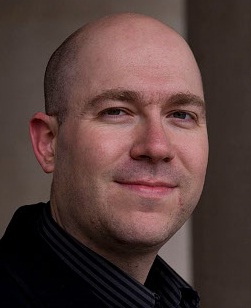
Professor Aspuru-Guzik joined Harvard University in 2006 and has been a full professor there since 2013 (the same year in which he received the ACS Early Career Award in Theoretical Chemistry). Prior to joining Harvard, Alán spent a couple of years as a postdoctoral researcher at the University of California, Berkeley, where he also completed his PhD in Physical Chemistry. He holds a BSc in Chemistry from the Universidad Nacional Autónoma de México.

Research
Alán leads the Aspuru-Guzik Research Group, a theoretical physical chemistry group in the Department of Chemistry and Chemical Biology at Harvard University. The group’s research focuses on:

  • The Clean Energy Project: a theory-driven search for the next generation of organic solar cell materials
  • Excitonics: aiming to understand, control, and harness electronic excitations in nanoscale environments
  • Quantum Simulation: developing digital and analogue quantum simulators for quantum chemistry, in order to enhance understanding of complicated electronic structures and molecules
  • Open Quantum Systems and Quantum Algorithms: developing efficient quantum algorithms for quantum simulation of chemical systems, reaction dynamics, and state preparation, and developing methods by which these algorithms can be successfully carried out on quantum computers
  • Electronic Structure Theory: developing methods to apply quantum chemical calculations to the description of new types of quantum processes

Alán is very interested in the design of novel materials for renewable energy in general. He recently had a breakthrough in screening for practical organic molecules for flow batteries. The theoretical aspects related to that work were published in Chemical Science as a cover article.

Chemical Science: Alan’s choice
We asked Alan to send us his pick of Chemical Science articles in the area of theoretical chemistry. His choices are listed below and you can read them by clicking on the links – all are free to access* until 24th May.

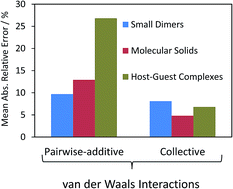
van der Waals dispersion interactions in molecular materials: beyond pairwise additivity
Anthony M. Reilly and Alexandre Tkatchenko 
Chem. Sci., 2015, Advance Article
DOI: 10.1039/C5SC00410A, Perspective
Open Access
C5SC00410A GA
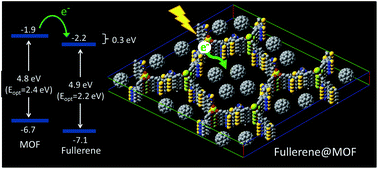
Novel metal–organic framework linkers for light harvesting applications
Michael E. Foster, Jason D. Azoulay, Bryan M. Wong and Mark D. Allendorf 
Chem. Sci., 2014, 5, 2081-2090
DOI: 10.1039/C4SC00333K, Edge Article
C4SC00333K GA
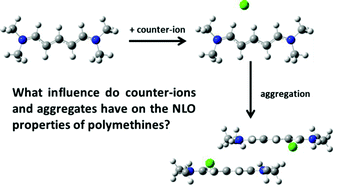
Polymethine dyes for all-optical switching applications: a quantum-chemical characterization of counter-ion and aggregation effects on the third-order nonlinear optical response
Sukrit Mukhopadhyay, Chad Risko, Seth R. Marder and Jean-Luc Brédas 
Chem. Sci., 2012,3, 3103-3112
DOI: 10.1039/C2SC20861J, Edge Article
 C2SC20861J GA
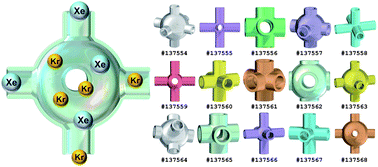
Thermodynamic analysis of Xe/Kr selectivity in over 137 000 hypothetical metal–organic frameworks
Benjamin J. Sikora, Christopher E. Wilmer, Michael L. Greenfield and Randall Q. Snurr 
Chem. Sci., 2012, 3, 2217-2223
DOI: 10.1039/C2SC01097F, Edge Article
From themed collection Physical Chemistry
 C2SC01097F GA
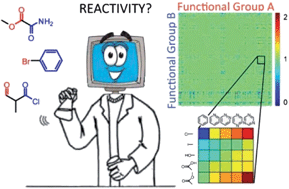
Estimating chemical reactivity and cross-influence from collective chemical knowledge
Siowling Soh, Yanhu Wei, Bartlomiej Kowalczyk, Chris M. Gothard, Bilge Baytekin, Nosheen Gothard and Bartosz A. Grzybowski 
Chem. Sci., 2012, 3, 1497-1502
DOI: 10.1039/C2SC00011C, Edge Article
C2SC00011C GA


Alán is now accepting submissions to Chemical Science in the area of theoretical chemistry.  He is keen to emphasize that he is interested not only in exceptional applications of theoretical methods, but also in the top methods-development manuscripts. He is also very interested in articles that are at the interface of theoretical chemistry and other fields.

Submit your high-impact research to Alán’s Editorial Office.

*Access is free with a registered RSC account.

Digg This
Reddit This
Stumble Now!
Share on Facebook
Bookmark this on Delicious
Share on LinkedIn
Bookmark this on Technorati
Post on Twitter
Google Buzz (aka. Google Reader)

Beyond the Mizoroki-Heck Reaction: Palladium-catalyzed Synthesis of α-Aryl Dicarbonyls via 1,2-Migration

The utility of palladium-catalyzed coupling has grown extensively as it has become one of the most powerful tools available to synthetic chemists.  By playing a strategic role in the formation of carbon-carbon and carbon-heteroatom bonds, this synthetic technology has provided numerous opportunities to access diverse molecular architectures. 

C5SC00505A GA

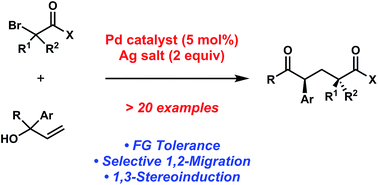
In this recently published Chemical Science Edge Article, Professor Uttam K. Tambar and colleague from the University of Texas Southwestern Medical Center at Dallas set out to determine whether the Mizoroki–Heck reaction could be extended to generate dicarbonyl species while circumventing the usual alkene products.  They envisioned that under the modified reaction conditions the initial coupling of substituted allylic alcohols and organohalides would be followed by the key 1,2-migration step, instead of the conventional β-hydride elimination.

After screening various reaction conditions, the Tambar group found that the desired aryl dicarbonyls were furnished in good yield when a catalytic amount of  bis(benzonitrile)dichloropalladium(II) was combined with a silver salt in the presence of 1,1-diphenylallyl alcohol and ethyl bromoacetate

An investigation of the scope revealed that the aryl groups substituted with electron-rich and electron-deficient groups, as well as geminal-disubstituted allylic alcohols provided the desired coupling products.  Based on the preliminary mechanistic studies, they proposed that the reactions proceeded through the acyclic free radical pathway.

Furthermore, Prof. Tambar and his coworker also tested the possibility of producing additional acyclic 1,5-dicarbonyl compounds containing multiple stereogenic centers.  For instance, when they utilized the piperidine-substituted methyl bromoamide as the reaction partner with 1,1-diphenylallyl alcohol, the researchers found that the coupling reaction yielded the diketone product with diastereomeric ratio of 5:1.

Because acyclic stereocontrol remains a challenging research area in stereoselective free radical reactions, the 5:1 ratio is notably the highest reported level of 1,3-stereoinduction in 1,2-aryl migrations. 

This exciting article was just published in Chemical Science as an Edge Article. Read “Palladium-catalyzed cross-coupling of α-bromocarbonyls and allylic alcohols for the synthesis of α-aryl dicarbonyl compounds” (DOI: 10.1039/C5SC00505A) by Professor Uttam K. Tambar and Yang Yu to learn more about their chemistry. The article is free to access until 20th May 2015*.

*Access is free through a registered RSC account


Dr. Tezcan Guney is a web writer for Chemical Society Reviews, Chemical Science and Chemical Communications. Dr. Guney received his Ph.D. from the Department of Chemistry at Iowa State University with Prof. George Kraus, where he focused on the synthesis of biologically active polycyclic natural products and multifunctional imaging probes. Currently, he is a postdoctoral research scholar at the Memorial Sloan-Kettering Cancer Center in New York with Prof. Derek Tan, contributing to the efforts to access biologically active small molecules using the diversity-oriented synthetic approach.

Digg This
Reddit This
Stumble Now!
Share on Facebook
Bookmark this on Delicious
Share on LinkedIn
Bookmark this on Technorati
Post on Twitter
Google Buzz (aka. Google Reader)

Jim McCusker joins Chemical Science as Associate Editor

Chemical Science is delighted to announce that Professor James K. McCusker of Michigan State University has joined the journal as an Associate Editor. Jim is now handling submissions in the area of Physical Inorganic chemistry.

Biography
Jim McCusker was born in New Haven, Connecticut in 1965. After graduating from Bucknell University and University of Illinois at Urbana-Champaign, he joined the University of North Carolina as an NIH Postdoctoral Fellow, where he worked with Professor Thomas J. Meyer from 1992-94. Following this he took up a position as Assistant Professor of Chemistry at the University of California, Berkeley. In 2001 Jim moved his research group to Michigan State University, where he is currently Professor of Chemistry and Director of the Center of Research Excellence in Complex Materials (CORE-CM).

Research
The McCusker Group’s research revolves around the ultrafast excited-state dynamics of transition metal complexes – in particular as this relates to the development of solar energy conversion strategies – as well as the interplay between zero-field spin polarization and the physical and photophysical properties of molecular systems.

Jim on Chemical Science
We asked Jim to talk us through some of his favourite Chemical Science articles. He picked the following as his highlights:

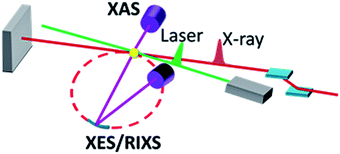
C4SC01333F GARecent advances on ultrafast X-ray spectroscopy in the chemical sciences
L. X. Chen, X. Zhang and M. L. Shelby  
Chem. Sci., 2014, 5, 4136-4152, DOI: 10.1039/C4SC01333F, Minireview

Jim says, “This is a mini-review by Chen and co-workers. It’s a great example of one of the formats that Chem Sci has created that allows an expert in a certain area to present his/her perspective. In this case, Lin Chen, one of the world’s experts in the application of ultrafast x-ray science to chemical problems, does a great job in explaining the history of the methodology and what the information derived from these experiments can provide to chemists. In essence, Chen takes a fairly sophisticated physical chemistry/chemical physics technique and explains its relevance to the broader chemical community.”

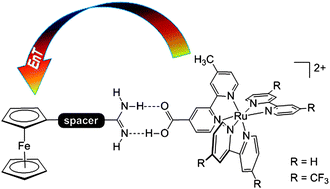
C1SC00596K GAEnergy transfer mediated by asymmetric hydrogen-bonded interfaces
Elizabeth R. Young, Joel Rosenthal and Daniel G. Nocera  
Chem. Sci., 2012, 3, 455-459 , DOI: 10.1039/C1SC00596K, Edge Article

“A paper by our new Editor-in-Chief. This is a great example of how judicious use of molecular design can be used to illustrate and expand our understanding of fundamental chemical principals. In this case, the topic is proton-coupled electron transfer (PCET), a field that Nocera (along with my colleague at MSU, Robert Cukier) effectively defined and codified back in the 90s. This paper shows that the motion of protons in donor-acceptor systems can not only play a role in electron transfer (hence the term PCET), but can also be important in energy transfer. This effectively expands the scope of the PCET picture into a completely new realm of reactivity.”

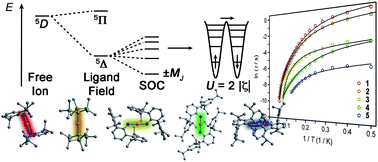
C2SC20801F GASlow magnetization dynamics in a series of two-coordinate iron(II) complexes
Joseph M. Zadrozny, Mihail Atanasov, Aimee M. Bryan, Chun-Yi Lin, Brian D. Rekken, Philip P. Power, Frank Neese and Jeffrey R. Long  
Chem. Sci., 2013, 4, 125-138, DOI: 10.1039/C2SC20801F, Edge Article

“A paper by former Associate Editor Jeffrey Long, this represents a terrific confluence of synthesis, physical methods, and theory to demonstrate the applicability of an important physical concept in setting that would previously have been deemed unlikely at best. The present case deals with the rapidly developing area of single-molecule magnetism. Once thought to be relegated to large metal clusters, this paper shows how, by paying attention to the true underlying basis for the phenomenon, one can design molecules that exhibit the same effect in the simplest of coordination environments, namely a single-ion, two-coordinate complex.”

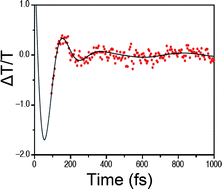
C0SC00262C GAVibrational coherence in the excited state dynamics of Cr(acac)3: probing the reaction coordinate for ultrafast intersystem crossing
Joel N. Schrauben, Kevin L. Dillman, Warren F. Beck and James K. McCusker  
Chem. Sci., 2010, 1, 405-410, DOI: 10.1039/C0SC00262C, Edge Article

On choosing this Edge Article from an early issue of Chemical Science, Jim comments, “Okay, this is a bit self-serving in that it comes out of my group, but I’m actually quite proud of this paper. In chemistry we often talk about the “reaction coordinate” for a chemical process, be it a thermal reaction or a photo physical transformation, but what does that really mean? In this study, we were actually able to identify what this reaction coordinate is in the context of ultrafast excited-state dynamics. This paper was the first to document vibrational coherence associated with ligand-field electronic states. The underlying nature of the molecular motion responsible for this coherence was identified, and that information was used to synthetically modify the compound. The result was a > 10x modulation of the kinetics associated with the photo physics of this system, demonstrating for the first time that one could in fact use synthetic chemistry to effect significant changes in the photo-induced properties of molecules, even those occurring on sub-picosecond time scales.”

These articles are all free to access until 14th May.

Jim is now accepting submissions to Chemical Science in the area of physical inorganic chemistry. Submit your high-impact research to his Editorial Office.

Digg This
Reddit This
Stumble Now!
Share on Facebook
Bookmark this on Delicious
Share on LinkedIn
Bookmark this on Technorati
Post on Twitter
Google Buzz (aka. Google Reader)