Safer sunscreens

Coating titania nanoparticles with carbon could result in a safer UV filter to be used in sunscreen, say Italian scientists.

Long-term exposure to UVA and UVB radiation from sunlight can cause wrinkles, damaged skin and, in some cases, skin cancer. Titania (TiO2), one of the main components in sunscreens, can absorb and scatter UVA and UVB radiation. However, titania can also become reactive under UV rays and in contact with water, generating free radicals that cause skin damage.

Now, Ivana Fenoglio from the University of Torino and Stefano Livraghi from the Institute for Health and Consumer Protection, Ispra, and their teams have modified the surface of titania nanoparticles to decrease their reactivity under UV. The groups coated the nanoparticles with ethylene glycol and heated the resulting compound to 300ºC to carbonise it. They found that this reduced the nanoparticles’ oxidative power and consequently decreased free radical formation. ‘It was very surprising to find out that by using ethylene glycol as a precursor, the formation of free radicals is reduced. This differs from the results of other studies done with titania nanoparticles modified with carbon,’ says Fenoglio.

Boy with sunscreen on his face

Long-term exposure to UV radiation from sunlight can cause wrinkles, damaged skin and, in some cases, skin cancer

‘To use titania particles for skin care, a delicate balance is needed to prevent formation of reactive oxygen species, which have been suspected to cause skin damage, without affecting the desirable optical properties,’ says Sefik Suzer, an expert in inorganic nanoparticles at Bilkent University in Ankara, Turkey. ‘This research will undoubtedly help in developing a new generation of cosmetic products as well as leading to formulation of new routes for special applications of titania.’

‘This research may be a starting point for setting up protocols to produce UV filters that may find applications in different fields including the cosmetics industry,’ says Fenoglio.

Lorena Tomas Laudo

Download the full ChemComm communication to find out more about this work.

Digg This
Reddit This
Stumble Now!
Share on Facebook
Bookmark this on Delicious
Share on LinkedIn
Bookmark this on Technorati
Post on Twitter
Google Buzz (aka. Google Reader)

Decorating peptide-polymer nanotapes

Peptide–polymer nanotapes can be decorated with diverse functionalities thanks to a versatile strategy developed by scientists in Germany.

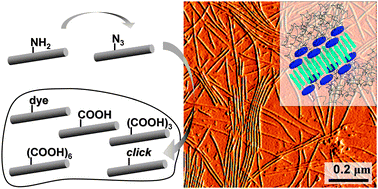
Hans Börner, at the Max Planck Institute of Colloids and Interfaces in Potsdam, and colleagues modified self-assembled nanotapes of poly(ethylene oxide)–peptide conjugates by a simple amine–azide transfer to create azide-containing nanofibres. Using click chemistry, they then introduced different carboxyl-bearing entities to modulate the calcium binding properties of the nanotapes.

Graphical abstract: A modular approach towards functional decoration of peptide–polymer nanotapes

To find out more, download Börner’s communication, which is free to access until 9th December.

Also of interest: Anti-wrinkle creams aided by nanotapes

Digg This
Reddit This
Stumble Now!
Share on Facebook
Bookmark this on Delicious
Share on LinkedIn
Bookmark this on Technorati
Post on Twitter
Google Buzz (aka. Google Reader)

Fluoride-free Hiyama couplings

A new, highly effective β-diketiminatophosphane palladium catalyst can be used in fluoride-free Hiyama coupling reactions of unactivated aryl chlorides in water.

Myung-Jong Jin and colleagues from the Inha University, in Korea, have published their findings in ChemComm. Fancy finding out more about this catalyst and the reaction conditions required? Then download the article today, which is free to access until the 9th December and why not blog some comments below too!

Digg This
Reddit This
Stumble Now!
Share on Facebook
Bookmark this on Delicious
Share on LinkedIn
Bookmark this on Technorati
Post on Twitter
Google Buzz (aka. Google Reader)

Decarboxylative cross-coupling with copper

This is the first time, say scientists in China, that copper-catalysed decarboxylative reactions have enabled cross-coupling of alkynyl carboxylic acids with aryl halides, under relatively mild reaction conditions.

Jingsong You, Ying Xue and colleagues from Sichuan University in China believe the process is not only simple and convenient in terms of the reaction conditions and purification, but also tolerant of a variety of functional groups. This is a practical route to give unsymmetric internal arylalkynes. The team have also shown that benzofurans can be smoothly prepared by a one-pot domino protocol on the basis of decarboxylative cross-coupling of 2-iodophenol.

The team have published their findings in ChemComm so why not download the article today, which will be free to access until the 9th December.


Digg This
Reddit This
Stumble Now!
Share on Facebook
Bookmark this on Delicious
Share on LinkedIn
Bookmark this on Technorati
Post on Twitter
Google Buzz (aka. Google Reader)

O-Glycoligases: a new category of glycoside bond-forming mutant enzymes

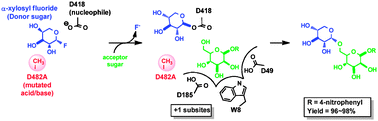
A team of scientists from Canada and Korea have developed a mutant glycosidase enzyme that can catalyse the synthesis of an O-linked sugar called isoprimeveroside in near quantitative yield.

Stephen Withers, at the University of British Columbia, Canada, and colleagues report their findings in their ChemComm communication, which is part of the ChemComm ‘Enzymes & Proteins’ web-based themed issue. The communication is free to access until 9th December 2010.

Graphical abstract: O-Glycoligases, a new category of glycoside bond-forming mutant glycosidases, catalyse facile syntheses of isoprimeverosides

Digg This
Reddit This
Stumble Now!
Share on Facebook
Bookmark this on Delicious
Share on LinkedIn
Bookmark this on Technorati
Post on Twitter
Google Buzz (aka. Google Reader)

Simple solution process for making ordered nanostructures

Simple aromatic compounds can self-assemble into low-dimensional aggregates with controlled architecture, according to US scientists.

Yi Liu, at Lawrence Berkeley National Laboratory, and colleagues have shown that single molecule-thick two-dimensional nanosheets self-assemble from symmetric hexakis(alkoxy)triphenylene derivatives, and then further stack to give multilayered nanofibres.

Cryo-TEM image of the HAT6 nanofibers (c) and magnified view of the end of a nanofiber (a) showing its multi-layer morphology. The nano-beam electron diffraction from the same fiber (b) clearly shows the signature of long-range order, the arrows pointing to the 1.4 nm and 0.45 nm spacings perpendicular and parallel to the wire axis, respectively.

Anisotropic nanostructures of organic semiconductors have good electronic and optical properties, making them suitable morphologies for advanced optoelectronic applications. But controlling the ordering of such materials at the molecular level remains a challenging task as it is affected by many structural and environmental aspects.

This simple solution process provides an attractive and convenient bottom-up path to hierarchical self-assembly nanostructures, Liu says.

For more information, read Liu’s ChemComm communication, free to access until 9th December.

If you are having trouble accessing free content in ChemComm, register for an RSC Publishing personal account today. To find out more, please visit the RSC Publishing Blog.

Digg This
Reddit This
Stumble Now!
Share on Facebook
Bookmark this on Delicious
Share on LinkedIn
Bookmark this on Technorati
Post on Twitter
Google Buzz (aka. Google Reader)

Gold-diphosphine cage plays host to small molecules

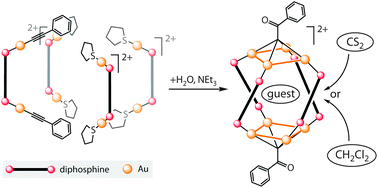
A collaboration of Finnish and Russian scientists has resulted in the creation of a gold-diphosphine helical cage that plays host to small organic molecules, like dichloromethane and carbon disulphide. Igor Koshevoy and colleagues from the University of Eastern Finland, and Sergey Tunikv and co-workers from St. Petersburg State University have shown that the assembly of these cages occur via an unprecedented transformation.

Why not discover what is so unprecedented about the transformation process and download the article today? The authors have published their results in ChemComm, which will be free to access until the 9th December.

Digg This
Reddit This
Stumble Now!
Share on Facebook
Bookmark this on Delicious
Share on LinkedIn
Bookmark this on Technorati
Post on Twitter
Google Buzz (aka. Google Reader)

Organic semiconductors for hydrogen production

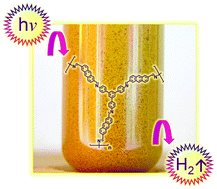
Organic conjugated poymer networks are found to be promising candidates for photocatalytic water splitting, say scientists in Germany.


Klaus Müllen and colleagues from the Max-Planck-Institute for Polymer Research in Mainz and the Max Planck Institute of Colloids and Interfaces in Potsdam, report a straightforward synthesis that leads to fully organic photocatalysts showing enhanced long-time stability.


Would you like to read more? Then why not download the article today, which has been published in ChemComm and will be free to acess until the 9th December.

Digg This
Reddit This
Stumble Now!
Share on Facebook
Bookmark this on Delicious
Share on LinkedIn
Bookmark this on Technorati
Post on Twitter
Google Buzz (aka. Google Reader)

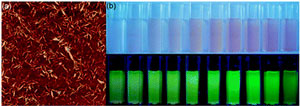
pH sensing cellulose nanocrystals

Cellulose nanocrystals can be transformed into pH sensing nanoparticles by dual fluorescent labelling employing a one-pot procedure, explain scientists in the UK and Denmark.

In particular, Wim Thielemans, Jonathan Aylott and co-workers from the University of Nottingham alongside colleagues from the University of Southern Denmark, have shown that the thiol–ene click reaction can be used to modify the cellulose nanocrystals surface, leading to many future applications in sensing or tissue engineering.

Fancy finding out more? Download the article today and blog some comments on the science below. The communication has been published in ChemComm where it will be free to access until the 9th December.

Digg This
Reddit This
Stumble Now!
Share on Facebook
Bookmark this on Delicious
Share on LinkedIn
Bookmark this on Technorati
Post on Twitter
Google Buzz (aka. Google Reader)

Native cellulose helps nanocatalyst efficiency

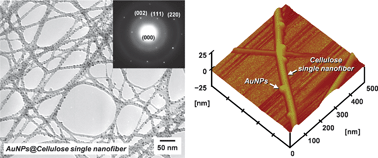
Japanese scientists claim to be breaking new ground by making optimal use of limited noble metal resources with one of the most abundant, renewable bioresources – cellulose.

They made gold nanoparticles (AuNPs) were made using crystalline cellulose single nanofibres (CSNFs), tailored from native cellulose. The AuNPs@CSNFs composite showed excellent catalytic efficiency, with a turnover efficiency of 840 times more than conventional polymer-supported AuNPs.


Takuya Kitaoka from Kyushu University and colleagues from the University of Tokyo, have published their findings in ChemComm, which is free to access until the 3rd December. So why not download the article today and blog some feedback below?


Digg This
Reddit This
Stumble Now!
Share on Facebook
Bookmark this on Delicious
Share on LinkedIn
Bookmark this on Technorati
Post on Twitter
Google Buzz (aka. Google Reader)