Archive for April, 2019

HOT ChemComm articles for February

All of the referee-recommended articles below are free to access until Friday 24th May.

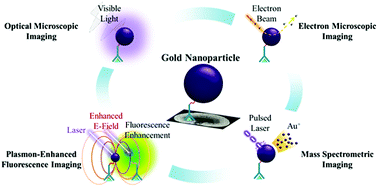
Plasmonic Gold Nanoparticle as Multifaceted Probe for Tissue Imaging
Yu-Hong Cheng, Toby Siu-Chung Tam, Siu-Leung Chau, Samuel Kin-Man Lai, Ho-Wai Tang, Chun-Nam Lok, Ching-Wan Lam and Kwan-Ming Ng*
Chem. Commun., 2019, 55, 2761-2764
DOI: 10.1039/C9CC00356H, Communication
___________________________________________________________

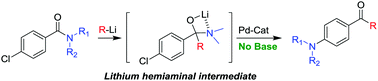
One-Pot, Modular Approach to Functionalized Ketones via Nucleophilic Addition/Buchwald-Hartwig Amination Strategy
Jorn de Jong, Dorus Heijnen, Hugo Helbert and Ben L. Feringa*
Chem. Commun., 2019, 55, 2908-2911
DOI: 10.1039/C8CC08444K, Communication
___________________________________________________________

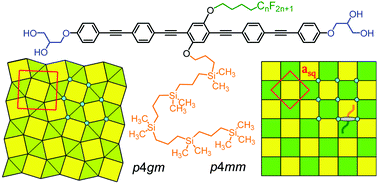
Soft Self-assembled Sub-5 nm Scale Chessboard and Snub-Square Tilings with Oligo(para-phenyleneethynylene) Rods
Constance Nürnberger, Huanjun Lu, Xiangbing Zeng, Feng Liu,* Goran Ungar,* Harald Hahn, Heinrich Lang, Marko Prehm and Carsten Tschierske*
Chem. Commun., 2019, 55, 4154-4157
DOI: 10.1039/C9CC00494G, Communication
 

___________________________________________________________

Dual-Wavelength Lasing from Organic Dye Encapsulated Metal-Organic Framework Microcrystals
Yue Zhang, Haiyun Dong, Yuan Liu, Chunhuan Zhang, Fengqin Hu* and Yong Sheng Zhao*
Chem. Commun., 2019, 55, 3445-3448
DOI: 10.1039/C8CC10232E, Communication

___________________________________________________________

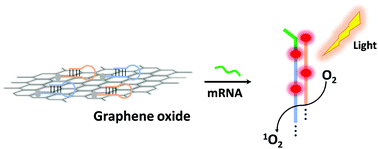
Hybridization Chain Reaction-Based Nanoprobe for Cancer Cell Recognition and Amplified Photodynamic Therapy
Mengyi Xiong, Qiming Rong, Gezhi Kong, Chan Yang, Yan Zhao, Feng-Li Qu,* Xiao-Bing Zhang* and Weihong Tan
Chem. Commun., 2019, 55, 3065-3068
DOI: 10.1039/C8CC10074H, Communication
___________________________________________________________

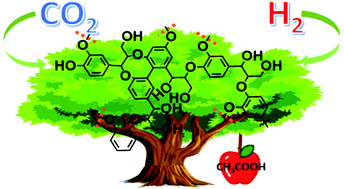
Synthesis of Renewable Acetic Acid from CO2 and Lignin over Ionic Liquid-Based Catalytic System
Huan Wang, Yanfei Zhao, Zhengang Ke, Bo Yu, Ruipeng Li, Yunyan Wu, Zhenpeng Wang, Juanjuan Han and Zhimin Liu*
Chem. Commun., 2019, 55, 3069-3072
DOI: 10.1039/C9CC00819E, Communication
 

___________________________________________________________

Digg This
Reddit This
Stumble Now!
Share on Facebook
Bookmark this on Delicious
Share on LinkedIn
Bookmark this on Technorati
Post on Twitter
Google Buzz (aka. Google Reader)

A Battery Cathode with a Bee Pupa-Filled Honeycomb Structure

Increasing the volumetric energy densities of batteries is essential for improving the durability of portable electronics and the operating ranges of electric vehicles. One way to improve energy density is to enlarge the mass fraction of active materials in battery electrodes; however, the degree of enhancement remains limited. This limitation results from the densification of the electrodes when the mass fraction increases, making electron transport and ion diffusion throughout the electrodes sluggish. These drawbacks lower the utilization efficiency of the overall electrode materials.

A team of scientists from China and the United States has recently addressed the aforementioned challenges. Specifically, they synthesized a 3D cathode of carbon-coated Li2MnSiO4 (Li2MnSiO4/C) with a structure mimicking a honeycomb filled with bee pupas (Fig. 1). This lithium-ion battery cathode possesses a high mass fraction of 90% (of overall electrode mass) as well as a volumetric energy density as high as 2443 Wh/dm3.

The uniquely structured electrodes were prepared through a hard-template method (Fig. 1). Using polystyrene particles, silica surface coating, and Li2MnSiO4 precursor infiltration, the authors synthesized a carbon-coated Li2MnSiO4 honeycomb scaffold with each cavity filled with a carbon-coated Li2MnSiO4 particle. This architecture differed from previously reported 3D structures, which typically had a large portion of voids, and enabled an ultrahigh active-material mass loading of 90 wt.%. Additionally, the gaps between the scaffold and the particles functioned as ion-diffusion channels, and the carbon coatings served as electron-transport expressways. These characteristics effectively addressed the problem of sluggish ion diffusion and electron transport.

Figure 1. The synthesis procedures of the BPFH-shaped Li2MnSiO4/C electrode. The green particles and yellow scaffold represent polystyrene spheres and the silica coating, respectively.

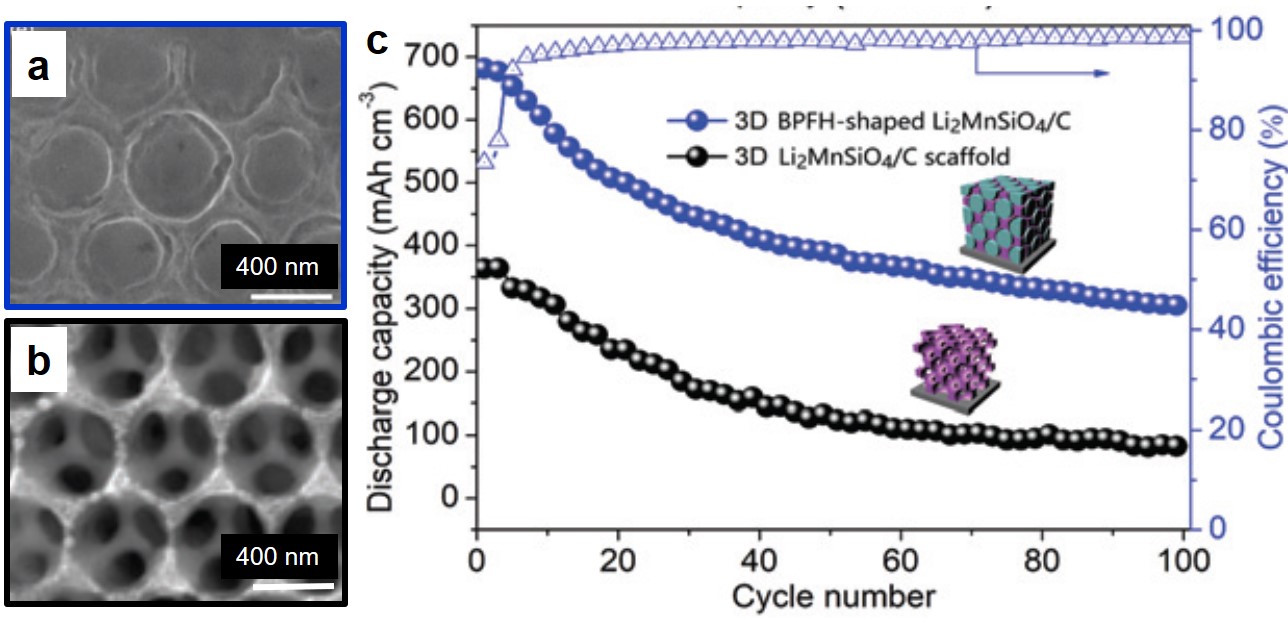
Due to the facilitated electron transport and ion diffusion, the Li2MnSiO4/C electrode with a bee pupa-filled honeycomb (BPFH) structure (Fig. 2a) exhibited an outstanding charge-storage performance. Specifically, it delivered a high volumetric capacity of 643 mAh/cm3 at a current density of 0.1 C, corresponding to a volumetric density of 2443 Wh/dm3. This volumetric capacity was approximately two times higher than that of a Li2MnSiO4/C honeycomb lattice without any Li2MnSiO4 particles (Fig. 2b). After 100 consecutive charge-discharge cycles, the BPFH-shaped Li2MnSiO4/C electrode retained a volumetric capacity of 328 mAh/cm3 (Fig. 2c).

Figure 2. (a and b) Scanning electron microscopy images of (a) the BPFH-shaped Li2MnSiO4/C electrode and (b) the Li2MnSiO4/C scaffold. (c) The capacities and the Coulombic efficiencies of the two electrodes during 100 charge-discharge cycles.

The demonstrated BPFH architecture could be extended to other materials for the synthesis of battery electrodes with both high mass fractions of active materials and outstanding volumetric energy densities.


To find out more please read:

A Bee Pupa-Infilled Honeycomb Structure-Inspired Li2MnSiO4 Cathode for High Volumetric Energy Density Secondary Batteries

Jinyun Liu, Xirong Lin, Huigang Zhang, Zihan Shen, Qianqian Lu, Junjie Niu, Jinjin Li and Paul V. Braun

Chem. Commun., 2019, 55, 3582-3585

About the blogger:

Tianyu Liu obtained his Ph.D. (2017) in Chemistry from University of California, Santa Cruz in the United States. He is passionate about scientific communication to introduce cutting-edge research to both the general public and scientists with diverse research expertise. He is a blog writer for Chem. Commun. and Chem. Sci. More information about him can be found at http://liutianyuresearch.weebly.com/.

Digg This
Reddit This
Stumble Now!
Share on Facebook
Bookmark this on Delicious
Share on LinkedIn
Bookmark this on Technorati
Post on Twitter
Google Buzz (aka. Google Reader)