Large scale production of graphene

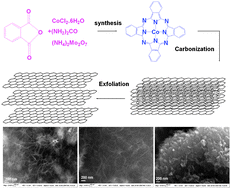
Chinese chemists have prepared graphene via carbonisation of microwave-synthesised metal phthalocyanine, followed by a rapid cooling process. They controlled the thickness of the graphene by using different coolants.

Graphical abstract: Large-scale production of graphene by microwave synthesis and rapid cooling

Download their ChemComm communication, free to access until 24th December, to find out more.

Digg This
Reddit This
Stumble Now!
Share on Facebook
Bookmark this on Delicious
Share on LinkedIn
Bookmark this on Technorati
Post on Twitter
Google Buzz (aka. Google Reader)

Major groove for anti-cancer drug

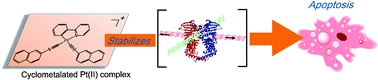
A platinum(II)-based major groove binder was identified as a potent human topoisomerase IIα poison, showing anti-proliferation activities in human cancer cells.

Chi-Ming Che and colleagues from the University of Hong Kong were able to stabilise the covalent TopoIIα–DNA cleavage complex and induce cancer cell death with its high potency – apparently it’s significantly higher than a clinically used TopoIIα poison.

Fancy reading more? Then why not download the article today and blog some comments below. The communication, published in ChemComm will be free to access until the 24th December.


Digg This
Reddit This
Stumble Now!
Share on Facebook
Bookmark this on Delicious
Share on LinkedIn
Bookmark this on Technorati
Post on Twitter
Google Buzz (aka. Google Reader)

Chemical synthesis on SU-8 particles

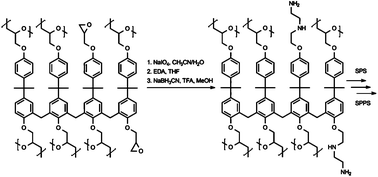
Chemists in Denmark have developed a procedure for modifying the surface of SU-8 microparticles and then using it for quantitative multi-step organic synthesis.

SU-8 is a novolac-epoxy resin used in the field of microfabrication and micropatterning. Thomas Nielsen, at Technical University of Denmark, and colleagues demonstrated how common linkers can be attached to the support surface and effectively used for solid-supported synthesis. 

Graphical abstract: Chemical synthesis on SU-8

They report transformations including reduction, oxidation, multi-step peptide synthesis and metal-catalysed cycloaddition and cross-coupling reactions in their ChemComm communication, free to download until 24th December.

Digg This
Reddit This
Stumble Now!
Share on Facebook
Bookmark this on Delicious
Share on LinkedIn
Bookmark this on Technorati
Post on Twitter
Google Buzz (aka. Google Reader)

Temperature breakthrough for hydrogen storage

A compound first made in 1923 releases hydrogen at a lower temperature than ammonia borane, one of the most studied materials for hydrogen storage.

Efficient hydrogen storage is an important step in developing a hydrogen economy. One way of storing hydrogen is in chemical compounds that reversibly release hydrogen when they are heated. Diammoniate of diborane (DADB, [(NH3)2BH2]+[BH4]) as a hydrogen-containing species has the potential to be a storage material, but the crystal structure of the compound that would give valuable information about its properties has not been resolved until now.

Using a combination of X-ray and neutron powder diffraction patterns, Mark Bowden and Tom Autrey at the Pacific Northwest National Laboratory, Richland, and the Los Alamos National Laboratory, and coworkers resolved the crystal structure. ‘DADB is an interesting compound because it contains a high weight fraction of hydrogen, one of the highest for a stable material at room temperature,’ says Bowden.

Diammoniate of diborane

Diammoniate of diborane contains a high weight fraction of hydrogen, one of the highest for a stable material at room temperature

When Bowden and the team heated DADB, they found that it behaved in a similar way to ammonia borane, but DADB releases hydrogen at 85°C, whereas ammonia borane releases hydrogen at 110°C. 

Hydrogen release at this temperature is very interesting since it is in this temperature range that a practical hydrogen storage system must operate, says Stewart Parker of the Rutherford Appleton Laboratory, Didcot, UK, but it is important to have better knowledge of the system’s reversibility. 

Jon Counsell

Enjoy this story? Download the full article from ChemComm and add your comments below.

Also of interest: the ChemComm web themed issue on Hydrogen.

Digg This
Reddit This
Stumble Now!
Share on Facebook
Bookmark this on Delicious
Share on LinkedIn
Bookmark this on Technorati
Post on Twitter
Google Buzz (aka. Google Reader)

Safer sunscreens

Coating titania nanoparticles with carbon could result in a safer UV filter to be used in sunscreen, say Italian scientists.

Long-term exposure to UVA and UVB radiation from sunlight can cause wrinkles, damaged skin and, in some cases, skin cancer. Titania (TiO2), one of the main components in sunscreens, can absorb and scatter UVA and UVB radiation. However, titania can also become reactive under UV rays and in contact with water, generating free radicals that cause skin damage.

Now, Ivana Fenoglio from the University of Torino and Stefano Livraghi from the Institute for Health and Consumer Protection, Ispra, and their teams have modified the surface of titania nanoparticles to decrease their reactivity under UV. The groups coated the nanoparticles with ethylene glycol and heated the resulting compound to 300ºC to carbonise it. They found that this reduced the nanoparticles’ oxidative power and consequently decreased free radical formation. ‘It was very surprising to find out that by using ethylene glycol as a precursor, the formation of free radicals is reduced. This differs from the results of other studies done with titania nanoparticles modified with carbon,’ says Fenoglio.

Boy with sunscreen on his face

Long-term exposure to UV radiation from sunlight can cause wrinkles, damaged skin and, in some cases, skin cancer

‘To use titania particles for skin care, a delicate balance is needed to prevent formation of reactive oxygen species, which have been suspected to cause skin damage, without affecting the desirable optical properties,’ says Sefik Suzer, an expert in inorganic nanoparticles at Bilkent University in Ankara, Turkey. ‘This research will undoubtedly help in developing a new generation of cosmetic products as well as leading to formulation of new routes for special applications of titania.’

‘This research may be a starting point for setting up protocols to produce UV filters that may find applications in different fields including the cosmetics industry,’ says Fenoglio.

Lorena Tomas Laudo

Download the full ChemComm communication to find out more about this work.

Digg This
Reddit This
Stumble Now!
Share on Facebook
Bookmark this on Delicious
Share on LinkedIn
Bookmark this on Technorati
Post on Twitter
Google Buzz (aka. Google Reader)

Decorating peptide-polymer nanotapes

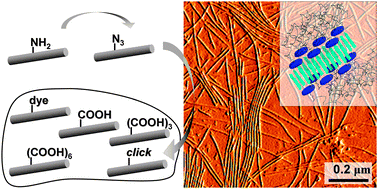
Peptide–polymer nanotapes can be decorated with diverse functionalities thanks to a versatile strategy developed by scientists in Germany.

Hans Börner, at the Max Planck Institute of Colloids and Interfaces in Potsdam, and colleagues modified self-assembled nanotapes of poly(ethylene oxide)–peptide conjugates by a simple amine–azide transfer to create azide-containing nanofibres. Using click chemistry, they then introduced different carboxyl-bearing entities to modulate the calcium binding properties of the nanotapes.

Graphical abstract: A modular approach towards functional decoration of peptide–polymer nanotapes

To find out more, download Börner’s communication, which is free to access until 9th December.

Also of interest: Anti-wrinkle creams aided by nanotapes

Digg This
Reddit This
Stumble Now!
Share on Facebook
Bookmark this on Delicious
Share on LinkedIn
Bookmark this on Technorati
Post on Twitter
Google Buzz (aka. Google Reader)

Fluoride-free Hiyama couplings

A new, highly effective β-diketiminatophosphane palladium catalyst can be used in fluoride-free Hiyama coupling reactions of unactivated aryl chlorides in water.

Myung-Jong Jin and colleagues from the Inha University, in Korea, have published their findings in ChemComm. Fancy finding out more about this catalyst and the reaction conditions required? Then download the article today, which is free to access until the 9th December and why not blog some comments below too!

Digg This
Reddit This
Stumble Now!
Share on Facebook
Bookmark this on Delicious
Share on LinkedIn
Bookmark this on Technorati
Post on Twitter
Google Buzz (aka. Google Reader)

Decarboxylative cross-coupling with copper

This is the first time, say scientists in China, that copper-catalysed decarboxylative reactions have enabled cross-coupling of alkynyl carboxylic acids with aryl halides, under relatively mild reaction conditions.

Jingsong You, Ying Xue and colleagues from Sichuan University in China believe the process is not only simple and convenient in terms of the reaction conditions and purification, but also tolerant of a variety of functional groups. This is a practical route to give unsymmetric internal arylalkynes. The team have also shown that benzofurans can be smoothly prepared by a one-pot domino protocol on the basis of decarboxylative cross-coupling of 2-iodophenol.

The team have published their findings in ChemComm so why not download the article today, which will be free to access until the 9th December.


Digg This
Reddit This
Stumble Now!
Share on Facebook
Bookmark this on Delicious
Share on LinkedIn
Bookmark this on Technorati
Post on Twitter
Google Buzz (aka. Google Reader)

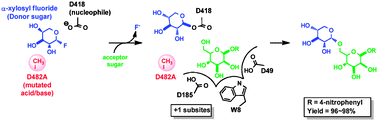
O-Glycoligases: a new category of glycoside bond-forming mutant enzymes

A team of scientists from Canada and Korea have developed a mutant glycosidase enzyme that can catalyse the synthesis of an O-linked sugar called isoprimeveroside in near quantitative yield.

Stephen Withers, at the University of British Columbia, Canada, and colleagues report their findings in their ChemComm communication, which is part of the ChemCommEnzymes & Proteins’ web-based themed issue. The communication is free to access until 9th December 2010.

Graphical abstract: O-Glycoligases, a new category of glycoside bond-forming mutant glycosidases, catalyse facile syntheses of isoprimeverosides

Digg This
Reddit This
Stumble Now!
Share on Facebook
Bookmark this on Delicious
Share on LinkedIn
Bookmark this on Technorati
Post on Twitter
Google Buzz (aka. Google Reader)

Simple solution process for making ordered nanostructures

Simple aromatic compounds can self-assemble into low-dimensional aggregates with controlled architecture, according to US scientists.

Yi Liu, at Lawrence Berkeley National Laboratory, and colleagues have shown that single molecule-thick two-dimensional nanosheets self-assemble from symmetric hexakis(alkoxy)triphenylene derivatives, and then further stack to give multilayered nanofibres.

Cryo-TEM image of the HAT6 nanofibers (c) and magnified view of the end of a nanofiber (a) showing its multi-layer morphology. The nano-beam electron diffraction from the same fiber (b) clearly shows the signature of long-range order, the arrows pointing to the 1.4 nm and 0.45 nm spacings perpendicular and parallel to the wire axis, respectively.

Anisotropic nanostructures of organic semiconductors have good electronic and optical properties, making them suitable morphologies for advanced optoelectronic applications. But controlling the ordering of such materials at the molecular level remains a challenging task as it is affected by many structural and environmental aspects.

This simple solution process provides an attractive and convenient bottom-up path to hierarchical self-assembly nanostructures, Liu says.

For more information, read Liu’s ChemComm communication, free to access until 9th December.

If you are having trouble accessing free content in ChemComm, register for an RSC Publishing personal account today. To find out more, please visit the RSC Publishing Blog.

Digg This
Reddit This
Stumble Now!
Share on Facebook
Bookmark this on Delicious
Share on LinkedIn
Bookmark this on Technorati
Post on Twitter
Google Buzz (aka. Google Reader)