
The Viewpoint: Help us with 100 years of ChemComm history!

100 Viewpoints spanning 100 years of ChemComm history to celebrate 100 issues!

This year ChemComm became the first chemistry journal to move to 100 issues per year. To celebrate this achievement, the journal is launching a new article type – the Viewpoint – with the aim of publishing 100 of these very high profile articles over the coming months.

Each of the 100 Viewpoint articles will aim to reflect upon the impact and influence of some of the most renowned papers that ChemComm (or its predecessor journals) have published over the last 100 years but we need help from the community in determining which articles have been the most influential.

Although Chemical Communications was officially launched in 1996, the roots of the journal go much further back through its predecessors – all the way to 1862 with the Journal of the Chemical Society. In the last 100 years, we’ve published close to 100000 articles, with well over 1000 of these articles coming from Nobel laureates alone!

Trying to determine which articles have been the most influential is going to be a massive challenge which will require the help of the entire chemical community – after all, the community is the best judge of what has been truly influential.

We think we’ve managed to come up with some examples of papers that we feel have been significant enough to deserve a Viewpoint:

  1. Hideki Shirakawa, Edwin J. Louis, Chwan K Chiang, Alan J Heeger and Alan G MacDiarmid’s 1977 communication reporting the first electrically conductive polymers.
  2. Neil Bartlett’s publication in 1962 reporting the world’s first noble gas compound, xenon hexafluoroplatinate.
  3. Mathias Brust, Merryl Walker, Donald Bethell, David J. Schiffrin and Robin Whyman’s 1994 communication on the functionalisation of gold nanoparticles with a thiol coating on the surface – ChemComm’s most cited paper of all time!
  4. Geoffrey Wilkinson’s 1965 paper reporting a rhodium catalyst for the hydroformylation of alkenes.


Our hope is that the Viewpoint articles will really engage our readers from across the chemical sciences and will shed a personal light on some truly influential chemistry that we have published over the last 10 decades! 

We would love it if you could e-mail us or tweet us (@ChemCommun) your suggestions of which articles (or even small group of seminal articles on one subject) from 1912 onwards, have been key to the development or history of chemistry.

We look forward to hearing from you soon.

History of Chemical Communications 1862 – Present

Journal of the Chemical Society (1862 – 1877)

Journal of the Chemical Society, Transactions (1878 – 1925)

Journal of the Chemical Society (resumed) (1926 – 1965)

Chemical Communications (London) (1965-1968)

Journal of the Chemical Society D: Chemical Communications (1969 – 1971)

Journal of the Chemical Society, Chemical Communications (1972-1995)

Chemical Communications (1996 – Present).

Digg This
Reddit This
Stumble Now!
Share on Facebook
Bookmark this on Delicious
Share on LinkedIn
Bookmark this on Technorati
Post on Twitter
Google Buzz (aka. Google Reader)

Porphyrins and Phthalocyanines – free access to articles for limited period

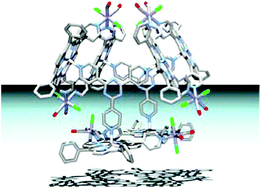
Graphical abstract: Modular self-assembled multiporphyrin cages with tunable shapeChemComm Editor Robert Eagling will be attending the seventh International Conference on Porphyrins & Phthalocyanines (ICPP-7) in Jeju, Korea on 1-6 July 2012.

Two of the conference co-chairs – ChemComm Associate Editor Jonathan Sessler and Changhee Lee from Kangwon National University – are the guest editors of ChemComm‘s Porphyrins & Phthalocyanines web theme issue, along with ChemComm Editorial Board member Penny Brothers.

To celebrate this exciting and vibrant area of research, we have made the whole of our Porphyrins & Phthalocyanines web theme FREE to access until 6th July. So don’t delay – view the web theme today!

Will you be attending ICPP-7? Email Robert if you’d like to arrange a meeting. Post your comments on the conference or the web theme below or tweet us @ChemCommun.

Digg This
Reddit This
Stumble Now!
Share on Facebook
Bookmark this on Delicious
Share on LinkedIn
Bookmark this on Technorati
Post on Twitter
Google Buzz (aka. Google Reader)

Lighting the way to explosive detection

Underwater explosive detector

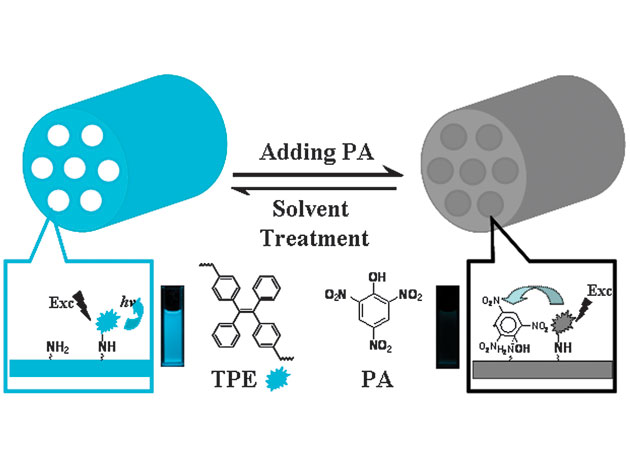
A mesoporous material functionalised with aggregation-induced emission (AIE) luminogens serves as an efficient and recyclable fluorescent sensor to detect picric acid (PA) in water

A reusable fluorescent sensor that detects explosives in groundwater or seawater could aid antiterrorist activities and environmental protection, say scientists in China.

Many techniques have been used to detect explosives, including gas chromatography, Raman spectroscopy and fluorescence spectroscopy. The latter is considered the most useful because of its simplicity, high sensitivity and low cost. With this technique, fluorescent dyes are incorporated into a solid matrix on which they interact with the explosive molecules, causing them to fluoresce.

However, the dyes often aggregate within the matrix, leading to a substantial decrease in fluorescence, known as quenching. This loss of efficiency and sensitivity motivated the discovery of molecules whose fluorescence is turned on by aggregation rather than suppressed. Materials based on such aggregation-induced emission (AIE) luminogens (luminescent compounds) have shown promise in explosive detection in organic solvents. Dispersion in aqueous solution has, until recently, proven difficult.

Read the full article in Chemistry World

Link to journal article
Supersensitive detection of explosives by recyclable AIE luminogen-functionalized mesoporous materials
Dongdong Li, Jianzhao Liu, Ryan T. K. Kwok, Zhiqiang Liang, Ben Zhong Tang and Jihong Yu
Chem. Commun., 2012, Advance Article, DOI: 10.1039/C2CC31890C, Communication

Digg This
Reddit This
Stumble Now!
Share on Facebook
Bookmark this on Delicious
Share on LinkedIn
Bookmark this on Technorati
Post on Twitter
Google Buzz (aka. Google Reader)

Outstanding organocatalysis – An article collection

A collection of high impact articles on organocatalysis from the RSC’s ChemComm, Catalysis Science & Technology, Organic & Biomolecular Chemistry (OBC) and Chem Soc Rev

Catalysts are key to some of the most important reactions on the planet; a world without the Haber process or catalysts to crack crude oil is difficult to imagine. Not to mention the enzymatic reactions that are crucial to all life on earth.

Organocatalysts are an important class of catalyst and consist of carbon-based molecules often functionalised with oxygen, sulfur, nitrogen or phosphorus. They have shown promise in a range of reactions including hydrogenation, Diels-Alder, Michael and Mannich reactions, and are of particular interest in asymmetric reactions.

To help keep you up-to-date with the latest in cutting-edge organocatalytic research we have made the following articles free to access until 9th July. After reading all these there will be little you won’t know about the exciting world of organocatalysis!

Click here for the full list of free articles

Digg This
Reddit This
Stumble Now!
Share on Facebook
Bookmark this on Delicious
Share on LinkedIn
Bookmark this on Technorati
Post on Twitter
Google Buzz (aka. Google Reader)

Mirrors to improve dye sensitised solar cell performance

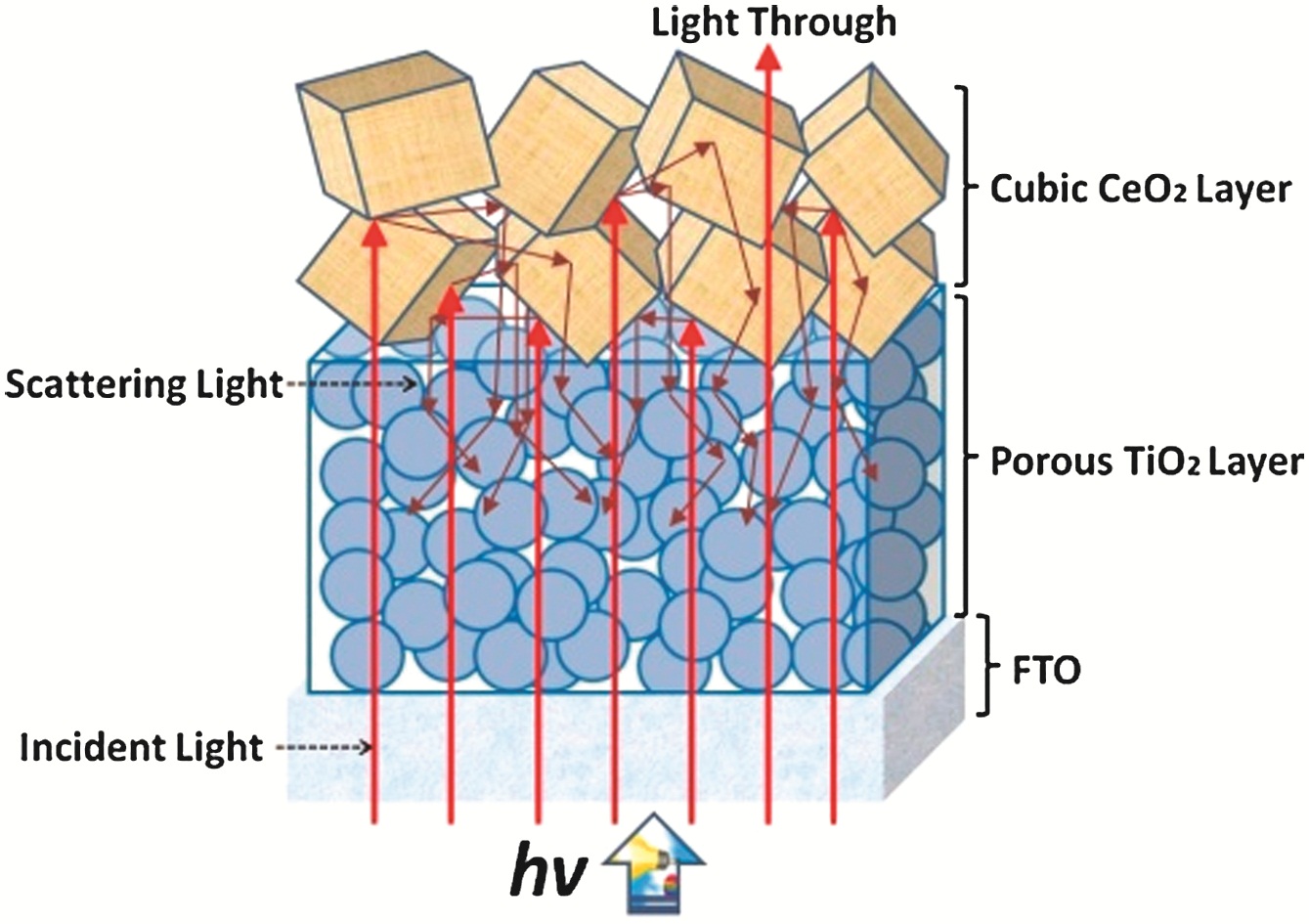
Mirror-like nanoparticles can boost the efficiency of solar cells. Scientists in Australia coated a solar cell’s TiO2 photoanode with cubic cerium oxide nanoparticles. The nanoparticles’ large mirror-like facets are good at scattering light back onto the TiO2 nanoparticles, resulting in a 17.8% improvement in the power conversion efficiency compared to regular dye sensitised solar cells.

Mirrors to improve dye sensitised solar cell performance


Link to journal article
Cubic CeO2 Nanoparticles as Mirror-like Scattering Layer for Efficient Light Harvesting in Dye-Sensitized Solar Cells
Lianzhou Wang
Chem. Commun., 2012, DOI: 10.1039/c2cc32239k

Digg This
Reddit This
Stumble Now!
Share on Facebook
Bookmark this on Delicious
Share on LinkedIn
Bookmark this on Technorati
Post on Twitter
Google Buzz (aka. Google Reader)

Challenging the consensus on nanotube electrochemistry

carbon-nanotubes

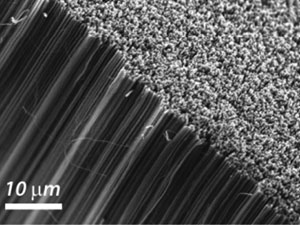
Field emission-scanning electron microscopy image of a single walled carbon nanotube forest

UK scientists have shown that the sidewalls and closed ends of carbon nanotubes can support fast electron transfer, challenging the belief that they are electrochemically inert.

Carbon nanotubes (CNTs) have wide ranging electrochemical applications for sensing and energy. Forests of vertically aligned CNTs have been proposed for use as electrodes, but it was thought that the inert sidewalls would have to be insulated and the ends opened to allow electron transfer.

Scientists from the University of Warwick have now challenged this position by showing that the sidewalls and closed ends of CNTs can support fast electron transfer.

See the full article in Chemistry World

Link to journal article
Electrochemistry at carbon nanotube forests: sidewalls and closed ends allow fast electron transfer
Thomas S. Miller, Neil Ebejer, Aleix G. Güell, Julie V. Macpherson and Patrick R. Unwin
Chem. Commun., 2012, Advance Article, DOI: 10.1039/C2CC32890A, Communication

Digg This
Reddit This
Stumble Now!
Share on Facebook
Bookmark this on Delicious
Share on LinkedIn
Bookmark this on Technorati
Post on Twitter
Google Buzz (aka. Google Reader)

Personal glucose sensors can be adapted to detect cancer too

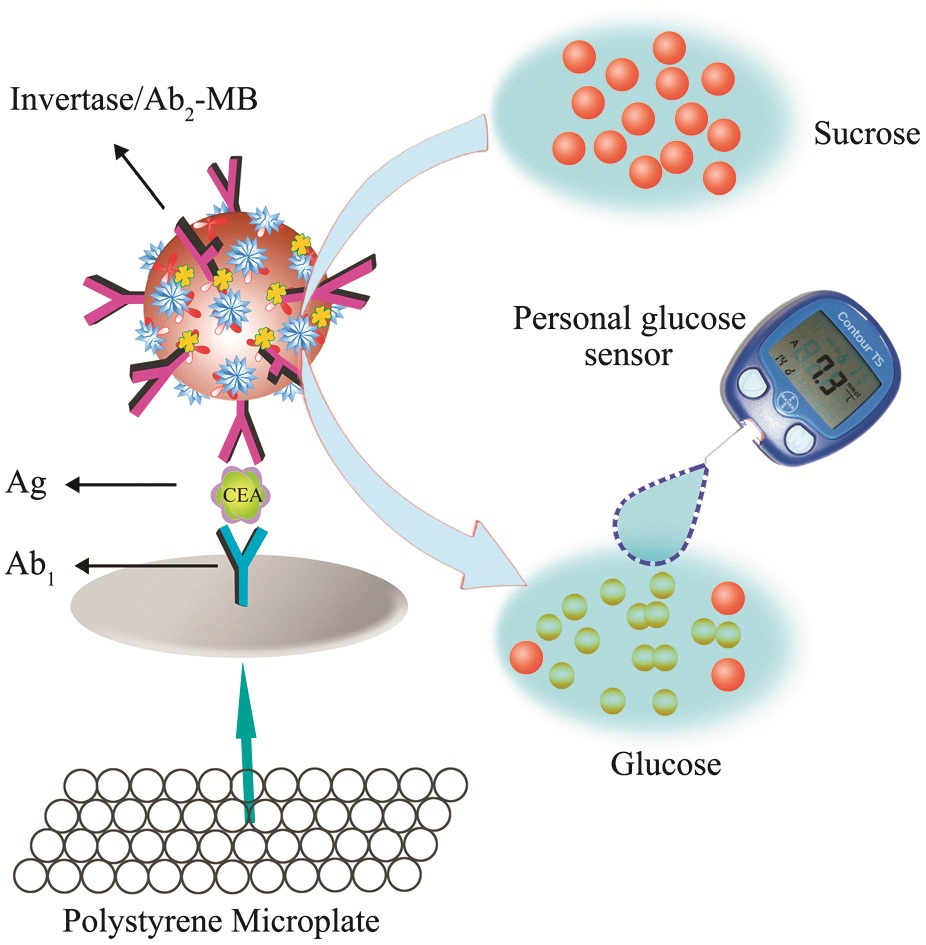
Personal glucose sensors (PGS) can be used to detect cancer, say Chinese scientists.

The team loaded magnetic beads with invertase (an enzyme that catalyses the hydrolysis of sucrose to glucose) and an antibody. The beads acted as a label for a lung cancer biomarker that had been captured on an antibody-coated ELISA plate. By monitoring the production of glucose from sucrose with a PGS, they could indirectly measure the amount of the biomarker down to the sub-nanogram per millilitre level.

Graphical Abstract


Link to journal article
Personal glucose sensor for point-of-care early cancer diagnosis
Jiao Su, Jin Xu, Ying Chen, Yun Xiang, Ruo Yuan and Yaqin Cha
Chem. Commun., 2012, Accepted Manuscript, DOI: 10.1039/C2CC32729E

Digg This
Reddit This
Stumble Now!
Share on Facebook
Bookmark this on Delicious
Share on LinkedIn
Bookmark this on Technorati
Post on Twitter
Google Buzz (aka. Google Reader)

Electronic skin for health and security checks

Electrochemical Sensor Tattoo

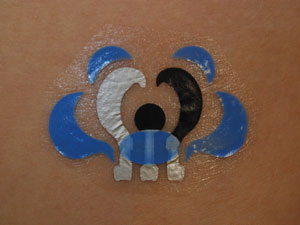
The tattoo incorporates a sensor that could be used to detect environmental hazards

Scientists in the US have developed an electrochemical sensor incorporated into a temporary transfer tattoo (T3) to be used as a device to warn the wearer of any health or security threats. Not only is the sensor non-invasive, it can also be concealed in an inconspicuous tattoo design, without compromising its resolution or performance.

Joseph Wang and his colleagues from the University of California, San Diego, have combined their expertise in printing flexible chemical sensors with commercially-available temporary tattoo paper. Integrating the electrochemical sensor within T3 maximises its contact with skin, including all epidermal irregularities, thanks to the elasticity of the T3 material. In addition to this, the team dispersed carbon fibre (CF) segments into the tattoo ink, providing an interlinked conductive backbone that enhances the sensor’s electrochemical behaviour. The CF constituents also help to counteract cracking and provide the mechanical reinforcement needed to protect the sensor against routine wear-and-tear while on the skin. The team also showed that the T3 sensor (on pig skin) could be used for detecting explosives like 2,4,6-trinitrotoluene (TNT), in connection with square wave voltammetry.

Read the full article in Chemistry World

Link to journal article
Electrochemical Sensing Based on Printable Temporary Transfer Tattoos
Joseph Wang
Chem. Commun., 2012, Accepted Manuscript, DOI: 10.1039/C2CC32839A, Communication

Digg This
Reddit This
Stumble Now!
Share on Facebook
Bookmark this on Delicious
Share on LinkedIn
Bookmark this on Technorati
Post on Twitter
Google Buzz (aka. Google Reader)

Exhaust emissions caught in a trap

The trap captures and retains light hydrocarbons for longer than current traps

The trap captures and retains light hydrocarbons for longer than current traps

A trap that adsorbs exhaust emission gases given off during the first two minutes after firing up an internal combustion engine has been developed by scientists in Spain. It’s during this cold start period that 50–80% of the total hydrocarbon emissions are produced, they say, so the trap could minimise levels of harmful exhaust gases pumped into the atmosphere.

Current traps are made from porous zeolites. They work well for the heavy hydrocarbons in fuel, which are retained until the engine’s temperature reaches 200–300oC (the light-off temperature), at which point, they are released and oxidised to carbon dioxide and water in a catalytic converter before being expelled into the atmosphere. But lighter hydrocarbons, such as ethane and propene, desorb from the trap before this temperature is reached and escape, unoxidised.

Read the full article in Chemistry World

Link to journal article
Molecular simulation design of a multisite solid for the abatement of cold start emissions
B. Puértolas, M. Navlani-García, J. M. López, T. García, R. Murillo, A. M. Mastral, M. V. Navarro, D. Lozano-Castelló, A. Bueno-López and D. Cazorla-Amorós
Chem. Commun., 2012, Advance Article, DOI: 10.1039/C2CC30688C, Communication

Digg This
Reddit This
Stumble Now!
Share on Facebook
Bookmark this on Delicious
Share on LinkedIn
Bookmark this on Technorati
Post on Twitter
Google Buzz (aka. Google Reader)

Easy synthesis of nanocups and nanopatches

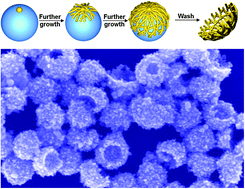
Graphical abstract: Facile synthesis of functional Au nanopatches and nanocupsA gold nanocup – it sounds like something a posh fairy might drink out of. But actually, metal nanocups are promising particles for sensing and nanoelectronics thanks to their plasmon coupling and light scattering properties. Until now, they have been difficult to make but Jinlong Gong at Tianjin University, China, Zhihong Nie, at the University of Maryland, USA, and colleagues have developed a new easy route suitable for large scale synthesis.

The team used a template-free, liquid-liquid interfacial reaction to build up the gold cups round polymer particles. These so called ‘patchy particles’ are themselves attractive as building blocks for nanostructures due to the directional interactions between the metal patches. Removing the polymers using organic solvent revealed the nanocups with diameters as small as 76 nm. The team demonstrated that the cups can enhance surface enhanced Raman scattering intensity up to the order of 108.

Find out more – download Gong’s ChemComm communication

Want to learn more about surface enhanced Raman spectroscopy? Check out the ChemComm web theme >

Digg This
Reddit This
Stumble Now!
Share on Facebook
Bookmark this on Delicious
Share on LinkedIn
Bookmark this on Technorati
Post on Twitter
Google Buzz (aka. Google Reader)