Mimicking transmembrane proteins

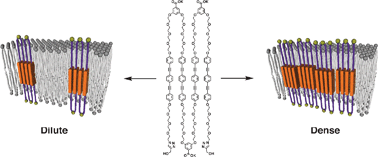
Japanese scientists have made a simple structural mimic of multipass transmembrane (MTM) proteins, one of the most common types of membrane protein.

Kazushi Kinbara, at Tohoku University, and colleagues made alternating amphiphilic multiblock molecules consisting of linearly connected hydrophilic and hydrophobic moieties. They found that the hydrophobic units stacked face-to-face  to give folded structures, like those of MTM proteins.

Graphical abstract: Mimicking multipass transmembrane proteins: synthesis, assembly and folding of alternating amphiphilic multiblock molecules in liposomal membranes

Find out more in their ChemComm communication, free to download until 25th October. And why not mimic the authors and submit your best research to ChemComm?

Digg This
Reddit This
Stumble Now!
Share on Facebook
Bookmark this on Delicious
Share on LinkedIn
Bookmark this on Technorati
Post on Twitter
Google Buzz (aka. Google Reader)

Surface plasmon resonance measures biomolecular interactions

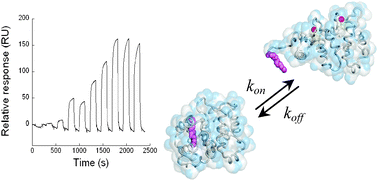
Calcium plays a central role in many signalling pathways, including neuronal and sensory function. Now scientists in Germany have shown that surface plasmon resonance can be used to monitor Ca2+-induced conformational changes in a Ca2+-sensor protein immobilised on a chip.

Graphical abstract: Quantitative detection of conformational transitions in a calcium sensor protein by surface plasmon resonance

Daniele Dell’Orco and colleagues at the University of Oldenburg, Germany describe their study in a recently published ChemComm communication. Download the article for free until 25th October.

You can submit your own high impact research to ChemComm using our online submission system.

Digg This
Reddit This
Stumble Now!
Share on Facebook
Bookmark this on Delicious
Share on LinkedIn
Bookmark this on Technorati
Post on Twitter
Google Buzz (aka. Google Reader)

Graphene oxide nanosheets reveal their colourful side

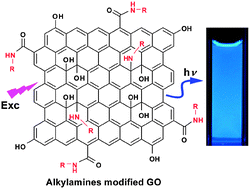
Chinese scientists have transformed graphene oxide (GO) nanosheets into efficient fluorescent emitters by functionalising their surfaces with alkylamines. The fluorescence quantum yields of the bright blue fluorescent GOs are enhanced up to 600 times compared with the original GO.

Graphical abstract: Highly efficient photoluminescent graphene oxide with tunable surface properties

Read more about Zhongping Zhang and colleague’s findings in their ChemComm communication, which is free to access until 25th October. And if you think your research presents some bright ideas, submit it to ChemComm today.

Digg This
Reddit This
Stumble Now!
Share on Facebook
Bookmark this on Delicious
Share on LinkedIn
Bookmark this on Technorati
Post on Twitter
Google Buzz (aka. Google Reader)

Battle of bond formations

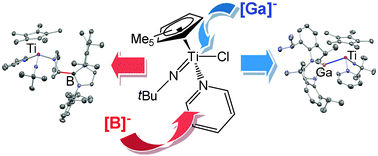
Anionic boron- and gallium-containing N-heterocyclic carbene (NHC) analogues display contrasting reactivity towards the half-sandwich titanium complex. Where one reacts to form the first example of a titanium gallyl compound, the other reaction (with boron NHC) generates a dearomatised pyridyl fragment.

Cameron Jones and his team from Monash University have collaborated once again with Simon Aldridge, Philip Mountford and colleagues at Oxford University, publishing their results in ChemComm. Why not download the article today and blog some comments below? The article is free to access until the 8th October 2010.


Digg This
Reddit This
Stumble Now!
Share on Facebook
Bookmark this on Delicious
Share on LinkedIn
Bookmark this on Technorati
Post on Twitter
Google Buzz (aka. Google Reader)

Printing microelectrodes

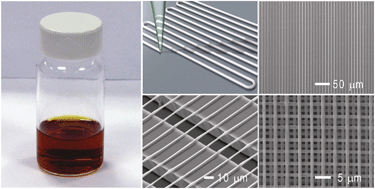
Tin-doped Indium oxide, a widely used conductor in optoelectronic devices, has been used to form microelectrodes that can be patterned in both 1D and 3D arrays, by direct-write assembly of sol–gel inks with varying concentration.

Jennifer A. Lewis and co-workers at the University of Illinois at Urbana-Champaign, in the US, have published their results in ChemComm and they believe the approach may open up new avenues for fabricating printed electronic and optoelectronic devices in unusual layouts.

Fancy reading more? Then why not download the article today and blog some comments below? This article is free to access until the 8th October.


Digg This
Reddit This
Stumble Now!
Share on Facebook
Bookmark this on Delicious
Share on LinkedIn
Bookmark this on Technorati
Post on Twitter
Google Buzz (aka. Google Reader)

Cold-welding for gold


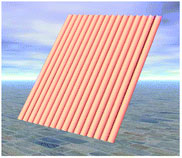
Large-scale fabrication of highly ordered gold nanochannel monolayers has been demonstrated by scientists in Japan. Yingpu Bi and Jinhua Ye fron the National Institute for Materials Science, in Tsukuba, have used the galvanic replacement reaction over aligned silver nanowire arrays, which can be employed as a simple and powerful cold-welding technique to make these gold nanochannels.

Why not read the article today and blog your thoughts below? Published in ChemComm, this communication is free to access until the 8th October.

Digg This
Reddit This
Stumble Now!
Share on Facebook
Bookmark this on Delicious
Share on LinkedIn
Bookmark this on Technorati
Post on Twitter
Google Buzz (aka. Google Reader)

Copper uncovers truth behind cytotoxicity

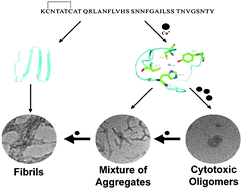
Many human disorders are characterized by amyloid accumulation, in particular Alzheimer’s disease, type 2 diabetes mellitus and Parkinson’s disease. Research shows that copper enhances amyloid activity and mediates human islet amyloid polypeptide (hIAPP) oligomerization.


Yan-Mei Li and co-workers at the Tsinghua University, in China, have used copper (and nickel) to mimic these effects and it has helped shed some light on why we observe cytotoxicity for type 2 diabetes.


Curious to know more, why not download the article today and blog some comments below? Published in ChemComm, this article is free to access until the 8th October.

Digg This
Reddit This
Stumble Now!
Share on Facebook
Bookmark this on Delicious
Share on LinkedIn
Bookmark this on Technorati
Post on Twitter
Google Buzz (aka. Google Reader)

Tinker, tailor, nanoparticle maker

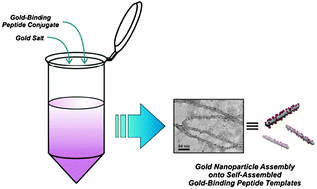
Scientists in the US have described a new way of preparing gold nanoparticle superstructures with tailorable thicknesses, formed using a self-assembled gold-binding peptide conjugate template. Nathaniel Rosi and colleagues at the University of Pittsburgh, examined how the synthesis and assembly mechanism impacts the organization of the superstructures.

The article is free to access until the 8th of October, so why not download the article today and blog your thoughts and comments below?

Digg This
Reddit This
Stumble Now!
Share on Facebook
Bookmark this on Delicious
Share on LinkedIn
Bookmark this on Technorati
Post on Twitter
Google Buzz (aka. Google Reader)

Step up for green iron production

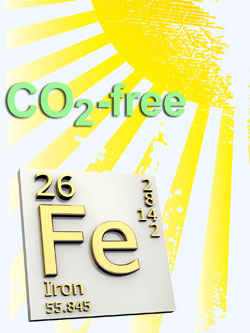
A more environmentally friendly way of producing iron developed by scientists in the US and China could reduce industrial carbon dioxide emissions by a quarter worldwide.

Since the beginning of the industrial revolution, iron metal has been produced by melting iron ore at temperatures over 2000°C in a blast furnace. This produces large amounts of CO2, which is released into the atmosphere and contributes to climate change.

The new method developed by Stuart Licht at George Washington University in Washington, DC and Baohui Wang at Northeast Petroleum University in Daqing could result in completely CO2-free iron production. The team show that iron ores (Fe2O3 and Fe3O4) can be dissolved in molten lithium carbonate  at temperatures of around 800°C – a process that was previously thought impossible. Adding an electrical current to the molten mix separates the iron ore into its component parts, iron and oxygen, which can be collected by two electrodes in the solution.
Green iron production
Global carbon dioxide emissions could be cut by a quarter

Less energy is required to generate the lower temperatures and power the electrolysis, but Licht also demonstrates that these can be achieved using renewable energy. The team employ their recently developed solar technique, called solar thermal electrochemical photo (Step) – which uses the Sun’s thermal energy to melt the lithium carbonate solution while the visible light energy powers the electrolysis. Using the Step process no CO2 is produced.

‘Step production of iron would be cost effective, and could allow iron production facilities to be housed in new geographic locations, such as in closer to urban centres or in high sunlight geographies,’ says Licht, as well as eliminating one of the major contributors to global carbon dioxide emission.

Neal Woodbury, a renewable energy expert at Arizona State University, US, comments ‘if the Step process can be performed at industrial scale, it holds considerable promise. Of particular note is that it should be possible to utilise waste heat from the processes that produce the required electricity, thus decreasing the energy input as well.’

Licht has previously shown that the Step technology can be used for carbon capture and for generating hydrogen fuel. And says he sees the scale-up of CO2-free iron production from the laborartory to industry as an exciting challenge.

Emma Shiells

Read the whole story in the ChemComm article.

Digg This
Reddit This
Stumble Now!
Share on Facebook
Bookmark this on Delicious
Share on LinkedIn
Bookmark this on Technorati
Post on Twitter
Google Buzz (aka. Google Reader)

Unilever-RSC International Symposium in China announced

One country, three cities, three meetings – The Royal Society of Chemistry (RSC) and Unilever are coming to China.

This Symposium will feature three one day meetings that will take place at three different locations throughout China. Each one day meeting will feature a selection of lectures covering the properties and applications of many different materials given by some of the world’s leading international scientists. The symposium is supported by Unilever and has been organised by them, the RSC, as well as the three host universities.

The three symposia will take place at the following:-

*  Monday 8th November – Symposium at University of Chemical Technology (BUCT), Beijing, hosted by  Professor Wantai Yang 
* Wednesday 10th November – Symposium at Zhejiang University, Hangzhou, hosted by Professor Bogeng Li 
* Thursday 11th November – Symposium at East China University of Science and Technology (ECUST),  Shanghai, hosted by Professor He Tian 


Attendance at any of the three one day meetings is free although delegates are asked to register; The symposium will appeal to academic and industrial scientists with an interest in functional materials science. Student participation is also strongly encouraged and each symposium will offer students the opportunity to present their work during a poster session.

For more information on this symposium, or to see the list of speakers or to register your attendance please visit the website for more details.

Digg This
Reddit This
Stumble Now!
Share on Facebook
Bookmark this on Delicious
Share on LinkedIn
Bookmark this on Technorati
Post on Twitter
Google Buzz (aka. Google Reader)