ChemComm symposia

Korea in a nut shell – not forgetting the super girl power!

We left the rain of Osaka and just one hour later arrived bathed in Korean sunshine at the impressive Incheon Airport. We followed a relaxed dinner in the hotel with a walk around Seoul’s lively streets. It seems the city does not sleep – it was Wednesday evening but it seemed like a Friday or Saturday. Apparently it’s the same every night! The day finished with discussions over red wine about who would win the 2010 Nobel prize in chemistry, but not before some confusion over price and the corking of a bottle…..

Professor Nam opened day one of the ChemComm symposium at Ewha Womans University and I was invited to say a few words. Short and sweet with many thanks!

After finishing proceedings in Japan, Professor Harry Gray opened the show in Korea. He spoke about his very early work in the 1960’s on the metal-oxo wall, before moving on to his current focus: building an artificial leaf without wires aided by a solar army of high school kids (see the interesting critical review by Woodhouse and Parkinson from the Chem Soc Rev Renewable Energy themed issue and the EES Opinion article by Parkinson). Professor Fukuzumi followed but he didn’t need a microphone – his voice boomed!  

At lunch I took a stroll around campus. The building where the symposium was being held was truly spectacular but I passed very few men on campus. Now I understand: Ehwa Womans University.

The night ended with a dinner reception for all speakers and a mixture of drinks, including a local favourite, the atomic bomb (soju and beer).

The second day continued in equally impressive style. High quality talks on water oxidation from Brudvig and Llobet were followed by the ChemComm speakers, Jonathan Sessler, Adrian Mulholland and Luet Wong. To finish the day, Jonathan Sessler became the ruthless session chair under strict instructions to finish by 6pm. Five presentations were given by young researchers and assistant professors. It was nice to see Youngmin You give an excellent talk on the sensing of biological zinc. The results had been published in ChemComm and highlighted in Nature Chemical Biology.

In closing the symposium, Professors Nam and Fukuzumi thanked the speakers but also the tremendous efforts of the local organisers, and in particular, girl power! A fabulous Korean banquet and performance showcasing Korean music and drums was the perfect way to finish the symposium…well almost. That honour was given to Adrian Mulholland, who in true British style could not resist the opportunity to join the performers on stage and bang the drum…

This was a tremendous serious of events, intense, with around 50 lectures in four days. The hospitality from both organisers was incredible and the selection and quality of the science was first rate. A big thank you also to Luet, Jonathan and Adrian for doing such a great job as the ChemComm speakers.

Next stop is Japan and China in May 2011 for the 5th ChemComm Symposia on organic chemistry and catalysis. Sign up for the ChemComm Chronicle and e-alert to receive more information as soon as it is available.

Digg This
Reddit This
Stumble Now!
Share on Facebook
Bookmark this on Delicious
Share on LinkedIn
Bookmark this on Technorati
Post on Twitter
Google Buzz (aka. Google Reader)

Greener oxidations with iodine organocatalyst

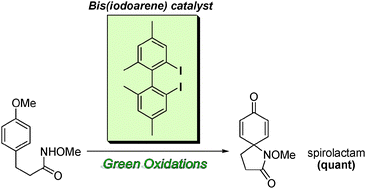
A new type hypervalent iodine reagent could enable more efficient and green catalytic oxidations, report Japanese chemists.

Hypervalent iodine reagents have emerged as promising organo-oxidants, replacing classical heavy metal oxidants such as lead and mercury. m-Chloroperbenzoic acid is commonly used as a stoichiometric reoxidant to regenerate the reactive iodine species, but scientists would like to use other, more environmentally friendly oxidants, such as peracetic acid, instead. Until now, however, no efficient iodine catalyst that works well with peracetic acid has been found.

Yasuyuki Kita, at Ritsumeikan University, Kusatsu, and colleagues discovered that their µ-oxo-bridged hypervalent iodine(III) compounds, in the presence of peracetic acid, could catalyse spirolactam formation. They also believe the compounds can catalyse other types of oxidation, such as phenolic oxidation, and, because they have a chiral structure, could have potential in asymmetric oxidative transformations.

Graphical abstract: Designer μ-oxo-bridged hypervalent iodine(iii) organocatalysts for greener oxidations

Download the communication for free until 5th November 2011. And if you have some exciting research of your own to report, submit your manuscript to ChemComm today.

Digg This
Reddit This
Stumble Now!
Share on Facebook
Bookmark this on Delicious
Share on LinkedIn
Bookmark this on Technorati
Post on Twitter
Google Buzz (aka. Google Reader)

The power of depletion attraction

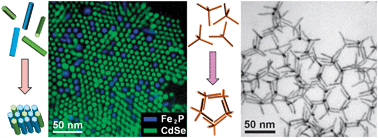
Depletion attraction forces can be used to assemble nanorod superlattices and branched nanocrystal networks, say Italian chemists. The nanostructures could be used in a variety of applications, including photovoltaics, they claim.

Liberato Manna and colleagues at the Italian Institute of Technology, Genova, discovered that in the presence of molecules such as oleic acid, nanorods assemble into superlattices. They also found that tetrapod-shaped nanocrystals form networks under similar conditions.

Graphical abstract: Assembly of shape-controlled nanocrystals by depletion attraction

Want to find out how this works? Read the ChemComm article, which is free to access until 5th November, and add your comments on the work below.

Digg This
Reddit This
Stumble Now!
Share on Facebook
Bookmark this on Delicious
Share on LinkedIn
Bookmark this on Technorati
Post on Twitter
Google Buzz (aka. Google Reader)

Is titanium the new platinum?

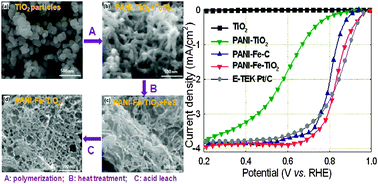
A new titanium dioxide-supported polyaniline iron catalyst exhibits improved catalytic activity for oxygen reduction when compared to traditional carbon-supported materials. With prohibitive costs of current platinum-based catalysts used in polymer electrolyte fuel cells this new catalyst material might be the cheaper alternative.


Piotr Zelenay, Gang Wu and co-workers at Los Alamos National Laboratory and a collaborator from the University of South Carolina, published their findings in ChemComm.

Interested to read more, then why not download the article today, which is free to access until the 5th of November and leave some blog comments below.


 Having trouble accessing the free content in ChemComm? Register for an RSC Publishing personal account today.

Digg This
Reddit This
Stumble Now!
Share on Facebook
Bookmark this on Delicious
Share on LinkedIn
Bookmark this on Technorati
Post on Twitter
Google Buzz (aka. Google Reader)

Functionalizing MOFs

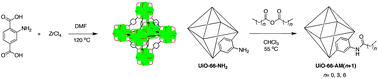
Amino, bromo, nitro, and naphthalene functionalized UiO-66 metal–organic frameworks have been synthesised using reticular chemistry.

Researchers Seth Cohen and Sergio Garibay from the University of California, in the US, have reported their findings in ChemComm. Fancy reading more? Then why not download the article today which is free to access until the 5th November and blog some comments below.

Having trouble accessing the free content in ChemComm? Register for an RSC Publishing personal account today.

Digg This
Reddit This
Stumble Now!
Share on Facebook
Bookmark this on Delicious
Share on LinkedIn
Bookmark this on Technorati
Post on Twitter
Google Buzz (aka. Google Reader)

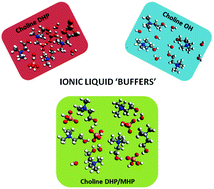
Ionic liquid buffers

Hydrated ionic liquids can be used as buffers, according to scientists have shown that it is possible to control proton activity, or pH, in concentrated ionic media. These ionic liquid buffers can help to establish and maintain pH in a variety of ionic liquid applications where solutes or processes are highly sensitive to proton activity in the medium.

Douglas MacFarlane and colleagues from Monash University, in Australia and co-workers based at the University of North Carolina at Charlotte, in the US, have reported their findings in ChemComm.

Why not download the article and blog your feedback below? The article will be free to access until the 5th November.

Having trouble accessing free content in ChemComm? Register for an RSC Publishing personal account today.

Digg This
Reddit This
Stumble Now!
Share on Facebook
Bookmark this on Delicious
Share on LinkedIn
Bookmark this on Technorati
Post on Twitter
Google Buzz (aka. Google Reader)

ChemComm Symposia – day 2

Lasers, lions and lots of chemistry at the 4th ChemComm International Symposium

As day 2 dawned, many of the international speakers were sleep-deprived due to jet lag and the fantastic Japanese hospitality. To ensure everyone remained focused it was essential that the science was of the highest order. Delegates were not disappointed!

Toni Llobet gave an impressive presentation on ruthenium-based water oxidation catalysts. These have been attached to surfaces so they can be incorporated into devices. Toni briefly spoke about his newest system, giving the analogy of a caged lion. This certainly got the attention of the audience. The new system has been designed only to allow water oxidation and not organics due to size constraints. Furthermore, as the ruthenium molecules are anchored to a surface, they can not attack and destroy each other.

Following another hefty lunch, it was the turn of the ChemComm speakers. Associate Editor Jonathan Sessler was first up, talking about results he recently published in Science. Following Jonathan, both ChemComm speakers (Luet Wong and Adrian Mulholland) gave outstanding talks to around 150 delegates. In the latter, Adrian highlighted that quantum mechanics/molecular mechanics (QM/MM) ‘would not save the world’ but certainly has a place in understanding reactivity, as currently the methods give good alignment with experimental data.

To finish the day, Harry Gray received the 60th Japanese Coordination Chemistry Award and spoke on the topic of electron transfer in bioinorganic chemistry. It was a beautiful talk, in Harry’s own unique style, covering 50 years of research. There were a few malfunctions with laser pointers but Felix Castellano stepped in to assist. His blue laser pointer was particularly impressive, very cool and expensive at $300.

The highlight of the day was the symposium banquet. There was plenty of great food and drink, with Harry Gray lead the celebratory opening of the saki barrel. I also enjoyed the traditional Chinese music entertainment. Thanks to the efforts of Shinobu Itoh (Dalton Transactions Regional Associate Editor for Japan) and Susumu Kitagawa (CrystEngComm Editorial Board member), RSC journals other than ChemComm were also well promoted.

The end of the banquet also marked the end to the first part of the ChemComm Symposium. Next stop Ehwa Womens University in Seoul, Korea.

Digg This
Reddit This
Stumble Now!
Share on Facebook
Bookmark this on Delicious
Share on LinkedIn
Bookmark this on Technorati
Post on Twitter
Google Buzz (aka. Google Reader)

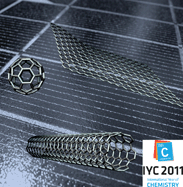
Carbon nanostructures for solar energy conversion schemes

IYC 2011Developing environmentally friendly, renewable energy is one of the challenges to society in the 21st century. One of the renewable energy technologies is solar energy conversion — a technology that directly converts daylight into electricity. 

In their ChemComm Highlight in Chemistry, Dirk Guldi and Vito Sgobba survey recent breakthroughs in implementing carbon nanostructures — fullerenes, carbon nanotubes, carbon nanohorns and graphene — into solar energy conversion schemes, that is, bulk heterojunction and dye-sensitised solar cells. Read the article today and let us know what you think by leaving a comment.

Carbon nanostructures

2011 is the International Year of Chemistry (IYC 2011), a worldwide celebration of the achievements of chemistry and its contributions to the well-being of humankind. ChemComm is marking IYC 2011 by publishing a series of ‘Highlights in Chemistry’. For more information visit the the ChemComm and IYC 2011 website.

Digg This
Reddit This
Stumble Now!
Share on Facebook
Bookmark this on Delicious
Share on LinkedIn
Bookmark this on Technorati
Post on Twitter
Google Buzz (aka. Google Reader)

ChemComm Symposium – Day 1

Day one of the ChemComm symposium was packed with 12 talks and a two hour poster session. A good hearty breakfast was essential to ensure energy levels remained high. At breakfast I was joined by Luet Wong, ChemComm Associate Editor Jonathan Sessler and the co-organiser of the event, Wonwoo Nam. Jonathan managed to work the conversation round to the topic of beer and its importance in collaborative research – a theme that would reappear later in the day! I also received an invitation to say a few words, as Editor, at the Korean ChemComm symposium. I accepted with pleasure, although I am sure I will be be less enthusiastic on Thursday with the onset of nerves.      

Following opening remarks from organiser Professor Shunichi Fukuzumi, Gary Brudvig (Yale) discussed model systems for water splitting based on photosystems 2 (it would be highlighted later that these systems currently rank as some of the best examples in the literature). My favourite talk of the day was given by Craig Hill (Emory). Craig discussed his cobalt polyoxometalates and highlighted that these are the most effective water splitting catalysts around to date, also benefitting from the fact that they are homogenous and simple to produce. He also alluded to new cobalt catalysts that have been produced in his lab, yet to be published, that are producing even more spectacular results.

Jonathan Sessler

Is that water or sake Jonathan's about to drink?

After such a great day of science there was only one way to finish: a speakers dinner consisting of 12 courses lubricated with fine Japanese beer and sake. En route to the dinner I shared the lift with 15+ Japanese ladies who appeared to be at a convention in the hotel. A surreal experience where I felt like a giant!

At dinner, Jonathan Sessler continued to highlight the importance of alcohol in research. I am sure this will not be the last time we hear this…. It should be added that such a philosophy has been wonderfully supported by our hosts already. The dinner ended with a group photo and three cheers for Wonwoo Nam and Shunichi Fukuzumi led by Harry Gray. A fine end to an excellent first day.

Digg This
Reddit This
Stumble Now!
Share on Facebook
Bookmark this on Delicious
Share on LinkedIn
Bookmark this on Technorati
Post on Twitter
Google Buzz (aka. Google Reader)

Top ten most accessed articles in August

This month sees the following articles in ChemComm that are in the top ten most accessed:-

Potassium carbonate-silica: a highly effective stationary phase for the chromatographic removal of organotin impurities 
David C. Harrowven, Dennis P. Curran, Sarah L. Kostiuk, Ian L. Wallis-Guy, Sally Whiting, Kerri J. Stenning, Bencan Tang, Emma Packard and Lana Nanson 
Chem. Commun., 2010, 46, 6335 – 6337, DOI: 10.1039/c0cc01328e

Hybrid nanomaterials for biomedical applications 
Kathryn M. L. Taylor-Pashow, Joseph Della Rocca, Rachel C. Huxford and Wenbin Lin 
Chem. Commun., 2010, 46, 5832 – 5849, DOI: 10.1039/c002073g, Feature Article 

A highly sensitive, selective, colorimetric and near-infrared fluorescent turn-on chemosensor for Cu2+ based on BODIPY 
Shouchun Yin, Volker Leen, Sven Van Snick, Noël Boens and Wim Dehaen 
Chem. Commun., 2010, 46, 6329 – 6331, DOI: 10.1039/c0cc01772h 

Pd nanoparticles in silica hollow spheres with mesoporous walls: a nanoreactor with extremely high activity 
Zhe Chen, Zhi-Min Cui, Fang Niu, Lei Jiang and Wei-Guo Song 
Chem. Commun., 2010, 46, 6524 – 6526, DOI: 10.1039/c0cc01786h 

Immunosensor for the detection of cancer biomarker based on percolated graphene thin film 
Minghui Yang and Shaoqin Gong 
Chem. Commun., 2010, 46, 5796 – 5798, DOI: 10.1039/c0cc00675k 

High-yield exfoliation of three-dimensional graphite into two-dimensional graphene-like sheets 
Eun-Kyoung Choi, In-Yup Jeon, Seo-Yoon Bae, Hwa-Jung Lee, Hyeon Suk Shin, Liming Dai and Jong-Beom Baek 
Chem. Commun., 2010, 46, 6320 – 6322, DOI: 10.1039/c0cc00753f 

A photoelectrochemical device for visible light driven water splitting by a molecular ruthenium catalyst assembled on dye-sensitized nanostructured TiO2 
Lin Li, Lele Duan, Yunhua Xu, Mikhail Gorlov, Anders Hagfeldt and Licheng Sun 
Chem. Commun., 2010, DOI: 10.1039/c0cc01828g 

High quality graphene with large flakes exfoliated by oleyl amine 
Jian Zheng, Chong-an Di, Yunqi Liu, Hongtao Liu, Yunlong Guo, Chunyan Du, Ti Wu, Gui Yu and Daoben Zhu 
Chem. Commun., 2010, 46, 5728 – 5730, DOI: 10.1039/c0cc00954g 

Synthesis and characterization of gold-deposited red, green and blue fluorescent silica nanoparticles for biosensor application 
Kyoung G. Lee, Rinbok Wi, Tae Jung Park, Sun Hong Yoon, Jaebeom Lee, Seok Jae Lee and Do Hyun Kim 
Chem. Commun., 2010, 46, 6374 – 6376, DOI: 10.1039/c0cc00762e 

Monodispersed molecular donors for bulk hetero-junction solar cells: from molecular properties to device performances 
Silvia Colella, Marco Mazzeo, Roberto Grisorio, Eduardo Fabiano, Giovanna Melcarne, Sonia Carallo, M. Daniela Angione, Luisa Torsi, Gian Paolo Suranna, Fabio della Sala, Piero Mastrorilli and Giuseppe Gigli 
Chem. Commun., 2010, 46, 6273 – 6275, DOI: 10.1039/c0cc01229g 

Why not take a look at the articles today and blog your thoughts and comments below.

Fancy submitting an article to ChemComm? Then why not submit to us today or alternatively email us your suggestions.

Digg This
Reddit This
Stumble Now!
Share on Facebook
Bookmark this on Delicious
Share on LinkedIn
Bookmark this on Technorati
Post on Twitter
Google Buzz (aka. Google Reader)