Nominations for the 2011 Prizes and Awards are now open

The RSC currently presents around 60 prestigious Prizes and Awards annually to scientists in all the main chemical science disciplines allowing for the greatest range of scientists to be recognised for their work; individuals, teams and organisations working across the globe.

There are nine categories of awards including specific categories for Industry and Education so whether you work in business, industry, research or education recognition is open to everyone.

Our Prizes and Awards represent the dedication and outstanding achievements in the chemicals sciences and are a platform to showcase inspiring science to gain the recognition deserved.

Do you know someone who has made a significant contribution to advancing the chemical sciences?

View our full list of Prizes and Awards and use the online system to nominate yourself or colleagues.

Digg This
Reddit This
Stumble Now!
Share on Facebook
Bookmark this on Delicious
Share on LinkedIn
Bookmark this on Technorati
Post on Twitter
Google Buzz (aka. Google Reader)

Water splitting over nanowires

Nanowires that efficiently split water into oxygen and hydrogen could be an important step toward affordable chemical storage of solar power according to US scientists. 

Water and sunlight are highly abundant and nature uses these to make energy through photosynthesis. Despite intensive studies on artificial photolysis, making it as efficient as nature is proving difficult. Titanium dioxide electrodes are one way to split water under ultraviolet light but the efficiency is low as they are only able to absorb ultraviolet light and the amout of light converted to energy is low.

Now, Hongkun Park and colleagues, at Harvard University, have synthesised TiO2 nanowires with high surface areas, deposited them on an electrode and found that chemically crosslinking them increases their optical density – allowing more light to be absorbed. This allows the light to energy conversion to be doubled compared to previous TiO2 electrodes, says Park.

Sunlight and water can be used to create energy

Doping the nanowire network with gold or silver nanoparticles allows the water splitting reaction to take place under visible light, adds Park. This could lead to a ten fold improvement in the catalysts ability to split water, he says.

‘Our work shows that the performance of a material can be enhanced by putting it in a nanostructured network, and this design can potentially be extended to many other materials to achieve the goal of highly efficient solar water-splitting,’ says Park.

Steve Dunn, an expert in materials chemistry, at the Centre for Materials Research, Queen Mary University of London comments, ‘This work is very interesting with the most significant new finding being the morphological change from using more traditional titania powders to using nanorods. The advantages of using titania, over other more exotic systems, is that the chemistry is well known, it is highly photostable, it is cheap and is also non-toxic.’

The group now plan to study water photoelectrolysis with other metal oxides, such as iron oxide, that can absorb visible light and to study how their efficiency is enhanced in a similar nanowire networks.

Carl Saxton

Want to find out more? Read the Chemical Science Edge article.


Digg This
Reddit This
Stumble Now!
Share on Facebook
Bookmark this on Delicious
Share on LinkedIn
Bookmark this on Technorati
Post on Twitter
Google Buzz (aka. Google Reader)

Speakers announced for ISACS 2011

International Symposia on Advancing the Chemical Sciences (ISACS)

Visit the ISACS website to find out who will be speaking at ISACS 4-6 in Boston, Manchester and Beijing.

New for 2011: We have a limited number of oral presentation slots available at ISACS 4-6. If you are interested in presenting your work at the meeting, submit your abstract for consideration by the conference committee via the website.

ISACS4: Challenges in Renewable Energy
ISACS5: Challenges in Chemical Biology
ISACS5: Challenges in Organic Materials & Supramolecular Chemistry

Digg This
Reddit This
Stumble Now!
Share on Facebook
Bookmark this on Delicious
Share on LinkedIn
Bookmark this on Technorati
Post on Twitter
Google Buzz (aka. Google Reader)

Perspective: A powerful method for C–X bond formation

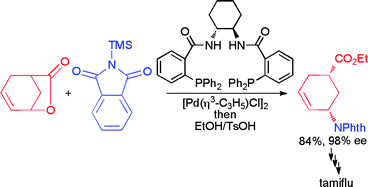
Metal catalysed asymmetric allylic alkylation (AAA) reactions have been an extensively studied and fruitful area of research in organic chemistry. The use of heteroatom-centered nucleophiles in this reaction is a powerful method for asymmetric C–X (X = heteroatom) bond formation.

In issue 4’s Perspective, Barry Trost and colleagues summarise developments and applications of metal catalysed AAA reactions employing heteroatom nucleophiles.

Graphical abstract: Catalytic asymmetric allylic alkylation employing heteroatom nucleophiles: a powerful method for C–X bond formation

To keep up-to-date with the latest articles from Chemical Science, sign up for the Chemical Science e-alert. For details about submitting your own high quality articles, please visit the website or contact the Editorial Office.

Digg This
Reddit This
Stumble Now!
Share on Facebook
Bookmark this on Delicious
Share on LinkedIn
Bookmark this on Technorati
Post on Twitter
Google Buzz (aka. Google Reader)

Mini review: Biocompatibility and drug delivery systems

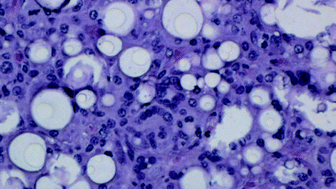
Drug delivery technology has emerged as an important focus of biotechnological research and commercial enterprise. While much attention is focused on the design and effectiveness of drug delivery devices, the nature of their interaction with surrounding tissues – their biocompatibility – is crucial.

Graphical abstract: Biocompatibility and drug delivery systems

In the latest Chemical Science Mini review Daniel Kohane and Robert Langer discuss biocompatibility, specifically as it relates to drug delivery systems, which differ from other biomaterial-based devices by possibly containing large quantities of drugs with their own effects on tissues. Let us know your thought on this topic by commenting below.

If you are interested in writing a review for Chemical Science, please contact the Editorial Office.

Digg This
Reddit This
Stumble Now!
Share on Facebook
Bookmark this on Delicious
Share on LinkedIn
Bookmark this on Technorati
Post on Twitter
Google Buzz (aka. Google Reader)

Rapid cell extraction using droplets

An aqueous two-phase microdroplet system that isolates and extracts cells could aid research into tissue engineering and regenerative medicine, say UK scientists.

Droplet-based microfluidic systems, using a fluorescence-based detection method have been used to locate, identify and discriminate cells within a specific droplets and more recently two-phase systems have been investigated for their ability to separate different biological materials. Target cells distribute between phases by their own thermal motion to reach equilibrium but so far this has proved a slow process.

Now, Andrew deMello and his team at Imperial College London have devised a novel method to separate cells using microfluidic droplets. The process could enable high throughput cell separation which would be ideal for clinical applications such as cell therapy and regeneration.


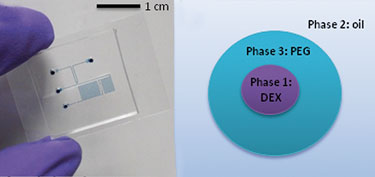
A PEG microdroplet completely encases the DEX droplet 

In deMello’s device, human T lymphoma cells enter the microdroplet system within a dextran solution. At a T-junction in the device, the dextran meets a polyethylene glycol (Peg) inlet where a droplet of Peg completely encapsulates a dextran droplet. These droplets then follow a winding channel in the device that causes both phases to mix – forming an emulsion and allowing the cells to experience the environment of both phases. When the two phases separate back into a double droplet, the cells remain in the outer Peg phase.

Binding the cells with an antibody-N-isopropylacrylamide (Ab-NIPAM) is crucial to the separations explains deMello as this makes them favour the Peg phase. Without the Ab-NIPAM, 98 per cent of the cells remain located within the dextran. But once bound this reverses to 93 per cent moving to the outer Peg droplet.

Shashi Murthy, an expert in microfluidic devices design at Northeastern University in Boston, comments that conventional approaches ‘are quite effective, but there’s a lot of interest in trying to make them more simple and as microfluidic systems are being proposed as disposable and cheap alternatives to more expensive instrumentation, this is of significant interest.’

The team believe that the technique will be able to separate heterogeneous cell populations in a high-throughput manner. Also, the use of Ab-NIPAM conjugates can be applied to a wide range of other cell systems simply by changing the antibody.

Rapid cell extraction in aqueous two-phase microdroplet systems
Kalpana Vijayakumar, Shelly Gulati, Andrew J. deMello and Joshua B. Edel, Chem. Sci., 2010
DOI: 10.1039/c0sc00229a

Digg This
Reddit This
Stumble Now!
Share on Facebook
Bookmark this on Delicious
Share on LinkedIn
Bookmark this on Technorati
Post on Twitter
Google Buzz (aka. Google Reader)

Reflecting on ACS Boston

My last few days in Boston were very busy, hence the lack of blogging. But I’m now home, well rested and have had a chance to reflect on my first ACS meeting.

A particular highlight on Tuesday was the Young Academic Investigators’ session. There were around 63 nominations for the 16 places in this session and so I was expecting the best of the best and was not disappointed. Speakers included Tobias Ritter (Harvard), who discussed the challenges involved in developing late-stage fluorination chemistry of complex molecules for use as positron-emission tomography tracers. Representing UK organic chemistry was Rebecca Goss (East Anglia), who likened natural product synthesis to extreme sports, such as mountain climbing, as it requires the development of new tools and can often be gruelling.

On Wednesday, I switched from extreme sports to everyday household items as I listened to George Whitesides’  (Harvard) talk on simple technologies for analysis. I am quite familiar with his work from my time as editor of Highlights in Chemical Technology and it was great to hear him discuss in person his paper- and egg beater-based techniques.

A lot more complex but no less interesting was Alice Ting’s (MIT) Lilly Award presentation on how fluorescent reporters can be used to image molecular events, such as protein-protein interactions, in live cells. And from imaging cells to programming them, my day concluded with a POLY/PMSE plenary lecture from David Mooney (Harvard). His group is working on regenerative medicine and tissue engineering and uses materials either to carry cells or attract host cell populations in vivo. The materials then program the cells and disperse them and the cells go on to form new tissues as required. One example he highlighted in an amazing movie was how he could regenerate the blood vessels and save the limbs of mice with restricted blood flow.

Boston harbour

On Thursday I caught the train over to Brandeis University and spent a very productive day meeting the faculty and learning about their work and their thoughts on publishing. And just to tease me and tempt me back to Boston, the weather cleared. As I made my way on the water taxi over to the airport, the sun sparkling on the buildings, I almost forgot the damp chill of the previous five days. And then it was back to a cold rainy Britain. Role on Anaheim….

Digg This
Reddit This
Stumble Now!
Share on Facebook
Bookmark this on Delicious
Share on LinkedIn
Bookmark this on Technorati
Post on Twitter
Google Buzz (aka. Google Reader)

Interview: Great expectations

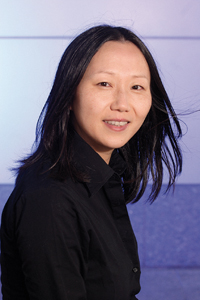
Zhenan Bao is tipped to be one of the great innovators of the 21st century. Joanne Thomson finds out what inspires her to succeed.

Zhenan BaoZhenan Bao is associate professor at Stanford University, US, where she uses chemical and chemical engineering approaches to make functional nano- and microstructures with novel electronic and photonic properties. Her work has gained her international recognition, including the RSC Beilby Medal and Prize in 2009. 


What inspired you to become a scientist?
I always had a very inquisitive nature and liked to ask ‘why?’ a lot. My parents were both scientists – one a chemist, one a physicist – and I was inspired by their careers. My father in particular instilled in me a curiosity for why things happened. He once bought me a popsicle ice lolly and asked if I thought it would sink or float in water. I said it would sink because it was solid so he threw it in the lake and said he would buy me another if we lost it. I was very surprised when it floated and, of course, wanted to learn why.

Your work focuses on organic electronics. Why did you decide to specialise in this area?
Around the time of my graduate studies at the University of Chicago, Francis Garnier reported the first printed transistor, which really inspired me. After my PhD, I joined Bell Labs (Lucent Technologies). They had already started some work in printed electronics and with my background in synthesis I thought I could immediately contribute. Following the tradition of Bell labs I was then given a lab and told to think about what I wanted to do. Organic electronics is an area with many useful applications and one where I felt I could make a real difference with my materials background.

Your work is multidisciplinary, combining chemistry, materials science, physics and various types of engineering. How do you coordinate such a diverse research group and stay on top of all the literature?
I find it very stimulating to have a group of students and post docs coming from very different backgrounds. My lab currently has nine chemists, ten chemical engineers, four electrical engineers, three physicists and several materials scientists. They all bring different expertise to the group. They learn from me and I learn from them – we are learning together. It is hard to keep on top of all the literature but if the students see some exciting work somewhere, they will let me and the whole group know so that helps a lot. I find the journal highlights very useful. They give me an idea of the current exciting work going on without having to read every issue of the journal.

What are you working on at the moment?
Lots of things! One of the areas I am most excited about is our electronic skin, where we are trying to mimic the chemical, biological and pressure sensing abilities of real skin. We also have really exciting results on transparent electrodes with carbon nanotubes, where we can achieve really good performance. We are establishing a start-up company from that work, which recently won the MIT Clean Energy Entrepreneurship prize and the Rice University business plan competition. I am very proud of the students who presented the work. In the solar cell area, we have developed new material design concepts which have started to show promising results.

How does a scientist without a business background go about setting up their own company?
I am still learning! There are other professors who have started companies so there is a lot of help and there are very helpful people who are willing to give advice. It is like doing research – when one gets stuck, one goes to the experts in the area.

Energy conversion and storage is one of the key challenges facing the modern world and something that the RSC is promoting as part of its Chemistry for Tomorrow’s World initiatives. What do you think are the main opportunities for chemists in this area?
A major part of energy research is about new materials for producing energy and also new and more energy efficient ways of making materials and chemicals. We must also take into consideration the environment – chemists can develop greener syntheses of materials and come up with materials that are more environmentally friendly. We can also develop sensors that can be used to monitor the environment. Chemistry is at the centre of all these very important global issues.

What is the best part of your job?
It is hard to rank the parts I enjoy the most. I love the interaction with students, meeting people from all over the world, being able to pursue an idea and see it become reality and also the freedom of being able to decide what to work on, who to work with. There are so many exciting possibilities and rewards for being a scientist.

You have been selected as both an outstanding young woman scientist who is expected to make a substantial impact in chemistry and one of the top 100 young innovators for this century. What is the secret to your success?
Being curious and asking lots of questions. Also being driven and willing to work hard. Being a scientist is a demanding job but there is no easy job in the world if one wants to be successful.

What is your advice to other young women thinking of embarking on a scientific career?
Women often underestimate their own ability but they must be confident and believe they can do it just as well as anybody else.

What do you do in your spare time?
I don’t have much spare time so any that I do have I spend with my two children. I try to inspire them to ask questions and think about everything they do and not take things for granted. I don’t know what they will choose to do in the future but I believe that if they develop good problem solving skills they will be successful.

If you weren’t a scientist, what would you be?
There is no other job I would like to do. Being a professor is simply the best job for me.

Digg This
Reddit This
Stumble Now!
Share on Facebook
Bookmark this on Delicious
Share on LinkedIn
Bookmark this on Technorati
Post on Twitter
Google Buzz (aka. Google Reader)

Battling against the elements at the ACS Boston

There are around 12000 people registered to attend the ACS meeting but it seems strangely quiet in the sessions. Maybe it’s the gale force winds and horizontal rain that are keeping people away but for me the draw of cutting edge chemistry is worth battling against the elements (and I don’t mean the chemical kind).
My lecture of the day came from Mo Movassaghi, who described his groups very elegant work on alkaloid synthesis. He has recently published an Edge article in Chemical Science and seemed delighted with the publication process at the RSC, so I look forward to receiving more top articles from him in the future.

Tonight I joined the Young Academic Investigators from the organic division for dinner. These ‘rising stars’ of organic chemistry were a very friendly and down to earth bunch and bearing in mind their session’s 8 am start tomorrow they sensibly headed off to bed at a very reasonable hour. Top tips from these leading minds:

1) Bad weather: you just need to wrap up and think of it as invigorating

2) Don’t trust a New Zealander’s sense of humour – you’ll never think of strawberries in the same way again…

Fancy reading Mo Movassaghi’s latest Edge Article on ‘Total synthesis of all (−)-agelastatin alkaloids’? Why not download it and read it here first – all Chemical Science articles are free to access until the end of 2011.

Digg This
Reddit This
Stumble Now!
Share on Facebook
Bookmark this on Delicious
Share on LinkedIn
Bookmark this on Technorati
Post on Twitter
Google Buzz (aka. Google Reader)

ACS Boston – very big, very wet and very geeky

It’s very early here on my second day in Boston at the ACS meeting. And it’s raining. Again. Thankfully the famed American hospitality extends to a complimentary umbrella in my room so with that and my trusty but hectic schedule I’m ready to go. Except that nothing starts for another hour and a half. Must try to adjust to the time zone tomorrow.

Day one for me started with the symposium in memory of Keith Fagnou. It was really touching to hear the speakers – Hartwig, Sanford, Yu, Jacobsen – talk with great warmth and affection both about Professor Fagnou as a person and his amazing contribution to C-H functionalisation chemistry. And of course they brought us up-to-date with their own chemistry, which, in the case of Jin-Quan Yu, involved quite a lot of table salt, which seems to very useful for promoting C-H activation by weak coordination.
My highlight for the afternoon was Laura Kiessling’s talk on carbohydrate polymer assembly. Carbohydrate polymers are the most abundant organic compounds on the planet and, amongst many other functions, are responsible for making the cell walls of tuberculosis mycobacteria really strong. So by understanding the polymerization process, we could be a step closer to working out how to eradicate the disease, which has infected a staggering one third of the world’s population.
It was also the first talk I’ve been to where the speaker has called her audience science geeks.
A geek – moi?

Digg This
Reddit This
Stumble Now!
Share on Facebook
Bookmark this on Delicious
Share on LinkedIn
Bookmark this on Technorati
Post on Twitter
Google Buzz (aka. Google Reader)