Hot article round up for January

January can seem like an extra long month for many, with post-holiday blues and dark wintery evenings to contend with. However, the winter solstice has past, so the evenings are gradually getting lighter and here at the ChemComm Editorial Office we have published enough hot articles to keep the blues at bay. So why not take a look at the selection of hot articles below, which caught some of our referees attention…

  • Clostridium botulinum produces the most lethal toxins known to man and, as such, they are high-risk terrorist threats. Alarmingly, there is no approved therapeutic. Why not read Kim Janda‘s communication to find out about a small molecule he’s discovered that inhibits the neurotoxin.                                   
  • Matthias Beller and Anahit Pews-Davtyan synthesised a variety of substituted imidazoles from commercially available starting materials, via a hydroamination–cyclization sequence. Take a look at the communication to see the excellent yields obtained, helped by the presence of catalytic zinc triflate.
  • Enhanced white-light emission was achieved by cleverly loading green- and red-light-emitting donor–acceptor pairs in the separate micellar cores, and inserting blue-light-emitting polymers around their periphery. To find out more on how this system works, take a look at Juan Peng‘s communication.
  • Juyoung Yoon and her colleagues from Ewha Womans University, have developed a unique pyrene-based colourimetric sensor that changes colour, from light yellow to pink, in the presence of lysine. More details can be found in the communication.
  • An observation reported by Gerhard Erker in ChemComm has opened up a new way of utilising frustrated Lewis pair chemistry. To see what has been uncovered in more detail, download their communication today!
  • Andreas Herrmann and co-workers have made ultra-high molecular weight DNA/polymer hybrid materials using molecular biology techniques. Take a look at the communication and read more about this fascinating advance.
  • Molly Stevens and her colleagues have shown that peptide-modified gold nanoparticles can be enzymatically phosphorylated and rapidly aggregated onto a surface or in solution by action of phosphospecific antibodies. The simple and rapid colorimetric response of the assays makes them an attractive approach for drug-screening applications – so why not download the communication to find out more about this exciting research?
  • QM/MM mechanistic modelling has been used to help understand the role of carbamate reactivity in fatty acid amide hydrolase inhibition, as reported in Adrian Mulholland‘s latest communication in ChemComm.
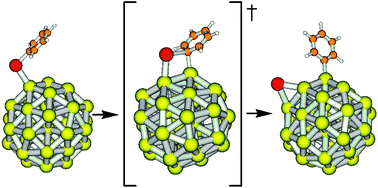
  • Paul O’Brien reports slow temperature growth of crystalline PbS films on plastic substrates by Chemical Vapour Deposition using xanthate. Why not read the communication for further details on the method, as well as looking at the mechanism proposed by the team, with the help of density functional theory calculations.
  • Jeremy Sanders and Ulrich Lüning present the efficient synthesis of a new type of a multi-hydrazone based macrocyclic receptor and investigates its complexation properties with alkali and alkaline earth metal ions using a dynamic combinatorial approach. Read more by downloading the communication today!

All communications have been made freely available until the 7th March 2011, so why not download the ones that interest you today and let us know what you think in our blog below.

If you have some of your own exciting, high impact research to publish then consider submitting your communication to ChemComm, via our online submission system.

Digg This
Reddit This
Stumble Now!
Share on Facebook
Bookmark this on Delicious
Share on LinkedIn
Bookmark this on Technorati
Post on Twitter
Google Buzz (aka. Google Reader)

Negishi cross-coupling using a bulky Pd-NHC catalyst

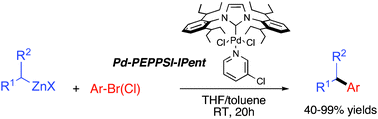
The hugely important field of transition metal catalysed C–C cross-coupling has come a long way over the years, but efficient coupling between Csp2 and secondary Csp3 centres remains a challenge. To achieve just that, Michael Organ and his colleague Selcuk Calimsiz (York University, Toronto) have developed and used a bulky Pd-NHC (N-heterocyclic carbene) catalyst called Pd-PEPPSI-IPent.

In the reactions of secondary alkylzincs with a variety aryl or heteroaryl halides, this catalyst provided excellent regioselectivity for the branched product over the isomerised unbranched product, far outperforming the less bulky Pd-PEPPSI-IPr analogue.

To see the impressive scope of the reaction download the ChemComm communication for free up until 7th March 2011 and leave your comments below.

Digg This
Reddit This
Stumble Now!
Share on Facebook
Bookmark this on Delicious
Share on LinkedIn
Bookmark this on Technorati
Post on Twitter
Google Buzz (aka. Google Reader)

MOF magnets deliver drugs

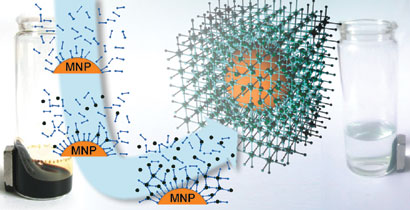
German scientists have encapsulated nanomagnets inside metal organic frameworks (MOFs). The MOF magnets can be filled with a drug, which is released when a magnetic field is applied. 

Stefan Kaskel from the Technical University of Dresden and colleagues made the MOF magnets by integrating superparamagnetic iron oxide particles into carboxylate MOFs. ‘Carboxylate molecules stabilise and activate the nanoparticles,’ explains team member Martin Lohe.

The group then loaded their MOF with ibuprofen and found that they were able to trigger and control its release by simply applying an external magnetic field. The magnetic field heats the magnets in the MOF, which causes the load to burst from the framework.

Superparamagnetic functionalisation of MOFs enables magnetic heating to trigger drug delivery

MOFs in which the frameworks themselves are magnetic have been made before, but they are not easy to manipulate. Kaskel’s embedded MOF magnets, however, can easily be manipulated from the outside. Magnetic fields can penetrate human skin, and magnetic triggers that could be used to release the drugs are already available on the market. However, before the MOF magnets can be used in the human body, toxicity tests will need to be done.

‘An enhanced sustainability of industrial and medical processes is crucial for our future,’ says Lohe. ‘Magnetically functionalised MOFs could be a small building block on this path.’

‘The particles will certainly increase the possibility of using nanoMOFs for drug delivery applications in the near future,’ agrees Christian Serre, an expert in porous solids from the University of Versailles  in France, ‘and they’ll add a new tool to the emerging domain of MOFs in biomedicine.’ 

Ruth Doherty


Link to ChemComm article

 Heating and separation using nanomagnet-functionalized metal–organic frameworks
Martin R. Lohe, Kristina Gedrich, Thomas Freudenberg, Emanuel Kockrick, Til Dellmann and Stefan Kaskel,

Chem. Commun., 2011, DOI: 10.1039/c0cc05278g


Digg This
Reddit This
Stumble Now!
Share on Facebook
Bookmark this on Delicious
Share on LinkedIn
Bookmark this on Technorati
Post on Twitter
Google Buzz (aka. Google Reader)

Palladium impurites are not essential for gold catalysis

Spanish scientists have proved that gold alone can catalyse cross-coupling reactions, following a claim made last year that palladium impurities in the gold are essential for the catalysis. 

Avelino Corma from the Polytechnic University of Valencia and colleagues used kinetic and theoretical studies to prove that gold can catalyse the Sonogashira coupling reaction between phenylacetylene and iodobenzene. ‘Gold nanoparticles are active enough to promote the reaction, regardless of the presence or absence of palladium,’ says Corma.

Graphical abstract: Gold catalyzes the Sonogashira coupling reaction without the requirement of palladium impurities

Read the full news story in Chemistry World and download Corma’s ChemComm communication

Digg This
Reddit This
Stumble Now!
Share on Facebook
Bookmark this on Delicious
Share on LinkedIn
Bookmark this on Technorati
Post on Twitter
Google Buzz (aka. Google Reader)

Novel chemical tag illuminates protein cholesterylation in cells

UK chemists have for the first time used a chemical probe to study the post- translational cholesterylation of proteins in living cells.

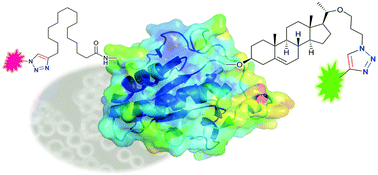
Post-translational modification (PTM) in cells plays an important role in the function of proteins in vivo. One example is the mammalian Hedgehog (Hh) protein family: the post-translational cholesterylation of Sonic hedgehog (shh) protein regulates its secretion. However, mis-regulation of this protein can promote different types of cancers. Therefore a simple way of studying this type of modification is important.

Graphical abstract: Bioorthogonal chemical tagging of protein cholesterylation in living cells

Edward Tate and colleagues at Imperial College, London have done just this. They first modified cholesterol molecules to bear an azide group and then gave this to their target cells, where it was used in PTM. They next managed to attach, via ‘click’ chemistry, a dye molecule called TAMRA to the modified proteins that carried the synthetic cholesterol. The team used this dye for ‘fluorescence visualisation’ of the target protein.

When compared to traditional techniques for studying cholesterylated proteins, this new method stacks up well. It makes significant savings in both time and expense, as well as avoiding the use of potentially harmful radiation. Furthermore, Tate suspects that in the future an optimised version of this process might be used to search for new cholesterylated proteins.

Want to find out more? Then download the ChemComm article for free today. You can also check out coverage of this article in C&EN.

Digg This
Reddit This
Stumble Now!
Share on Facebook
Bookmark this on Delicious
Share on LinkedIn
Bookmark this on Technorati
Post on Twitter
Google Buzz (aka. Google Reader)

Proof-of-principle concept for label-free detection of glucose and alpha-glucosidase activity

Research offers hope of better diagnosis and treatment for Pompe disease patients

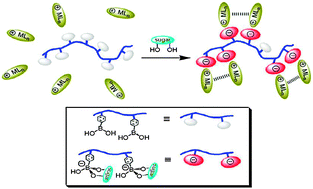
Glycogen storage disease type II (GSD II), also known as Pompe disease, is a genetic disorder that results in muscle and nerve cell damage caused by deficiency of the lysosomal acid a-glucosidase enzyme. In an effort to achieve a better technique for screening enzyme activity in patients suffering from Pompe disease, Prof. Vivian Yam and colleagues at the Institute of Molecular Functional Materials, University of Hong Kong, have synthesised a two-component platinum (II) complex-polymer ensemble for glucose sensing and a-glucosidase assay.

The system works by strongly binding glucose, resulting in a 46-fold increase in the low energy emission band (800 nm) of the electronic emission spectrum. Additionally, in the presence of a-glucosidase and maltose (which is broken down to glucose by a-glucosidase), the intensity of the 800 nm emission band was found to increase with time. These results provide a “proof-of-principle” concept for label-free detection of glucose and open the way for rapid and sensitive detection of a-glucosidase.

To find out more download the ChemComm communication for free until 25th February 2011.

Digg This
Reddit This
Stumble Now!
Share on Facebook
Bookmark this on Delicious
Share on LinkedIn
Bookmark this on Technorati
Post on Twitter
Google Buzz (aka. Google Reader)

Cram Lehn Pedersen Prize – winner announced

Congratulations to Professor Amar Flood (Indiana University) who is the winner of the Cram Lehn Pedersen prize 2011.

The prize, sponsored by ChemComm and named in honour of the winners of the 1987 Nobel Prize in Chemistry, recognises significant, original and independent work in supramolecular chemistry by emerging investigators.

The prize is awarded to Professor Flood for his pioneering work in macrocyclic and supramolecular chemistry and, in particular, for his development of receptors that employ pure CH hydrogen bonding to bind anionic guest species.

Professor Flood will receive £2,000 and will present his award lecture at the 6th International Symposium on Macrocyclic and Supramolecular Chemistry (6-ISMSC) in Brighton in July. ChemComm Editor Robert Eagling and Deputy Editor Joanne Thomson will be at the symposium – let us know if you’ll be there too.

Prof Phil Gale, Chair of the Scientific Committee for 6-ISMSC said: “I’m really delighted that Amar has been selected by the International Committee to be the first recipient of the Cram Lehn Pedersen Prize. I’m already looking forward to hearing his latest results in Brighton in July.”

Nominations for the 2012 award, which will be presented at 7-ISMSC in New Zealand, will open shortly. Email us to register your interest.

Find out more about Professor Flood’s research by reading his Chem Soc Rev tutorial review:

Click chemistry generates privileged CH hydrogen-bonding triazoles: the latest addition to anion supramolecular chemistry,  Yuran Hua and Amar H. Flood, Chem. Soc. Rev., 2010, 39, 1262-1271
(This review is part of the themed issue Click chemistry: Function follows form)

Also of interest:
A tristable [2]pseudo[2]rotaxane,  Ali Trabolsi, Albert C. Fahrenbach, Sanjeev K. Dey, Andrew I. Share, Douglas C. Friedman, Subhadeep Basu, Travis B. Gasa, Niveen M. Khashab, Sourav Saha, Ivan Aprahamian, Hussam A. Khatib, Amar H. Flood and J. Fraser Stoddart, Chem. Commun., 2010, 46, 871-873

Digg This
Reddit This
Stumble Now!
Share on Facebook
Bookmark this on Delicious
Share on LinkedIn
Bookmark this on Technorati
Post on Twitter
Google Buzz (aka. Google Reader)

Top ten most accessed articles in December

This month sees the following articles in ChemComm that are in the top ten most accessed:-

Light operated molecular machines 
Serena Silvi, Margherita Venturi and Alberto Credi 
Chem. Commun., 2011, Advance Article, DOI: 10.1039/C0CC03829F, Highlight 

A facile synthesis of anatase TiO2 nanosheets-based hierarchical spheres with over 90% {001} facets for dye-sensitized solar cells 
Weiguang Yang, Jianming Li, Yali Wang, Feng Zhu, Weimin Shi, Farong Wan and Dongsheng Xu 
Chem. Commun., 2011, Advance Article, DOI: 10.1039/C0CC03312J, Communication 

An unprecedented 2D → 3D metal–organic polyrotaxane framework constructed from cadmium and a flexible star-like ligand  
Hua Wu, Hai-Yan Liu, Ying-Ying Liu, Jin Yang, Bo Liu and Jian-Fang Ma 
Chem. Commun., 2011, Advance Article, DOI: 10.1039/C0CC04724D, Communication 

Arranging pseudorotaxanes octahedrally around [60]fullerene 
Sanjeev K. Dey, Florian Beuerle, Mark A. Olson and J. Fraser Stoddart 
Chem. Commun., 2011, 47, 1425-1427, DOI: 10.1039/C0CC03963B, Communication 

Boronic acid building blocks: tools for sensing and separation 
Ryuhei Nishiyabu, Yuji Kubo, Tony D. James and John S. Fossey 
Chem. Commun., 2011, 47, 1106-1123, DOI: 10.1039/C0CC02920C, Feature Article 

Campestarenes: novel shape-persistent Schiff base macrocycles with 5-fold symmetry 
Samuel Guieu, Angela K. Crane and Mark J. MacLachlan 
Chem. Commun., 2011, 47, 1169-1171, DOI: 10.1039/C0CC04493H, Communication 

Synthesis of Cu nanoparticles in mesoporous silica SBA-15 functionalized with carboxylic acid groups 
Ching-Shiun Chen, Chen-Chih Chen, Ching-Ting Chen and Hsien-Ming Kao 
Chem. Commun., 2011, Advance Article, DOI: 10.1039/C0CC04719H, Communication 

Fluorescent nanoscale zinc(ii)-carboxylate coordination polymers for explosive sensing 
Chengyi Zhang, Yanke Che, Zengxing Zhang, Xiaomei Yang and Ling Zang 
Chem. Commun., 2011, Advance Article, DOI: 10.1039/C0CC04836D, Communication 

Copper-catalyzed aerobic oxidative synthesis of aromatic carboxylic acids 
Daoshan Yang, Haijun Yang and Hua Fu 
Chem. Commun., 2011, Advance Article, DOI: 10.1039/C0CC04319B, Communication 

Iodoamidation of olefins with chloramine salts and iodine in aqueous media 
Satoshi Minakata and Junpei Hayakawa 
Chem. Commun., 2011, Advance Article, DOI: 10.1039/C0CC03855E, Communication 

Why not take a look at the articles today and blog your thoughts and comments below.

Fancy submitting an article to ChemComm? Then why not submit to us today or alternatively email us your suggestions.

Digg This
Reddit This
Stumble Now!
Share on Facebook
Bookmark this on Delicious
Share on LinkedIn
Bookmark this on Technorati
Post on Twitter
Google Buzz (aka. Google Reader)

Novel concept for switchable olefin metathesis catalysts

Chemists have discovered a novel triggering mechanism for olefin metathesis catalysts while unravelling the mechanism of a crucial ligand rearrangement step.

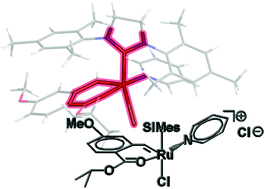
Olefin metathesis is a widely used reaction in organic and polymer synthesis. cis Dichloro ruthenium benzylidene complexes bearing an N-heterocyclic carbene ligand have recently gained considerable attention as stable metathesis catalysts. They are known as latent catalysts as they initiate slowly, which is thought to be because the cis dichloro precursors have to rearrange to their trans dichloro counterparts to become active.

While studying the reaction mechanism, Christian Slugovc and colleagues at Graz University of Technology, Austria, discovered that a cationic complex is an intermediate in the rearrangement step. They also observed that pyridine, which is a donor ligand, facilitates the displacement of one of the chloride ligands, the first step in the rearrangement.

Graphical abstract: Pyridine as trigger for chloride isomerisation in chelated ruthenium benzylidene complexes: implications for olefin metathesis

But most striking, says Slugovc, is that the chloride counterion (or, more generally, a counterion that can coordinate to ruthenium) is indispensible for the catalytic activity. Changing the counterion for the non-coordinating hexafluorophosphate ion produced an almost inactive catalyst, but the activity was triggered again by adding chloride. Slugovc says this constitutes a novel concept for switchable olefin metathesis catalysts.

Download Slugovc’s ChemComm communication to find out more.

Digg This
Reddit This
Stumble Now!
Share on Facebook
Bookmark this on Delicious
Share on LinkedIn
Bookmark this on Technorati
Post on Twitter
Google Buzz (aka. Google Reader)

New polymer hydrogels offer step forward in desalination

Chemists working in Australia have used polymer hydrogels as a ‘draw’ agent in a desalination process.

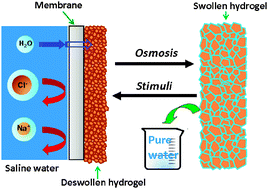
Forward osmosis (FO) desalination is an emerging area of interest for chemists as it provides a low energy method of obtaining salt free water from the sea. Typically in FO, saline water is separated by a membrane from a ‘draw’ solute. Water passes through the membrane from the saline side to the ‘draw’ solute via osmosis. The water is then recovered from the ‘draw’ agent using distillation.

Now Huanting Wang and colleagues at Monash University have investigated the use of polymer hydrogels as the draw agent for FO desalination. Polymer hydrogels can reversibly change their volume when exposed to certain stimuli such as temperature and pressure. This gives them an advantage over traditional draw agents as they can potentially be recycled and release the water at lower energy and therefore cost.

Graphical abstract: Stimuli-responsive polymer hydrogels as a new class of draw agent for forward osmosis desalination

The team found that it is indeed possible to release significant amounts of water from the polymer hydrogels tested and are investigating other stimuli, such as light, to further increase the efficiency of this process.

Read more about this exciting advance by downloading  the full ChemComm communication today and let us know what you think below.

Digg This
Reddit This
Stumble Now!
Share on Facebook
Bookmark this on Delicious
Share on LinkedIn
Bookmark this on Technorati
Post on Twitter
Google Buzz (aka. Google Reader)