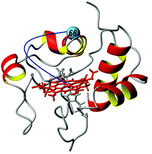
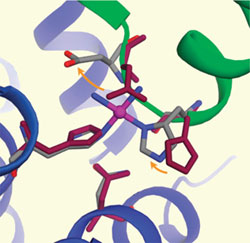
| A new thiol-specific reagent can introduce a small bis(methylamino)terephthalic acid fluorophore into proteins. The noninvasive probe has distinct spectroscopic properties and can offer many advantages towards protein labelling, purification, and mechanistic work. Ekaterina Pletneva and her team at Dartmouth College in the US believe that this complex promises to serve as a powerful tool when it comes to studying protein folding and heme redox reactions.
Did you find this result exciting? Then download the ChemComm communication to find out more. The article will be free to access until the 10th June 2011.
|
A new twist on fluorescent labelling proteins
Incorporating a small fluorophore allows protein folding and redox states to be monitored
The first use of organometallic hosts in crystalline organic frameworks
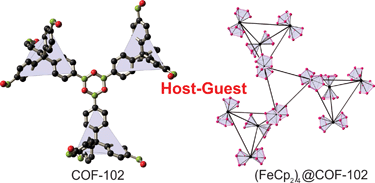
Chemists working at Ruhr-University Bochum in Germany have for the first time studied the host–guest chemistry of organometallic complexes with covalent organic frameworks (COVs).
COVs are the organic analogues of metal–organic frameworks (MOFs) and are made up of strong organic covalent bonds to form large organic polymers. They have a crystalline structure and have attracted a lot of attention due to their possible applications in gas storage, sensing and catalysis. To date, only the host–guest chemistry of small gas molecules such as CO2 and H2 have been studied in COVs. The team in Germany, led by Roland A. Fischer, set about changing this and demonstrated the use of organometallic molecules as guests.

Using COF-102 as the host, the team looked at the adsorption of FeCp2 , CoCp2 and [Ru(cod)(cot)] within the framework. They found that FeCp2 remained intact within the framework and that it assumed a structure reminscent of the host via π–π interactions. Overall, the work displayed the similarity between COVs and MOFS as hosts for metal complexes.
If you are interested in finding out more on this hot area then why not download the full ChemComm article for free today?
The inhibition effect of Naringenin
With the help of two single-molecule techniques, the inhibitor effects of Naringenin become apparent
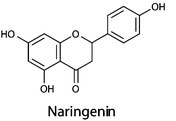
Chinese scientists have confirmed that Naringenin inhibits transforming growth factor-β (TGF-β) signaling in living cells.
| TGF-β signalling plays a crucial role in a wide variety of biological processes, such as cell growth, differentiation, apoptosis, and embryonic development. Xiaohong Fang and colleagues from the Chinese Academy of Sciences, in Beijing, and co-workers from nearby Peking University, believe that developing TGF-β signalling inhibitors will help create new therapeutic reagents and anticancer drugs of the future. Here, Fang and his team have shown that Naringenin, a natural flavonone, inhibits this important signalling receptor, evidence supported by single-molecule fluorescence microscopy and single molecule force spectroscopy techniques.
Fancy reading about the techniques used, or finding out more on the inhibition mechanism? Then download the ChemComm communication, which is free to access until the 3rd June 2011! |
To expand or not to expand?
Find out how 10 degrees can make all the difference for dumbell-shaped polymorphs
![]() |
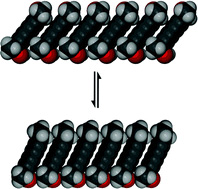
Two dumbbell-shaped polymorphs possess similar packing arrangements, but one shows anomalously anisotropic thermal expansion while the other does not.
Leonard J. Barbour and his team from the University of Stellenbosch, in South Africa and a co-worker from the Polish Academy of Sciences, have investigated these polymorphs further and discovered that by adjusting the molecular stacking angle by approximately 10° effectively disables the molecules’ ability to undergo thermal expansion. Fancy expanding your knowledge? Then why not download the ChemComm communication today and read all about the teams research results? This article is free to access until Friday 3rd June. |
New copper complex offers easy access to complex structures
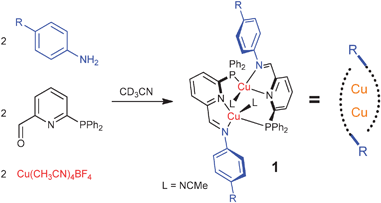
Chemists working at the University of Cambridge in the UK have discovered a new dicopper complex capable of forming diverse supramolecular structures.
The creation of supramolecular structures for a wide variety of uses has been something that chemists have pursued for years and, as such, new methods to access these structures are constantly sought. Jonathan Nitschke and colleagues are prominent figures in this field and have just reported a new copper complex that self assembles into larger architectures.

The team first assembled the copper complex and then showed they could modified it at two points. This is done either by substitution of solvent molecules with ligands capable of linking multiple complexes or by modifying the imine bonds. Using both these approaches and varying the ligands, it was possible to achieve the templated synthesis of 26- and 52-membered macrocycles. More complex assemblies that utilise this approach are currently being investigated.
Interested in finding out more? Then download Nitschke’s ChemComm article for free today. Also why not check out Dr Nitschke’s mini review and edge article form our sister journal Chemical Science?
Reactivity modulation in container molecules
Boris Breiner, Jack K. Clegg and Jonathan R. Nitschke
Chem. Sci., 2011, 2, 51-56
DOI: 10.1039/C0SC00329H, Minireview
Selective anion binding by a “Chameleon” capsule with a dynamically reconfigurable exterior
Yana R. Hristova, Maarten M. J. Smulders, Jack K. Clegg, Boris Breiner and Jonathan R. Nitschke
Chem. Sci., 2011, 2, 638-641
DOI: 10.1039/C0SC00495B, Edge Article
Call for communications: Artificial Photosynthesis
We are delighted to announce a forthcoming web themed issue:
Artificial Photosynthesis
Guest editor: Andrew Benniston (Newcastle University)
Submission deadline: 15th August 2011 EXTENDED TO 30TH SEPTEMBER!!
We are now welcoming submissions for this web theme, which will be a celebration of current achievements and future perspectives in this exciting field of research. Communications covering all aspects of the following areas are encouraged:
- new materials and photocatalysts for solar photochemistry
- hydrogen production and water splitting
- nitrogen and carbon dioxide functionalisation
- light harvesting and energy transfer
- electron transfer (tunnelling vs hopping)
- coupled proton/electron transfer
- long-range electron transport
- multi-electron redox processes
- bioinspired molecular systems
- nanostructures for solar energy usage
All manuscripts will undergo strict peer review and should be very important and conceptually significant in accord with the ChemComm mandate.
Publication of the peer-reviewed articles will occur without delay to ensure the timely dissemination of the work. The articles will then be assembled on the ChemComm website as a web-based thematic issue, to permit readers to consult and download individual contributions from the entire series.
Communications for this web theme can be submitted anytime from now until 30th September using our web submission system. Please add the phrase ‘artifical photosynthesis’ in the comments to the editor field.
New nerve agent sensor to join fight against terror
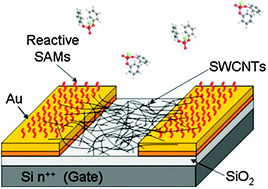
A new sensor for detecting nerve agents has been developed by scientists in France.
Organophosphorus (OP) compounds, such as sarin, are extremely neurotoxic compounds that have been used both in the battlefield and in terrorist attacks, including the Tokyo subway attack in 1995.
Current technologies for detecting OPs are not very practical, say Jean-Pierre Simonato (CEA Grenoble) and colleagues, so they’ve developed a new sensor based on carbon nanotube field-effect transistors.
Find out more in Simonato’s recently published ChemComm communication, free to download until 2nd June.
Anticancer drug found to cause zinc deficiency
Researchers now know why cisplatin, a leading cancer drug, causes zinc deficiency in patients
Cisplatin is responsible for abnormally low zinc levels in patients undergoing chemotherapy, say scientists in China and the UK.
Platinum-based compounds, like cisplatin, are the most widely used anticancer drugs in medicine. Research shows that up to 98 per cent of cisplatin binds to blood plasma proteins, particularly albumin. Until now, little has been known about the specific binding sites for platinum on albumin. ‘Since albumin plays a major role in cisplatin metabolism, a better understanding of its interactions with albumin should lead to more effective use of the drug and avoidance or control of side effects,’ says Peter Sadler from the University of Warwick, in the UK.
| Together with Fuyi Wang’s team from the Chinese Academy of Sciences in Beijing, Sadler used mass spectroscopy techniques to reveal that cisplatin reacts with recombinant human albumin (rHA) to create a cisplatin-rHA adduct. The platinum occupies zinc binding sites on the albumin, displacing the zinc, which causes hypozincemia (lack of zinc for metabolic processes) and hyperzincuria (increased zinc in urine).
Would you like to know more? Then read the full story on the Chemistry World website and download the ChemComm communication. |
Titanate cigarette filter
Significant reduction of harmful compounds in tobacco smoke
Chinese researchers have shown for the first time that nanomaterials made from titanium dioxide (TiO2) can be used in cigarette filters to significantly reduce the amount of harmful chemicals inhaled by smokers. They say it offers a cheaper and safer alternative than using carbon-based nanomaterials and show potential for use in other filtering devices including gas masks and air purification systems.
Current cigarette filters are made from cellulose acetate, which absorbs some of the toxic and carcinogenic compounds present in tobacco smoke, including tar, nicotine, polycyclic aromatic hydrocarbons and tobacco-specific nitrosamines. In recent years, scientists have attempted to improve standard filters by adding nanomaterials, including carbon nanotubes or mesoporous silica, to capture more of these chemicals. But these experimental methods remain expensive and could pose unknown health risks.