Overcoming obstacles in labelling RNA

If you can’t beat them, join them… or rather incorporate, and then join them together. This is the approach adopted by Srivatsan and colleagues for conjugating labels to RNA, which they achieve by incorporating azide functionality into RNA nucleotides.

DNA oligonucleotides are routinely labelled by incorporating modified nucleosides into the desired DNA sequence and introducing the label post-synthesis; however, these standard methods offer low yields of the desired conjugate. Furthermore, modification of RNA is more challenging than DNA modification due to its inherent instability.

Copper catalysed alkyne–azide cycloadditions (CuAAC) and Staudinger ligations are the conjugation reactions du jour due to their high chemoselectivity and reported high yield. So, with this in mind, were Srivatsan and his team able to incorporate the required moieties into RNA oligonucleotides?

Yes! Using some extremely nice chemistry, they synthesised an azide-modified nucleotide and incorporated it into an oligoribonucleotide using in vivo transcription reactions in the presence of a series of promoter-template oligonucleotides. After rigorous testing and analysis of their modified nucleic acid sequence, click reactions were performed to yield biotinylated and fluorescent-labelled click products. They also showed that amine functionality can be introduced through Staudinger ligation.
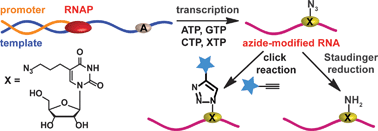
Although azides are not usually found in nature, they are becoming more useful and versatile in the design of diagnostic and therapeutic biological probes as has been very elegantly demonstrated here.

Read more in Srivatsan’s ChemComm article…

Also of interest: Synthetic DNA synthesises RNA by transcription: ‘click’ here for more

Posted on behalf of Sarah Brown, web science writer for ChemComm.

Digg This
Reddit This
Stumble Now!
Share on Facebook
Bookmark this on Delicious
Share on LinkedIn
Bookmark this on Technorati
Post on Twitter
Google Buzz (aka. Google Reader)

Green hydrogenation of cyclic di-esters to diols

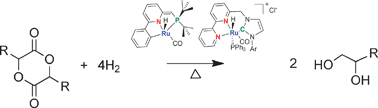
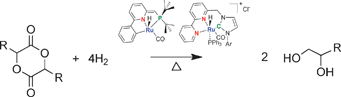
Israeli scientists report on an unprecedented complete catalytic hydrogenation of cyclic di-esters in their recent ChemComm article.

Hydrogenation of esters under mild conditions is difficult at best, however David Milstein and his team push the boundaries by hydrogenating biomass products, glycolide and lactide, to afford the corresponding 1,2-diols. Their synthesis, which utilises ruthenium pincer complex catalysts, offers an atom-economical, green alternative to existing methods for producing 1,2-diols, which currently rely on petroleum-derived ethylene and propylene feedstocks.

The team say that the cyclic di-esters can be selectively and efficiently hydrogenated under very mild conditions, whilst producing no waste, and even discovered that optically pure diols could be produced from chiral lactide.

Download the ChemComm article today to find out how Milstein and his team did this.

Digg This
Reddit This
Stumble Now!
Share on Facebook
Bookmark this on Delicious
Share on LinkedIn
Bookmark this on Technorati
Post on Twitter
Google Buzz (aka. Google Reader)

Aromaticity web theme issue – welcoming submissions

We are delighted to announce a high-profile web themed issue on Aromaticity.

Guest editors: Nazario Martín (University Complutense of Madrid), Michael Hayley (University of Oregon) and Rik Tykwinski (University of Erlangen-Nuremberg)

This themed issue will consist of a series of invited Communications and Feature Articles covering work on all aspects of chemistry related with aromaticity – from new fundamental knowledge about aromaticity and theoretically interesting new arene structures to novel applications of aromatics and heteroaromatics which take advantage of their unique optical and electronic attributes.

The level of quality of this issue will be extremely high, and all manuscripts will undergo strict peer review. You are therefore encouraged to report work that you consider to be very important and conceptually significant. Please note that inclusion in the issue is subject to the discretion of the guest editors.

Publication of the peer-reviewed articles will occur without delay to ensure the timely dissemination of the work. The articles will then be assembled on the ChemComm website as a web-based thematic issue.

Submit your work before 31st May 2012. Please add “aromaticity” in the comments to the editor section.

Digg This
Reddit This
Stumble Now!
Share on Facebook
Bookmark this on Delicious
Share on LinkedIn
Bookmark this on Technorati
Post on Twitter
Google Buzz (aka. Google Reader)

Further insight into aromatic borylation chemistry

UK scientists have investigated the interaction between borane Lewis acids and arenes through the synthesis of a dibromoborenium cation.

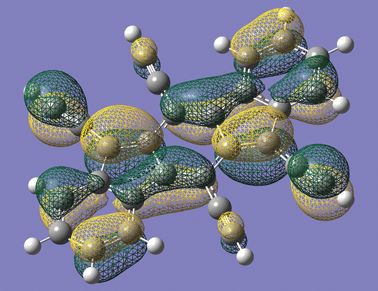
Thorough characterisation of arene–borane Lewis acid contacts is essential for understanding the mechanistic pathway for aromatic borylation chemistry and by extension, electrophilic aromatic substitution. However, until now, structural determination of such arene–borane compounds has been somewhat ambiguous.

Simon Aldridge and his team have set out to fill this knowledge gap by reacting a sterically encumbered pyridine donor with BBr3 to yield a cationic tri-coordinate borane–arene complex. Employing crystallography and computational studies, the team found that a weak electrostatic interaction is responsible for the short contacts between the positively charged boron centre and the arene π system.

Read the ChemComm article to find out more…

Digg This
Reddit This
Stumble Now!
Share on Facebook
Bookmark this on Delicious
Share on LinkedIn
Bookmark this on Technorati
Post on Twitter
Google Buzz (aka. Google Reader)

Metal evasion still leads to nitration

A metal-free nitration of boronic acids

Researchers from Germany and China have designed a simple method for forming nitroarenes.

Aromatics substituted with nitro groups are ubiquitous motifs in important molecules required by the textiles, materials and pharmaceutical industries. 

However, installing nitro groups can be tricky because it requires the use of strong acids or dinitrogen peroxide. These harsh conditions are not commonly tolerated by sensitive functionality present in molecules, and problems of selectivity or over-nitration commonly arise.  Alternate methods use large quantities of silver salts or expensive palladium catalysts. 

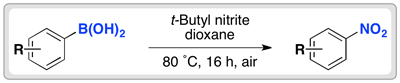
Now Xiao-Feng Wu (Zhejiang Sci-Tech University, China), Matthias Beller (Leibniz Institute for Catalysis, Germany) and colleagues have designed a metal-free method for nitrating aryl boronic acids.

nitration of aryl boronic acids

The team used an alkyl nitrite at 80 ˚C to convert the boronic acid group to a nitro group. The reaction works in moderate to good yields for electron-rich and electron-neutral aryl boronic acids. Electron-poor aromatics are more challenging substrates, as the boronic acid are less reactive. 

While this method is not yet suitable for vinyl or hydroxy substituted aryl boronic acids, it offers an economically and operationally attractive method for synthesising nitro compounds.

Researcher’s perspective:Our initial investigations started with the use of a rhodium catalyst, because of rhodium’s known ability to transmetalate with arylboronic acid. Our target product, nitrobenzene, was formed but we found that the rhodium catalyst is not necessary for this transformation.

On one hand, we were disappointed, as our aim is to develop catalytic reactions; on the other hand, we are happy, because this reaction works so nicely.

Xiao-Feng Wu

Using this method, nitroarenes can be easily prepared from arylboronic acids without using catalyst and hazardous reagents.

More information can be found in the ChemComm communication, free to download for a limited period.

Posted on behalf of Alice E. Williamson, ChemComm web writer.

Digg This
Reddit This
Stumble Now!
Share on Facebook
Bookmark this on Delicious
Share on LinkedIn
Bookmark this on Technorati
Post on Twitter
Google Buzz (aka. Google Reader)

Supramolecular assembly of polyoxometalate triangles

Polyoxometalates (POMs) are a diverse class of inorganic materials that are of great interest due to their exciting range of redox, conducting, magnetic and catalytic properties. Recent collaborative work from Professor Garry Hanan in Montreal and Professor Bernold Hasenknopf in Paris reports the inclusion of a Lindqvist-type hexavanadate POM as a component of a self-assembling supramolecular framework.

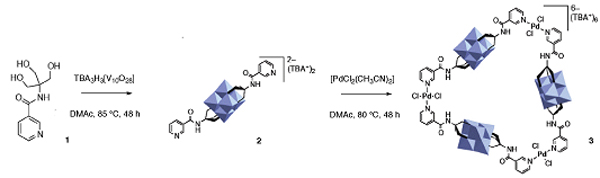
They designed ligand 1 utilising a triol motif to complex the POM in combination with pyridyl groups to serve as binding sites for a transition metal. The reaction of 1 with a suitable decavanadate yielded complex 2, a hexavanadate POM complex that is itself a structurally rigid and spatially well-defined bi-pyridyl ligand. The 60° angle between the coordination vectors of the pyridyl groups led the authors to predict that the coordination of a trans-PdCl2 unit by 2 would result in a supramolecular triangle.

supramolecular assembly of polyoxometalate triangles

Initially the reaction of 2 with [PdCl2(CH3CN)2] in DMAc yielded a complex mixture of products; however, heating to 80 °C for 48 hours led to just a single assembly. This was shown by a number of analytical techniques to be the predicted triangular assembly 3.

This work elegantly uses a classical motif for self-assembly to create a multi-component supramolecular architecture. It is a great step towards the goal of creating functional supramolecular arrays, integrating the desirable properties of POMs into a new framework and bridging the gap between solid state oxides and coordination chemistry.

Researcher’s perspective:
The obtention of discrete coordination-driven POM-based arrays had so far eluded the community, with only a few well characterised coordination polymers. We started this challenging project of a molecular triangle by a simple drawing based on geometrical considerations. A range of conditions were explored, but most lead to complex mixtures except one. This identification of optimal conditions was our first satisfaction. However, we needed solid evidence of the triangular nature of the obtained array to validate our approach as a rational design: a combination of techniques confirmed the successful and selective synthesis of the triangle. As a student, I learnt a lot from the complementary competencies provided by the two groups on a project at the interface of inorganic, organic, supramolecular and coordination chemistry. Dealing with the specific difficulties of each domain has been an exciting challenge that has re-confirmed my choice in academic research. Marie-Pierre Santoni, a student in the research collaboration

To read more about Hanan and Hasenknopf’s work, download their ChemComm article.

Posted on behalf of Cally Haynes, ChemComm web writer.

Digg This
Reddit This
Stumble Now!
Share on Facebook
Bookmark this on Delicious
Share on LinkedIn
Bookmark this on Technorati
Post on Twitter
Google Buzz (aka. Google Reader)

65 days until 100 issues…

….and did you know….?

There are 65 articles in ChemComm‘s ‘Selective Catalysis for Organic Synthesis’ web themed issue. This was ChemComm‘s first web theme, published back in 2009. Since then, we’ve published a host of exciting themes, all of which are available to browse on the ChemComm website.

Do you have an idea for a web theme? Get in touch with us by email, Twitter or leave your comments below.

Also of interest:
100 days to 100 issues
96 days until 100 issues…
93 days until 100 issues…
81 days until 100 issues…
72 days until 100 issues…

70 days until 100 issues…

Digg This
Reddit This
Stumble Now!
Share on Facebook
Bookmark this on Delicious
Share on LinkedIn
Bookmark this on Technorati
Post on Twitter
Google Buzz (aka. Google Reader)

70 days until 100 issues…

….and did you know?….

I’ve been working for RSC Publishing for 70 months, during which time I’ve worked on Physical Chemistry Chemical Physics, Faraday Discussions, Organic & Biomolecular Chemistry and Natural Product Reports before my move to ChemComm, Chem Soc Rev and Chemical Science in 2009.

To learn more about the people that work on ChemComm, visit our staff webpage.

Find out more about the move to 100 issues >

Also of interest:
100 days to 100 issues
96 days until 100 issues…
93 days until 100 issues…
81 days until 100 issues…
72 days until 100 issues…

Digg This
Reddit This
Stumble Now!
Share on Facebook
Bookmark this on Delicious
Share on LinkedIn
Bookmark this on Technorati
Post on Twitter
Google Buzz (aka. Google Reader)

Highlights in Chemistry: short reviews from the brightest scientists

As the nights are drawing in here in Cambridge, it is nice to bring a little light in to our lives in the form of Highlights in Chemistry. 

Commissioned to celebrate the International Year of Chemistry 2011, these short reviews cover the most significant advances in the chemical sciences since the millennium. The topics include photocatalytic hydrogen production, nucleic acid sequencing, antibiotic resistance mechanisms, molecular machines and metathesis, to name just a few. 

We’ve nearly published all the Highlights in Chemistry so take a look at the collection on the ChemComm website. There are some fun graphical abstracts to accompany the articles – can you guess who supplied the images I’ve used in this blog? Click on the images to find out.

Digg This
Reddit This
Stumble Now!
Share on Facebook
Bookmark this on Delicious
Share on LinkedIn
Bookmark this on Technorati
Post on Twitter
Google Buzz (aka. Google Reader)

72 days until 100 issues…

Journal cover: ….and did you know?….

Back in ’72, the journal changed its name from Journal of the Chemical Society D: Chemical Communications to Journal of the Chemical Society, Chemical Communications.

It looked pretty different back then – someone liked green!

Find out more about the move to 100 issues >

Also of interest:
100 days to 100 issues
96 days until 100 issues…
93 days until 100 issues…
81 days until 100 issues…

Digg This
Reddit This
Stumble Now!
Share on Facebook
Bookmark this on Delicious
Share on LinkedIn
Bookmark this on Technorati
Post on Twitter
Google Buzz (aka. Google Reader)