Combating Influenza: Anthraquinone–Sialic Acid Hybrids for the Inhibition of Viral Neuraminidase

In the fight against influenza, viral neuraminidase (NA) represents an important target. This enzyme is essential for the replication of the virus, and its inhibition can prevent the spread of the disease. Scientists at Keio University have now identified a set of novel anthraquinone–sialic acid hybrids which can inhibit influenza virus neuraminidase with photo-irradiation under neutral conditions.

Anthraquinone derivatives were found to degrade proteins when subjected to photo-irradiation; this degradation is likely caused by hydroxy radicals which are produced from the photolysis of anthraquinone and oxygen. Crucially, researchers led by Prof. Kazunobu Toshima proposed that NA-inhibition could be obtained if such an anthraquinone derivative could be tethered to an NA-binding moiety. Sialic acid is a native ligand for NA— both “normal” NA and drug-resistant NA— and so researchers prepared and investigated a number of anthraquinone–sialic acid hybrids (1–3).
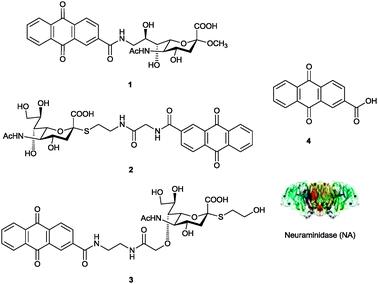
These hybrids were found to be effective for the inhibition of NA under photo-irradiation, and interestingly, showed comparable or superior results compared to the leading anti-NA drug, especially in the inhibition of drug-resistant NA. While further tests are ongoing, this research represents an important advance in influenza treatment, and offers great potential for the inhibition of other disease targets.

For more, read this ‘HOT’ ChemComm article in full:

Photodegradation and inhibition of drug-resistant influenza virus neuraminidase using anthraquinone–sialic acid hybrids

Yusuke Aoki,  Shuho Tanimoto,  Daisuke Takahashi and Kazunobu Toshima
Chem. Commun., 2013, 49, 1169–1171
DOI: 10.1039/C2CC38742E
Digg This
Reddit This
Stumble Now!
Share on Facebook
Bookmark this on Delicious
Share on LinkedIn
Bookmark this on Technorati
Post on Twitter
Google Buzz (aka. Google Reader)

A new system for cancer detection

While current cancer-diagnosis methods rely on an invasive biopsy or the detection of cancer-specific biomarkers, South Korean scientists have developed a simple and non-invasive detector for cancer cells that could speed up the early diagnosis of the condition, leading to a greater chance of survival for cancer patients.

Cancer cells fluorescing

Daunomycin interacting cancer cells viewed with fluorescene microscopy

Cancer cells have been found to differ from normal cells in several ways, including the make up of their cell membranes. Cancer-cell membranes have been found to contain more anionic lipids than normal cells, leading to an overall negatively charged cell surface. Yoon-Bo Shim and co-workers from Pusan National University, have exploited this negative surface charge to develop a probe based on daunomycin, an anti-cancer drug that is known to interact strongly with anionic lipids.

Read the full article in Chemistry World.

Read the original journal article:
Cancer cell detection based on the interaction between an anticancer drug and cell membrane components
Chem. Commun., 2013, 49, 1900-1902
DOI: 10.1039/C2CC38235K

Digg This
Reddit This
Stumble Now!
Share on Facebook
Bookmark this on Delicious
Share on LinkedIn
Bookmark this on Technorati
Post on Twitter
Google Buzz (aka. Google Reader)

Penny Brothers joins ChemComm as Associate Editor

ChemComm warmly welcomes Professor Penny Brothers (University of Auckland, New Zealand) as a new Associate Editor. 

Penny Brothers is now accepting submissions to ChemComm in the areas of porphyrin chemistry, the main group elements and organometallic chemistry.  Her current research interests also include the chemistry of new sustainable materials and inorganic medicinal chemistry. 

Submit your next top-notch, high-impact Communication to Penny Brother’s Editorial Office.

Biography

Penny Brothers was born and grew up in Auckland, New Zealand, and completed her BSc and MSc(Hons) degrees in chemistry at the University of Auckland.  In 1979 she was awarded a Fulbright Fellowship and set off for Stanford University to begin a PhD in chemistry under the supervision of Professor Jim Collman.  Her PhD thesis, and much of her subsequent research work, has centered around the chemistry of porphyrin complexes.Professor Penny Brothers

In 1986 she returned to Auckland and spent two years working as a postdoctoral fellow with Professor Warren Roper in the Department of Chemistry, focussing on organometallic chemistry.  In 1988 she took up her current academic position at the University of Auckland.

She has been a visiting scientist at Los Alamos National Laboratory (2003, 2005, 2006) and a visiting professor at the University of California at Davis (1993), the University of Heidelberg (2003) and the University of Burgundy (2004, 2006).  She has been awarded a Fulbright Senior Scholar Award for 2007.

Her current research brings together her interests in porphyrin chemistry, the main group elements and organometallic chemistry.  She investigates how the porphyrin ligand can be used to modify the chemistry of elements such as boron and bismuth, and as a ligand in complexes containing unusual chemical bonds between transition metal and main group elements.  She has a number of research collaborations in NZ and internationally.

Digg This
Reddit This
Stumble Now!
Share on Facebook
Bookmark this on Delicious
Share on LinkedIn
Bookmark this on Technorati
Post on Twitter
Google Buzz (aka. Google Reader)

Novel silicon-mediated transannular cyclopropanation

An intriguing new method of transannular cyclopropanation has been reported by Prof. James Dowden‘s group at the University of Nottingham. This cyclopropanation, mediated by the presence of a trimethylsilyl group, allows the rapid formation of 4-azabicyclo(5.1.0)octenones (3) from simple starting materials. Divinyl beta-lactam (1) was elegantly formed via a Staudinger cycloaddition reaction beginning from 3-trimethylsilylpropenal, 4-methoxyaniline and crotonyl chloride. Next, researchers were able to transform 1 into dihydroazocinone (2) using a thermal Cope rearrangement.

The Dowden group discovered that if 2 was treated with TBAF or aqueous sodium hydroxide, 4-azabicyclo(5.1.0)octenone (3) could be formed. Interestingly, the reaction was dependent on the presence of the silicon group; when the trimethylsilyl group was replaced with an ester, no cyclopropanation occurred. The researchers proposed that the transannular cyclopropanation could be viewed as a Lewis-base–promoted Hosomi–Sakurai reaction proceeding via intramolecular 1,4-conjugate addition. 4-azabicyclo(5.1.0)octenones (3) are an unusual structural motif and it is hoped that this facile method for their construction may facilitate further examination of chemical space interactions.

Read this ‘HOT’ Chem Comm article today:

An unusual silicon mediated transannular cyclopropanation

Bing You,  Kate Hamer,  William Lewis and James Dowden
Chem. Commun., 2013, 49, 795-797
DOI: 10.1039/C2CC37739J
Digg This
Reddit This
Stumble Now!
Share on Facebook
Bookmark this on Delicious
Share on LinkedIn
Bookmark this on Technorati
Post on Twitter
Google Buzz (aka. Google Reader)

Liquid crystal relaxation controlled by dopant kinetics

Liquid crystals are an area of intense interest due to their potential use in smart materials such as displays. Cholesteric liquid crystals are of particular interest due to their helical nature and their ability to selectively reflect light over a narrow range of wavelengths. This range can be modified by the inclusion of photo-responsive dopants.  

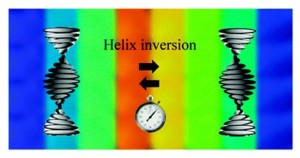
Dopants include overcrowded alkenes which undergo a stable to unstable (cis–trans) transition upon irradiation with UV light. This results in an unwinding and eventual inversion of the cholesteric helix. This is accompanied by a red-shift of the reflection band which then returns close to the original position. However, the handedness of the helix has changed, and therefore the polarization of the light has also changed.  

Helix inversion of a cholesteric liquid crystal.

An important parameter with all liquid crystals is their relaxation step which needs to be suitable for the envisioned application. Nathalie Katsonis and her team have studied cholesteric liquid crystals doped with overcrowded alkenes in an effort to find a general paradigm correlating relaxation kinetics with the rate of helix inversion.  

In their recent Communication, Katsonis’ group shows that the helix relaxation kinetics are fully determined by the kinetics of the light-sensitive dopants. The relaxation of the dopants from unstable to stable is unperturbed by the liquid crystalline environment.  

On the other hand, the presence of the dopants can dramatically accelerate helix inversion. Therefore the inversion can be time-programmed by judicious choice of the dopant. This opens up the great potential of fine tuning cholesteric liquid crystals for smart materials with sophisticated functions.  

For more, read this ‘HOT’ Chem Comm article in full:  

Time-programmed helix inversion in phototunable liquid crystals  

Sarah J. Aßhoff, Supitchaya Iamsaard, Alessandro Bosco, Jeroen J. L. M. Cornelissen, Ben L. Feringa and Nathalie Katsonis
Chem. Commun., 2013, Advance Article
DOI: 10.1039/C2CC37161H
Digg This
Reddit This
Stumble Now!
Share on Facebook
Bookmark this on Delicious
Share on LinkedIn
Bookmark this on Technorati
Post on Twitter
Google Buzz (aka. Google Reader)

True racemic crystals: Surprising new insights on preparation and structure

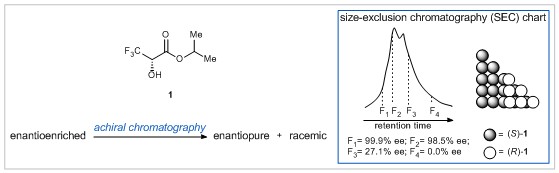
Isopropyl 3,3,3-trifluoro-2-hydroxypropanoate (1) is an important compound for the study of self-disproportionation of enantiomers (SDE), in which an enantiomerically enriched mixture can be separated into enantiopure and racemic portions under achiral conditions. This remarkable separation is made possible by the differences in physicochemical properties of enantiopure and racemic substances. Research led by Professor Vadim A. Soloshonok at the University of the Basque Country has now shed light on the unusual properties of racemic crystals of 1.

True racemic crystals were obtained by sublimation of a mixture of (S)- and (R)- crystal conglomerates at ambient temperature and atmospheric pressure. Surprisingly, when these racemic crystals were analysed, the unit cell was not dimeric in nature as previously thought, but rather contained two distinct (S)- and (R)- enantiomers with no heterochiral H-bonding. The preference of 1 for homochiral intermolecular interactions may explain its extraordinary ability for SDE. Indeed, Soloshonok and co-workers showed that achiral chromatography could be used to obtain enantiopure 1 from an original sample with just 75% ee (see above).

For more, read this ‘HOT’ Chem Comm article today:

Unconventional preparation of racemic crystals of isopropyl 3,3,3-trifluoro-2-hydroxypropanoate and their unusual crystallographic structure: the ultimate preference for homochiral intermolecular interactions

José Luis Aceña, Alexander E. Sorochinsky, Toshimasa Katagiri and Vadim A. Soloshonok
Chem. Commun., 2013, 49, 373–375
DOI: 10.1039/c2cc37491a
Digg This
Reddit This
Stumble Now!
Share on Facebook
Bookmark this on Delicious
Share on LinkedIn
Bookmark this on Technorati
Post on Twitter
Google Buzz (aka. Google Reader)

A new way to look at cancer cell detection

Cancer cell detection based on the interaction between an anticancer drug and cell membrane components

A novel cancer cell detection method, based on the interaction between daunomycin (DAN – an anticancer drug used in chemotherapy) and cell membrane components, has been developed by scientists in South Korea.

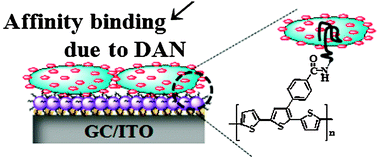
The method uses the electrochemical and fluorescence behaviour of DAN and uses an aptamer probe immobilised on a conducting polymer-gold nanoparticle composite film.

he aptamer sensor probes using electrochemical impedance spectroscopy and fluorescence microscopy. The method differentiates between cancerous and non-cancerous cells at low concentrations (0.01μM).

Read the ‘HOT’ Communication in full:

Cancer cell detection based on the interaction between an anticancer drug and cell membrane components
Pranjal Chandra , Hui-Bog Noh and Yoon-Bo Shim
Chem. Commun., 2013, DOI: 10.1039/C2CC38235K

Digg This
Reddit This
Stumble Now!
Share on Facebook
Bookmark this on Delicious
Share on LinkedIn
Bookmark this on Technorati
Post on Twitter
Google Buzz (aka. Google Reader)

Early Alzheimer’s diagnosis compound

Alzheimer’s disease is the most common form of dementia and, as there is no cure, early diagnosis is crucial for treatment to be effective. To this end, UK and US scientists have developed a labelled tracer compound that binds to plaques closely associated with Alzheimer’s disease (AD) so that the plaques can be picked up by a medical imaging technique.

The tracer compound is a [18F]-labelled barbiturate and is used with the imaging technique positron emission tomography (PET). Although other radiolabelled compounds have been used as PET tracers, using [18F]-labelled barbiturates for molecular imaging in AD has distinct advantages, such as good blood-brain barrier crossing ability, metabolic stability and easy accessibility.

Tree that looks like a face with some leaves blowing away to represent memory loss in Alzheimer's diseaseAs Alzheimer’s disease advances, symptoms can include confusion, irritability and aggression, and long-term memory loss © Shutterstock
 Matteo Zanda at the University of Aberdeen and colleagues, in conjunction with Pfizer in the US, developed several fluorinated barbiturate analogues. The key to developing an effective molecular imaging radiotracer is the ability to distinguish between a healthy individual and someone suffering from a neurological disease, such as AD, they say. Barbiturates have a strong capacity for forming structures with biopolymers and are effective metal ion chelators. As such, the team thought that they would bind to AD-related plaques, which consist of the biopolymer β-amyloid and metal cations, such as Zn(II) and Cu(II).

See the Chemistry World story in full or read the Chem Comm article:

18 F-barbiturates are PET tracers with diagnostic potential in Alzheimer’s disease
Elisa Calamai , Sergio Dall’Angelo , David Koss , Juozas Domarkas , Timothy J. McCarthy , Marco Mingarelli , Gernot Riedel , Lutz F. Schweiger , Andy Welch , Bettina Platt and Matteo Zanda
Chem. Commun., 2013,49, 792-794
DOI: 10.1039/C2CC38443D

Digg This
Reddit This
Stumble Now!
Share on Facebook
Bookmark this on Delicious
Share on LinkedIn
Bookmark this on Technorati
Post on Twitter
Google Buzz (aka. Google Reader)

Probing assembly of supramolecular architectures with non-linear optics

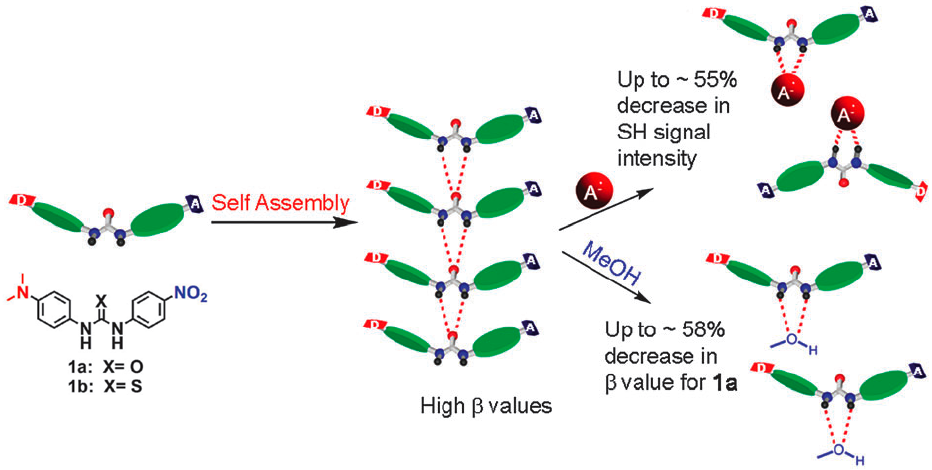
Molecules containing urea and thiourea groups are well known in supramolecular chemistry to self assemble into chains via hydrogen bonding interactions, which can be broken by interaction with ions or polar molecules.


Pritam Mukhopadhyay’s
group in New Delhi have found that, with the right functionalization, this can lead to interesting optical properties in solution.

Molecules such as 1a and 1b were found to have non-linear optical (NLO) behaviour in THF solution. On adding a polar molecule such as methanol, or a strongly coordinating anion such as acetate, the NLO behaviour was reduced. This corresponds to the self-assembled urea chains being disrupted by adding a guest that can compete for hydrogen bonding to the urea NH groups.

With this work, the authors have identified an effective new method to probe the assembly and disassembly of supramolecular architectures.

For more information, you can download the full article (free for a limited time) here.

Digg This
Reddit This
Stumble Now!
Share on Facebook
Bookmark this on Delicious
Share on LinkedIn
Bookmark this on Technorati
Post on Twitter
Google Buzz (aka. Google Reader)

ChemComm Emerging Investigator Lectureship: Nomination Deadline Friday 7 December

We are delighted to invite nominations for ChemComm Emerging Investigator Lectureship 2013. The lectureship, which is awarded annually, will recognise an emerging scientist in the early stages of their independent academic career. 

 Deadline for Nominations: 7 December 2012
Nominate now

To qualify
To be eligible for the ChemComm Emerging Investigator Lectureship, the candidate should have completed their PhD on or after 5th September 2004.

The candidate should also have published at least one article in ChemComm during the course of their independent career. 

Award details
The recipient of the award will be invited to present a lecture at three different locations over a 12 month period. It is expected that at least one of the locations will be a conference. The recipient will receive a contribution of £1500 towards travel and accommodation costs. S/he will also be presented with a certificate and be asked to contribute a ChemComm Feature Article.

Nominations
Those wishing to make a nomination should send the following details to the ChemComm Editorial Office by 7th December 2012: 

  • Recommendation letter, including the name, contact details and website URL of the nominee.  
  • A one page CV for the nominee, including their date of birth, summary of education and career, list of up to five independent publications, total numbers of publications and patents and other indicators of esteem and evidence of independence.
  • A copy of the candidate’s best publication to date (as judged by the nominator).
  • Two supporting letters of recommendation from two independent referees. These should not be someone from the same institution or the candidate’s post doc or PhD supervisor.

The nominator and independent referees are requested to comment on the candidate’s presenting skills. 

Please note that self nomination is not permitted.

Selection procedure
The ChemComm Editorial Board will draw up a short-list of candidates based on the information provided by the referees and nominator. Short-listed candidates will be asked to provide a supporting statement justifying why they deserve the award. The recipient of the award will then be selected and endorsed by the ChemComm Editorial Board. 

Previous winners

Hiromitsu Maeda 

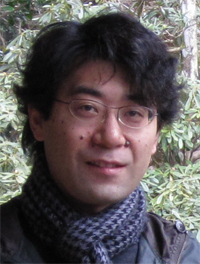
2012 Professor Hiromitsu Maeda (Ritsumeikan University, Japan) – he’ll be presented with his lecture certificate at ICPOC 21.
2011 Dr Scott Dalgarno (Heriot-Watt University, Edinburgh, UK) – Find out about his Emerging Investigator Lecture tour in China.
Digg This
Reddit This
Stumble Now!
Share on Facebook
Bookmark this on Delicious
Share on LinkedIn
Bookmark this on Technorati
Post on Twitter
Google Buzz (aka. Google Reader)