A macrocyclic ‘hole’ that fits round AND square molecular ‘pegs’

Researchers from the South University of Science and Technology of China have developed a structurally dynamic macrocycle, which is able to modulate the dimensions of its internal cavity and show binding affinities for molecular guests of a range of shapes and sizes.

As children, we learn very early on about the concept of shape and size complementarity. No matter how many times you try, the square peg doesn’t fit in the round hole, and that second (or third!) piece of cake just wasn’t a good idea. This same concept also extends to supramolecular interactions, especially when we consider the arena of host–guest chemistry.

Generally speaking, the conformation of a macrocyclic host is relatively rigid, which means that the scope of host molecules it can encase is also somewhat limited. Whilst this feature of host–guest chemistry and molecular recognition is the basis for a range of catalytic events and the template-directed synthesis of mechanically interlocked molecules, it would be advantageous in expanding the scope of this field if a macrocycle existed that could happily host a wide range of guest molecules.
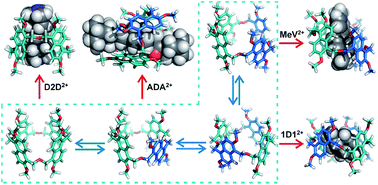
Wei Jiang and his team from the South University of Science and Technology of China have achieved this feat in the synthesis of a naphthalene-based macrocycle, oxatub[4]arene, that has the rigidity required of host–guest interactions, but, in addition, the flexibility necessary to adapt to and accommodate the chemical shape and size of a variety of guest molecules. Its naphthalene units are able to rotate, and in doing so generate four predominant conformers, each with different cavity depths and diameters, as well as different binding affinities for molecular guest molecules.

The dynamic nature of this unique macrocycle is an important step forward in the construction of host–guest complexes, especially as we look to introduce further complexity into the arsenal of supramolecular interactions we have at our disposal, and particularly in the development of increasingly multifaceted stimuli-responsive and molecular machines.

Read this hot ChemSci article in full – it’s open access and free to download:

Oxatub[4]arene: A smart macrocyclic receptor with multiple interconvertible cavities
Fei Jia, Zhenfeng He, Liu-Pan Yang, Zhi-Sheng Pan, Min Yi, Ren-Wang Jiang and Wei Jiang
Chem. Sci., 2015, Advance Article.
DOI: 10.1039/C5SC03251B, Edge Article

About the Writer:

Anthea Blackburn is a guest web writer for Chemical Science. Anthea is a recent graduate student hailing from New Zealand. She studied at Northwestern University in the US under the tutelage of Prof. Fraser Stoddart (a Scot), where she exploited supramolecular chemistry to develop multidimensional systems and study the emergent properties that arise in these superstructures. When time and money allowed, she ambitiously attempted to visit all 50 US states.

Digg This
Reddit This
Stumble Now!
Share on Facebook
Bookmark this on Delicious
Share on LinkedIn
Bookmark this on Technorati
Post on Twitter
Google Buzz (aka. Google Reader)

Hot Chemical Science articles for October

Take a look at this selection of recently published referee-recommended articles – all are open access and free to download.

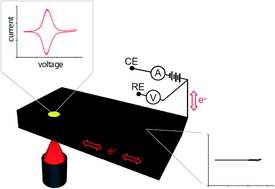
Connecting electrodes with light: one wire, many electrodes
Moinul H. Choudhury, Simone Ciampi, Ying Yang, Roya Tavallaie, Ying Zhu, Leila Zarei, Vinicius R. Gonçales and J. Justin Gooding
DOI: 10.1039/C5SC03011K, Edge Article

C5SC03011K GA


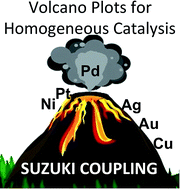
Linear scaling relationships and volcano plots in homogeneous catalysis – revisiting the Suzuki reaction
Michael Busch, Matthew D. Wodrich and Clémence Corminboeuf
DOI: 10.1039/C5SC02910D, Edge Article

C5SC02910D GA


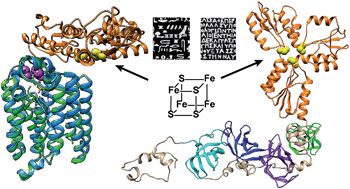
IspH–RPS1 and IspH–UbiA: “Rosetta stone” proteins
Guodong Rao, Bing O’Dowd, Jikun Li, Ke Wang and Eric Oldfield
DOI: 10.1039/C5SC02600H, Edge Article

C5SC02600H GA


An optoelectronic nose for identification of explosives
Jon R. Askim, Zheng Li, Maria K. LaGasse, Jaqueline M. Rankin and Kenneth S. Suslick
DOI: 10.1039/C5SC02632F, Edge Article

C5SC02632F GA

Digg This
Reddit This
Stumble Now!
Share on Facebook
Bookmark this on Delicious
Share on LinkedIn
Bookmark this on Technorati
Post on Twitter
Google Buzz (aka. Google Reader)

A sensor array with a nose for explosives

Hugh Cowley highlights a recent hot Chemical Science article

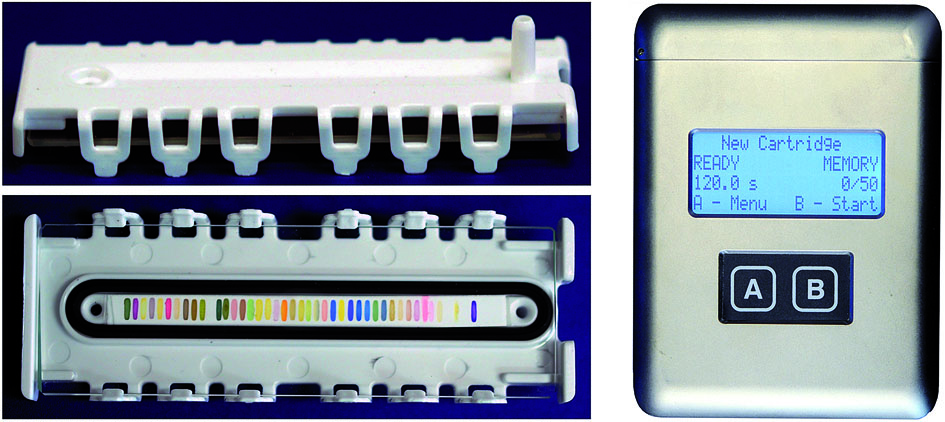
A portable optoelectronic device for accurately detecting a wide array of explosives has been reported in a recently published Chemical Science article.

Kenneth Suslick and co-workers from the University of Illinois at Urbana-Champaign, USA, have combined responsive dyes to differentiate between explosive compound groups with sensitivity up to ten times that of currently used methods.

This detection kit was able to distinguish:

  • common explosives
  • compounds related to home-made explosives
  • compounds found in improvised explosive devices
  • signature non-explosive compounds found in military-grade explosives

Integration of the colorimetric array with a hand-held reader based on business card scanners means there is no need for specialist expertise by the user. Its fast scan rates, portability and lack of moving parts could find use in accompanying existing security technology.


Read the original article in Chemical Science – it’s open access:

An optoelectronic nose for identification of explosives
Jon R. Askim, Zheng Li, Maria K. LaGasse, Jaqueline M. Rankin and Kenneth S. Suslick
DOI: 10.1039/C5SC02632F, Edge Article
Open Access

Digg This
Reddit This
Stumble Now!
Share on Facebook
Bookmark this on Delicious
Share on LinkedIn
Bookmark this on Technorati
Post on Twitter
Google Buzz (aka. Google Reader)

Subtle forces yield profound effects on heavy element bonding

Jason Woolford writes about a hot Chemical Science article for Chemistry World

Using theoretical calculations, researchers in the US and Japan, have cast a spotlight on the vital role that subtle, and previously overlooked, dispersion forces play in stabilising p-block heavy element bonding.

It was once thought that heavy elements could not form multiple bonds, but landmark work by inorganic chemists such as Mike Lappert in the 1970s blew the doors off this notion and opened up a whole new world for main group chemistry. Since then, the study of heavier p-block elements with multiple bonds has remained a topic of broad interest and exciting discoveries. One key development was that sterically large ligands block decomposition and stabilise bonds. However, questions over how and why these compounds remain stable continue to be debated. Read the full article in Chemistry World»


Read the original journal article in Chemical Science – it’s open access:
The multiple bonding in heavier group 14 element alkene analogues is stabilized mainly by dispersion force effects
Jing-Dong Guo, David J. Liptrot, Shigeru Nagase and Philip P. Power 
DOI: 10.1039/C5SC02707A, Edge Article

Digg This
Reddit This
Stumble Now!
Share on Facebook
Bookmark this on Delicious
Share on LinkedIn
Bookmark this on Technorati
Post on Twitter
Google Buzz (aka. Google Reader)

Hypervalent bonding controversy out for the electron count?

Hugh Cowley writes about a hot Chemical Science article for Chemistry World

Durrant has proposed a simple but quantitative measure of hypervalency

A researcher in the UK has presented a controversial new definition for hypervalency that may ignite debates over atomic charge and allow students to draw nitrogen atoms with five covalent bonds.

Marcus Durrant from the University of Northumbria describes his account of hypervalency as going back to the drawing board. By bringing together electron counts on atoms in different resonance structures, he presents a valence electron equivalent parameter to indicate an overall number of electrons associated with each atom. A count greater than eight defines hypervalency. Read the full article in Chemistry World»


Read the original journal article in Chemical Science – it’s open access:
A quantitative definition of hypervalency
Marcus C. Durrant 
DOI: 10.1039/C5SC02076J, Edge Article

Digg This
Reddit This
Stumble Now!
Share on Facebook
Bookmark this on Delicious
Share on LinkedIn
Bookmark this on Technorati
Post on Twitter
Google Buzz (aka. Google Reader)

Hot Chemical Science articles for September

Here are some of the latest referee-recommended articles published in Chemical Science – all are open access and free to read:

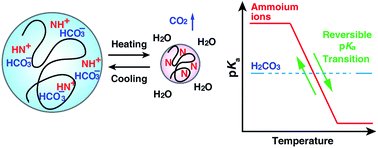
Design rationale of thermally responsive microgel particle films that reversibly absorb large amounts of CO2: fine tuning the pKa of ammonium ions in the particles
Mengchen Yue, Yu Hoshino and Yoshiko Miura 
DOI: 10.1039/C5SC01978H, Edge Article

C5SC01978H GA


Singly and doubly ß-to-ß platinum-bridged porphyrin dimers and their reductive eliminations
Hua-Wei Jiang, Takayuki Tanaka and Atsuhiro Osuka 
DOI: 10.1039/C5SC02553B, Edge Article

C5SC02553B GA


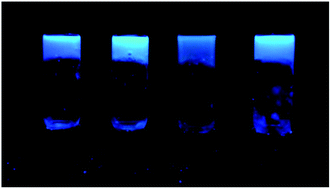
Fluorescent carbon dot–molecular salt hydrogels
Angelina Cayuela, Stuart R. Kennedy, M. Laura Soriano, Christopher D. Jones, Miguel Valcárcel and Jonathan W. Steed 
DOI: 10.1039/C5SC01859E, Edge Article

C5SC01859E GA


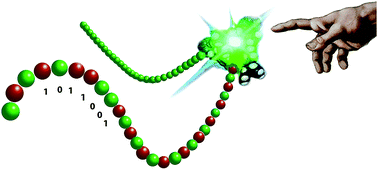
Molecular computing: paths to chemical Turing machines
Shaji Varghese, Johannes A. A. W. Elemans, Alan E. Rowan and Roeland J. M. Nolte 
DOI: 10.1039/C5SC02317C, Perspective

C5SC02317C GA


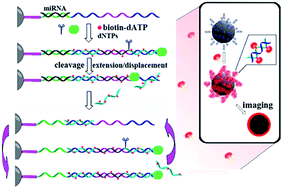
Lab on a single microbead: an ultrasensitive detection strategy enabling microRNA analysis at the single-molecule level
Xiaobo Zhang, Chenghui Liu, Lingbo Sun, Xinrui Duan and Zhengping Li 
DOI: 10.1039/C5SC02641E, Edge Article

C5SC02641E GA

Digg This
Reddit This
Stumble Now!
Share on Facebook
Bookmark this on Delicious
Share on LinkedIn
Bookmark this on Technorati
Post on Twitter
Google Buzz (aka. Google Reader)

Individual microRNA molecules detected with a single microbead

Christopher Barnard writes about a hot Chemical Science article for Chemistry World

An elegant strategy for detecting minuscule quantities of microRNA using just a single functionalised microbead could be an important innovation for biomedical research and molecular diagnostics.

Identifying biomolecules with vanishingly small copy numbers in cells is vital in deciphering the chemical blueprint for life. Homogeneous exponential amplification methods (such as the polymerase chain reaction), northern blotting, microarray detection and the isothermal exponential amplification reaction (EXPAR) are just some of the techniques that have undergone extensive tailoring to detect all manner of genetic material in cells as sensitively as possible. However, few approaches have even come close to reliably detecting nucleic acids at the single molecule level. Read the full article in Chemistry World»


Read the original journal article in Chemical Science – it’s open access:
Lab on a single microbead: an ultrasensitive detection strategy enabling microRNA analysis at the single-molecule level
Xiaobo Zhang, Chenghui Liu, Lingbo Sun, Xinrui Duan and Zhengping Li 
Chem. Sci., 2015, Advance Article
DOI: 10.1039/C5SC02641E, Edge Article

Digg This
Reddit This
Stumble Now!
Share on Facebook
Bookmark this on Delicious
Share on LinkedIn
Bookmark this on Technorati
Post on Twitter
Google Buzz (aka. Google Reader)

Probing for a better way to detect important antioxidants in cells

Iain Larmour is a guest web writer for ChemSci. He has researched a wide variety of topics during his years in the lab including nanostructured surfaces for water repellency and developing nanoparticle systems for bioanalysis by surface enhanced optical spectroscopies. He currently works in science management. In his spare time he enjoys reading, photography, art and inventing.

Glutathione is an antioxidant enzyme and the most abundant biothiol in human cells. It plays a crucial role in protecting cells against oxidative damage from various toxins that the body produces. However, abnormal levels of glutathione can lead to oxidative stress, which in turn can lead to premature aging and conditions such as Alzheimer’s or Parkinson’s disease. 

There is, therefore, a need for the selective detection of glutathione, so that its role in biological systems can be better understood. However, it is challenging to design a selective fluorescent probe for a specific biothiol due to the structural and reactivity similarities with other biothiols. This is the challenge that David Churchill and team from the Department of Chemistry at the Korea Advanced Institute of Science and Technology set out to meet.

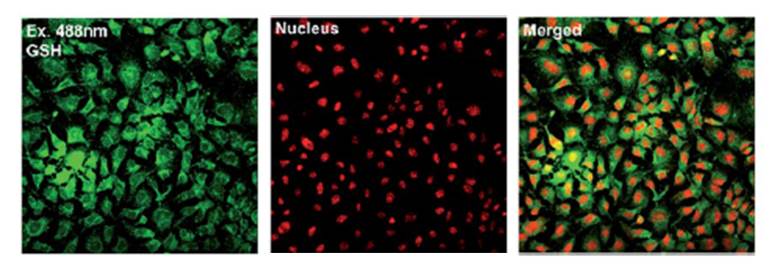
Fluorescence response seen in Hep3B cells treated with the probe molecule

The team has previously explored the use of fluorescent probes containing selenium as the reactive centre and they have taken a similar approach with this challenge, using a phenylselenide group. The images below show the phenylselenide probe reacting with cellular glutathione, which fluoresces green in the images. The intensity of the fluorescence was around a hundred times greater than for cysteine or homocysteine, which are closely related to glutathione.

Until now, there has been no probe that can selectively detect glutathione in real time, so it will be interesting to see what future results come from this advance.

To read the details, download the Chemical Science article and read it in full – it’s open access:
Exceptional time response, stability and selectivity in doubly-activated phenyl selenium-based glutathione-selective platform
Youngsam Kim, Sandip V. Mulay, Minsuk Choi, Seungyoon B Yu, Sangyong Jon and David G Churchill
Chem. Sci., 2015, 6, Advance Article
DOI: 10.1039/C5SC02090E 

Digg This
Reddit This
Stumble Now!
Share on Facebook
Bookmark this on Delicious
Share on LinkedIn
Bookmark this on Technorati
Post on Twitter
Google Buzz (aka. Google Reader)

Antioxidant assumptions flipped for garlic thiosulfinates

Jessie-May Morgan writes about a hot Chemical Science article for Chemistry World

Garlic bulbs

Garlic is often called the world's oldest know medicine © Shutterstock

New mechanistic investigations at the interface of chemistry and biology reveal thiosulfinates of garlic and petiveria are not the superstars of the antioxidant world they were once thought to be.

Allicin, a thiosulfinate from garlic, well-known for its potent antimicrobial activity, is a popular molecule under investigation for its medicinal potential to treat diseases such as cardiovascular and neurodegenerative diseases. It has long been hoped that its biocidal properties would translate into therapeutic effects in human cells. Previous studies carried out in organic solution indicated that allicin and petivericin, an analogous thiosulfinate derived from the South American plant Petiveria alliacea, were potent radical-trapping antioxidants because they decompose to give sulfenic acids that reduced free radicals and inhibited the undesirable oxidation of important biomolecules. Read the full article in Chemistry World»


Read the original journal article in Chemical Science:
The medicinal thiosulfinates from garlic and Petiveria are not radical-trapping antioxidants in liposomes and cells, but lipophilic analogs are
Bo Li, Feng Zheng, Jean-Philippe R. Chauvin and Derek A. Pratt 
Chem. Sci., 2015, Advance Article
DOI: 10.1039/C5SC02270C, Edge Article

Digg This
Reddit This
Stumble Now!
Share on Facebook
Bookmark this on Delicious
Share on LinkedIn
Bookmark this on Technorati
Post on Twitter
Google Buzz (aka. Google Reader)

Streamlined synthesis yields longer sugar chains

Emma Cooper writes about a hot Chemical Science article for Chemistry World

By using bigger building blocks, scientists in the UK have shown they can make much longer oligosaccharide sequences than previously possible.

The traditional synthetic route to long chain oligosaccharides is drawn out and complicated; they require numerous steps to produce the precursor tetrasaccharides, then further steps to connect these precursors into long chains. Normally they’re made by an iterative two block process, generating chains up to 12 units long. Now, a four block approach, developed by John Gardiner and colleagues at the University of Manchester, significantly reduces the number of steps enabling longer sugar lengths from 16 up to 40 units. Read the full article in Chemistry World»


Read the original journal article in Chemical Science – it’s open access:
Making the longest sugars: a chemical synthesis of heparin-related [4]n oligosaccharides from 16-mer to 40-mer
Steen U. Hansen, Gavin J. Miller, Matthew J. Cliff, Gordon C. Jayson and John M. Gardiner 
Chem. Sci., 2015, Advance Article
DOI: 10.1039/C5SC02091C, Edge Article

Digg This
Reddit This
Stumble Now!
Share on Facebook
Bookmark this on Delicious
Share on LinkedIn
Bookmark this on Technorati
Post on Twitter
Google Buzz (aka. Google Reader)