Archive for the ‘Hot Articles’ Category

HOT Chem Sci articles for June

Optimising in situ click chemistry: the screening and identification of biotin protein ligase inhibitors
Andrew D Abell, William Tieu, Tatina Soares da Costa, Min Yap, Kelly Keeling, Matthew C. J. Wilce, John Wallace, Grant Booker and Steven William Polyak
Chem. Sci., 2013, Accepted Manuscript
DOI: 10.1039/C3SC51127H, Edge Article

Free to access until 28th July 2013


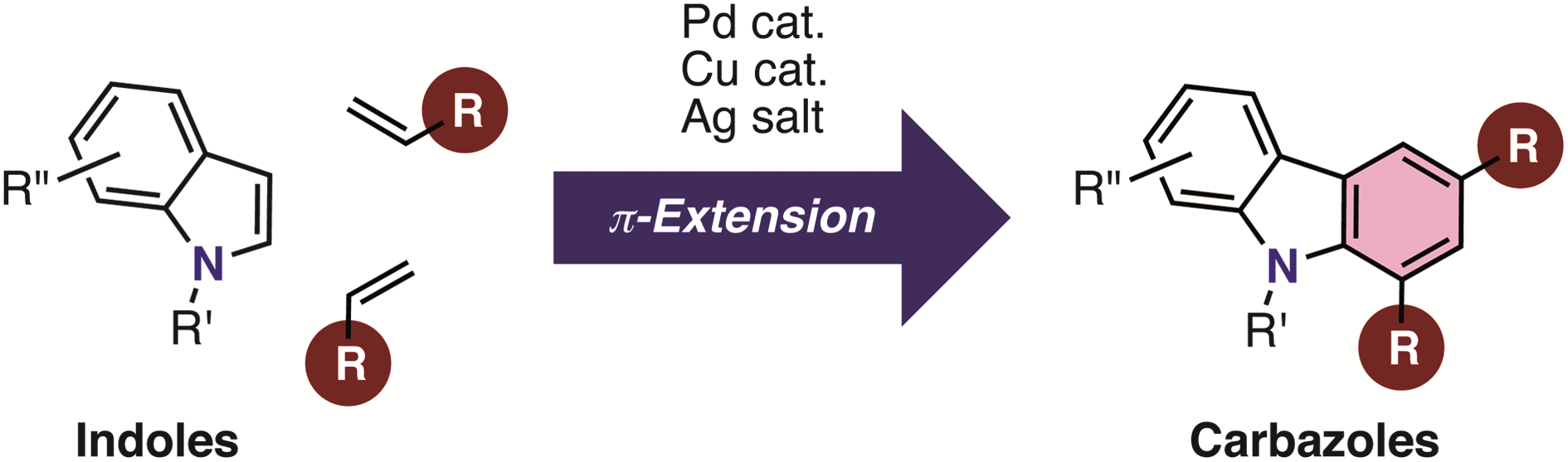
One-shot indole-to-carbazole p-extension by Pd-Cu-Ag trimetallic system
Kyohei Ozaki, Hua Zhang, Hideto Ito, Aiwen Lei and Kenichiro Itami
Chem. Sci., 2013, Advance Article
DOI: 10.1039/C3SC51447A, Edge Article

Free to access until 28th July 2013


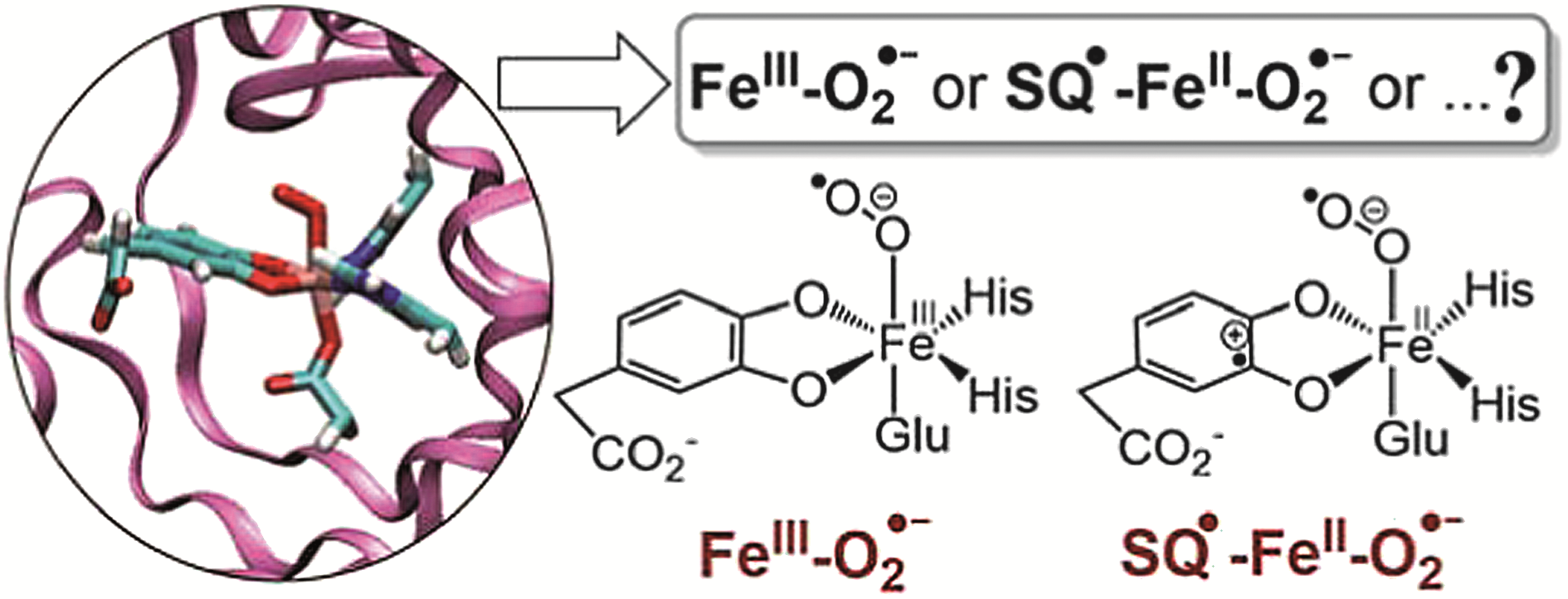
Oxygen activation by homoprotocatechuate 2,3-dioxygenase: a QM/MM study reveals the key intermediates in the activation cycle
Wenzhen Lai, Geng Dong and Sason Shaik
Chem. Sci., 2013, Accepted Manuscript
DOI: 10.1039/C3SC51147B, Edge Article

Free to access until 28th July 2013

Click here for more free HOT Chemical Science articles for June!

Digg This
Reddit This
Stumble Now!
Share on Facebook
Bookmark this on Delicious
Share on LinkedIn
Bookmark this on Technorati
Post on Twitter
Google Buzz (aka. Google Reader)

Two labels, two locations, one protein

Research reported in Chemical Science describes a new method for labelling proteins with two different chemical components at two separate, selected locations on the protein structure.

Scientists in the UK used the local protein microenvironment to control the outcome of reactions between cysteine residues on the surface of a double cysteine mutant of green fluorescent protein (GFP).

They formed sulfonium salts of the two cysteine residues and found that, dependent on the different environments of their α-protons, one underwent an elimination reaction to form a dehydroalanine while the other residue was protected from elimination by another part of the protein. They were able to convert this second sulfonium salt to an azide, presenting two different functional groups on the protein that could react in different ways to label the protein surface.

The team demonstrated that they could successfully label the protein with both an alkyne dye via the azide and a simple thiol via the dehydroalanine, presenting a simple method for site-selective dual labelling of proteins.

Read this ‘HOT’ Chemical Science article today for free:

A novel approach to the site-selective dual labelling of a protein via chemoselective cysteine modification
Ramiz I. Nathani, Paul Moody, Vijay Chudasama, Mark E. B. Smith, Richard J. Fitzmaurice and Stephen Caddick*
Chem. Sci., 2013, Advance Article
DOI: 10.1039/C3SC51333E

Digg This
Reddit This
Stumble Now!
Share on Facebook
Bookmark this on Delicious
Share on LinkedIn
Bookmark this on Technorati
Post on Twitter
Google Buzz (aka. Google Reader)

Homogeneous catalysis for nanoscale surface designs

Scientists in France have combined homogeneous catalysis and atomic force microscopy to create intricate surface patterns.

Atomic Force Microscopy (AFM) works by dragging a sharp tip across a material’s surface to map nanoscale surface topologies or measure surface interactions. Innovations in the design of AFM tips have allowed AFM to become a tool, not only for reading, but also for writing onto surfaces, analogous to creating tattoos on a molecular scale.

To date, AFM tips have only been able to use a narrow range of chemical transformations, including heterogeneous catalysis, to create patterns on a surface.

Now, Jean-Luc Parrain, Sylvain Clair, Olivier Chuzel and colleagues from Aix Marseille University and the National Centre for Scientific Research (CNRS), have attached a homogeneous catalyst to a commercially available AFM probe and used it to carry out…

Continue reading the full article in Chemistry World »

Read the original journal article in Chemical Science:
Grafting a homogeneous transition metal catalyst onto a silicon AFM probe: a promising strategy for chemically constructive nanolithography
Dmitry A. Valyaev, Sylvain Clair, Lionel Patrone, Mathieu Abel, Louis Porte, Olivier Chuzel and Jean-Luc Parrain  
Chem. Sci., 2013, 4, 2815-2821
DOI: 10.1039/C3SC50979F

Digg This
Reddit This
Stumble Now!
Share on Facebook
Bookmark this on Delicious
Share on LinkedIn
Bookmark this on Technorati
Post on Twitter
Google Buzz (aka. Google Reader)

Splitting the sea

Image of the sun setting over the sea

© Shutterstock

Scientists in Australia are closer to harvesting hydrogen from two of the most abundant and naturally occurring resources in our environment – seawater and sunlight.

Water oxidation, the first part of the water splitting reaction that can produce hydrogen, is difficult as it is so kinetically unfavourable. Using photocatalysts to overcome this energy barrier is appealing as sunlight can supply the required energy rather than needing electrical or thermal energy.

Unlike some photocatalytic water oxidation methods that use catalysts mounted on a semiconductor to form an electrode, a team, led by Jun Chen and Gerhard Swiegers, from the University of Wollongong, Australia, have shown that…

Continue reading the full article in Chemistry World »

Read the original journal article in Chemical Science:
A light-assisted, polymeric water oxidation catalyst that selectively oxidizes seawater with a low onset potential
Jun Chen, Pawel Wagner, Lei Tong, Danijel Boskovic, Weimin Zhang, David Officer, Gordon G. Wallace and Gerhard F. Swiegers  
Chem. Sci., 2013, 4, 2797-2803
DOI: 10.1039/C3SC50812A

Digg This
Reddit This
Stumble Now!
Share on Facebook
Bookmark this on Delicious
Share on LinkedIn
Bookmark this on Technorati
Post on Twitter
Google Buzz (aka. Google Reader)

Sensing zinc beyond the cell

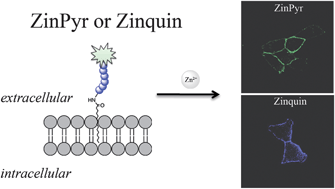
Research published in Chemical Science describes the design of a new fluorescent probe that can sense ‘mobile’ zinc outside cells by using a targeting peptide that delivers the probe to the extracellular side of the plasma membrane.

Understanding zinc signalling is a significant area of interest in biological studies. Readily-exchangeable or ‘mobile’ zinc is important in human health and has been shown to have a role in the function of the pancreas, prostate and central nervous system. Current fluorescent zinc sensors tend to be based on small molecules that readily diffuse across cell membranes to give information on zinc in the intracellular environment, but it is difficult to predict how these sensors are distributed beyond the cell membrane where it would be useful to monitor zinc ions released by cells.

Scientists in the United States have developed a design for a zinc sensor that is directed the extracellular plasma membrane by attaching the zinc-signalling fluorophore to a membrane-targeting peptide scaffold. The probes can be readily prepared by solid-phase synthesis to insert the targeting peptide between the fluorophore and a fatty acid that anchors the probe to the cell membrane. The scientists conducted live cell imaging experiments that gave a positive signal for zinc in the plasma membranes of the cells.

zinc signal

Read the ‘HOT’ article for free today:

Peptide-based targeting of fluorescent zinc sensors to the plasma membrane of live cells
Robert J. Radford,a Wen Chyana and Stephen J. Lippard*a
Chem. Sci., 2013, Advance Article, DOI: 10.1039/C3SC50974E

Digg This
Reddit This
Stumble Now!
Share on Facebook
Bookmark this on Delicious
Share on LinkedIn
Bookmark this on Technorati
Post on Twitter
Google Buzz (aka. Google Reader)

The chemistry behind anion transport

An essential feature of cell function and development is the transportation of molecules across the cell wall.

The maxim of ‘like dissolves like’ is well known by every high school chemist and is the reason why the cell itself does not dissolve; the cell wall and the water outside it naturally repel each other.

Whilst this is excellent news for the stability of the cell, it presents a problem for the water-soluble molecules trying to get into the cell.  If such a molecule is dissolved in water outside of the cell then it follows that it will be unhappy passing through the greasy cell wall.

Nature as always has a solution and solves this problem by effectively wrapping up these molecules in an oily layer making transport across the cell wall more efficient.  A similar concept is responsible for the cleaning action of detergent in a dirty cooking pan.

This transportation is of particular interest to the pharmaceutical industry where transport of small drug molecules into cells is of paramount importance.  Drugs can have remarkable activity in a laboratory experiment but if it cannot find its way into the cell then it will be unable to achieve this in a person.  Understanding the factors which control this process is therefore crucial.

Prof. Philip Gale’s research group at the University of Southampton along with co-workers at the Universidade de Aveiro have published a detailed and systematic study which highlights some critical features of molecules which are capable of fulfilling this role.

Interested in more?  Read this HOT Chem Sci Edge article now!

Towards predictable transmembrane transport: QSAR analysis of anion binding and transport
Nathalie Busschaert, Samuel J. Bradberry, Marco Wenzel, Cally J. E. Haynes, Jennifer R. Hiscock, Isabelle L. Kirby, Louise E. Karagiannidis, Stephen J. Moore, Neil J. Wells, Julie Herniman, G. John Langley, Peter N. Horton, Mark E. Light, Igor Marques, Paulo J. Costa, Vítor Félix, Jeremy G. Frey and Philip A. Gale
Chem. Sci., 2013, Advance Article
DOI: 10.1039/C3SC51023A

Ruaraidh McIntosh is a guest web-writer for Chemical Science.  His research interests include supramolecular chemistry and catalysis.  When not working as a Research Fellow at Heriot-Watt University, Ruaraidh can usually be found in the kitchen where he has found a secondary application for his redoubtable skills of burning and profanity.

Digg This
Reddit This
Stumble Now!
Share on Facebook
Bookmark this on Delicious
Share on LinkedIn
Bookmark this on Technorati
Post on Twitter
Google Buzz (aka. Google Reader)

A chiral, responsive handle on poly(phenylacetylene) properties

In this Chemical Science Edge article, researchers from the Center for Research in Biological Chemistry and Molecular Materials (CIQUS) and Department of Organic Chemistry at the University of Santiago de Compostela, describe a highly elegant method of controlling and changing the helical sense and elongation of poly(phenylacetylene)s.  This is achieved via modifying the polymer backbone with a chiral group which responds to different solvent environments in a reliable way.  The system seems ideal for chemical sensor technology development.

The polymer highlighted in the article is a poly(phenylacetylene) derivatised with a chiral methoxytrifluoro-phenylacetic acid (MTPA) group.  The monomer was prepared from the alkyne 4-ethynylaniline, (R)-α-methoxy-α-(trifluoromethyl)phenylacetic acid and oxalyl chloride in two steps.  Subsequent polymerization was carried out using a rhodium norbornadiene dimer catalyst, under argon, and the polymer was precipitated from a tetrahydrofuran (THF) solution using methanol and hexane.

The key to the effects described in changes to the polymer properties is due to the chemical structure of the pendant group, which contains an amide and a chiral centre, giving rise to four stereoisomers.  The amide group function can result in cis or trans geometry, and the carbonyl and chiral centre yield syn (sp) or anti-periplanar (ap) conformers.

In a range of solvents, the resultant 4 states of this moiety have profound and different effects on the elongation and the sense (or direction), and tightness (compression or elongation), of the helical polymer.  The effect is shown here:
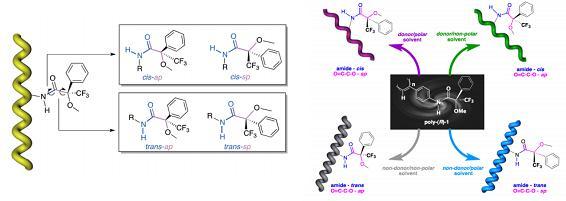
Solvent donor effects which destabilise the amide group to a cis orientation were proven by UV-Vis spectroscopy to elongate and change the sense of the helicate.  A bathochromic shift was observed.  The authors suggest that solvent polarity plays a greater role with the carbonyl-methoxy group in changing the sense (or direction) of the helicate, via circular dichroism measurements. Overall, any destabilisation in the pendant group is accomodated in the polymer backbone, via a change in the orientation and elongation of the helicate, resulting in a new stable state.

Sequential stimulation of the two functional groups was performed, as were experiments using thin films of the polymer. A large amount of analytical data: IR, NMR, UV-Vis, Raman spectroscopy and differential scanning calorimetry (DSC) is presented, as are atomic force microscopy (AFM) measurements and findings from molecular mechanics calculations.

This work should prove of interest to polymer chemists and sensor researchers alike, and to the wider scientific community.

Controlled Modulation of the Helical Sense and Elongation of Poly(phenylacetylene)s by Polar and Donor Effects
Ricardo Riguera, Felix Freire, Seila Leiras, José Manuel Seco and Emilio Quiñoá
Chem. Sci., 2013, Accepted Manuscript
DOI: 10.1039/C3SC50835H

Kevin Murnaghan is a guest web-writer for Chemical Science. He is currently a Research Chemist in the Adhesive Technologies Business Sector of Henkel AG & Co. KGaA, based in Düsseldorf, Germany. His research interests focus primarily on enabling chemistries and technologies for next generation adhesives and surface treatments. Any views expressed here are his personal ones and not those of Henkel AG & Co. KGaA.


Digg This
Reddit This
Stumble Now!
Share on Facebook
Bookmark this on Delicious
Share on LinkedIn
Bookmark this on Technorati
Post on Twitter
Google Buzz (aka. Google Reader)

Selective sulfane sulfur detection

Scientists in the US have made two fluorescent probes that can distinguish persulfides and polysulfides from hydrogen sulfide. This work paves the way for developing non-destructive probes for sulfane sulfurs that can be used in living cells and even in vivo.

Fluorescence image of a polysulfide in H9c2 cells

Fluorescence image of a polysulfide in H9c2 cells

Sulfane sulfurs – which feature divalent sulfur atoms bonded to other sulfur – appear in a number of biologically important compounds. They include thiocysteine and thiocystine, two products of cysteine metabolism which are found at higher than normal concentrations in cancer cells. Until now, the only selective methods for detecting sulfane sulfurs were destructive and could therefore not be used for real-time imaging.

Now, Ming Xian and colleagues at Washington State University have designed a probe for sulfane sulfurs and tested it on living cells.

Continue reading the full article in Chemistry World »

Read the original journal article in Chemical Science:
New fluorescent probes for sulfane sulfurs and the application in bioimaging
Wei Chen, Chunrong Liu, Bo Peng, Yu Zhao, Armando Pacheco and Ming Xian  
Chem. Sci., 2013, Advance Article
DOI: 10.1039/C3SC50754H, Edge Article

Digg This
Reddit This
Stumble Now!
Share on Facebook
Bookmark this on Delicious
Share on LinkedIn
Bookmark this on Technorati
Post on Twitter
Google Buzz (aka. Google Reader)

Dynamic and bio-orthogonal protein assembly along a supramolecular polymer

Scientists from the Netherlands show how supramolecular polymers can be used to steer the assembly of proteins in a reversible, dynamic manner.

Synthetic supramolecular polymers have already shown great potential in the materials field, but their potential to target biological systems has been underexplored until now. This is surprising considering their self-assembling nature, providing access to structures and molecular properties analogous to biological systems.

The synthesis of a mono-functional discotic molecule, forming supramolecular columnar polymers, allows for the site-selective, covalent attachment of proteins. The supramolecular polymer, displaying the proteins along the columns, acts as a dynamic framework; the simultaneous conjugation of two different proteins enables their assembly in close proximity, resulting in efficient energy transfer. The dynamic nature of the protein-conjugated discotic monomers in the supramolecular polymers allows the exchange of supramolecular building blocks between the columns and tuning of protein density.

The concept of supramolecular polymers displaying proteins could bridge the gap between synthetic and biological systems, providing entry to create dynamic multi- and heterovalent protein assemblies with a responsive nature.

Read the ‘HOT’ Chemical Science article:

 Dynamic and bio-orthogonal protein assembly along a supramolecular polymer
Katja Petkau-Milroy, Dana A. Uhlenheuer, A. J. H. Spiering, Jef A. J. M. Vekemans and Luc Brunsveld
Chem. Sci., 2013, Advance Article, DOI: 10.1039/C3SC50891A

Digg This
Reddit This
Stumble Now!
Share on Facebook
Bookmark this on Delicious
Share on LinkedIn
Bookmark this on Technorati
Post on Twitter
Google Buzz (aka. Google Reader)

Controlling the bonding/debonding of polymer systems

Controlling polymer debonding/rebonding properties using responsive materials is an exciting emerging area of chemistry and it is widely accepted that control of these properties can be achieved by engineering the functional end-groups responsible for monomer dynamic bonding.

Scientists in Germany and Australia report that the control of the bonding/debonding properties in materials obtained by Diels–Alder reactions between difunctional polymeric building blocks can also be governed by entropy considerations such as chain length and branching of the building blocks. They have shown this theoretically and experimentally for two Diels–Alder polymer systems, each based on a different difunctional diene and a common difunctional dienophile.

This interesting finding will help polymer and materials chemists transform the approach they take to designing reversibly/dynamically bonding materials and could aid the development of self-healing materials.

Read this ‘HOT’ Chemical Science article, hot off the press:

Harnessing entropy to direct the bonding/debonding of polymer systems based on reversible chemistry
N K Guimard et al, Chem. Sci., 2013, DOI: 10.1039/c3sc50642h

Digg This
Reddit This
Stumble Now!
Share on Facebook
Bookmark this on Delicious
Share on LinkedIn
Bookmark this on Technorati
Post on Twitter
Google Buzz (aka. Google Reader)