Archive for the ‘Hot Articles’ Category

Synthetic Porphyrin Nanorings as Biomimetic Light Harvesters

In this Chemical Science Edge Article, the Anderson group and colleagues at the Universitiy of Oxford describe ultra-fast light harvesting materials which function in a similar way to various natural light harvesters, like, for example, those found in the chlorophyll assemblies of purple bacteria. These materials represent excellent candidates for use in next generation carbon based solar cells. 

The materials, which may contain up to 24 porphyrin units separated by conjugating butadiyne bridges, can measure up to 10nm in diameter. Recent advances in template directed synthesis mean these molecules have become more accessible.

Barriers to energy delocalisation are overcome due to distortions that occur in the molecular structure. A rigidifying template was used to probe the effect of distortions – without a coordinating constraint present, significantly different behaviour was observed, underlying the importance of flexibility to the behaviour observed.
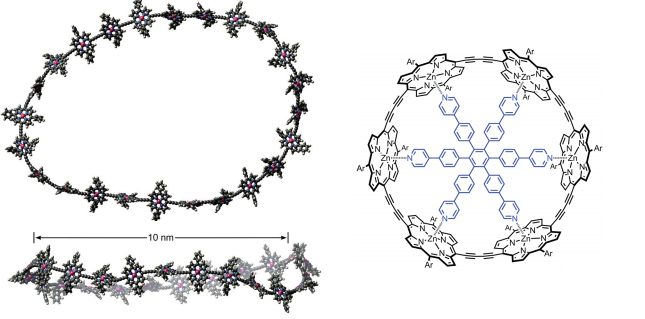
24 prophyrin containing nanoring, and an example of a 6 unit ring containing a rigidifying template


Physical techniques were used to characterise the complex phenomena being observed, including time resolved photoluminescence spectroscopy, using femtosecond LASERs and steady state fluorescence. Further information about electronic structure was gained by comparing spectra of the ring structures with those of  linear oligomeric analogues. 

The authors describe synthetic materials which show a level of light harvesting and rapid energy delocalising ability, usually only seen in natural systems. The promise of technological applications which exploit these properties will drive the study of the fundamental physics and chemistry of such fascinating systems. 

Read this Chemical Science Edge Article today: 

Ultrafast Delocalisation of excitation in synthetic light-harvesting nanorings
Chaw-Keong Yong, Patrick Parkinson, Dmitry V. Kondratuk, Wei-Hsin Chen, Andrew Stannard, Alex Summerfield, Johannes K. Sprafke, Melanie C. O’Sullivan, Peter H. Beton, Harry L. Anderson and Laura M. Herz.
DOI: 10.1039/C4SC02424A

Digg This
Reddit This
Stumble Now!
Share on Facebook
Bookmark this on Delicious
Share on LinkedIn
Bookmark this on Technorati
Post on Twitter
Google Buzz (aka. Google Reader)

Benchtop NMR gives feedback in flow

Flow reactors are edging towards self-regulation, thanks to researchers in the UK.

Inspired by previous self-optimised flow systems with in-line analytical monitoring, Lee Cronin’s group at the University of Glasgow has extended this concept so that multinuclear and 2D NMR can be performed in the fume hood.


Read the full article in Chemistry World»

Read the original journal article in Chemical Science:
A Self Optimizing Synthetic Organic Reactor System Using Real-time In-line NMR spectroscopy
Lee Cronin, Victor Sans, Luzian Porwol and Vincenza Dragone  
Chem. Sci., 2014, Accepted Manuscript
DOI: 10.1039/C4SC03075C, Edge Article

Digg This
Reddit This
Stumble Now!
Share on Facebook
Bookmark this on Delicious
Share on LinkedIn
Bookmark this on Technorati
Post on Twitter
Google Buzz (aka. Google Reader)

Expanding the supramolecular toolbox

Macrocyclic scaffolds have been hugely influential in supramolecular chemistry and now scientists in China have synthesised a new addition to this pool of chemical building blocks.

The biphen[n]arene macrocycles, created by Chunju Li of Shanghai University and colleagues, are based on 4,4’-biphenol and are reminiscent of popular phenol and biphenol based macrocycles such as  calix[n]arenes, resorcin[n]arenes and pillar[n]arenes.

Macrocyclic arenes play a very important role in supramolecular chemistry


Read the full article in Chemistry World»

Read the original journal article in Chemical Science:
Biphen[n]arenes
Huanqing Chen, Jiazeng Fan, Xiaoshi Hu, Junwei Ma, Shilu Wang, Jian Li, Yihua Yu, Xueshun Jia and Chunju Li  
Chem. Sci., 2015, Advance Article
DOI: 10.1039/C4SC02422B, Edge Article

Digg This
Reddit This
Stumble Now!
Share on Facebook
Bookmark this on Delicious
Share on LinkedIn
Bookmark this on Technorati
Post on Twitter
Google Buzz (aka. Google Reader)

Switching activation modes in an organocatalyst

The ability to select which common building blocks of a mixture react, producing different products on demand, holds great promise for chemical synthesis. Think about systems where you have to add a great deal of additional components to prevent one reaction route and initiate another; wouldn’t it be simpler if you could add just one component that switches the chemical transformation?

This is what David Leigh and his team from the School of Chemistry at The University of Manchester have done. They have created a rotaxane with two different activation sites which promote different reactions and thus different products in the same mixture. The macrocycle position within the rotaxane is controlled and leads to one of the active sites being blocked while the other is active.

Switchable Rotaxane Organocatalyst – the position of the macrocycle either blocks or reveals one of the catalytic sites, leading to different products being formed from the same mixture of building blocks

The developed system promotes Michael addition reactions through iminium ion or hydrogen-bond-activated catalysis. The switch between these modes is provided by acid-base control of the position of the rotaxane macrocycle and leads to different products being formed.

This elegant catalytical switch approach holds great promise for chemical transformation and organic synthesis generally. To read the details of the transformations and, more importantly, how to make the rotaxane, read the Chemical Science paper today!

Read this Open Access Chem Sci article in full:
Selecting Reactions and Reactants using a Switchable Rotaxane Organocatalyst with Two Different Active Sites
David A Leigh, Jack Beswick, Victor Blanco, Guillaume De Bo, Urszula Lewandowska, Bartosz Lewandowski and Kenji Mishiro
Chem. Sci., 2014, Accepted Manuscript
DOI: 10.1039/C4SC03279A, Edge Article

Digg This
Reddit This
Stumble Now!
Share on Facebook
Bookmark this on Delicious
Share on LinkedIn
Bookmark this on Technorati
Post on Twitter
Google Buzz (aka. Google Reader)

Engineered metalloenzyme catalyses Friedel–Crafts reaction

Reprogramming the genetic code of bacteria to incorporate an unnatural amino acid has allowed scientists in the Netherlands to create a new metalloenzyme capable of catalysing an enantioselective reaction.

The artificial metalloenzymes were applied in a catalytic asymmetric Friedel–Crafts alkylation reaction

‘Nature is extremely good at catalysing reactions with very high rate accelerations and very high selectivity. But it does so, from our perspective, with a relatively limited set of reactions,’ explains Gerard Roelfes from the University of Groningen, the Netherlands, who led the study. His group is targeting existing reactions that use traditional catalysts, but fail to achieve the same rate acceleration and selectivity as enzyme catalysed reactions.


Read the full article in Chemistry World»

Read the original journal article in Chemical Science:
Novel artificial metalloenzymes by in vivo incorporation of metal-binding unnatural amino acids
vana Drienovská, Ana Rioz-Martínez, Apparao Draksharapu and Gerard Roelfes  
Chem. Sci., 2015, Advance Article
DOI: 10.1039/C4SC01525H, Edge Article

Digg This
Reddit This
Stumble Now!
Share on Facebook
Bookmark this on Delicious
Share on LinkedIn
Bookmark this on Technorati
Post on Twitter
Google Buzz (aka. Google Reader)

Square planar iron complex breaks inorganic dogma

University chemistry students are taught that the shapes and electronics of inorganic complexes are predictable. For example, d8 square-planar Pd(ii) and Pt(ii) complexes are invariably low spin, while d3–d7 tetrahedral complexes are high spin. Now, researchers in the US have thrown away the textbook by synthesising a square-planar Fe(ii) complex that is not only high spin, but has a different core (FeO2NCl) to the only other examples of this complex type, all of which feature an FeO4 core. 


Read the full article in Chemistry World» 

Read the original journal article in Chemical Science:
A high-spin square-planar Fe(II) complex stabilized by a trianionic pincer-type ligand and conclusive evidence for retention of geometry and spin state in solution
M. E. Pascualini, N. V. Di Russo, A. E. Thuijs, A. Ozarowski, S. A. Stoian, K. A. Abboud, G. Christou and A. S. Veige  
Chem. Sci., 2015, Advance Article
DOI: 10.1039/C4SC02634A, Edge Article

Digg This
Reddit This
Stumble Now!
Share on Facebook
Bookmark this on Delicious
Share on LinkedIn
Bookmark this on Technorati
Post on Twitter
Google Buzz (aka. Google Reader)

Through the looking glass with switchable mirrors

Scientists in South Korea have developed a reversible electrochemical mirror (REM) that can switch between a transparent and reflective state, and remain reflective for up to two hours without external electrical power. Such mirrors could be used in smart windows to control lighting and reduce cooling costs for buildings.

The REM, developed by the group of Eunkyoung Kim at Yonsei University, consists of a thin layer of silver-containing electrolyte sandwiched between two transparent electrode panes…


Read the full article in Chemistry World»

Read the original journal article in Chemical Science:
Switchable silver mirrors with long memory effects
Chihyun Park, Seogjae Seo, Haijin Shin, Bhimrao D. Sarwade, Jongbeom Na and Eunkyoung Kim  
Chem. Sci., 2014, DOI: 10.1039/C4SC01912A

Digg This
Reddit This
Stumble Now!
Share on Facebook
Bookmark this on Delicious
Share on LinkedIn
Bookmark this on Technorati
Post on Twitter
Google Buzz (aka. Google Reader)

Dangling bonds induce ferromagnetism in graphitic carbon nitride

Researchers in China have achieved ferromagnetism in graphitic carbon nitride, g-C3N4, by introducing hydrogen dangling bonds into its two-dimensional structure, making the material suitable for spintronic devices.

Spintronics exploits the intrinsic spin of electrons and their associated magnetic moments and charges to make solid-state devices such as storage media and sensors. Generally, the materials used to make these devices are ferromagnetic, that is, they form permanent magnets. Ultrathin 2D nanosheets can be used to construct such devices because they exhibit spin ordering within their structures.


Read the full article in Chemistry World»

Read the original journal article in Chemical Science:
Hydrogen dangling bonds induce ferromagnetism in two-dimensional metal-free graphitic-C3N4 nanosheets
Kun Xu, Xiuling Li, Pengzuo Chen, Dan Zhou, Changzheng Wu, Yuqiao Guo, Lidong Zhang, Jiyin Zhao, Xiaojun Wu and Yi Xie  
DOI: 10.1039/C4SC02576H
This article is Open Access

Digg This
Reddit This
Stumble Now!
Share on Facebook
Bookmark this on Delicious
Share on LinkedIn
Bookmark this on Technorati
Post on Twitter
Google Buzz (aka. Google Reader)

Hot Chemical Science articles for October

All of the referee-recommended articles below are free to access until 9th November 2014

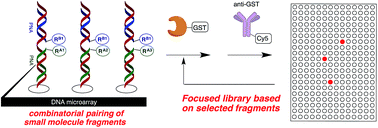
DNA display of fragment pairs as a tool for the discovery of novel biologically active small molecules
J.-P. Daguer, C. Zambaldo, M. Ciobanu, P. Morieux, S. Barluenga and N. Winssinger  
Chem. Sci., 2014, Advance Article
DOI: 10.1039/C4SC01654H, Edge Article

C4SC01654H GA


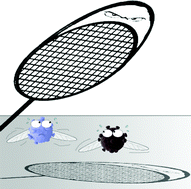
Macromolecular prodrugs of ribavirin: towards a treatment for co-infection with HIV and HCV
Anton A. A. Smith, Kaja Zuwala, Mille B. L. Kryger, Benjamin M. Wohl, Carlos Guerrero-Sanchez, Martin Tolstrup, Almar Postma and Alexander N. Zelikin  
Chem. Sci., 2015, Advance Article
DOI: 10.1039/C4SC02754J, Edge Article
This article is Open Access

C4SC02754J GA


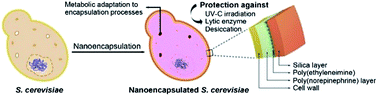
Organic/Inorganic Double-Layered Shells for Multiple Cytoprotection of Individual Living Cells
Daewha Hong, Hojae Lee, Eun Hyea Ko, Juno Lee, Hyeoncheol Cho, Matthew Park, Sung Ho Yang and Insung S Choi  
Chem. Sci., 2014, Accepted Manuscript
DOI: 10.1039/C4SC02789B, Edge Article
This article is Open Access

C4SC02789B GA


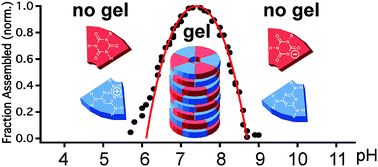
Ultra-sensitive pH control of supramolecular polymers and hydrogels: pKa matching of biomimetic monomers
B. J. Cafferty, R. R. Avirah, G. B. Schuster and N. V. Hud  
Chem. Sci., 2014, Advance Article
DOI: 10.1039/C4SC02182G, Edge Article

C4SC02182G GA

Digg This
Reddit This
Stumble Now!
Share on Facebook
Bookmark this on Delicious
Share on LinkedIn
Bookmark this on Technorati
Post on Twitter
Google Buzz (aka. Google Reader)

Mirror peptides hitch a lift into the cell

Scientists in the US have developed a method for successfully transporting chemotherapeutic d-peptides into the cell cytosol.

D-peptides – also known as mirror peptides, as their constituent amino acid building blocks are mirror images of the naturally occurring l-amino acids – have been an intriguing target in drug development for many years. Their unnatural stereochemistry results in high resistance to proteolytic degradation as intracellular enzymes are unable to act upon them – usually a major pathway for the destruction and removal of ‘foreign’ peptides, including those intended as therapeutic agents, in cells. However, transporting these molecules across cell membranes has been a significant barrier to their potential application.


Read the full article in Chemistry World»

Read the original journal article in Chemical Science – it’s free to access until 11th November:
Delivery of mirror image polypeptides into cells

Amy E. Rabideau, Xiaoli Liao and Bradley L. Pentelute  
Chem. Sci., 2014, Advance Article, DOI: 10.1039/C4SC02078B

Digg This
Reddit This
Stumble Now!
Share on Facebook
Bookmark this on Delicious
Share on LinkedIn
Bookmark this on Technorati
Post on Twitter
Google Buzz (aka. Google Reader)