
Chemical Science Reviewer Spotlight – December 2025
To further thank and recognise the support from our excellent reviewer community, we are highlighting reviewers who have provided exceptional support to the journal over the past year.
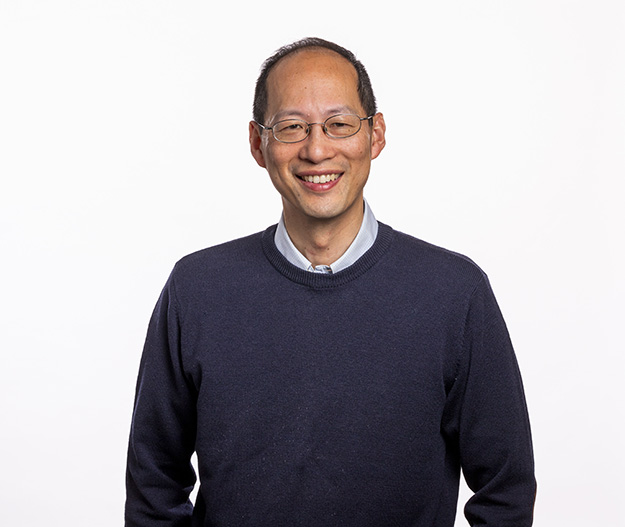
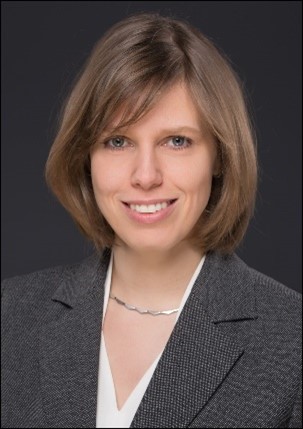
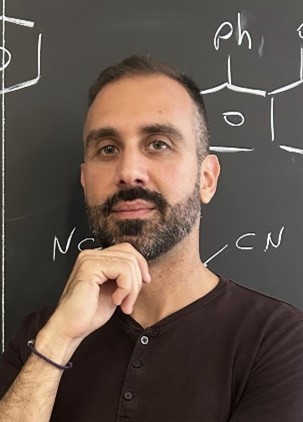
This month, we’ll be highlighting Dr Alexandra Brumberg, Professor Liliana Quintanar, Dr Sami Lakhdar, Professor Kathryn Fairfull-Smith and Professor Louise Berben. We asked our reviewers a few questions about what they enjoy about reviewing, and their thoughts on how to provide a useful review.

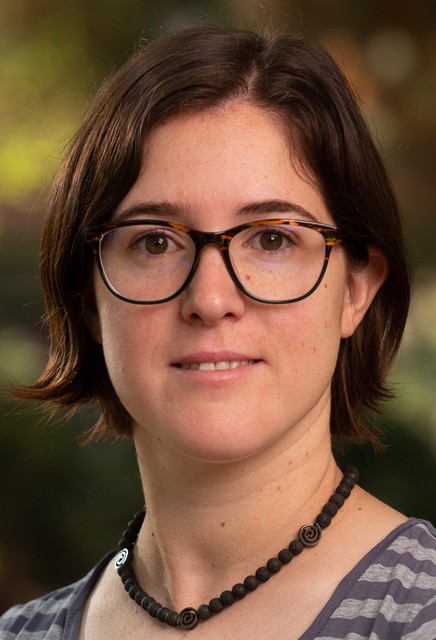
Dr Alexandra Brumberg. Our group combines materials synthesis with steady-state and time-resolved optical spectroscopy to control and understand dynamic structural processes in bulk and nanocrystalline inorganic materials. Ultimately, our aim is to enable control over optoelectronic and other physico-chemical properties in inorganic materials through enhanced fundamental understanding of how electron and carrier dynamics are influenced by changes in structure.

Professor Liliana Quintanar. My research group studies the interaction of metal ions with proteins that are involved in degenerative diseases, such as Alzheimer´s and cataract disease. In particular, we study essential metals such as copper and zinc, and we use different spectroscopic tools to understand how these metals interact with the proteins associated with disease.

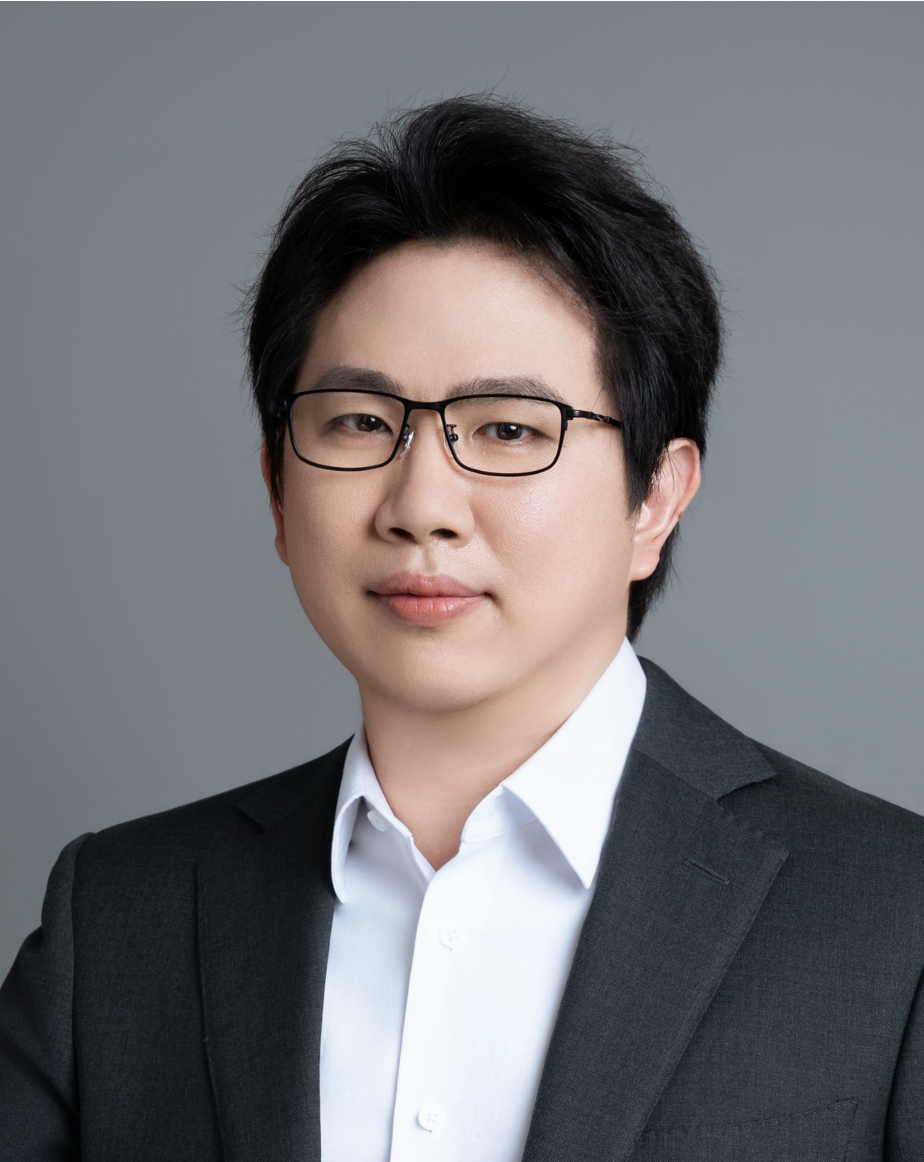
Dr Sami Lakhdar. My group develops new chemical reactions by combining modern synthetic methods, light-driven catalysis, and mechanistic insight. We are particularly interested in phosphorus chemistry and in creating more efficient and sustainable chemical processes

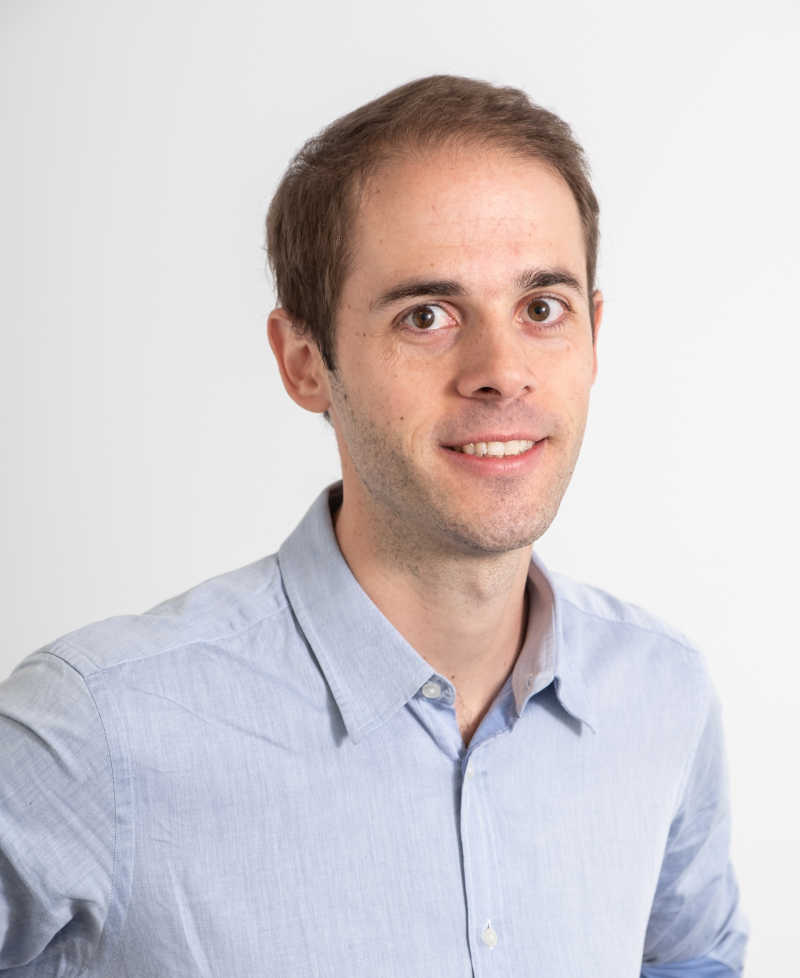
Professor Kathryn Fairfull-Smith. My research focuses the use of organic synthesis to build molecules or functionalize surfaces and polymers for various applications, including the development of novel anti-biofilm agents and materials.

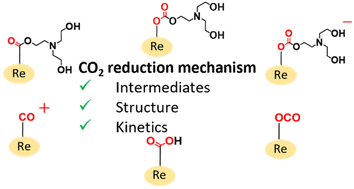
Professor Louise Berben. Louise’s research group studies new molecular catalysts made from earth abundance elements, including their properties and reactivity to create new sustainable catalytic processes.
What encouraged you to review for Chemical Science?
Dr Alexandra Brumberg: I think very highly of the work that is published in Chemical Science, which often highlights research that requires expertise spanning multiple chemical subdisciplines. I’m always impressed by papers that successfully bridge these areas, and I value the opportunity to contribute reviews on interdisciplinary work that aligns with my expertise.
Professor Kathryn Fairfull-Smith: Chemical Science publishes high quality interdisciplinary research findings – it is always interesting to review for this journal. Reviewing gives early access to the latest data, methods, and ideas before they’re published, helping me stay up to date in fast-moving fields.
Dr Sami Lakhdar: I chose to review for Chemical Science because it consistently highlights ambitious research with broad impact. Its open-access model gives the work real reach and reviewing feels like a small but meaningful way to support a community committed to innovation and rigour.
What advice would you give a first-time author looking to maximise their chances of successful peer review?
Dr Sami Lakhdar: Be clear about what is new and why it matters. Present a focused, coherent story supported by strong evidence and well-crafted figures. Be transparent about methods and limitations, avoid overstating claims, and refine the manuscript so reviewers can fully engage with the science.
Professor Liliana Quintanar: It is important to write the manuscript in a concise and succinct manner, considering the audience is broad across the wide range of areas of chemistry and related fields. I also think it is important to provide editors with a list of colleagues who can serve as potential reviewers and provide constructive feedback to their work.
Professor Louise Berben: Write a story that can be understood by a general chemistry audience, teach the reader something new and tell them clearly what you believe is the most important conclusion of the paper. Arrange the presentation so that the necessary complicated parts don’t detract from your punchline.
Did reviewing for Chemical Science affect how you approached preparation of your recent publication with us?
Professor Louise Berben: Absolutely, reviewing other researchers’ manuscripts provides insights for the construction of your own story and presentation, in a way that will be accessible and interesting to the reader. It’s always easier to see issues with work you read for the first time than it is with your own writing, and those elements can improve your approach to writing.
What makes a paper truly stand out for you when reviewing a paper?
Dr Alexandra Brumberg: Of course, truly innovative scientific approaches or ideas are great, but I also find that clear, well-organized writing and clean figures can be hard to come across. Both as an early career researcher and as a reviewer who sometimes reviews papers outside of my immediate area of expertise, it can be difficult to determine if I am struggling to understand a section in a paper because I do not have the necessary expertise or because it was not explained well. The papers that stand out are those that explain everything clearly.
What do you enjoy most about reviewing?
Professor Liliana Quintanar: I enjoy reviewing manuscripts when they are well written and they communicate concisely. I also like to give constructive feedback to authors to help them improve their manuscripts.
Professor Kathryn Fairfull-Smith: Learning about scientific breakthroughs and helping to maintain high standards of scientific rigour in my discipline.
How has your approach to peer reviewing changed over time?
Dr Sami Lakhdar: Over time, I’ve learned to look beyond individual technical details and to focus more on clarity, significance, and constructive guidance. I now try to provide reviews that are fair, respectful, and genuinely useful to authors and to the scientific community.
What has been your biggest learning point from reviewing?
Dr Alexandra Brumberg: Serving as a reviewer has helped me learn how to focus my feedback. I find it difficult to refrain from including every critique in my review, but this can lead to overwhelmingly long reviews that detract from the main issue(s) in the paper. Now, I’ve gotten better at identifying the main points that will genuinely improve the paper and learning to let the smaller things go.
Professor Kathryn Fairfull-Smith: Manuscripts worthy of publication generally have the same components: clear research questions, tight logic, appropriate controls, and a coherent narrative that matches the journal’s scope. As a reviewer, it is also interesting to see how your perspective compares or contrasts with the other reviewers and observe how editorial decisions are made — knowledge that is invaluable when submitting your own papers.
If you want to learn more about how we support our reviewers, check out our Reviewer Hub.
Interested in joining our ever-growing reviewer community? Apply here now!





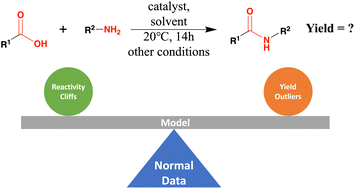
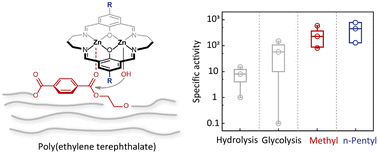
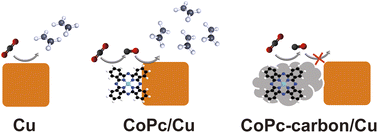
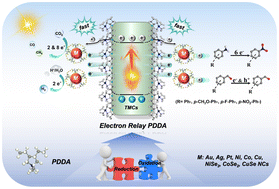




![[double bond, length as m-dash]](https://www.rsc.org/images/entities/char_e001.gif) C isomers
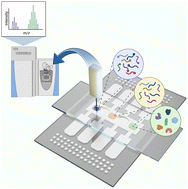
C isomers![Graphical abstract: High-throughput single-cell mass spectrometry enables metabolic network analysis by resolving phospholipid C [[double bond, length as m-dash]] C isomers](https://pubs.rsc.org/en/Image/Get?imageInfo.ImageType=GA&imageInfo.ImageIdentifier.ManuscriptID=D3SC06573A&imageInfo.ImageIdentifier.Year=2024)


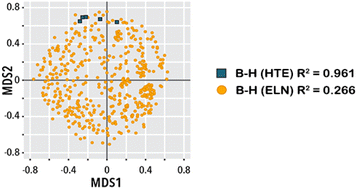
![Graphical abstract: 1,2-Disubstituted bicyclo[2.1.1]hexanes as saturated bioisosteres of ortho-substituted benzene](https://pubs.rsc.org/en/Image/Get?imageInfo.ImageType=GA&imageInfo.ImageIdentifier.ManuscriptID=D3SC05121H&imageInfo.ImageIdentifier.Year=2023)
![Graphical abstract: Synthesis of polysubstituted bicyclo[2.1.1]hexanes enabling access to new chemical space](https://pubs.rsc.org/en/Image/Get?imageInfo.ImageType=GA&imageInfo.ImageIdentifier.ManuscriptID=D3SC03083K&imageInfo.ImageIdentifier.Year=2023)
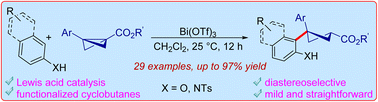
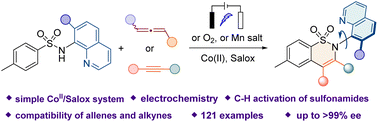
![Graphical abstract: Lemniscular carbon nanohoops with contiguous conjugation from planar chiral [2.2]paracyclophane: influence of the regioselective synthesis on topological chirality](https://pubs.rsc.org/en/Image/Get?imageInfo.ImageType=GA&imageInfo.ImageIdentifier.ManuscriptID=D2SC06825G&imageInfo.ImageIdentifier.Year=2023)
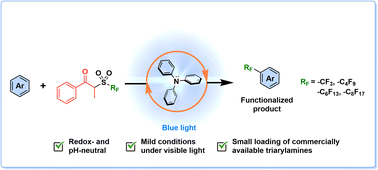
![Graphical abstract: 2,5-disubstituted bicyclo[2.1.1]hexanes as rigidified cyclopentane variants](https://pubs.rsc.org/en/Image/Get?imageInfo.ImageType=GA&imageInfo.ImageIdentifier.ManuscriptID=D3SC02695G&imageInfo.ImageIdentifier.Year=2023)

![Graphical abstract: Lewis acid catalyzed [4+2] annulation of bicyclobutanes with dienol ethers for the synthesis of bicyclo[4.1.1]octanes](https://pubs.rsc.org/en/Image/Get?imageInfo.ImageType=GA&imageInfo.ImageIdentifier.ManuscriptID=D4SC02767A&imageInfo.ImageIdentifier.Year=2024)
![Graphical abstract: Palladium-catalyzed decarboxylative (4 + 3) cycloadditions of bicyclobutanes with 2-alkylidenetrimethylene carbonates for the synthesis of 2-oxabicyclo[4.1.1]octanes](https://pubs.rsc.org/en/Image/Get?imageInfo.ImageType=GA&imageInfo.ImageIdentifier.ManuscriptID=D4SC02998D&imageInfo.ImageIdentifier.Year=2024)
![Graphical abstract: De novo synthesis of inherently chiral heteracalix[4]aromatics from enantioselective macrocyclization enabled by chiral phosphoric acid-catalyzed intramolecular SNAr reaction](https://pubs.rsc.org/en/Image/Get?imageInfo.ImageType=GA&imageInfo.ImageIdentifier.ManuscriptID=D3SC06436K&imageInfo.ImageIdentifier.Year=2024)