Some of the most accessed articles in 2011 are…

Below is a list containing some of the most downloaded RSC Advances articles in 2011:

A novel bath lily-like graphene sheet-wrapped nano-Si composite as a high performance anode material for Li-ion batteries
Yu-Shi He, Pengfei Gao, Jun Chen, Xiaowei Yang, Xiao-Zhen Liao, Jun Yang and Zi-Feng Ma
RSC Adv., 2011, 1, 958-960

Electrochemistry of graphene: not such a beneficial electrode material?
Dale A. C. Brownson, Lindsey J. Munro, Dimitrios K. Kampouris and Craig E. Banks
RSC Adv., 2011, 1, 978-988

CO2 chemistry: task-specific ionic liquids for CO2 capture/activation and subsequent conversion
Zhen-Zhen Yang, Ya-Nan Zhao and Liang-Nian He
RSC Adv., 2011, 1, 545-567

Incorporation of pyridazine rings in the structure of functionalized π-conjugated materials
Sylvain Achelle, Nelly Plé and Alain Turck
RSC Adv., 2011, 1, 364-388

Fe3O4@SiO2@Pd-Au: a highly efficient and magnetically separable catalyst for liquid-phase hydrodechlorination of 4-chlorophenol
Zhijie Wu, Chongxia Sun, Yan Chai and Minghui Zhang
RSC Adv., 2011, 1, 1179-1182

Modulation of the photophysical properties of BODIPY dyes by substitution at their meso position
Jorge Bañuelos, Ismael J. Arroyo-Córdoba, Ismael Valois-Escamilla, Alejandro Alvarez-Hernández, Eduardo Peña-Cabrera, Rongrong Hu, Ben Zhong Tang, Ixone Esnal, Virginia Martínez and Iñigo López Arbeloa
RSC Adv., 2011, 1, 677-684

All the articles are free to download upon a simple registration process.

Digg This
Reddit This
Stumble Now!
Share on Facebook
Bookmark this on Delicious
Share on LinkedIn
Bookmark this on Technorati
Post on Twitter
Google Buzz (aka. Google Reader)

Selecting chiral nanotubes using phage display

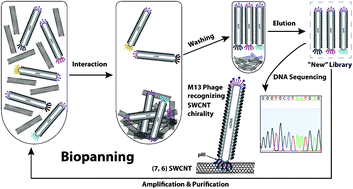
“Peptides with an affinity for carbon nanotubes with specific chiralities have been selected by phage display for the first time”, claim scientists from Singapore and China. Phage display is a selection technique in which a combinatorial library of polypeptides allows identification of peptides with desired binding specificities to various target molecules.

Separation of single walled carbon nanotubes (SWCNTs) with a specific chirality is important in the field of carbon nanotube research and a prerequisite for their applications in nanoelectronics. “The availability of single-chirality SWCNT components is still a formidable challenge, although remarkable progress has been made in obtaining narrow chirality distributions of SWCNTs in the past few years”, explain Liao and co-workers.

The figure on the right shows the “biopanning” procedure designed to retain the desired phage and eliminate the undesired phages in the phage display library. More information  about “biopanning” can be obtained by reading the full article online.

Free to access article reference:

Recognition of carbon nanotube chirality by phage display
Ting Yu, Yingxue Gong, Tingting Lu, Li Wei, Yuanqing Li, Yuguang Mu, Yuan Chen and Kin Liao

RSC Adv., 2012, Advance Article, DOI: 10.1039/C1RA00581B

Digg This
Reddit This
Stumble Now!
Share on Facebook
Bookmark this on Delicious
Share on LinkedIn
Bookmark this on Technorati
Post on Twitter
Google Buzz (aka. Google Reader)

EAQ converts nanotubes from metallic to semiconducting

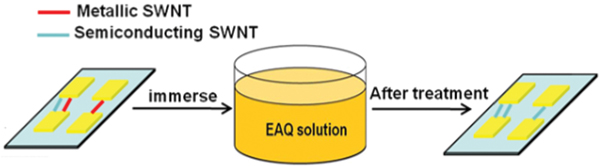
The practical use of single-walled carbon nanotubes (SWNTs) in electronics such as field-effect transistors has been somewhat hindered by the presence of metallic nanotubes in current synthetic methods.   Scientists in Singapore and the US have come up with a simple method to convert unwanted metallic single-walled carbon nanotubes (M-SWNTs) into semiconducting ones (S-SWNTs).

The team immersed as synthesised SWNT on-chip devices and immersed them into a solution containing an aromatic compound – 2-ethylanthraquinone (EAQ), which is a mild radical initiator. The EAQ-generated radicals preferentially attack the M-SWNTs over the S-SWNTs in situ, converting them to its semiconducting mode.

Alternative methods for converting M-SWNTs to S-SWNTs use either electron irradiation, which is difficult to scale up, or hydrogen plasma, which is aggressive and can’t be controlled. “This approach (using EAQ…) is simple, mild and easily scalable to whole wafers,” claim John Rogers (University of Illinois at Urbana-Champaign, US) and Mary Chan-Park (Nanyang Technological University, Singapore).

Free access to the full article online:
 

On-chip diameter-dependent conversion of metallic to semiconducting single-walled carbon nanotubes by immersion in 2-ethylanthraquinone
Jiangbo Li, Xuena Luan, Yinxi Huang, Simon Dunham, Peng Chen, John A. Rogers and Mary B. Chan-Park
RSC Adv., 2012, Advance Article, DOI: 10.1039/C1RA00817J, Communication

Digg This
Reddit This
Stumble Now!
Share on Facebook
Bookmark this on Delicious
Share on LinkedIn
Bookmark this on Technorati
Post on Twitter
Google Buzz (aka. Google Reader)

A dual combo for mouth wash or dental paste

“Chlorhexidine-loaded calcium phosphate nanoparticles provide a dual system with both mineralising and antibacterial properties,” claim German scientists.

Calcium phosphate is a natural component of tooth mineral and it can help to remineralise damaged enamel. On the other hand, chlrohexidine is an antibacterial agent, which helps prevent the bacterial colonisation on the tooth surface. The team led by Professor Matthis Epple at the University of Duisburg-Essen synthesised chlorhexidine-loaded calcium phosphate nanoparticles for use either in mouth wash or as a paste.  

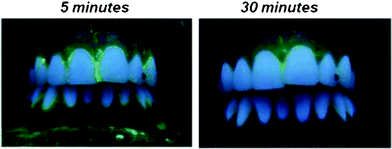
The figure below shows that “the fluorescein-labelled paste containing the functionalised nanoparticles adhered well onto the tooth surface, especially at the cervical and proximal areas”. Epple and co-workers also demonstrate that the paste sticks well to the root surface and closes dentin tubules.

Read the full paper published in RSC Advances by clicking on the title below or simply register online, if you do not have free access to the Journal content already.

Chlorhexidine-loaded calcium phosphate nanoparticles for dental maintenance treatment: combination of mineralising and antibacterial effects
Anna Kovtun, Diana Kozlova, Kathirvel Ganesan, Caroline Biewald, Nadine Seipold, Peter Gaengler, Wolfgang H. Arnold and Matthias Epple
RSC Adv., 2012, Advance Article
DOI: 10.1039/C1RA00955A, Paper


Also of interest is a recent review article recently published in RSC Advances. Click on the title for free access.

Recent advances in the development of dental composite resins
Christine Lavigueur and X. X. Zhu
RSC Adv., 2012, 2, 59-63
DOI: 10.1039/C1RA00922B, Review

Digg This
Reddit This
Stumble Now!
Share on Facebook
Bookmark this on Delicious
Share on LinkedIn
Bookmark this on Technorati
Post on Twitter
Google Buzz (aka. Google Reader)

Top ten most accessed articles in November

This month sees the following articles in RSC Advances that are in the top ten most accessed:-

Graphene-based photocatalytic composites
Xiaoqiang An and Jimmy C. Yu
RSC Adv., 2011, 1, 1426-1434, DOI: 10.1039/C1RA00382H

Electrochemistry of graphene: not such a beneficial electrode material?
Dale A. C. Brownson, Lindsey J. Munro, Dimitrios K. Kampouris and Craig E. Banks
RSC Adv., 2011, 1, 978-988, DOI: 10.1039/C1RA00393C

Electrochemical capacitors utilising transition metal oxides: an update of recent developments
Wentao Deng, Xiaobo Ji, Qiyuan Chen and Craig E. Banks
RSC Adv., 2011, 1, 1171-1178, DOI: 10.1039/C1RA00664A

A one-pot microwave-assisted non-aqueous sol-gel approach to metal oxide/graphene nanocomposites for Li-ion batteries
Seunghwan Baek, Seung-Ho Yu, Seung-Keun Park, Andrea Pucci, Catherine Marichy, Dong-Chan Lee, Yung-Eun Sung, Yuanzhe Piao and Nicola Pinna
RSC Adv., 2011, 1, 1687-1690, DOI: 10.1039/C1RA00797A

Long term cycling studies of electrospun TiO2 nanostructures and their composites with MWCNTs for rechargeable Li-ion batteries
Peining Zhu, Yongzhi Wu, M. V. Reddy, A. Sreekumaran Nair, B. V. R. Chowdari and S. Ramakrishna
RSC Adv., 2012, Advance Article, DOI: 10.1039/C1RA00514F

Selective adsorption and photocatalysis of low-temperature base-modified anatase nanocrystals
Manoj A. Lazar and Walid A. Daoud
RSC Adv., 2012, Advance Article, DOI: 10.1039/C1RA00539A

Double-heterojunction structure of SbxSn1-xO2/TiO2/CdSe for efficient decomposition of gaseous 2-propanol under visible-light irradiation
Sher Bahadur Rawal, Ashok Kumar Chakraborty, Yong Joo Kim, Hark Jin Kim and Wan In Lee
RSC Adv., 2012, Advance Article, DOI: 10.1039/C1RA00551K

One-pot green synthesis of Ag nanoparticles-graphene nanocomposites and their applications in SERS, H2O2, and glucose sensing
Yingwei Zhang, Sen Liu, Lei Wang, Xiaoyun Qin, Jingqi Tian, Wenbo Lu, Guohui Chang and Xuping Sun
RSC Adv., 2012, Advance Article, DOI: 10.1039/C1RA00641J

CO2 chemistry: task-specific ionic liquids for CO2 capture/activation and subsequent conversion
Zhen-Zhen Yang, Ya-Nan Zhao and Liang-Nian He
RSC Adv., 2011, 1, 545-567, DOI: 10.1039/C1RA00307K

Synthesis, characterization and application of carbon nanocages as anode materials for high-performance lithium-ion batteries
Guangda Li, Liqiang Xu, Qin Hao, Meng Wang and Yitai Qian
RSC Adv., 2012, 2, 284-291, DOI: 10.1039/C1RA00631B

Why not take a look at the articles today and blog your thoughts and comments below.

Fancy submitting an article to RSC Advances? Then why not submit to us today or alternatively email us your suggestions.

Digg This
Reddit This
Stumble Now!
Share on Facebook
Bookmark this on Delicious
Share on LinkedIn
Bookmark this on Technorati
Post on Twitter
Google Buzz (aka. Google Reader)

Eastern Promise

Yongyuth Yuthavong discusses the challenges that face scientists in Thailand

Yongyuth Yuthavong is interested in the development of novel antimalarial agents. He currently leads a research group at the National Center for Genetic Engineering and Biotechnology (BIOTEC) in Thailand. Professor Yuthavong was the first president of the National Science and Technology Development Agency (1992-1998) and served as the minister of science and technology (2006-2008), both in Thailand.

When did you become interested in malaria?

During my studies at the University of Oxford, UK, I was investigating the chemical kinetics of enzymatic reactions. When I went back to Thailand, I realised that no one understood, or cared, about enzymes. To make people understand that studying enzymes is important, I decided to tackle a significant problem in the country using my expertise.  I studied red blood cell membranes and saw that malaria was a significant problem, and that both chemistry and biochemistry could be used to understand the parasite’s life and processes. The available drugs – such as chloroquine and pyrimethamine – were becoming ineffective so we needed new drugs. Together with other biochemists, I formed a malaria research group. We were lucky that we were mostly in the same department so we could meet on a daily basis, because it was very difficult to do research in Thailand.

Is the cure for malaria drug-based or vaccine-based?

It is still drug based. Some vaccines are being developed by GlaxoSmithKline, but they are not as effective. I think that there is still a long way to go on the vaccination side. The ideal drugs have to be cheap, orally administered and preferably cause no resistance, which is almost impossible. You will find that almost all anti-infection drugs, including antibiotics, will last at most 5-10 years before resistance is developed. I think that we need a new paradigm where the drug hits a more fundamental mechanism so that no mutation or resistance is possible.

What have you discovered?

We found the structure of the enzyme (Plasmodium falciparum) dihydrofolate reductase-thymidylate synthase [a target for antimalarials] (published in Nature Structural Biology in 2003). From there, we understood the basis of resistance owing to mutation in the active site so that we could design compounds that would avert the effect of mutation. Now we have many candidates, but we have not published the details yet. One in particular is P218, which is a flexible diamino pyrimidine with good efficacy. P218 is effective orally and does not cause much resistance (although this part needs to be investigated), and it is relatively cheap to manufacture.

How can developed countries help developing countries to eradicate the disease?

Thailand is good in certain areas of research but poor in others. For example, in malaria research, we are very strong in the clinical sciences. International researchers come from outside Thailand to study the disease clinically. Thailand is a good base for them to go to neighbouring countries where the disease is still prevalent. We also have very good basic early applied research, such as fundamental research in the discovery and development of new drugs. But, we severely lack scale-up capabilities, and an understanding of toxicology, pharmacokinetics and pharmacodynamics. We don’t have the facilities to study the preclinical phase and mutational studies.

So, we have to collaborate with external groups, for example that of Livia Vivas at the London School of Hygiene and Tropical Medicine, UK. We have an ongoing collaboration with the Medicines for Malaria Venture, based in Switzerland, to help us validate the structure of the target and support us in developing good drug candidates based on those targets.

However, we can do some things on our own and lead our own researchers. I think that this is really important for scientists from developing countries. Most scientists in developing countries have participated in international research projects but until now, they have played very small parts, doing some screening or cell culture work. Very few rise to the level of planning and executing and developing that strategic thinking to lead a project. We do need that.

Is it difficult to find funding in Thailand?

We have to go out and tell people that our work is really important to get support. I decided to approach people who have important positions in national research councils and universities to persuade them that we do need a new kind of granting organisation. I found some very good people who listened to us and we founded the BIOTEC research centre and later on the National Science and Technology Development Agency. These are agencies that give grants as well as do their own research. Also, I helped to draft a law that started the Thailand Research Fund, which gives grants to researchers of £30,000-50,000. This would go a long way in Thailand.

Read the full interview published in Chemistry World here.

Digg This
Reddit This
Stumble Now!
Share on Facebook
Bookmark this on Delicious
Share on LinkedIn
Bookmark this on Technorati
Post on Twitter
Google Buzz (aka. Google Reader)

Organic reviews in RSC Advances

RSC Advances has published a number of organic chemistry review articles covering a wide array of topics such as organocatalysis, organometallics, aromatic, ionic liquids, DNA and supramolecular chemistry. All of our articles are free to download until December 2012. Simply register online for free access.

Iron-catalysed reduction of carbonyls and olefins
Bryden A. F. Le Bailly and Stephen P. Thomas
RSC Adv., 2011, 1, 1435-1445

Regioselective formation of medium-ring heterocycles of biological relevance by intramolecular cyclization
K. C. Majumdar
RSC Adv., 2011, 1, 1152-1170

Synthetically useful carbon–carbon and carbon–sulphur bond construction mediated by carbon- and sulphur-centred radicals in water and aqueous media
Al Postigo
RSC Adv., 2011, 1, 14-32

Incorporation of pyridazine rings in the structure of functionalized π-conjugated materials
Sylvain Achelle, Nelly Plé and Alain Turck
RSC Adv., 2011, 1, 364-388

CO2 chemistry: task-specific ionic liquids for CO2 capture/activation and subsequent conversion
Zhen-Zhen Yang, Ya-Nan Zhao and Liang-Nian He
RSC Adv., 2011, 1, 545-567

The pyrolytic behavior of cellulose in lignocellulosic biomass: a review
Dekui Shen, Rui Xiao, Sai Gu and Kaihong Luo
RSC Adv., 2011, 1, 1641-1660

Fast repair of DNA radicals in the earliest stage of carcinogenesis suppresses hallmarks of cancer
Rongliang Zheng, Zhongjian Jia, Ji Li, Shuangsheng Huang, Ping Mu, Fangxin Zhang, Chunming Wang and Chengshan Yuan
RSC Adv., 2011, 1, 1610-1619

Take the first peep at the 2012 organic chemistry reviews here:

Homogeneous and heterogeneous catalysts for multicomponent reactions
Maria José Climent, Avelino Corma and Sara Iborra
RSC Adv., 2012, 2, 16-58

Cucurbituril chemistry: a tale of supramolecular success
Eric Masson, Xiaoxi Ling, Roymon Joseph, Lawrence Kyeremeh-Mensah and Xiaoyong Lu
RSC Adv., 2012, Advance Article, DOI: 10.1039/C1RA00768H

 Methods for SAR visualization
Dagmar Stumpfe and Jürgen Bajorath
RSC Adv., 2012, Advance Article, DOI: 10.1039/C1RA00924A

Enantioselective organocatalytic α-heterofunctionalization of active methines
Alessio Russo, Claudia De Fusco and Alessandra Lattanzi
RSC Adv., 2012, Advance Article, DOI: 10.1039/C1RA00612F

Targeted drugs by olefin metathesis: piperidine-based iminosugars
Ileana Dragutan, Valerian Dragutan and Albert Demonceau
RSC Adv., 2012, Advance Article, DOI: 10.1039/C1RA00910A

Aromatic hydroxyl group—a hydrogen bonding activator in bifunctional asymmetric organocatalysis
Pankaj Chauhan and Swapandeep Singh Chimni
RSC Adv., 2012, Advance Article, DOI: 10.1039/C1RA00872B

If you fancy submitting your next article to RSC Advances, please click here.

Digg This
Reddit This
Stumble Now!
Share on Facebook
Bookmark this on Delicious
Share on LinkedIn
Bookmark this on Technorati
Post on Twitter
Google Buzz (aka. Google Reader)

Welcome to the first issue of 2012!

RSC Advances has published 9 issues in 2011 containing 234 articles and our first issue of 2012 is also online now. In this issue, you can read the following review articles:

Homogeneous and heterogeneous catalysts for multicomponent reactions
Maria José Climent, Avelino Corma and Sara Iborra
RSC Adv., 2012, 2, 16-58

Recent advances in the development of dental composite resins
Christine Lavigueur and X. X. Zhu
RSC Adv., 2012, 2, 59-63

Graphene–inorganic nanocomposites
Song Bai and Xiaoping Shen
RSC Adv., 2012, 2, 64-98

Other articles in the first issue of 2012 include: carbon nanocages for Li ion batteries, an inorganic biocatalyst, self-repairable polymer that changes to red when damaged. You can also learn about phonon-mode Raman spectra or how to purify drugs from bacteria.

Our content is free to download until December 2012. Please also note that RSC Advances authors can now choose to publish their articles immediately after acceptance. Click here for more details.

Thank you to all our authors, referees and editors for your dedicated support to RSC Advances. We wish you a Merry Christmas and a Happy New year 2012!

Digg This
Reddit This
Stumble Now!
Share on Facebook
Bookmark this on Delicious
Share on LinkedIn
Bookmark this on Technorati
Post on Twitter
Google Buzz (aka. Google Reader)

It’s a wrap!

Have you thought of wrapping your nanoparticles with graphene?

Graphene-wrapped nanosilicon for high performance Li-ion batteries

Chinese scientists have used graphene sheets to wrap silicon nanoparticles to make nanocomposites which resemble bath lilies.

Zi-Feng Ma and co-workers, from Shanghai Jiao Tong University, have assessed the performance of the novel bath lily-like graphene sheet-wrapped silicon (GS-Si) nanocomposites as anode materials for Li-ion batteries. They showed that the GS-Si nanocomposites exhibit a high reversible capacity of 1525mAh g1 and superior cycling stability.  Conventional graphite anodes display a theoretical specific capacity of only 372 mAh g-1, making it a weak candidate for anodes of Li-ion batteries.

The GS-Si nanocomposites were synthesised using a spray-drying technique which requires “no surfactant, no filtration or washing processes and no high vacuum conditions.” The authors believe that the procedure is safe and environmentally friendly and can be scaled up for the mass production of graphene-based composite materials.

The obtained GS-Si composite possesses an open nano/micro-structure, in which nanosized Si particles are uniformly dispersed and wrapped in the graphene sheet (GS) matrix. “The GS not only constitutes a good conducting network, but also provides enough void spaces to accommodate the volume change of Si and prevent the aggregation of nano-Si particles during cycling, ” explains Ma et al.

Find out more about graphene sheet-wrapped nanocomposites by downloading the full article for free until December 2012.

A novel bath lily-like graphene sheet-wrapped nano-Si composite as a high performance anode material for Li-ion batteries
Yu-Shi He, Pengfei Gao, Jun Chen, Xiaowei Yang, Xiao-Zhen Liao, Jun Yang and Zi-Feng Ma
RSC Adv., 2011, 1, 958-960

Digg This
Reddit This
Stumble Now!
Share on Facebook
Bookmark this on Delicious
Share on LinkedIn
Bookmark this on Technorati
Post on Twitter
Google Buzz (aka. Google Reader)

Red marks the spot

Self-healing polymer shows red when damaged and clear when repaired

A self-healing polymer coating that changes from clear to red when damaged has been developed by a research team in the US. The coating repairs itself in sunlight, under heating or with exposure to acidic vapours, and becomes clear again.

Marek Urban, leading researcher at the University of Southern Mississippi, explains that the polymer “films are capable of sensing color changes upon mechanical scratches, but upon exposure to the visible (VIS) portion of the electromagnetic radiation (y580 nm), temperature, and/or acidic atmospheres, not only mechanical damage is repaired, but also the mechanically induced red coloured scar vanishes.”

The red colour is because of a ring-opening reaction to form merocyanine, which is red. As the ring closes again under light, heat or an acidic vapour, it forms spironaphthoxazine, which is clear.

Want to find out more? Download the full paper for free until December 2012.

Self-repairable copolymers that change color
Dhanya Ramachandran, Fang Liu and Marek W. Urban
RSC Adv., 2012, Advance Article, DOI: 10.1039/C1RA00137J

Digg This
Reddit This
Stumble Now!
Share on Facebook
Bookmark this on Delicious
Share on LinkedIn
Bookmark this on Technorati
Post on Twitter
Google Buzz (aka. Google Reader)