Archive for August, 2011

Hydrogenation reactions in micelles

Can hydrogenation reactions be performed in water? German scientists say: “Yes we can!”

Often, water is seen as the “green solvent” of choice as it is non-flammable and non-toxic. However, organic chemists usually face issues with the solubility of the reactants in water. In this RSC Advances article, Schwarze et al. demonstrate the power of the surfactants in a hydrogenation reaction of prochical C–C, double bonds in itaconate, e.g. dimethyl itaconate.

The selectivity were comparable to when the same reaction were performed in methanol. The reaction rates however were slightly slower. This was due to the lower hydrogen solubility in the micellar aqueous systems. But the beauty of the reaction is that no notable catalyst deactivation occurred and the latter was recyclable with a turn-over number of >1000 in the aqueous micellar conditions .
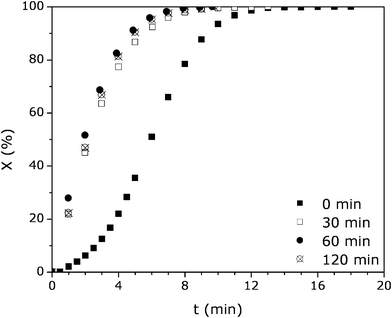
In this publication, the authors also developed a model to predict the performance of micellar reaction systems. The partition coefficient of the substrates between the micelles and the continuous aqueous phase can be predicted using the Conductor-like Screening Model for Real Solvents (COSMO-RS).

If you want to find out more about this work, please read the full paper here*.

Rhodium catalyzed hydrogenation reactions in aqueous micellar systems as green solvents
M. Schwarze, J.S. Milano-Brusco, V. Strempel, T. Hamerla, S. Wille, C. Fischer, W. Baumann, W. Arlt and R. Schomäcker
RSC Adv., 2011, DOI: 10.1039/C1RA00397F, Advance Article

*Individuals can access the content by signing up for an RSC Publishing Personal Account. Existing institutional RSC journal subscribers, with registered IP, have automatic access. Other institutions can register for free access.

Digg This
Reddit This
Stumble Now!
Share on Facebook
Bookmark this on Delicious
Share on LinkedIn
Bookmark this on Technorati
Post on Twitter
Google Buzz (aka. Google Reader)

RSC Advances issue 2 now online!

All RSC Advances articles published in 2011 and 2012 will be made free to access until December 2012. Please sign up to receive free access to the latest articles published in the journal.

Issue 2 has now been published online and consists of research from a wide spectrum of subject areas.  Whether you are a materials scientist, biologist, physicist or medicinal chemist, you are guaranteed to find articles of relevance to your specialist interests.

Noteworthy articles include:

Two unique (4,5,6)-connected 2D CdII coordination polymers based on the 5-nitro-1,2,3-benzenetricarboxylate ligand
Lu-Fang Ma, Jian-Hua Qin, Li-Ya Wang and Dong-Sheng Li
RSC Adv., 2011, 1, 180-183
DOI: 10.1039/C1RA00119A

One-pot alkaline vapor oxidation synthesis and electrocatalytic activity towards glucose oxidation of CuO nanobelt arrays
Tetsuro Soejima, Hitomi Yagyu, Nobuo Kimizuka and Seishiro Ito
RSC Adv., 2011, 1, 187-190
DOI: 10.1039/C1RA00109D

The flow of magnetic nanoparticles in magnetic drug targeting
Sibnath Kayal, Dipankar Bandyopadhyay, Tapas Kumar Mandal and Raju V. Ramanujan
RSC Adv., 2011, 1, 238-246
DOI: 10.1039/C1RA00023C

The electrogenerated chemiluminescence detection of IS6110 of Mycobacterium tuberculosis based on a luminol functionalized gold nanoprobe
Jie Jiang, Ying Chai and Hua Cui
RSC Adv., 2011, 1, 247-254
DOI: 10.1039/C1RA00206F

Facile synthesis of 5-(alkylidene)thiophen-2(5H)-ones. A new class of antimicrobial agents
Tore Benneche, Gunnar Herstad, Marianne Rosenberg, Synnøve Assev and Anne Aamdal Scheie
RSC Adv., 2011, 1, 323-332
DOI: 10.1039/C1RA00254F

Take advantage of our automated subject classification to view articles that are most relevant to you.

To be notified of our latest issue published, please sign up to our e-mail alert today!

Digg This
Reddit This
Stumble Now!
Share on Facebook
Bookmark this on Delicious
Share on LinkedIn
Bookmark this on Technorati
Post on Twitter
Google Buzz (aka. Google Reader)

Where can I meet the RSC Advances team?

Over the coming months, members of the team will be at the following conferences where they will be happy to talk to you:

  • James Batteas, Associate Editor, will be at the Fall ACS meeting in Denver at the end of the month. Look for RSC Booth 1100! Lots of prizes to be won each day, incl. T-shirts, games & books.


  • Kathleen Too, Deputy Editor, travels to the 14th Asian Chemical Congress 2011 (14 ACC) taking place between 5-8 September 2011 in Bangkok, Thailand. Please contact us if you’d like to arrange a meeting.


  • Mike Ward, Chair of the Editorial Board, is attending the 3rd Asian Conference on Coordination Chemistry (ACCC3) in New Delhi, India at the end of October. An RSC Advances poster prize will be awarded at this meeting.

And look out for our eye-catching RSC Advances materials, appearing at a variety of conferences over the coming months.

Digg This
Reddit This
Stumble Now!
Share on Facebook
Bookmark this on Delicious
Share on LinkedIn
Bookmark this on Technorati
Post on Twitter
Google Buzz (aka. Google Reader)

RSC Advances Issue 1 published

From Argentina to New Zealand, Korea to USA, scientists around the world have shown their support for RSC Advances by submitting their work. Our first issue is online now and access is free.*

Communications, full papers and reviews are all represented in the mix that encompasses all the main areas of the chemical sciences. But finding the articles that are most relevant to you won’t be a problem: our sophisticated behind-the-scenes topic modelling classifies the content into one or more of twelve subject categories, accessible via the subject tab on the website. 

Among the highlights in this issue:

Marcos Eberlin, who is one of RSC Advances’ Associate Editors, has demonstrated his support through publishing his work on charge-tagged N-heterocyclic carbenes.

Of the first issue Marcos commented: “Very nice collection indeed … The subject tab is superb!”

Plus, Editorial Board Chair Mike Ward and RSC Publishing Editor Sarah Ruthven share their aspirations for the journal in the Editorial

Let us know what you think of this first issue by adding your comments below.

And to be alerted to each new issue of the journal, sign up for e-alerts today. 

*Individuals can access the content by signing up for an RSC Publishing Personal Account. Existing institutional RSC journal subscribers, with registered IP, have automatic access. Other institutions can register for free access.

Digg This
Reddit This
Stumble Now!
Share on Facebook
Bookmark this on Delicious
Share on LinkedIn
Bookmark this on Technorati
Post on Twitter
Google Buzz (aka. Google Reader)