Archive for November, 2011

It’s a wrap!

Graphene-wrapped nanosilicon for high performance Li-ion batteries

Chinese scientists have used graphene sheets to wrap silicon nanoparticles to make nanocomposites which resemble bath lilies.

Zi-Feng Ma and co-workers, from Shanghai Jiao Tong University, have assessed the performance of the novel bath lily-like graphene sheet-wrapped silicon (GS-Si) nanocomposites as anode materials for Li-ion batteries. They showed that the GS-Si nanocomposites exhibit a high reversible capacity of 1525mAh g1 and superior cycling stability.  Conventional graphite anodes display a theoretical specific capacity of only 372 mAh g-1, making it a weak candidate for anodes of Li-ion batteries.
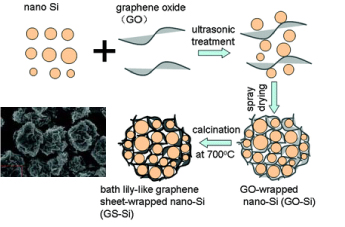
The GS-Si nanocomposites were synthesised using a spray-drying technique which requires “no surfactant, no filtration or washing processes and no high vacuum conditions.” The authors believe that the procedure is safe and environmentally friendly and can be scaled up for the mass production of graphene-based composite materials.

The obtained GS-Si composite possesses an open nano/micro-structure, in which nanosized Si particles are uniformly dispersed and wrapped in the graphene sheet (GS) matrix. “The GS not only constitutes a good conducting network, but also provides enough void spaces to accommodate the volume change of Si and prevent the aggregation of nano-Si particles during cycling, ” explains Ma et al.

Find out more about graphene sheet-wrapped nanocomposites by downloading the full article for free until December 2012.

A novel bath lily-like graphene sheet-wrapped nano-Si composite as a high performance anode material for Li-ion batteries
Yu-Shi He, Pengfei Gao, Jun Chen, Xiaowei Yang, Xiao-Zhen Liao, Jun Yang and Zi-Feng Ma
RSC Adv., 2011, 1, 958-960

Digg This
Reddit This
Stumble Now!
Share on Facebook
Bookmark this on Delicious
Share on LinkedIn
Bookmark this on Technorati
Post on Twitter
Google Buzz (aka. Google Reader)

Red marks the spot

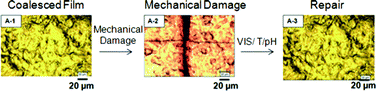
A self-healing polymer coating that changes from clear to red when damaged has been developed by a research team in the US. The coating repairs itself in sunlight, under heating or with exposure to acidic vapours, and becomes clear again.

Marek Urban, leading researcher at the University of Southern Mississippi, explains that the polymer “films are capable of sensing color changes upon mechanical scratches, but upon exposure to the visible (VIS) portion of the electromagnetic radiation (y580 nm), temperature, and/or acidic atmospheres, not only mechanical damage is repaired, but also the mechanically induced red coloured scar vanishes.”

The red colour is because of a ring-opening reaction to form merocyanine, which is red. As the ring closes again under light, heat or an acidic vapour, it forms spironaphthoxazine, which is clear.

Want to find out more? Download the full paper for free until December 2012.

Self-repairable copolymers that change color
Dhanya Ramachandran, Fang Liu and Marek W. Urban
RSC Adv., 2012, Advance Article, DOI: 10.1039/C1RA00137J

Digg This
Reddit This
Stumble Now!
Share on Facebook
Bookmark this on Delicious
Share on LinkedIn
Bookmark this on Technorati
Post on Twitter
Google Buzz (aka. Google Reader)

Top ten most accessed articles in October

This month sees the following articles in RSC Advances that are in the top ten most accessed:-

A novel bath lily-like graphene sheet-wrapped nano-Si composite as a high performance anode material for Li-ion batteries
Yu-Shi He, Pengfei Gao, Jun Chen, Xiaowei Yang, Xiao-Zhen Liao, Jun Yang and Zi-Feng Ma
RSC Adv., 2011, 1, 958-960, DOI: 10.1039/C1RA00429H

Nitrogen-doped graphene nanosheet-supported non-precious iron nitride nanoparticles as an efficient electrocatalyst for oxygen reduction
Chi-Wen Tsai, Meng-Hsiu Tu, Chih-Jung Chen, Tai-Feng Hung, Ru-Shi Liu, Wei-Ren Liu, Man-Yin Lo, Yu-Min Peng, Lei Zhang, Jiujun Zhang, Der-Shiuh Shy and Xue-Kun Xing
RSC Adv., 2011, 1, 1349-1357, DOI: 10.1039/C1RA00373A

Electrochemistry of graphene: not such a beneficial electrode material?
Dale A. C. Brownson, Lindsey J. Munro, Dimitrios K. Kampouris and Craig E. Banks
RSC Adv., 2011, 1, 978-988, DOI: 10.1039/C1RA00393C

Well-crystallized square-like 2D BiOCl nanoplates: mannitol-assisted hydrothermal synthesis and improved visible-light-driven photocatalytic performance
Jinyan Xiong, Gang Cheng, Guangfang Li, Fan Qin and Rong Chen
RSC Adv., 2011, 1, 1542-1553, DOI: 10.1039/C1RA00335F

A nanocomposite of SnO2 and single-walled carbon nanohorns as a long life and high capacity anode material for lithium ion batteries
Yi Zhao, Jiaxin Li, Yunhai Ding and Lunhui Guan
RSC Adv., 2011, 1, 852-856, DOI: 10.1039/C1RA00267H

Graphene-V2O5·nH2O xerogel composite cathodes for lithium ion batteries
Guodong Du, Kuok Hau Seng, Zaiping Guo, Jun Liu, Wenxian Li, Dianzeng Jia, Chris Cook, Zongwen Liu and Huakun Liu
RSC Adv., 2011, 1, 690-697, DOI: 10.1039/C1RA00258A

CO2 chemistry: task-specific ionic liquids for CO2 capture/activation and subsequent conversion
Zhen-Zhen Yang, Ya-Nan Zhao and Liang-Nian He
RSC Adv., 2011, 1, 545-567, DOI: 10.1039/C1RA00307K

Urchin-like Co3O4 microspherical hierarchical superstructures constructed by one-dimension nanowires toward electrochemical capacitors
Linrui Hou, Changzhou Yuan, Long Yang, Laifa Shen, Fang Zhang and Xiaogang Zhang
RSC Adv., 2011, 1, 1521-1526, DOI: 10.1039/C1RA00312G

Room-temperature synthesis from molecular precursors and photocatalytic activities of ultralong Sb2S3 nanowires
Qiaofeng Han, Shanshan Sun, Dongping Sun, Junwu Zhu and Xin Wang
RSC Adv., 2011, 1, 1364-1369, DOI: 10.1039/C1RA00379H

Triplet-triplet annihilation based upconversion: from triplet sensitizers and triplet acceptors to upconversion quantum yields
Jianzhang Zhao, Shaomin Ji and Huimin Guo
RSC Adv., 2011, 1, 937-950, DOI: 10.1039/C1RA00469G

Why not take a look at the articles today and blog your thoughts and comments below.

Fancy submitting an article to RSC Advances? Then why not submit to us today or alternatively email us your suggestions.

Digg This
Reddit This
Stumble Now!
Share on Facebook
Bookmark this on Delicious
Share on LinkedIn
Bookmark this on Technorati
Post on Twitter
Google Buzz (aka. Google Reader)

Nanotubes infiltrate plant cell walls via induced nanoholes

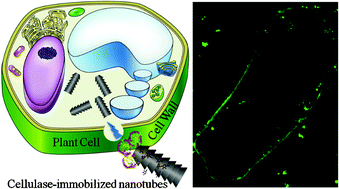
Carbon nanotubes that look like cups stacked on top of each other have been functionalized with cellulase enzyme to enable them to penetrate inside cells through induced nanoholes without damaging the entire plant cell wall.

Plant cell wall is a unique barrier made up of cellulosic materials which prevent the passage of macromolecules inside the cells. Traditionally, when studying plant biology, scientists strip away the cell wall using cellulase (an enzyme that causes cellulose hydrolysis) or other chemical treatments. The latter procedures to disorganize the cell walls may affect the cell viability or the cell’s capability to divide.

Scientists at Nagoya University in Japan, have developed a clever way to functionalize cup-stacked carbon nanotubes functionalized on their tips and walls with cellulase. The immobilized cellulase is proposed to induce local lesions in the cell wall, through which carbon nanotubes can transport into the interior of the cell.

The authors believe that this new method could open a lot of opportunities for studying plant cell genetics or plant diseases.

Download the full article for free by simply registering here.

Introducing carbon nanotubes into living walled plant cells through cellulase-induced nanoholes
Maged F. Serag, Noritada Kaji, Manabu Tokeshi and Yoshinobu Baba
RSC Adv., 2012, Advance Article, DOI: 10.1039/C1RA00760B, Communication

Digg This
Reddit This
Stumble Now!
Share on Facebook
Bookmark this on Delicious
Share on LinkedIn
Bookmark this on Technorati
Post on Twitter
Google Buzz (aka. Google Reader)

200th RSC Advances Article published online: A biochip for detecting ocean microbes

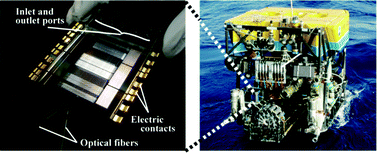
Fujii and co-workers have fabricated a microfluidic device capable of analyzing microbial genes in deep sea environments. The genetic analyzer consists of a PDMS–glass microfluidic device that is capable of cell lysis, DNA purification, PCR, and optical detection. The Integrated In Situ Analyzer was named “IISA-Gene’’. It was developed and evaluated in Tokyo as a result of a fruitful collabotation between the University of Tokyo and the Tokyo Institute of Technology.

“We were able to use IISA-Gene to achieve spatiotemporally resolved profiling of microbial ecosystems in ocean environments”, claims Fujii. The technique which incorporates microfluidic technology minimises the risks of contamination through sample collections and manipulations.   

By employing a simple flow-through PCR method, complicated genetic analyses can be automatically performed in extreme oceanic conditions. The performance of the system has been examined through at-sea experiments, taking it down to the deep sea using a remotely-operated vehicle. “Field evaluations at deep sea have shown that the amplification of the eubacterial universal 16S rRNA gene and the recovery of the PCR product to the surface”, says Fujii. The technology could provide a significant step to aid the discovery of further microbial life-forms in our oceans. 

This is the 200th article published online by RSC Advances, a newly launched Journal by the Royal Society of Chemistry. You can download the full article for free by simply registering here.

Integrated in situ genetic analyzer for microbiology in extreme environments
Tatsuhiro Fukuba, Akimitsu Miyaji, Takuji Okamoto, Takatoki Yamamoto, Shohei Kaneda and Teruo Fujii
RSC Adv., 2011, 1, 1567-1573

Digg This
Reddit This
Stumble Now!
Share on Facebook
Bookmark this on Delicious
Share on LinkedIn
Bookmark this on Technorati
Post on Twitter
Google Buzz (aka. Google Reader)

Announcement: RSC Advances is now indexed in SCI

We are pleased to announce that RSC Advances is now fully indexed in Thomson Reuters SCI-expanded databases including ISI Web of Science. This will enhance the visibility and discoverability of all the articles published. Issues 1-6 of RSC Advances are already listed on ISI. Congratulations to the authors who have their articles cited already!

Below is a list of RSC Advances articles that have already received citations:

The role of the intermolecular potential on the dynamics of ethylene confined in cylindrical nanopores
Fernando J. A. L. Cruz, Erich A. Müller and José P. B. Mota
RSC Adv., 2011, 1, 270-281

Fabrication of cuprous oxide nanoparticles by laser ablation in PVP aqueous solution
Peisheng Liu, Zhigang Li, Weiping Cai, Ming Fang and Xiangdong Luo
RSC Adv., 2011, 1, 847-851

A novel application of porphyrin nanoparticles as an effective fluorescent assay platform for nucleic acid detection
Junfeng Zhai, Hailong Li and Xuping Sun
RSC Adv., 2011, 1, 36-39
DOI: 10.1039/C1RA00026H

Please remember that all our articles are free to download until December 2012!

RSC Advances publishes high quality articles covering emerging areas and multidiciplinary fields. The subject coverage includes: Analytical, Biological, Catalysis, Environmental, Inorganic, Materials, Physical, Organic, Nanoscience, Energy, Food, Chemical Biology and Medicinal. More information on our scope can be read here.

Digg This
Reddit This
Stumble Now!
Share on Facebook
Bookmark this on Delicious
Share on LinkedIn
Bookmark this on Technorati
Post on Twitter
Google Buzz (aka. Google Reader)

Latest advances in fluorinated contrast agents for MRI

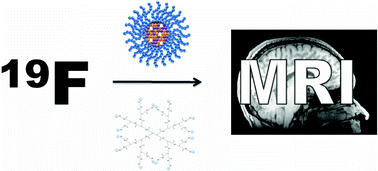
There are an increasing number of articles reporting novel fluorinated responsive (smart) agents, micelles, dendrimers and hyperbranched polymers being investigated as targets for 19F-magnetic resonance imaging (MRI). 

James Knight (University of Alberta, Canada) and co-workers based at Cardiff University, UK, give a pertinent account of the latest developments in the field. Their review article also covers multimodal contrast agents containing 19F nuclei.

Read the review article for free upon a simple registration process:

Fluorinated contrast agents for magnetic resonance imaging; a review of recent developments
James C. Knight, Peter G. Edwards and Stephen J. Paisey
RSC Adv., 2011, Advance Article, DOI: 10.1039/C1RA00627D, Review

A simplified representation of a micelle containing a hydrophobic core with a large population of fluorine nuclei. The incorporation of n-butyl acrylate (purple spheres) into the hydrophobic block via statistical copolymerisation has been shown by Peng et al. (Biomacromolecules, 2009, 374) to enable longer T2 relaxation times by lowering the glass transition temperature.

Digg This
Reddit This
Stumble Now!
Share on Facebook
Bookmark this on Delicious
Share on LinkedIn
Bookmark this on Technorati
Post on Twitter
Google Buzz (aka. Google Reader)