Archive for the ‘Hot articles’ Category

Purifying and picturing proteins

Do you spend your day running HPLC or other lengthy column chromatography to purify your proteins or other biological entities? 
 
Deborah F. Kelly and co-workers have found the perfect solution for a rapid purification of proteins and in-situ imaging using transmission electron microscopy (TEM). 
 
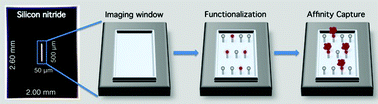
The purification of biological complexes such as proteins remains the rate-limiting step for structural studies in the electron microscopy (EM) field. In a recent RSC Advances article, the team led by Kelly developed an improved affinity capture device capable of purifying tagged biomacromolecules of interest while viewing them in a liquid-flow environment within a TEM column. The purification component of the device works at high specificity and nanogram sensitivity.  
 
“The method also lends itself for use with antibodies against cell surface proteins to isolate whole cells. The isolation of rare cells or cancer cells may be possible in combination with TEM imaging. This opens a new avenue for the visual screening of therapeutic interventions aimed at multiscale imaging—from the molecular to the cellular levels. Overall, the use of affinity capture devices and live TEM imaging provide a unique platform to view active biological processes at nanometer resolution,” say the US scienstists.   
 
Read the full article online. Free to access upon a simple registration process.   

The development of affinity capture devices—a nanoscale purification platform for biological in situ transmission electron microscopy
Katherine Degen ,  Madeline Dukes ,  Justin R. Tanner and Deborah F. Kelly
RSC Adv., 2012, Advance Article, DOI: 10.1039/C2RA01163H

Digg This
Reddit This
Stumble Now!
Share on Facebook
Bookmark this on Delicious
Share on LinkedIn
Bookmark this on Technorati
Post on Twitter
Google Buzz (aka. Google Reader)

Towards light-controllable anticoagulant drug

Aptamers are single-stranded oligonucleotides that fold into 3-D structures to specifically bind targets such as ions, small biological organic or inorganic molecules. Previously, it has been shown that thrombin binding aptamers (TBA) have good anticoagulant activity with high-affinity, non-immunogenicity, and non-toxicity.

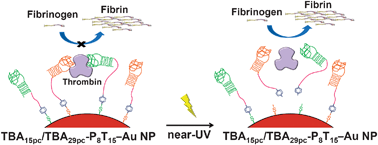
In a recently published RSC Advances article, Huang et al. show that multivalent TBA bound to gold nanoparticles have 10000 times higher binding affinity than TBA15 (thrombin binding aptamer containing 15 bases). The anticoagulant activity of multivalent TBA-gold nanoparticles is reported to be extremely high, even better than the commercial drugs, argatroban and hirudin.

Moreover, the authors have also developed a photocleavable (PC) version of the multivalent TBA-gold nanoparticles. Upon irradiation with near UV light (365 nm), the 2-nitrobenzyl PC linker of the terminal-modified TBA can be cleaved resulting in the reversal of thrombin activity. The authors are confident that the light-controllable anticoagulant drug will be potentially useful in biomedical aplications.

“We believe that our described technique can be widely used to modify nanoparticles with other DNA or RNA aptamers for different proteins or cancer targets”, say Huang and co-workers from National Taiwan University.

The article was published in our latest issue of RSC Advances, issue 4, 2012. It is free to access by simply registering online before December 2012.

Highly flexible and stable aptamer-caged nanoparticles for control of thrombin activity
Chia-Lun Hsu, Shih-Chun Wei, Jyun-Wei Jian, Huan-Tsung Chang, Wei-Hsi Chen and Chih-Ching Huang
RSC Adv., 2012, 2, 1577-1584

Digg This
Reddit This
Stumble Now!
Share on Facebook
Bookmark this on Delicious
Share on LinkedIn
Bookmark this on Technorati
Post on Twitter
Google Buzz (aka. Google Reader)

Biofunctionalised graphene as an anticoagulant

Scientists in China have come up with a green way to reduce graphene oxide so that it can be used in the biomedical field.

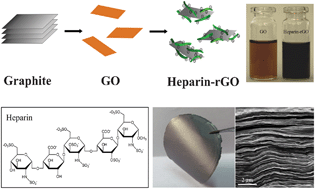
The team has used the anticoagulant heparin, a straight-chain anionic glycosaminoglycan and a natural polymer, to reduce and stabilise the graphene oxide. The heparin–reduced graphene oxide sheets show excellent biocompatibility and activity as a blood anticoagulant, according to the researchers. They also say that the heparin–reduced graphene oxide could bind strongly to anticancer drugs for highly efficient loading.

In order to read more about this work, please download the full article for free by simply registering here:

Green and easy synthesis of biocompatible graphene for use as an anticoagulant
Yi Wang, Pu Zhang, Chun Fang Liu, Lei Zhan, Yuan Fang Li and Cheng Zhi Huang
RSC Adv., 2012, Advance Article, DOI: 10.1039/C2RA00841F, Paper

Digg This
Reddit This
Stumble Now!
Share on Facebook
Bookmark this on Delicious
Share on LinkedIn
Bookmark this on Technorati
Post on Twitter
Google Buzz (aka. Google Reader)

Selecting chiral nanotubes using phage display

“Peptides with an affinity for carbon nanotubes with specific chiralities have been selected by phage display for the first time”, claim scientists from Singapore and China. Phage display is a selection technique in which a combinatorial library of polypeptides allows identification of peptides with desired binding specificities to various target molecules.

Separation of single walled carbon nanotubes (SWCNTs) with a specific chirality is important in the field of carbon nanotube research and a prerequisite for their applications in nanoelectronics. “The availability of single-chirality SWCNT components is still a formidable challenge, although remarkable progress has been made in obtaining narrow chirality distributions of SWCNTs in the past few years”, explain Liao and co-workers.

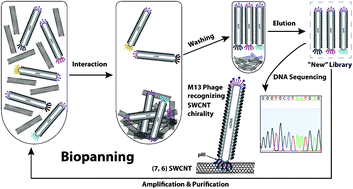
The figure on the right shows the “biopanning” procedure designed to retain the desired phage and eliminate the undesired phages in the phage display library. More information  about “biopanning” can be obtained by reading the full article online.

Free to access article reference:

Recognition of carbon nanotube chirality by phage display
Ting Yu, Yingxue Gong, Tingting Lu, Li Wei, Yuanqing Li, Yuguang Mu, Yuan Chen and Kin Liao

RSC Adv., 2012, Advance Article, DOI: 10.1039/C1RA00581B

Digg This
Reddit This
Stumble Now!
Share on Facebook
Bookmark this on Delicious
Share on LinkedIn
Bookmark this on Technorati
Post on Twitter
Google Buzz (aka. Google Reader)

EAQ converts nanotubes from metallic to semiconducting

The practical use of single-walled carbon nanotubes (SWNTs) in electronics such as field-effect transistors has been somewhat hindered by the presence of metallic nanotubes in current synthetic methods.   Scientists in Singapore and the US have come up with a simple method to convert unwanted metallic single-walled carbon nanotubes (M-SWNTs) into semiconducting ones (S-SWNTs).

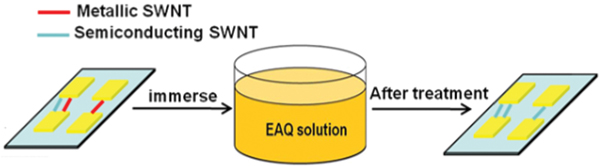
The team immersed as synthesised SWNT on-chip devices and immersed them into a solution containing an aromatic compound – 2-ethylanthraquinone (EAQ), which is a mild radical initiator. The EAQ-generated radicals preferentially attack the M-SWNTs over the S-SWNTs in situ, converting them to its semiconducting mode.

Alternative methods for converting M-SWNTs to S-SWNTs use either electron irradiation, which is difficult to scale up, or hydrogen plasma, which is aggressive and can’t be controlled. “This approach (using EAQ…) is simple, mild and easily scalable to whole wafers,” claim John Rogers (University of Illinois at Urbana-Champaign, US) and Mary Chan-Park (Nanyang Technological University, Singapore).

Free access to the full article online:
 

On-chip diameter-dependent conversion of metallic to semiconducting single-walled carbon nanotubes by immersion in 2-ethylanthraquinone
Jiangbo Li, Xuena Luan, Yinxi Huang, Simon Dunham, Peng Chen, John A. Rogers and Mary B. Chan-Park
RSC Adv., 2012, Advance Article, DOI: 10.1039/C1RA00817J, Communication

Digg This
Reddit This
Stumble Now!
Share on Facebook
Bookmark this on Delicious
Share on LinkedIn
Bookmark this on Technorati
Post on Twitter
Google Buzz (aka. Google Reader)

A dual combo for mouth wash or dental paste

“Chlorhexidine-loaded calcium phosphate nanoparticles provide a dual system with both mineralising and antibacterial properties,” claim German scientists.

Calcium phosphate is a natural component of tooth mineral and it can help to remineralise damaged enamel. On the other hand, chlrohexidine is an antibacterial agent, which helps prevent the bacterial colonisation on the tooth surface. The team led by Professor Matthis Epple at the University of Duisburg-Essen synthesised chlorhexidine-loaded calcium phosphate nanoparticles for use either in mouth wash or as a paste.  

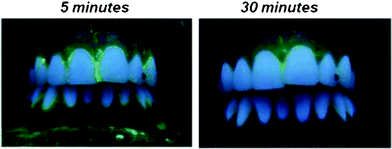
The figure below shows that “the fluorescein-labelled paste containing the functionalised nanoparticles adhered well onto the tooth surface, especially at the cervical and proximal areas”. Epple and co-workers also demonstrate that the paste sticks well to the root surface and closes dentin tubules.

Read the full paper published in RSC Advances by clicking on the title below or simply register online, if you do not have free access to the Journal content already.

Chlorhexidine-loaded calcium phosphate nanoparticles for dental maintenance treatment: combination of mineralising and antibacterial effects
Anna Kovtun, Diana Kozlova, Kathirvel Ganesan, Caroline Biewald, Nadine Seipold, Peter Gaengler, Wolfgang H. Arnold and Matthias Epple
RSC Adv., 2012, Advance Article
DOI: 10.1039/C1RA00955A, Paper


Also of interest is a recent review article recently published in RSC Advances. Click on the title for free access.

Recent advances in the development of dental composite resins
Christine Lavigueur and X. X. Zhu
RSC Adv., 2012, 2, 59-63
DOI: 10.1039/C1RA00922B, Review

Digg This
Reddit This
Stumble Now!
Share on Facebook
Bookmark this on Delicious
Share on LinkedIn
Bookmark this on Technorati
Post on Twitter
Google Buzz (aka. Google Reader)

It’s a wrap!

Graphene-wrapped nanosilicon for high performance Li-ion batteries

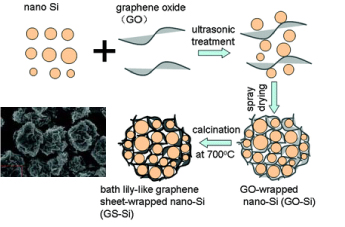
Chinese scientists have used graphene sheets to wrap silicon nanoparticles to make nanocomposites which resemble bath lilies.

Zi-Feng Ma and co-workers, from Shanghai Jiao Tong University, have assessed the performance of the novel bath lily-like graphene sheet-wrapped silicon (GS-Si) nanocomposites as anode materials for Li-ion batteries. They showed that the GS-Si nanocomposites exhibit a high reversible capacity of 1525mAh g1 and superior cycling stability.  Conventional graphite anodes display a theoretical specific capacity of only 372 mAh g-1, making it a weak candidate for anodes of Li-ion batteries.

The GS-Si nanocomposites were synthesised using a spray-drying technique which requires “no surfactant, no filtration or washing processes and no high vacuum conditions.” The authors believe that the procedure is safe and environmentally friendly and can be scaled up for the mass production of graphene-based composite materials.

The obtained GS-Si composite possesses an open nano/micro-structure, in which nanosized Si particles are uniformly dispersed and wrapped in the graphene sheet (GS) matrix. “The GS not only constitutes a good conducting network, but also provides enough void spaces to accommodate the volume change of Si and prevent the aggregation of nano-Si particles during cycling, ” explains Ma et al.

Find out more about graphene sheet-wrapped nanocomposites by downloading the full article for free until December 2012.

A novel bath lily-like graphene sheet-wrapped nano-Si composite as a high performance anode material for Li-ion batteries
Yu-Shi He, Pengfei Gao, Jun Chen, Xiaowei Yang, Xiao-Zhen Liao, Jun Yang and Zi-Feng Ma
RSC Adv., 2011, 1, 958-960

Digg This
Reddit This
Stumble Now!
Share on Facebook
Bookmark this on Delicious
Share on LinkedIn
Bookmark this on Technorati
Post on Twitter
Google Buzz (aka. Google Reader)

Red marks the spot

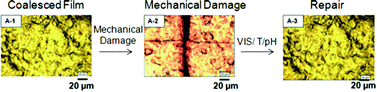
A self-healing polymer coating that changes from clear to red when damaged has been developed by a research team in the US. The coating repairs itself in sunlight, under heating or with exposure to acidic vapours, and becomes clear again.

Marek Urban, leading researcher at the University of Southern Mississippi, explains that the polymer “films are capable of sensing color changes upon mechanical scratches, but upon exposure to the visible (VIS) portion of the electromagnetic radiation (y580 nm), temperature, and/or acidic atmospheres, not only mechanical damage is repaired, but also the mechanically induced red coloured scar vanishes.”

The red colour is because of a ring-opening reaction to form merocyanine, which is red. As the ring closes again under light, heat or an acidic vapour, it forms spironaphthoxazine, which is clear.

Want to find out more? Download the full paper for free until December 2012.

Self-repairable copolymers that change color
Dhanya Ramachandran, Fang Liu and Marek W. Urban
RSC Adv., 2012, Advance Article, DOI: 10.1039/C1RA00137J

Digg This
Reddit This
Stumble Now!
Share on Facebook
Bookmark this on Delicious
Share on LinkedIn
Bookmark this on Technorati
Post on Twitter
Google Buzz (aka. Google Reader)

Nanotubes infiltrate plant cell walls via induced nanoholes

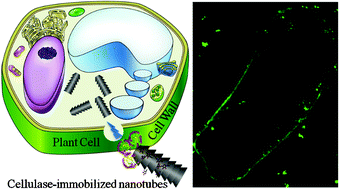
Carbon nanotubes that look like cups stacked on top of each other have been functionalized with cellulase enzyme to enable them to penetrate inside cells through induced nanoholes without damaging the entire plant cell wall.

Plant cell wall is a unique barrier made up of cellulosic materials which prevent the passage of macromolecules inside the cells. Traditionally, when studying plant biology, scientists strip away the cell wall using cellulase (an enzyme that causes cellulose hydrolysis) or other chemical treatments. The latter procedures to disorganize the cell walls may affect the cell viability or the cell’s capability to divide.

Scientists at Nagoya University in Japan, have developed a clever way to functionalize cup-stacked carbon nanotubes functionalized on their tips and walls with cellulase. The immobilized cellulase is proposed to induce local lesions in the cell wall, through which carbon nanotubes can transport into the interior of the cell.

The authors believe that this new method could open a lot of opportunities for studying plant cell genetics or plant diseases.

Download the full article for free by simply registering here.

Introducing carbon nanotubes into living walled plant cells through cellulase-induced nanoholes
Maged F. Serag, Noritada Kaji, Manabu Tokeshi and Yoshinobu Baba
RSC Adv., 2012, Advance Article, DOI: 10.1039/C1RA00760B, Communication

Digg This
Reddit This
Stumble Now!
Share on Facebook
Bookmark this on Delicious
Share on LinkedIn
Bookmark this on Technorati
Post on Twitter
Google Buzz (aka. Google Reader)

200th RSC Advances Article published online: A biochip for detecting ocean microbes

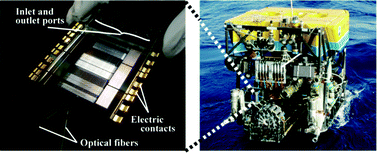
Fujii and co-workers have fabricated a microfluidic device capable of analyzing microbial genes in deep sea environments. The genetic analyzer consists of a PDMS–glass microfluidic device that is capable of cell lysis, DNA purification, PCR, and optical detection. The Integrated In Situ Analyzer was named “IISA-Gene’’. It was developed and evaluated in Tokyo as a result of a fruitful collabotation between the University of Tokyo and the Tokyo Institute of Technology.

“We were able to use IISA-Gene to achieve spatiotemporally resolved profiling of microbial ecosystems in ocean environments”, claims Fujii. The technique which incorporates microfluidic technology minimises the risks of contamination through sample collections and manipulations.   

By employing a simple flow-through PCR method, complicated genetic analyses can be automatically performed in extreme oceanic conditions. The performance of the system has been examined through at-sea experiments, taking it down to the deep sea using a remotely-operated vehicle. “Field evaluations at deep sea have shown that the amplification of the eubacterial universal 16S rRNA gene and the recovery of the PCR product to the surface”, says Fujii. The technology could provide a significant step to aid the discovery of further microbial life-forms in our oceans. 

This is the 200th article published online by RSC Advances, a newly launched Journal by the Royal Society of Chemistry. You can download the full article for free by simply registering here.

Integrated in situ genetic analyzer for microbiology in extreme environments
Tatsuhiro Fukuba, Akimitsu Miyaji, Takuji Okamoto, Takatoki Yamamoto, Shohei Kaneda and Teruo Fujii
RSC Adv., 2011, 1, 1567-1573

Digg This
Reddit This
Stumble Now!
Share on Facebook
Bookmark this on Delicious
Share on LinkedIn
Bookmark this on Technorati
Post on Twitter
Google Buzz (aka. Google Reader)