Author Archive

Davide Corinti joins RSC Advances as Associate Editor

RSC Advances is delighted to welcome Professor Davide Corinti, Sapienza University of Rome, as Associate Editor!

Dr Davide Corinti obtained his Ph.D. in Pharmaceutical Sciences from Sapienza University of Rome in 2018 and subsequently received the 2019 Best PhD Thesis in Inorganic Chemistry award from the Italian Chemistry Society.

His research focuses on exploring the interactions between metal-based drugs and biomolecules utilizing advanced mass spectrometry, ion spectroscopy, and quantum mechanical calculations. Furthermore, he combines analytical methodologies with theoretical calculations to establish gas-phase spectroscopic techniques for the structural discrimination of isomeric metabolites. His research involves an active international network, encompassing visiting appointments, as well as conducting experiments at European free-electron laser facilities, including FEL CLIO and FELIX.

Dr Corinti is currently an Assistant Professor in the Department of Drug Chemistry and Technologies at Sapienza University of Rome.


Research areas:

  • Spectroscopy
  • Mass spectrometry
  • Bioinorganic chemistry
  • Coordination chemistry
  • Computational reactivity and structure
  • Density functional theory


Browse a selection of Davide’s RSC publications:
Zn(ii) complexation promotes isomerization and oxidative rearrangements of naringenin: evidence from IR ion spectroscopy and DFT calculations
Lucretia Rotari, Valeria Vergine, Giel Berden, Jos Oomens, Barbara Chiavarino, Davide Corinti, Maria Elisa Crestoni
Dalton Trans. 2026; 55 (13): 5290–5300

Vibrational analysis of auranofin complexes with cysteine and selenocysteine unveils distinct binding motifs and specific unimolecular reactivity
Roberto Paciotti, Davide Corinti, Cecilia Coletti, Nazzareno Re, Giel Berden, Jos Oomens, Simonetta Fornarini, Maria Elisa Crestoni
Inorg. Chem. Front. 2024; 11 (23): 8464–8478

Complexation of halide ions to tyrosine: role of non-covalent interactions evidenced by IRMPD spectroscopy
Davide Corinti, Barbara Gregori, Leonardo Guidoni, Debora Scuderi, Terry B. McMahon, Barbara Chiavarino, Simonetta Fornarini, Maria Elisa Crestoni
Phys. Chem. Chem. Phys. 2018; 20 (6): 4429–4441.

Hydrolysis of cis- and transplatin: structure and reactivity of the aqua complexes in a solvent free environment
Davide Corinti, Cecilia Coletti, Nazzareno Re, Susanna Piccirillo, Marco Giampà, Maria Elisa Crestoni, Simonetta Fornarini
RSC Adv. 2017; 7 (26): 15877–15884

RSC Advances Royal Society of Chemistry

Submit to RSC Advances today! Check out our author guidelines for information on our article types or find out more about the advantages of publishing in a Royal Society of Chemistry journal.

Keep up to date with our latest Popular Advances, Reviews, Collections & more by following us on Bluesky. You can also keep informed by signing up to our E-Alerts.

Digg This
Reddit This
Stumble Now!
Share on Facebook
Bookmark this on Delicious
Share on LinkedIn
Bookmark this on Technorati
Post on Twitter
Google Buzz (aka. Google Reader)

Submit your nanocatalysis research to our new themed collection

RSC Advances is excited to launch a themed collection entitled “Nanocatalysis”, which is Guest Edited by Professor Anil Banerjee (University of Connecticut), Professor Steven Suib (University of Connecticut) and Professor Koustuv Ray (Indian Institute of Technology Kharagpur)

Nanocatalysis represents an exciting subfield in nanoscience and nanotechnology which involves the use of nanomaterials in the research fields in physics, chemistry, biology, medicine and particularly catalysis. They are defined as substances in the shape of spherical dots, rods, thin plates, or any irregular shape with a cross section of less than 100 nm. Even subnano-sized materials (nanoclusters, diatoms, single atoms) are preferably used as catalysts for a wide variety of homogeneous and heterogeneous catalytic reactions. Along with significant advances in nanomaterial design and synthesis assisted by machine learning, in-situ/ex-situ characterization techniques, and computational chemistry, the past several decades have witnessed a flood of research activities in this rapidly evolving area with most of the studies focusing on the effects of size, shape, chemical composition and morphology on catalytic properties and performance.


Nanocatalysts can potentially bridge the gap between homogeneous and heterogeneous catalysts, and offer better promise for activity, selectivity, stability, efficiency, atom economy and reusability. By controlling the size, shape, spatial distribution, surface composition, and electronic structures, the properties of nanocatalysts could be tweaked for new applications in chemical reactions. Interestingly, nanocatalysts have a wide range of applications including environmental and automobile pollution control, renewable energy, alternative fuels, polymerization, and design of novel catalytic processes and reactions. The types of nanocatalysts include carbon nano tubes, nanowires, nano composites, nano porous materials, low-dimensional materials (including 2D materials) monometallic, bimetallic and oxide nano catalysts. Broadly, the three classes of reaction domains namely thermal catalysis, electrocatalysis and photocatalysis, are going to be highlighted to showcase research directions towards environmental and energy related challenges.


This special themed collection aims to provide a platform to showcase the recent progress and challenges in the field of nanocatalysis. The way forward and novel techniques to overcome activity-stability and activity–selectivity trade-off are provisioned to broaden the scope.


We invite submissions that contribute to the advancement of knowledge in the broad field of nanocatalysis, with particular emphasis on the following broad topics. To keep the focus on nanocatalysis, research articles without application to nanocatalytic reactions will not be considered for this themed collection.


•           Synthesis, characterization and reactions in thermal catalysis, photocatalysis, electrocatalysis

•           Automotive and air pollution nanocatalysis

•           Structure-activity relations, confinement effects, dynamic evolution of active sites

•           Mechanism and catalytic cycles of nanocatalysts

•           Theoretical modelling (First-principles based DFT calculations, catalyst screening and exploring new and alternative catalysts by the use of machine learning) on nanocatalysis

•           Process and product development involving nanocatalysts


RSC Advances is a gold Open Access journal publishing high-quality research on all aspects of chemistry. Both papers and review articles are welcome. More information on the article types can be found on the journal web page.


The deadline for manuscript submission is 31 March 2026.


All manuscripts will be subject to the journal’s usual peer review process. Accepted manuscripts will be published in a regular issue of the journal as soon as possible and then added to the themed collection on the journal webpage.


RSC Advances’ article processing charge (APC) is among the lowest in chemistry and waivers are also available for authors who meet the eligibility criteria outlined here.


In order to view any deals that your institute may have in place with the Royal Society of Chemistry for Open Access publishing, or to discover any discounts that you may be entitled to, authors are encouraged to use our Journal Finder tool.


Did you know?


At RSC Advances, our themed collections are built in collaboration between our Guest Editors and expert Associate Editors. Our Guest Editors guide the scope and curate the contributions in our collections but all submissions are handled through peer review by our team of resident Associate Editors. This means that as an author you receive a consistent experience, and as a reader you can trust the quality of the science being presented.


Digg This
Reddit This
Stumble Now!
Share on Facebook
Bookmark this on Delicious
Share on LinkedIn
Bookmark this on Technorati
Post on Twitter
Google Buzz (aka. Google Reader)

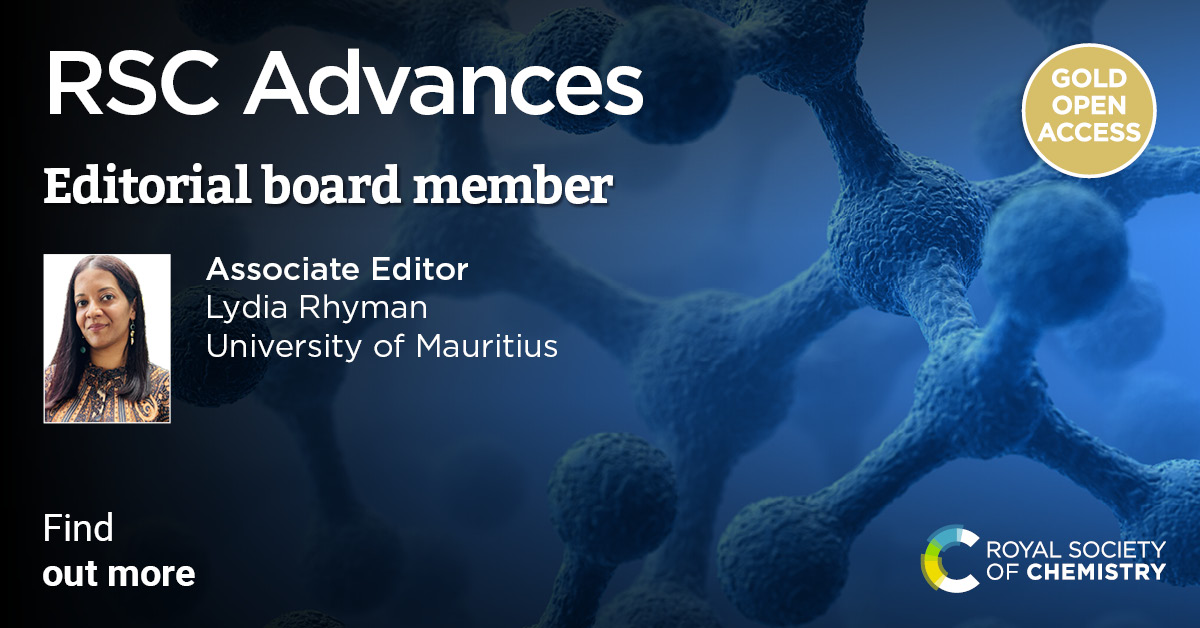
Lydia Rhyman joins RSC Advances as Editorial Board member and Associate Editor

RSC Advances is delighted to welcome Dr Lydia Rhyman, University of Mauritius as Editorial Board member and Associate Editor.


Lydia Rhyman was awarded her PhD in Computational Chemistry from the University of Mauritius under the supervision of Prof Ponnadurai Ramasami. She did her postdoctoral research at the University of Johannesburg and the University of Mauritius. She is currently an independent researcher. Her research interests lie in the use of Computational Chemistry methods to complement experimental results, to solve chemistry and interdisciplinary problems and address problem beyond experimental reach.


She actively promotes Computational Chemistry in Africa. She is a strong advocate for women in science, for open-access publishing and research integrity and raises awareness through various outreach activities.


She is an affiliate of the African Academy of Sciences, a member of the Royal Society of Chemistry, a member of the Global Young Academy and a TWAS Young Affiliate. She works closely with the RSC through her involvement with Commonwealth Chemistry where she serves as the African regional representative of the Early Career Chemists Network committee.


Discover some of her recent publications:


Computational study of the interaction of the psychoactive amphetamine with 1,2-indanedione and 1,8-diazafluoren-9-one as fingerprinting reagents

Divya Bhikharee, Lydia Rhyman and Ponnadurai Ramasami

RSC Adv., 2023, 13, 4077-4088


A study of the thermodynamics and mechanisms of the atmospherically relevant reaction dimethyl sulphide (DMS) with atomic chlorine (Cl) in the absence and presence of water, using electronic structure methods

Lydia Rhyman, Edmond P.F. Lee, Ponnadurai Ramasami and John M. Dyke

Phys. Chem. Chem. Phys., 2023, 25, 47780-4793


Unveiling the non-polar [3+2] cycloaddition reactions of cyclic nitrones with strained alkylidene cyclopropanes within a molecular electron density theory study

Luis R. Domingo, Mar Ríos-Gutiérrez, Rishikesh Chulan, M.H.H. Mahmoud, Mohamed M. Ibrahim, Salah M. El-Bahy, Lydia Rhyman and Ponnadurai Ramasami

RSC Adv., 2022, 12, 25354-25363


Please join us in welcoming Lydia Rhyman!


Submit your research now


A brief overview of RSC Advances


  • one of the world’s largest gold open access chemistry journals
  • international readership
  • fast publication times ensure rapid visibility of your work
  • authors retain copyright of their article
  • all submissions are handled by a team of associate editors, who are established scientists actively working in the area
  • all articles published in RSC Advances have been through the full peer review process
  • the APC is among the lowest in the industry
  • the Royal Society of Chemistry is a not-for-profit publisher – all surplus is re-invested back into the global scientific community


Find out more about RSC Advances and the benefits of publishing with us at rsc.li/rsc-advances.

Digg This
Reddit This
Stumble Now!
Share on Facebook
Bookmark this on Delicious
Share on LinkedIn
Bookmark this on Technorati
Post on Twitter
Google Buzz (aka. Google Reader)

Brenno Neto at Organic Synthesis Workshop, Brazil

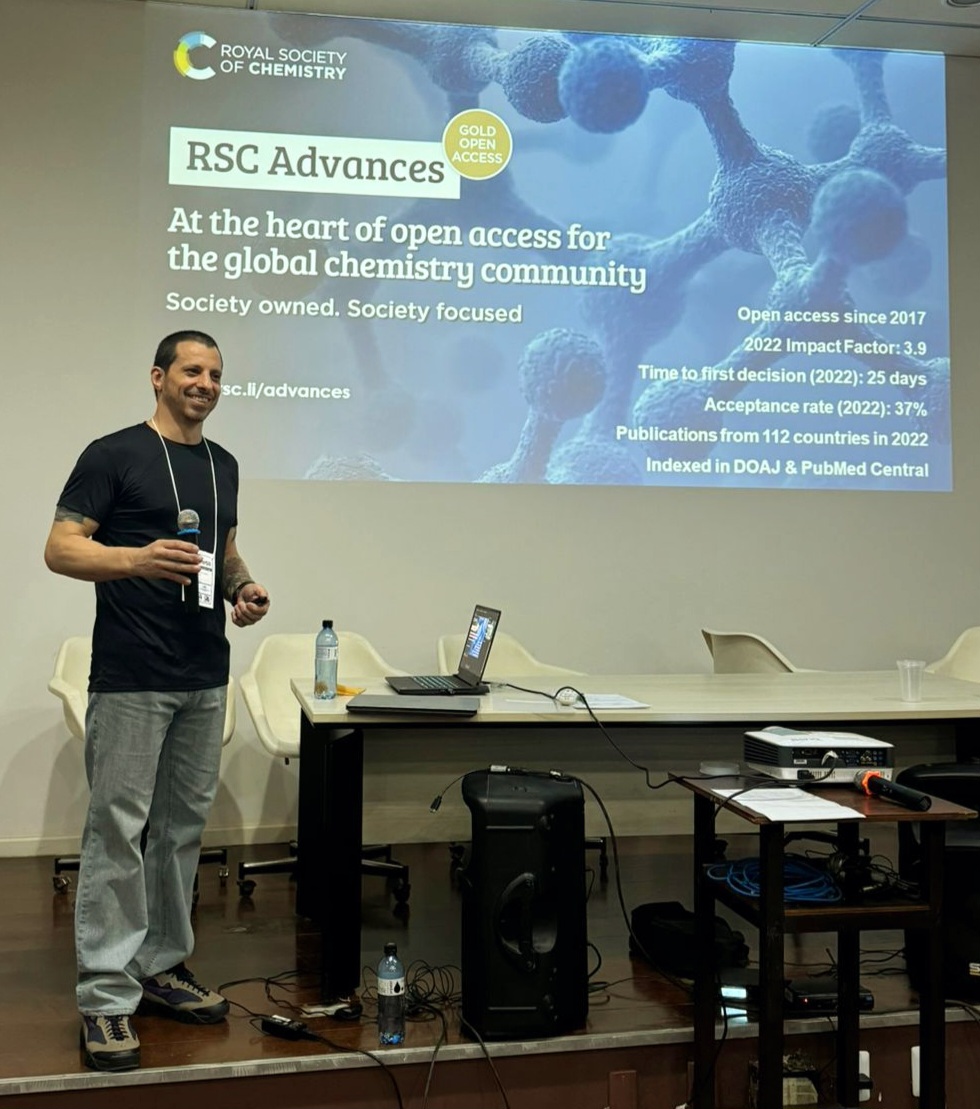
RSC Advances Associate Editor Brenno Neto recently attended the 7th Organic Synthesis Workshop of the North, Northeast and Midwest, which took place at the Federal University of Bahia, Brazil.


The aim of the congress was to foster exchanges between Organic Synthesis researchers from these Regions. The Workshop program included lectures and oral presentations of student work, reflecting the results of research groups.


Brenno Neto presented his latest research results and took the opportunity to also talk about RSC Advances and how it supports the global chemistry community.


Digg This
Reddit This
Stumble Now!
Share on Facebook
Bookmark this on Delicious
Share on LinkedIn
Bookmark this on Technorati
Post on Twitter
Google Buzz (aka. Google Reader)