
It is with great pleasure that we announce Dr Julien Nicolas (Université Paris Sud, France) as the recipient of the 2017 Polymer Chemistry Lectureship.
This award, now in its third year, honours an early-career researcher who has made significant contribution to the polymer chemistry field. The recipient is selected by the Polymer Chemistry Editorial Board from a list of candidates nominated by the community.
Read on to find out more about Julien…

Dr Julien Nicolas
Julien Nicolas obtained his Doctor of Philosophy in Chemistry and Physical Chemistry of Polymers in 2005 from the Laboratory of Polymer Chemistry, at the Université Pierre and Marie Curie, in Paris, France, under the supervision of Prof. Bernadette Charleux. He then joined Prof. David Haddleton’s group at the University of Warwick as a postdoctoral fellow in 2006. In 2007, he became a CNRS researcher at Institut Galien, Paris Sud, and became a Director of Research in the same institute in 2016. He has published more than 80 refereed scientific articles (h-index 36), filled 5 patents and is currently Associate Editor for Chemistry of Materials (ACS).
Julien’s current research interests are multidisciplinary and span from organic chemistry and polymer synthesis to nanoparticulate systems and biomedical applications. The current interests of his group are focused on multifunctional biodegradable nanoparticles, well-defined molecular/polymer prodrug nanoparticles and controlled polymerization techniques from both fundamental and applied standpoints, with an emphasis on their application for the synthesis of biodegradable vinyl polymers and innovative biomaterials. Awards and honours he has received to date include the French Polymer Society (GFP) / French Chemical Society (SCF) award in 2016, and the 2017 Polymer Chemistry Lectureship award.
To learn more about Julien’s research, have a look at some of his publications in Polymer Chemistry:
Structure–cytotoxicity relationship of drug-initiated polymer prodrug nanoparticles
Yinyin Bao and Julien Nicolas
Polym. Chem., 2017, DOI: 10.1039/C7PY00536A
Efficient synthesis of 2-methylene-4-phenyl-1,3-dioxolane, a cyclic ketene acetal for controlling the NMP of methyl methacrylate and conferring tunable degradability
Johanna Tran,Elise Guégain, Nada Ibrahim, Simon Harrisson and Julien Nicolas
Polym. Chem., 2016, 7, 4427-4435
On the structure–control relationship of amide-functionalized SG1-based alkoxyamines for nitroxide-mediated polymerization and conjugation
Elise Guégain, Vianney Delplace, Thomas Trimaille, Didier Gigmes, Didier Siri, Sylvain R. A. Marque, Yohann Guillaneuf and Julien Nicolas
Polym. Chem., 2015,6, 5693-5704
Recent trends in the design of anticancer polymer prodrug nanocarriers
Vianney Delplace, Patrick Couvreur and Julien Nicolas
Polym. Chem., 2014, 5, 1529-1544
We would like to thank everybody who nominated a candidate for the Lectureship; we received many excellent nominations, and the Editorial Board had a difficult task in choosing between some outstanding candidates.
Please join us in congratulating Julien on his award!



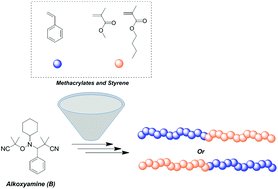 Reversible addition-fragmentation chain transfer polymerization (RAFT) and transition metal-mediated radical polymerization (TMM-RDRP) are two widely used techniques employed for the preparation of controlled polymeric architectures. However, both of them exhibit significant colouring and complete purification of the final materials is challenging. On the other hand, nitroxide mediated polymerization (NMP) requires no or minimal purification although designing alkoxyamines that can facilitate the controlled polymerization of both styrene and methacrylates is a challenge. In this contribution, Asua and co-workers employed three different alkoxyamines to study the homopolymerization of styrene and its chain extension with methacrylates. Upon careful evaluation of the reaction kinetics as well as variation of the polymerization temperature, high monomer conversions with uncompromised end group fidelity could be achieved. A wide range of molecular weights were targeted in order to identify the limitations of the system. It was found that for targeted degrees of polymerization beyond 333, there was an increased difference between theoretical and experimental molecular weights, due to the thermal initiation of styrene. In addition, the nature of the substituents in the nitroxide adduct was also found to be crucial for the controlled polymerization of styrene with bulkier adducts providing more extensive control. The retention of the reactive alkoxyamine chain end was further confirmed via nuclear magnetic resonance (NMR) and matrix assisted laser desorption ionization time of flight mass spectrometry (MALDI-ToF-MS). Well-defined PS-b-PBMA and PMMA-b-PS block copolymers were also successfully prepared highlighting these classes of alkoxyamines as a versatile mediator for the controlled polymerization of both methacrylates and styrene.