A rare example of synthon polymorphism

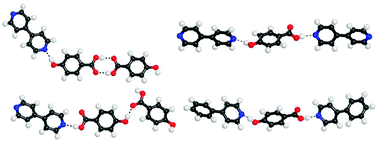
Scientists in India have reported a rare example of synthon polymorphism in co-crystals of 4,4′-bipyridine and 4-hydroxybenzoic acid.

Graphical abstract: Synthon polymorphism and pseudopolymorphism in co-crystals. The 4,4′-bipyridine–4-hydroxybenzoic acid structural landscape

Polymorphism is defined as the ability of a material to exist in more than one form or crystal structure. It has important implications for the properties of such materials; for example in pharmaceuticals, the dissolution rate of a drug can be dependent on the polymorphic form. While this is a common phenomenon in single crystals it is much less common in co-crystals, systems where the structure has at least two distinct components.

Gautam Desiraju from the Indian Institute of Science, found that when 4,4′-bipyridine and 4-hydroxybenzoic acid were dissolved together in a solvent such as methanol they would co-crystallise to form two different polymorphs. They noticed that a third form, a pseudopolymorph, was also present.

If you would like to read more about Desiraju’s discovery then why not download his ChemComm article for free today? This article is also part the ChemComm web themed issue on Supramolecular Chemistry to mark the International Year of Chemistry 2011.

Digg This
Reddit This
Stumble Now!
Share on Facebook
Bookmark this on Delicious
Share on LinkedIn
Bookmark this on Technorati
Post on Twitter
Google Buzz (aka. Google Reader)

Call for communications: catalytic C–C bond formation via late transition metals

Michael KrischeChemComm Associate Editor Michael Krische is delighted to announce a forthcoming web themed issue:

New advances in catalytic C–C bond formation via late transition metals

Guest editor: Michael Krische (University of Texas at Austin)

Submission deadline: 30th September 2011

We are now welcoming submissions for this web theme, which will be a celebration of current achievements and future perspectives in this exciting field of research.

All manuscripts will undergo strict peer review and should be very important and conceptually significant in accord with the ChemComm mandate.

Publication of the peer-reviewed articles will occur without delay to ensure the timely dissemination of the work. The articles will then be assembled on the ChemComm website as a web-based thematic issue, to permit readers to consult and download individual contributions from the entire series.

Communications for this web theme can be submitted anytime from now until 30th September using our web submission system. Please add the phrase ‘catalytic C–C bond formation’ in the comments to the editor field.

Digg This
Reddit This
Stumble Now!
Share on Facebook
Bookmark this on Delicious
Share on LinkedIn
Bookmark this on Technorati
Post on Twitter
Google Buzz (aka. Google Reader)

Nanoparticles help reveal hidden fingerprints

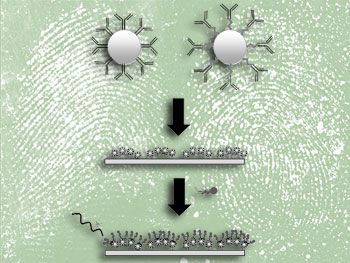
Criminal investigations may benefit from new forensic methods based on nanoparticles. A technique using gold nanoparticles in combination with antibodies has shown promising results for enhancing fingerprints that are over a week old.

Fingerprinting, first reported in the 19th century, is still the primary source of evidence used in crime scene investigation and new methods for improving fingerprint visualisation remain in demand. Unseen (latent) fingerprints can be revealed using chemical treatments that target molecules likely to be deposited in fingerprints, such as those in hair follicle secretions.

Xanthe Spindler at the University of Technology Sydney in Australia and colleagues now report a technique that targets amino acids – present ubiquitously in sweat and thus in most fingerprints. They linked amino acid-binding antibodies to gold nanoparticles and applied them to fingerprints. To develop and image the prints, they used red fluorescent secondary antibodies that would stick to the nanoparticle-bound antibodies.

Antibody structures
Antibodies bound to nanoparticles can bind to amino acids in fingerprints that are over 12 months old

 Read the full news story in Chemistry World and Spindler’s ChemComm communication to find out more.

Digg This
Reddit This
Stumble Now!
Share on Facebook
Bookmark this on Delicious
Share on LinkedIn
Bookmark this on Technorati
Post on Twitter
Google Buzz (aka. Google Reader)

A supramolecular approach to zwitterionic metal silanides

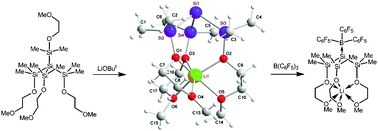
Zwitterionic metal silanides represent a structurally novel class of tri-coordinated silyl anions in which the cationic metal centre is separated from the silicon anion by internal donor bridges.

Clemens Krempner and co-workers have now reported that key to the synthesis of stable, isolable species is the use of pendant polydonor groups that exclusively bind to the metal cation and serve to prevent self-aggregation. 

Due to the shape of these unusual compounds, the electron pair located at the central silicon anion is available for additional metal binding. This has allowed for the synthesis of hitherto unknown zwitterionic heterobimetallic silanides, by reaction of the zwitterionic metal silanides with boron, aluminium or tungsten-containing species.

To read about these intriguing compounds in more detail, download the ChemComm communication, which is available for free until April 28th.

Digg This
Reddit This
Stumble Now!
Share on Facebook
Bookmark this on Delicious
Share on LinkedIn
Bookmark this on Technorati
Post on Twitter
Google Buzz (aka. Google Reader)

Catalytic reaction cascade forms substituted pyrroles

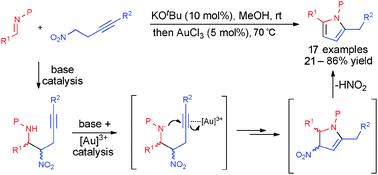
Catalytic reaction cascades present a neat, efficient way to synthesise valuable organic molecules. However, their success relies upon the compatibilty of the reactants and catalysts involved, and identifying this requires ingenuity and experimentation.

Now Darren Dixon and co-workers at the University of  Oxford have reported a one-pot nitro-Mannich/hydroamination cascade for direct synthesis of 2,5-disubstituted pyrroles from imines and nitro alkynes. The reaction is catalysed by base and a gold(I) catalyst, and has been optimised to achieve yields up to 86%.  

To find out more download the ChemComm communication, which is free to access until April 28th

Start a discussion by leaving your comments below

Digg This
Reddit This
Stumble Now!
Share on Facebook
Bookmark this on Delicious
Share on LinkedIn
Bookmark this on Technorati
Post on Twitter
Google Buzz (aka. Google Reader)

A Sustainable Global Society: How Can Materials Chemistry Help?

A high profile white paper A Sustainable Global Society: How Can Materials Chemistry Help? was launched internationally on 27 March.

The output of the Chemical Sciences and Society Summit (CS3) 2010, which took place in London, September 2010, outlines five key areas in which materials chemists, through collaboration with other scientists, industry and policy makers, can seize exciting opportunities to address global challenges. This project was driven by the RSC and is a collaboration between the chemical societies of China, Germany, Japan, the US, the UK and national funding bodies. Around 30 leading materials chemists from the participating nations participated in CS3 2010 and the white paper is a reflection of the outcome of the summit, in particular their view of the future direction for materials chemistry.

View the official website of the white paper.

Read the 27 March press release.

Digg This
Reddit This
Stumble Now!
Share on Facebook
Bookmark this on Delicious
Share on LinkedIn
Bookmark this on Technorati
Post on Twitter
Google Buzz (aka. Google Reader)

Top ten most accessed articles in February

This month sees the following articles in ChemComm that are in the top ten most accessed:-

Porous metal-organic frameworks as platforms for functional applications 
Hai-Long Jiang and Qiang Xu 
Chem. Commun., 2011, 47, 3351-3370, DOI: 10.1039/C0CC05419D, Feature Article 

Iron-catalyzed direct amination of azoles using formamides or amines as nitrogen sources in air 
Jian Wang, Ji-Ting Hou, Jun Wen, Ji Zhang and Xiao-Qi Yu 
Chem. Commun., 2011, 47, 3652-3654, DOI: 10.1039/C0CC05811D, Communication 

A bright tetranuclear iridium(iii) complex 
Etienne Baranoff, Enrico Orselli, Lionel Allouche, Davide Di Censo, Rosario Scopelliti, Michael Grätzel and Md. Khaja Nazeeruddin 
Chem. Commun., 2011, 47, 2799-2801, DOI: 10.1039/C0CC05029F, Communication 

Light operated molecular machines 
Serena Silvi, Margherita Venturi and Alberto Credi 
Chem. Commun., 2011, 47, 2483-2489, DOI: 10.1039/C0CC03829F, Highlight 

Novel C  3-symmetric n-type tris(aroyleneimidazole) and its analogs: synthesis, physical properties and self-assembly 
David Hanifi, Dennis Cao, Liana M. Klivansky and Yi Liu 
Chem. Commun., 2011, 47, 3454-3456, DOI: 10.1039/C0CC04753H, Communication 

Triarylboron-functionalized 8-hydroxyquinolines and their aluminium(iii) complexes 
Vladimir Zlojutro, Yi Sun, Zachary M. Hudson and Suning Wang 
Chem. Commun., 2011, 47, 3837-3839, DOI: 10.1039/C0CC04573J, Communication 

Dinuclear Ru(ii) complexes of bis-(dipyrid-2′-yl)triazine (bis-dpt) ligands as efficient electron reservoirs 
Marie-Pierre Santoni, Garry S. Hanan, Bernold Hasenknopf, Anna Proust, Francesco Nastasi, Scolastica Serroni and Sebastiano Campagna 
Chem. Commun., 2011, 47, 3586-3588, DOI: 10.1039/C0CC03245J, Communication 

A near-infrared fluorescent sensor for detection of cyanide in aqueous solution and its application for bioimaging 
Xiaoqiang Chen, Seong-Won Nam, Gun-Hee Kim, Nari Song, Yongsuk Jeong, Injae Shin, Seog K. Kim, Jinheung Kim, Sungsu Park and Juyoung Yoon 
Chem. Commun., 2010, 46, 8953-8955, DOI: 10.1039/C0CC03398G, Communication 

Acene-linked conjugated polymers with ratiometric fluorescent response to 1O2 
Jingjing Zhang, Syena Sarrafpour, Robert H. Pawle and Samuel W. Thomas III 
Chem. Commun., 2011, 47, 3445-3447, DOI: 10.1039/C0CC05770C, Communication 

Heating and separation using nanomagnet-functionalized metal-organic frameworks 
Martin R. Lohe, Kristina Gedrich, Thomas Freudenberg, Emanuel Kockrick, Til Dellmann and Stefan Kaskel 
Chem. Commun., 2011, 47, 3075-3077, DOI: 10.1039/C0CC05278G, Communication 

Why not take a look at the articles today and blog your thoughts and comments below.

Fancy submitting an article to ChemComm? Then why not submit to us today or alternatively email us your suggestions.

Digg This
Reddit This
Stumble Now!
Share on Facebook
Bookmark this on Delicious
Share on LinkedIn
Bookmark this on Technorati
Post on Twitter
Google Buzz (aka. Google Reader)

RSC Publishing Recognises Outstanding ChemComm Achievements in China

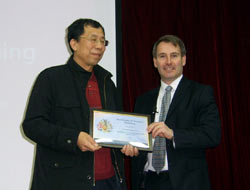
This week Dr James Milne (RSC Publishing) presented a certificate of achievement to Professor Hongjie Zhang, at Changchun Institute of Applied Chemistry. 

Professor Zhang was recognised for his prolific published research over the last year. RSC has published 17 of Professor Zhang’s papers – making him the most successful author from China during the year and three of these papers were published in ChemComm. 

Read Professor Zhang’s excellent work published in ChemComm: 

High intensity focused ultrasound and redox dual responsive polymer micelles
Yongwen Li, Rui Tong, Hesheng Xia, Hongji Zhang and Juan Xuan, Chem. Commun., 2010, 46, 7739-7741 (DOI: 10.1039/C0CC02628J)

Selective synthesis of dibenzo[a,c]cyclooctatetraenes via palladium-catalyzed [4+4] cyclic homocoupling of borylvinyl iodobenzene derivatives
Hui-jun Zhang, Junnian Wei, Fei Zhao, Yun Liang, Zitao Wang and Zhenfeng Xi, Chem. Commun., 2010, 46, 7439-7441 (DOI: 10.1039/C0CC02380A)

Making a [Co24] metallamacrocycle from the shuttlecock-like tetranuclear cobalt-calixarene building blocks
Yanfeng Bi, Guancheng Xu, Wuping Liao, Shangchao Du, Xinwu Wang, Ruiping Deng, Hongjie Zhang and Song Gao, Chem. Commun., 2010, 46, 6362-6364 (DOI: 10.1039/C0CC01844A)

Dr Milne and Dr Daping Zhang (RSC Publisher, China) are on a tour of China where they will visit seven universities/institutes and four companies in Beijing, Changchun, Shanghai and Xiamen.

Digg This
Reddit This
Stumble Now!
Share on Facebook
Bookmark this on Delicious
Share on LinkedIn
Bookmark this on Technorati
Post on Twitter
Google Buzz (aka. Google Reader)

New tool for speeding up porous materials discovery

A new tool (Infrasorb-12) for screening porosity has been developed by scientists in Germany. The tool identifies high surface area materials in a very short time with high accuracy.  The researchers say that Infrasorb-12 development will speed up the discovery of new porous materials significantly and broaden the wide range of materials suitable for gas storage, selective adsorption, catalysis, and life science applications.

Further information:
High-throughput screening: speeding up porous materials discovery
Philipp Wollmann, Matthias Leistner, Ulrich Stoeck, Ronny Grünker, Kristina Gedrich, Nicole Klein, Oliver Throl, Wulf Grählert, Irena Senkovska, Frieder Dreisbach and Stefan Kaskel, Chem. Commun., 2011, DOI: 10.1039/C1CC10674K

Also of interest:
Modifying MOFs: new chemistry, new materials
Seth M. Cohen, Chem. Sci., 2010, 1, 32-36 (DOI: 10.1039/C0SC00127A)

Digg This
Reddit This
Stumble Now!
Share on Facebook
Bookmark this on Delicious
Share on LinkedIn
Bookmark this on Technorati
Post on Twitter
Google Buzz (aka. Google Reader)

Carbon dioxide adsorption in porous phosphine coordination material

US, UK and Korean scientists have made a new porous phosphine coordination material, PCM-11. The material is an unusual 8,4-connected coordination polymer with an open 3-D pore structure, say the researchers. 

The team formed the material by reacting Mg(II) with tris(para-carboxylato)triphenylphosphine oxide. The highly ionic nature of the metal–ligand bonding results in excellent thermal stability upon desolvation (>460 ºC), they say. PCM-11 is easily activated for small molecule sorption at low temperature without the requirement for solvent pre-exchange.  It adsorbs 47.5 wt% CO2 at 11.6 bar and 30ºC.

Find out more in the ChemComm communication:
High capacity CO2 adsorption in a Mg(II)-based phosphine oxide coordination material
Alisha M. Bohnsack, Ilich A. Ibarra, Peter W. Hatfield, Ji Woong Yoon, Young Kyu Hwang, Jong-San Chang and Simon M. Humphrey, Chem. Commun., 2011, DOI: 10.1039/C1CC10754B

Digg This
Reddit This
Stumble Now!
Share on Facebook
Bookmark this on Delicious
Share on LinkedIn
Bookmark this on Technorati
Post on Twitter
Google Buzz (aka. Google Reader)