
Archive for the ‘Subject Areas’ Category

Call for communications: catalytic C–C bond formation via late transition metals

Michael KrischeChemComm Associate Editor Michael Krische is delighted to announce a forthcoming web themed issue:

New advances in catalytic C–C bond formation via late transition metals

Guest editor: Michael Krische (University of Texas at Austin)

Submission deadline: 30th September 2011

We are now welcoming submissions for this web theme, which will be a celebration of current achievements and future perspectives in this exciting field of research.

All manuscripts will undergo strict peer review and should be very important and conceptually significant in accord with the ChemComm mandate.

Publication of the peer-reviewed articles will occur without delay to ensure the timely dissemination of the work. The articles will then be assembled on the ChemComm website as a web-based thematic issue, to permit readers to consult and download individual contributions from the entire series.

Communications for this web theme can be submitted anytime from now until 30th September using our web submission system. Please add the phrase ‘catalytic C–C bond formation’ in the comments to the editor field.

Digg This
Reddit This
Stumble Now!
Share on Facebook
Bookmark this on Delicious
Share on LinkedIn
Bookmark this on Technorati
Post on Twitter
Google Buzz (aka. Google Reader)

Nanoparticles help reveal hidden fingerprints

Criminal investigations may benefit from new forensic methods based on nanoparticles. A technique using gold nanoparticles in combination with antibodies has shown promising results for enhancing fingerprints that are over a week old.

Fingerprinting, first reported in the 19th century, is still the primary source of evidence used in crime scene investigation and new methods for improving fingerprint visualisation remain in demand. Unseen (latent) fingerprints can be revealed using chemical treatments that target molecules likely to be deposited in fingerprints, such as those in hair follicle secretions.

Xanthe Spindler at the University of Technology Sydney in Australia and colleagues now report a technique that targets amino acids – present ubiquitously in sweat and thus in most fingerprints. They linked amino acid-binding antibodies to gold nanoparticles and applied them to fingerprints. To develop and image the prints, they used red fluorescent secondary antibodies that would stick to the nanoparticle-bound antibodies.

Antibody structures
Antibodies bound to nanoparticles can bind to amino acids in fingerprints that are over 12 months old

 Read the full news story in Chemistry World and Spindler’s ChemComm communication to find out more.

Digg This
Reddit This
Stumble Now!
Share on Facebook
Bookmark this on Delicious
Share on LinkedIn
Bookmark this on Technorati
Post on Twitter
Google Buzz (aka. Google Reader)

A supramolecular approach to zwitterionic metal silanides

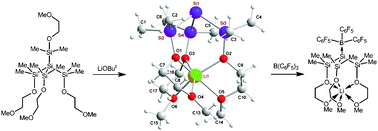
Zwitterionic metal silanides represent a structurally novel class of tri-coordinated silyl anions in which the cationic metal centre is separated from the silicon anion by internal donor bridges.

Clemens Krempner and co-workers have now reported that key to the synthesis of stable, isolable species is the use of pendant polydonor groups that exclusively bind to the metal cation and serve to prevent self-aggregation. 

Due to the shape of these unusual compounds, the electron pair located at the central silicon anion is available for additional metal binding. This has allowed for the synthesis of hitherto unknown zwitterionic heterobimetallic silanides, by reaction of the zwitterionic metal silanides with boron, aluminium or tungsten-containing species.

To read about these intriguing compounds in more detail, download the ChemComm communication, which is available for free until April 28th.

Digg This
Reddit This
Stumble Now!
Share on Facebook
Bookmark this on Delicious
Share on LinkedIn
Bookmark this on Technorati
Post on Twitter
Google Buzz (aka. Google Reader)

Catalytic reaction cascade forms substituted pyrroles

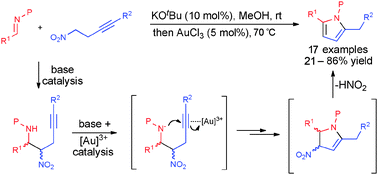
Catalytic reaction cascades present a neat, efficient way to synthesise valuable organic molecules. However, their success relies upon the compatibilty of the reactants and catalysts involved, and identifying this requires ingenuity and experimentation.

Now Darren Dixon and co-workers at the University of  Oxford have reported a one-pot nitro-Mannich/hydroamination cascade for direct synthesis of 2,5-disubstituted pyrroles from imines and nitro alkynes. The reaction is catalysed by base and a gold(I) catalyst, and has been optimised to achieve yields up to 86%.  

To find out more download the ChemComm communication, which is free to access until April 28th

Start a discussion by leaving your comments below

Digg This
Reddit This
Stumble Now!
Share on Facebook
Bookmark this on Delicious
Share on LinkedIn
Bookmark this on Technorati
Post on Twitter
Google Buzz (aka. Google Reader)

A Sustainable Global Society: How Can Materials Chemistry Help?

A high profile white paper A Sustainable Global Society: How Can Materials Chemistry Help? was launched internationally on 27 March.

The output of the Chemical Sciences and Society Summit (CS3) 2010, which took place in London, September 2010, outlines five key areas in which materials chemists, through collaboration with other scientists, industry and policy makers, can seize exciting opportunities to address global challenges. This project was driven by the RSC and is a collaboration between the chemical societies of China, Germany, Japan, the US, the UK and national funding bodies. Around 30 leading materials chemists from the participating nations participated in CS3 2010 and the white paper is a reflection of the outcome of the summit, in particular their view of the future direction for materials chemistry.

View the official website of the white paper.

Read the 27 March press release.

Digg This
Reddit This
Stumble Now!
Share on Facebook
Bookmark this on Delicious
Share on LinkedIn
Bookmark this on Technorati
Post on Twitter
Google Buzz (aka. Google Reader)

New tool for speeding up porous materials discovery

A new tool (Infrasorb-12) for screening porosity has been developed by scientists in Germany. The tool identifies high surface area materials in a very short time with high accuracy.  The researchers say that Infrasorb-12 development will speed up the discovery of new porous materials significantly and broaden the wide range of materials suitable for gas storage, selective adsorption, catalysis, and life science applications.

Further information:
High-throughput screening: speeding up porous materials discovery
Philipp Wollmann, Matthias Leistner, Ulrich Stoeck, Ronny Grünker, Kristina Gedrich, Nicole Klein, Oliver Throl, Wulf Grählert, Irena Senkovska, Frieder Dreisbach and Stefan Kaskel, Chem. Commun., 2011, DOI: 10.1039/C1CC10674K

Also of interest:
Modifying MOFs: new chemistry, new materials
Seth M. Cohen, Chem. Sci., 2010, 1, 32-36 (DOI: 10.1039/C0SC00127A)

Digg This
Reddit This
Stumble Now!
Share on Facebook
Bookmark this on Delicious
Share on LinkedIn
Bookmark this on Technorati
Post on Twitter
Google Buzz (aka. Google Reader)

Carbon dioxide adsorption in porous phosphine coordination material

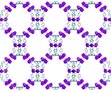
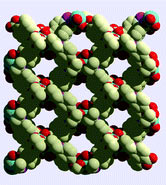
US, UK and Korean scientists have made a new porous phosphine coordination material, PCM-11. The material is an unusual 8,4-connected coordination polymer with an open 3-D pore structure, say the researchers. 

The team formed the material by reacting Mg(II) with tris(para-carboxylato)triphenylphosphine oxide. The highly ionic nature of the metal–ligand bonding results in excellent thermal stability upon desolvation (>460 ºC), they say. PCM-11 is easily activated for small molecule sorption at low temperature without the requirement for solvent pre-exchange.  It adsorbs 47.5 wt% CO2 at 11.6 bar and 30ºC.

Find out more in the ChemComm communication:
High capacity CO2 adsorption in a Mg(II)-based phosphine oxide coordination material
Alisha M. Bohnsack, Ilich A. Ibarra, Peter W. Hatfield, Ji Woong Yoon, Young Kyu Hwang, Jong-San Chang and Simon M. Humphrey, Chem. Commun., 2011, DOI: 10.1039/C1CC10754B

Digg This
Reddit This
Stumble Now!
Share on Facebook
Bookmark this on Delicious
Share on LinkedIn
Bookmark this on Technorati
Post on Twitter
Google Buzz (aka. Google Reader)

Novel methodologies for synthesising pyroglutamates

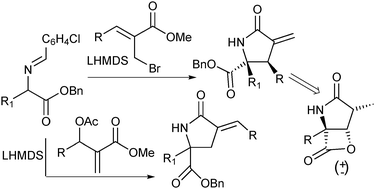
Several pyroglutamate-based natural products have been found to exhibit potent anti-cancer and anti-microbial properties. Although their syntheses have been a focus of research for many groups, their is still room for improvement in the development of highly tunable methodologies for the diverse functionalisation of the pyroglutamate ring.

Venkatram R. Mereddy and co-workers have  developed a novel and exceptionally short methodology for the synthesis of such functionalised pyroglutamates via alkylation of amino acid-derived iminoesters with allyl bromides or allyl acetates, easily obtained by Bayliss-Hilman reaction.

To learn more download the ChemComm communication, available for free until March 28th

Digg This
Reddit This
Stumble Now!
Share on Facebook
Bookmark this on Delicious
Share on LinkedIn
Bookmark this on Technorati
Post on Twitter
Google Buzz (aka. Google Reader)

A new class of molecular propellers

Scientist based in Italy have recently demonstrated a new class of molecular propellers based upon polyoxometalates (POMs).

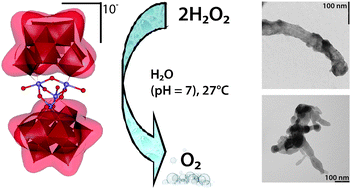
POMs consist of a cluster of transition metal oxides that are water soluble and are used for a wide range of applications. In particular, Andrea Sartorel and Marcella Bonchio, from the Univerity of Padova, are interested in their use as photosynthetic oxygen-evolving catalysts. The team studied a series of POMs with different metal centres and their catalytic performance in the disproportionation of hydrogen peroxide (H2O2) to water and oxygen.

They found that of all the POMS studied, Ru4(SiW10)2 performed the best in terms of oxygen evolution. This production of oxygen could then be used to create movement of the POM;  in effect using H2O2as fuel to create oxygen that then propels the POM material in aqueous solution. A video of this can be seen here. This represents a step towards the use of light-driven molecular machines based on POMs.

If you are interested in finding out more, then why not download Sartorel and Bonchio’s ChemComm article for free today? Also, don’t forget to leave a comment below!

Digg This
Reddit This
Stumble Now!
Share on Facebook
Bookmark this on Delicious
Share on LinkedIn
Bookmark this on Technorati
Post on Twitter
Google Buzz (aka. Google Reader)

Intramolecular cycloaddition leads to the pentacyclic core of cortistatins

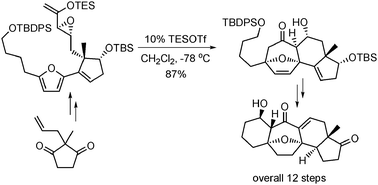
Synthesising intriguing bioactive natural products in the most expedient and atom-efficient manner remains a highly active and competitive field of research. Cortistatins A and J, first isolated from the marine sponge Corticium simplex in 2006, have been identified as effective anti-angiogenics, which studies have found could suppress cancer recurrence when given in conjunction with traditional cancer drugs.

Lok Lok Liu and Pauline Chiu at the University of Hong Kong have reported a concise, high yielding, asymmetric synthesis of the pentacyclic framework of the cortistatins, in 12 steps from commercially available starting materials. Their synthesis employs a highly diastereoselective intramolecular [4+3] cycloaddition of epoxy enolsilanes as the key step and brings them close to their ultimate goal.

To find out more, download the ChemComm communication for free up until March 28th

To start a discussion, leave your comments below and for a related blog post see the Totally Synthetic blog pages.

Digg This
Reddit This
Stumble Now!
Share on Facebook
Bookmark this on Delicious
Share on LinkedIn
Bookmark this on Technorati
Post on Twitter
Google Buzz (aka. Google Reader)