
Archive for the ‘Subject Areas’ Category

Free analytical content in ChemComm

ChemComm-RSC Prizes & Awards Symposium

The ChemComm–RSC Prizes & Awards Symposium takes place at Imperial College London on 22nd February 2012 with the theme of (bio)analytical science.

This is ChemComm‘s first UK-based symposium and to celebrate we’ve made some of our best analytical content free to access for a limited period.

We hope you enjoy these articles – but don’t delay! Free access only runs until 29th February.

Perspectives in imaging using mass spectrometry
Allison L. Dill, Livia S. Eberlin, Demian R. Ifa and R. Graham Cooks
Chem. Commun., 2011, 47, 2741-2746

Metal binding to a zinc-finger peptide: a comparison between solution and the gas phase
Yana Berezovskaya, Craig T. Armstrong, Aimee L. Boyle, Massimiliano Porrini, Derek N. Woolfson and Perdita E. Barran
Chem. Commun., 2011, 47, 412-414

Spectroscopic analysis of immobilised redox enzymes under direct electrochemical control
Philip A. Ash and Kylie A. Vincent
Chem. Commun., 2012, 48, 1400-1409

Fluorescent dye-doped silica nanoparticles: new tools for bioapplications
Se Won Bae, Weihong Tan and Jong-In Hong
Chem. Commun., 2012, 48, 2270-2282

Ultrasensitive fluorescence-based methods for nucleic acid detection: towards amplification-free genetic analysis
Rohan T. Ranasinghe and Tom Brown
Chem. Commun., 2011, 47, 3717-3735

An optimized isotopic labelling strategy of isoleucine-γ2 methyl groups for solution NMR studies of high molecular weight proteins
Isabel Ayala, Olivier Hamelin, Carlos Amero, Ombeline Pessey, Michael J. Plevin, Pierre Gans and Jérôme Boisbouvier
Chem. Commun., 2012, 48, 1434-1436

Nucleobase recognition at alkaline pH and apparent pKa of single DNA bases immobilised within a biological nanopore
Lorenzo Franceschini, Ellina Mikhailova, Hagan Bayley and Giovanni Maglia
Chem. Commun., 2012, 48, 1520-1522

FRET detection of amyloid β-peptide oligomerization using a fluorescent protein probe presenting a pseudo-amyloid structure
Tsuyoshi Takahashi and Hisakazu Mihara
Chem. Commun., 2012, 48, 1568-1570

Digg This
Reddit This
Stumble Now!
Share on Facebook
Bookmark this on Delicious
Share on LinkedIn
Bookmark this on Technorati
Post on Twitter
Google Buzz (aka. Google Reader)

The first direct metalation of indazoles

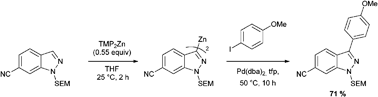
Paul Knochel from the Ludwig Maximilians University in Munich has developed a method to directly metalate and then functionalise N-protected indazoles.

Indazole heterocycles are important molecules in medicinal chemistry and methods to functionalise them are widely sought after. Direct metalation of indazoles at their 3 position is often problematic as this can quite easily lead to ring opening and formation of an aminonitrile product. Knochel overcame this problem by using a zinc reagent to form a bis-indazoylzinc compound.

The bis-indazoylzinc compound reacts with a wide range of electrophiles and can also undergo arylation in a Negishi cross-coupling reaction.  In general, such reactions are not possible using normal metalation reagents. Future work will concentrate on the synthesis of biologically active molecules using this methodology.

If you want to find out more then download the ChemComm article, free for a limited period.

Digg This
Reddit This
Stumble Now!
Share on Facebook
Bookmark this on Delicious
Share on LinkedIn
Bookmark this on Technorati
Post on Twitter
Google Buzz (aka. Google Reader)

Grinding gathers momentum for coordination polymers

It is a fairly common assumption that the sample you are characterising is the same sample that you made at the lab bench. While it may indeed be the same sample, it may not be the same structure as Peter Stephens and Jagadese Vittal discovered.

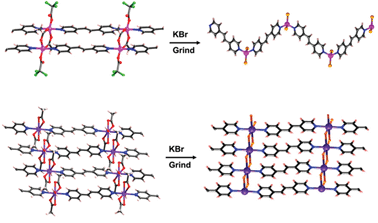
By grinding coordination polymers with KBr (as is standard practise in solid state sample preparation for infrared characterisation), they generated coordination polymers with completely new structures – and as a result, completely different optical properties as well.

The team have attributed this to an exchange between the bridging ligands and the bromide ions from KBr. While this is an interesting avenue to explore for the preparation of new coordination polymers, Stephens and Vittal warn researchers working with such materials that observed changes in sample colour or texture during pre-characterisation preparation may not always be a physical phenomenon and to tread with caution…

Read the ChemComm article today.

Digg This
Reddit This
Stumble Now!
Share on Facebook
Bookmark this on Delicious
Share on LinkedIn
Bookmark this on Technorati
Post on Twitter
Google Buzz (aka. Google Reader)

Cram Lehn Pedersen Prize awarded at ISMSC

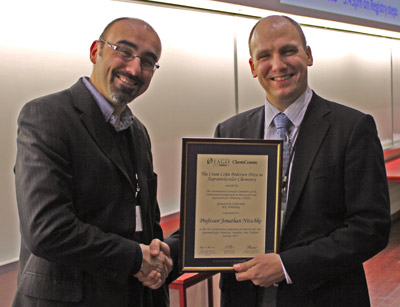
The 2012 Cram Lehn Pedersen Prize has recently been awarded to Dr Jonathan Nitschke at the 2012 International Symposium on Macrocyclic and Supramolecular Chemistry (ISMSC-7) at the University of Otago in Dunedin, New Zealand. 

The prize, sponsored by ChemComm and named in honour of the winners of the 1987 Nobel Prize in Chemistry, recognises significant, original and independent work in supramolecular chemistry by emerging investigators.

Jonathan Steed presents Jonathan Nitschke with the Cram Lehn Pedersen Prize
ChemComm Associate Editor Jonathan Steed (left) presents Jonathan Nitschke with the Cram Lehn Pedersen Prize (photo taken by Scott Cameron)

Presenting the award on behalf of ChemComm and the Organising Committee of the ISMSC, Professor Jonathan Steed of Durham University commented that “the forward-looking and sophisticated approach to the field adopted by its new stars such as Jonathan Nitschke highlights just how far the area has moved forward from its roots in classical macrocyclic chemistry. We can never forget just how visionary those early macrocyclic pioneers were in recognising the key interrelated importance of shape and function at a molecular level. This startling evolution was beautifully documented at the meeting by a fascinating retrospective by macrocyclic pioneer Prof. Neil Curtis that immediately preceded Prof. Nitschke’s elegant description of the self-assembled container chemistry and thermally switchable gels he is producing using the same principles some 55 years after Curtis’ initial discoveries.”

The conference continues until 2nd February. Later in the year, Jonathan Nitschke will be taking part in a Swiss lecture tour to celebrate his award: University of Zurich (29 May), Federal Polytechnic School of Lausanne (EPFL; 30 May), University of Geneva (31 May), Swiss Federal Institute of Technology Zurich (ETH; 1 June).  

Nominations for the 2013 Cram Lehn Pedersen prize to be awarded at ISMSC-8 in Crystal City, Virginia, USA, will open later in the year. Stay tuned to the ChemComm blog for details.

Also of interest:
2011 Winner: Professor Amar Flood
ChemComm Supramolecular Chemistry web theme

Digg This
Reddit This
Stumble Now!
Share on Facebook
Bookmark this on Delicious
Share on LinkedIn
Bookmark this on Technorati
Post on Twitter
Google Buzz (aka. Google Reader)

Selective condensations of saccharides

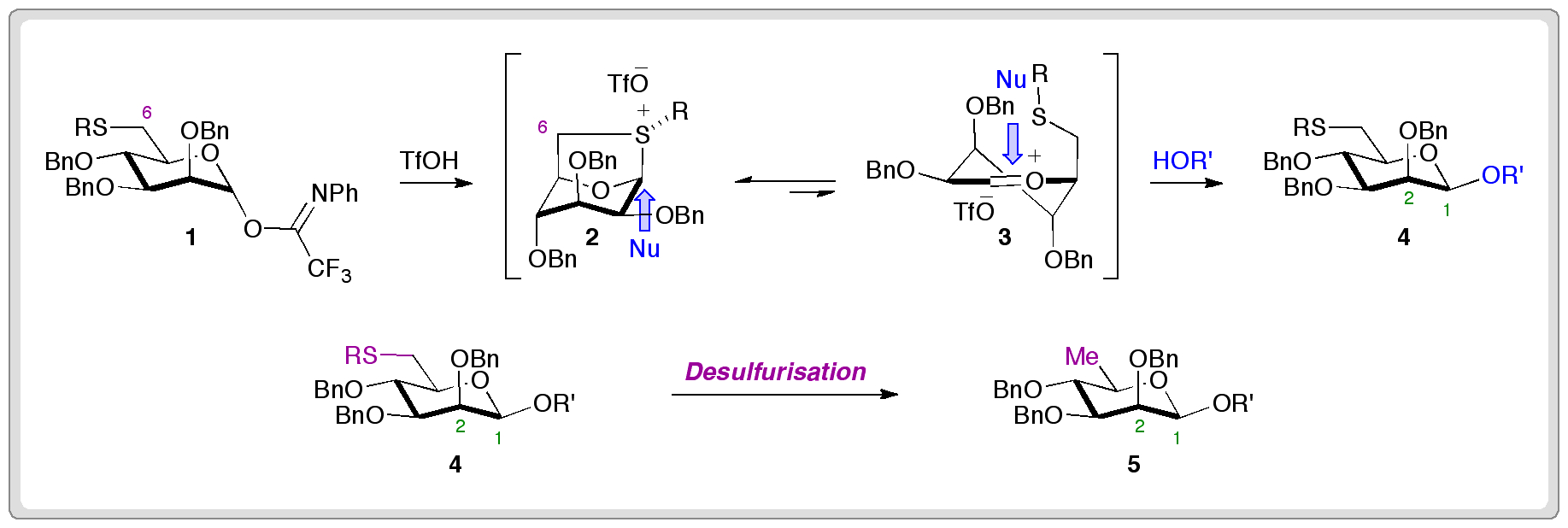
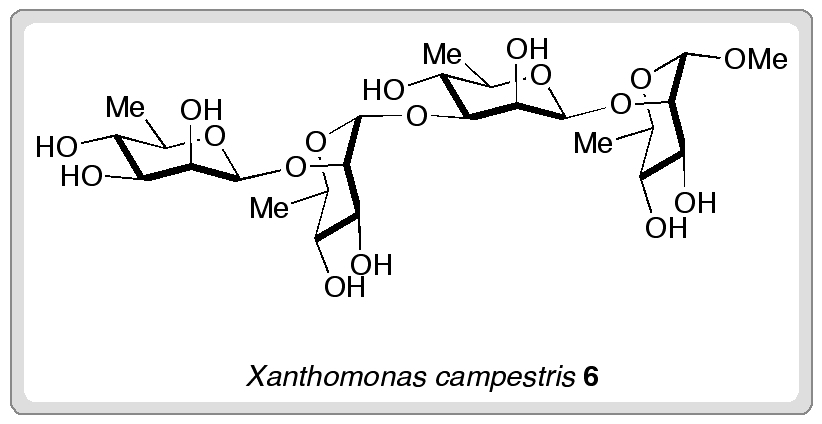
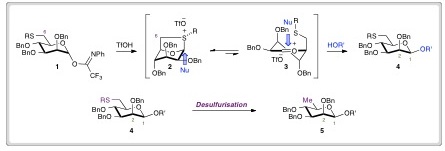
Researchers from Leiden University have developed a new method for the synthesis of βD-rhamnosides (5).

Gijsbert van der Marel’s group showed that C-6 thiophenyl ethers act as stereodirecting groups for condensation reactions of mannosyl donors (1), leading to 1,2-cis products.

They think the reaction proceeds via formation of a bicyclic sulfonium ion (2) that acts as a ‘reservoir’ for a reactive oxocarbenium species (3). Following reaction with an intermolecular nucleophile to form 4, desulfurisation provides the corresponding 1,2-cisD-rhamnoside (5).

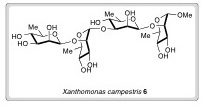
The researchers demonstrated the method’s utility for assembling complex oligosaccharides by making tetrasaccharide 6. This tetrasaccharide forms part of the structure of Xanthomonas campestris pathovar campestris, the causative agent of a devastating disease affecting cruciferous crops such as cabbage and broccoli.

To find out more, download the group’s ChemComm communication.

Digg This
Reddit This
Stumble Now!
Share on Facebook
Bookmark this on Delicious
Share on LinkedIn
Bookmark this on Technorati
Post on Twitter
Google Buzz (aka. Google Reader)

100th anniversary of first X-ray diffraction experiment

It’s 2012 and avid readers of our blog will know that the number 100 is very important to ChemComm this year.

This is the first year ChemComm will publish 100 issues  but did you know it is also 100 years since Max von Laue’s first X-ray diffraction experiment?

Max von Laue was a Professor of Physics at the University of Munich in Germany and he used copper sulfate as a 3D diffraction grating for X-rays. The field developed rapidly after this pioneering work and today X-ray diffraction is a commonly used technique for revealing information about the structure of materials.

The anniversary of Laue diffraction has been highlighted on the cover of ChemComm issue 16 by Oliver Oeckler and colleagues, who report their recent use of Laue diffraction in the issue. More specifically, they used in situ microfocus Laue diffraction to investigate temperature-dependent phase transitions of GeTe-rich compounds. Find out what they discovered by downloading their communication.

Digg This
Reddit This
Stumble Now!
Share on Facebook
Bookmark this on Delicious
Share on LinkedIn
Bookmark this on Technorati
Post on Twitter
Google Buzz (aka. Google Reader)

Solvent effects in supramolecules

We know the importance of water in protein folding but what about organic solvent effects in self-assembling structures?

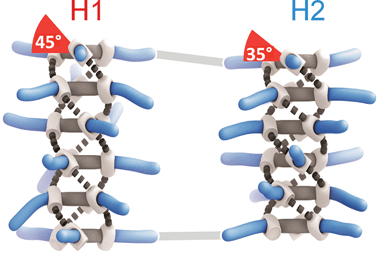
A team of scientists from the Netherlands decided to find out what happens to the supramolecular structure of deuterated benzene tricarboxamide (D-BTA) when the molecular structure of the organic solvent is changed. You may not think that swapping methylcyclohexane for heptane may make much difference – both are non-polar with similar properties. Think again.

D-BTA conformers exhibiting M helicity

Paul van der Schoot, Bert Meijer, Anja Palmans and their team discovered that substitution of one solvent for another was enough to influence the helical sense preference and conformation of D-BTA supramolecular polymers. It seems that linear solvents, such as heptane used here, actively participate in the self-assembly of the D-BTA units, causing the supramolecular aggregates to favour one helicity over the other, whereas solvents with branched or cyclic molecular structures do not permit such solvent–molecule interactions.

Once again, chemistry shows us that the smallest of changes on the molecular scale can influence more than first thought.

Keep an eye out for many more chirality-related articles to come as part of our forthcoming Chirality web theme issue. To read more about Palmans and colleagues’ findings, download the ChemComm article.

Digg This
Reddit This
Stumble Now!
Share on Facebook
Bookmark this on Delicious
Share on LinkedIn
Bookmark this on Technorati
Post on Twitter
Google Buzz (aka. Google Reader)

Monooxygenase blends

When deciding which material to use for a particular application, it’s often necessary to weigh up the pros and cons of each candidate. Wouldn’t it be great if you could combine the best bits from each one to produce the ideal material?

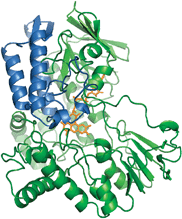
This is exactly what Marco Fraaije and his team from the University of Groningen did to create a new monooxygenase enzyme capable of performing Baeyer–Villiger oxidations with ultimate catalytic properties. For biocatalytic applications, enzymes need to be robust and should ideally be able to catalyse a broad range of substrates. Unfortunately, the only monooxygenase shown to be thermally stable (phenylacetone monooxygenase, PAMO) has narrow substrate specificity. On the other hand, there is cyclohexanone monooxygenase, CHMO, which can oxidise hundreds of substrates yet cannot be used at elevated temperatures.

The monooxygenase. Original PAMO structure is shown in green; the replaced sub-domain is shown in blue.

By replacing the substrate-binding domain of PAMO with that of CHMO or steroid monooxygenase (STMO), Fraaije was able to engineer an enzyme that was thermally robust and able to accept a wide range of substrates. Not only were the team able to combine the best of both worlds but in some cases, supersede them as they found when evaluating the conversions and enantiomeric excesses. It seems that the enzyme blend is not necessarily an average of the parent enzymes but can exhibit new properties.

Read the ChemComm article to find out more on how the team were able to improve the properties of Baeyer–Villiger monooxygenases.

Also of interest… ChemComm‘s Enzymes and Proteins web theme issue guest edited by Professors Nicholas Turner, Wilfred van der Donk and Herbert Waldmann.

Digg This
Reddit This
Stumble Now!
Share on Facebook
Bookmark this on Delicious
Share on LinkedIn
Bookmark this on Technorati
Post on Twitter
Google Buzz (aka. Google Reader)

Polydiacetylenes: Functional supramolecular smart materials

Polydiacetylene polymers (PDAs) are a popular research topic for polymer and materials chemists due to their interesting optical, spectral, electronic and structural properties. Jong-Man Kim and colleagues’ recent Feature Article gives a detailed overview of the diverse range of structural morphologies and the related functional properties featured by PDAs in recent years and highlight their importance in sensor and display technologies.

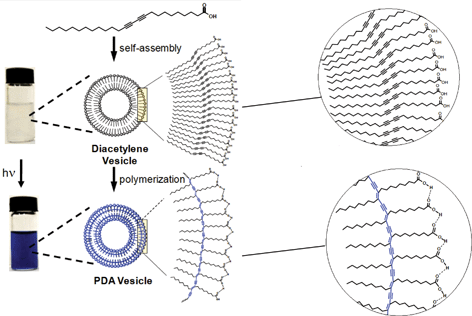
Interactions between the diacetylene (DA) monomers before polymerisation can directly influence the final polymerised structure. The monomers can be functionalised to contain motifs that encourage non-covalent interactions such as hydrogen bonding, π-stacking, electrostatics and hydrophobic interactions, allowing the DAs to self-assemble into nanostructures. Subsequent polymerisation of the acetylene groups results in cross-linking within the nanostructure, forming new materials with striking properties. One particularly interesting example of this is shown below – the DA monomers are substituted with long hydrophobic chains and polar head groups which assemble in water to form vesicles. Shining UV light on the vesicles causes the diacetylene groups to polymerise, generating PDA vesicles which are blue in colour.

For an in-depth and fascinating overview of the recent conceptual and technological advances in the chemistry of PDAs, download the full Feature Article here.

Posted on behalf of Cally Haynes, web science writer for ChemComm.

Digg This
Reddit This
Stumble Now!
Share on Facebook
Bookmark this on Delicious
Share on LinkedIn
Bookmark this on Technorati
Post on Twitter
Google Buzz (aka. Google Reader)

Germanium-bridged polymer for organic solar cells

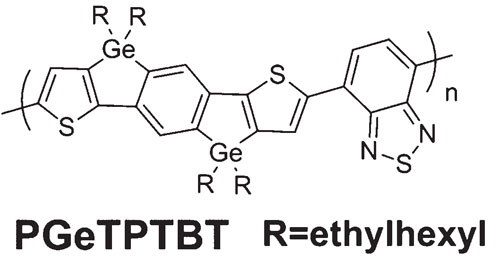
A team of scientists from the UK and US have made a novel germanium-bridged polymer that shows promise for organic solar cells.

Martin Heeney, at Imperial College London, and colleagues synthesised a heterocyclic monomer bridged with two germanium atoms. They co-polymerised it with an electron-accepting benzothiadiazole to give a polymer that, in contrast to the analogous C-bridged system, is semicrystalline.

Being able to design crystallinity into conjugated polymers in such a way is useful because crystalline polymers are better at transporting charge and hence offer more potential for solar cells. Heeney’s polymer exhibited power conversion efficiencies of over 5 % in bulk heterojunction solar cells. The team are now investigating the use of additives and co-solvents to increase this further.

Find out more – download Heeney’s ChemComm communication.

Digg This
Reddit This
Stumble Now!
Share on Facebook
Bookmark this on Delicious
Share on LinkedIn
Bookmark this on Technorati
Post on Twitter
Google Buzz (aka. Google Reader)