Archive for the ‘Subject Areas’ Category

Organometallics in catalysis: an article collection

Perhaps the most well-known applications of organometallics in catalysis are the Ziegler–Natta catalysts which are used to generate polymers; the catalysts are made up of mixtures of transition metal halides and organo-aluminium complexes. Karl Ziegler and Giulio Natta were awarded the 1963 Nobel Prize in Chemistry for their discovery and development of the catalysts, which today are the most commonly used catalysts for the manufacture of polythene.

The esteemed history of organometallics is not to be under-estimated and includes Grignard’s reagents, the Heck reaction, Schrock catalysts, Grubbs’ catalysts and the Suzuki Coupling to name just a few. Organometallic compounds have revolutionised science and industry and to keep you up to date with the latest break-through research being made across all areas of organometallics in catalysis, we have made this cross-journal article collection free until 26th September.

Organometallic hydrogen transfer and dehydrogenation catalysts for the conversion of bio-renewable alcohols, Andrew C. Marr, Catal. Sci. Technol., 2012, 2, 279-287

Synthesis of functionalized thiophenes and oligothiophenes by selective and iterative cross-coupling reactions using indium organometallics, M. Montserrat Martínez, Miguel Peña-López, José Pérez Sestelo and Luis A. Sarandeses, Org. Biomol. Chem., 2012, 10, 3892-3898

Homogeneous and heterogeneous catalysts for multicomponent reactions, Maria José Climent, Avelino Corma and Sara Iborra, RSC Adv., 2012, 2, 16-58

Amine directed Pd(II)-catalyzed C–H bond functionalization under ambient conditions, Benjamin Haffemayer, Moises Gulias and Matthew J. Gaunt, Chem. Sci., 2011, 2, 312-315

Metal–ligand bifunctional activation and transfer of N–H bonds, Kilian Muñiz, Anton Lishchynskyi, Jan Streuff, Martin Nieger, Eduardo C. Escudero-Adán and Marta Martínez Belmonte, Chem. Commun., 2011, 47, 4911-4913

Symmetrical and unsymmetrical pincer complexes with group 10 metals: synthesis via aryl C–H activation and some catalytic applications, Jun-Long Niu, Xin-Qi Hao, Jun-Fang Gong and Mao-Ping Song, Dalton Trans., 2011, 40, 5135-5150

Well-defined copper(I) complexes for Click azide–alkyne cycloaddition reactions: one Click beyond, Silvia Díez-González, Catal. Sci. Technol., 2011, 1, 166-178

Access to chiral α-bromo and α-H-substituted tertiary allylic alcohols via copper(I) catalyzed 1,2-addition of Grignard reagents to enones, Ashoka V. R. Madduri, Adriaan J. Minnaard and Syuzanna R. Harutyunyan, Org. Biomol. Chem., 2012, 10, 2878-2884

Catalytic versus stoichiometric dehydrocoupling using main group metals, Robert J. Less, Rebecca L. Melen and Dominic S. Wright, RSC Adv., 2012, 2, 2191-2199

An improved catalyst architecture for rhodium(III) catalyzed C–H activation and its application to pyridone synthesis, Todd K. Hyster and Tomislav Rovis, Chem. Sci., 2011, 2, 1606-1610
Continuous flow organometallic catalysis: new wind in old sails, Ulrich Hintermair, Giancarlo Franciò and Walter Leitner, Chem. Commun., 2011, 47, 3691-3701

Organometallic reactivity: the role of metal–ligand bond energies from a computational perspective, Natalie Fey, Benjamin M. Ridgway, Jesús Jover, Claire L. McMullin and Jeremy N. Harvey, Dalton Trans., 2011, 40, 11184-11191

An introduction to X-ray absorption spectroscopy and its in situ application to organometallic compounds and homogeneous catalysts, Ryan C. Nelson and Jeffrey T. Miller, Catal. Sci. Technol., 2012, 2, 461-470

Palladium-catalyzed cross-coupling reactions of organogold(I) phosphanes with allylic electrophiles, Miguel Peña-López, Miguel Ayán-Varela, Luis A. Sarandeses and José Pérez Sestelo, Org. Biomol. Chem., 2012, 10, 1686-1694

Transition metal complexes with strong absorption of visible light and long-lived triplet excited states: from molecular design to applications, Jianzhang Zhao, Shaomin Ji, Wanhua Wu, Wenting Wu, Huimin Guo, Jifu Sun, Haiyang Sun, Yifan Liu, Qiuting Li and Ling Huang, RSC Adv., 2012, 2, 1712-1728

Mechanism of the gold-catalyzed cyclopropanation of alkenes with 1,6-enynes, Patricia Pérez-Galán, Elena Herrero-Gómez, Daniel T. Hog, Nolwenn J. A. Martin, Feliu Maseras and Antonio M. Echavarren, Chem. Sci., 2011, 2, 141-149

A dual organic/organometallic approach for catalytic ring-opening polymerization, Estefanía Piedra-Arroni, Pierre Brignou, Abderrahmane Amgoune, Sophie M. Guillaume, Jean-François Carpentier and Didier Bourissou, Chem. Commun., 2011, 47, 9828-9830

Half-titanocenes for precise olefin polymerisation: effects of ligand substituents and some mechanistic aspects, Kotohiro Nomura and Jingyu Liu, Dalton Trans., 2011, 40, 7666-7682

Exploring the versatility of a bis(phosphinimine) pincer ligand: effect of sterics on structure and lactide polymerization activity of cationic zinc complexes, Craig A. Wheaton and Paul G. Hayes, Catal. Sci. Technol., 2012, 2, 125-138

Enantioselective Friedel–Crafts alkylation of indole derivatives catalyzed by new Yb(OTf)3-pyridylalkylamine complexes as chiral Lewis acids, Guillaume Grach, Aurelia Dinut, Sylvain Marque, Jérôme Marrot, Richard Gil and Damien Prim, Org. Biomol. Chem., 2011, 9, 497-503

Mononuclear and dinuclear complexes of manganese(III) and Iron(III) supported by 2-salicyloylhydrazono-1,3-dithiane ligand: synthesis, characterization and magnetic properties, Weiwei Zuo, Vitor Rosa, Clarisse Tourbillon, David Specklin, Cheaib Khaled, Mohamedally Kurmoo and Richard Welter, RSC Adv., 2012, 2, 2517-2526

Design and Preparation of New Palladium Precatalysts for C-C and C-N Cross-Coupling Reactions, Nicholas Bruno, Stephen Buchwald and Matthew T Tudge, Chem. Sci., 2012, Accepted Manuscript

Negishi cross-coupling of secondary alkylzinc halides with aryl/heteroaryl halides using Pd–PEPPSI–Ipent, Selçuk Çalimsiz and Michael G. Organ, Chem. Commun., 2011, 47, 5181-5183

Catalytic dehydrogenation of dimethylamine borane by group 4 metallocene alkyne complexes and homoleptic amido compounds, Torsten Beweries, Sven Hansen, Monty Kessler, Marcus Klahn and Uwe Rosenthal, Dalton Trans., 2011, 40, 7689-7692

Bimetallic aluminium(acen) complexes as catalysts for the synthesis of cyclic carbonates from carbon dioxide and epoxides, Michael North and Carl Young, Catal. Sci. Technol., 2011, 1, 93-99

Planar chiral (η5-cyclohexadienyl)- and (η6-arene)-tricarbonylmanganese complexes: synthetic routes and application, Francoise Rose-Munch and Eric Rose, Org. Biomol. Chem., 2011, 9, 4725-4735

Iron-catalysed reduction of carbonyls and olefins, Bryden A. F. Le Bailly and Stephen P. Thomas, RSC Adv., 2011, 1, 1435-1445


Palladium-catalyzed selective oxidative olefination and arylation of 2-pyridones
, Yuye Chen, Fen Wang, Aiqun Jia and Xingwei Li, Chem. Sci., 2012, Advance Article

Hydrogenation of imino bonds with half-sandwich metal catalysts, Chao Wang, Barbara Villa-Marcos and Jianliang Xiao, Chem. Commun., 2011, 47, 9773-9785

Rational design of diphosphorus ligands – a route to superior catalysts, Jason A. Gillespie, Deborah L. Dodds and Paul C. J. Kamer, Dalton Trans., 2010, 39, 2751-2764

For even more articles, take a look at the Dalton Transactions Themed Issue d0 organometallics in catalysis or browse through over 30 RSC Journals covering topics across the chemical sciences.

You can also follow your favourite publications on twitter and sign up to the e-alert service!

Digg This
Reddit This
Stumble Now!
Share on Facebook
Bookmark this on Delicious
Share on LinkedIn
Bookmark this on Technorati
Post on Twitter
Google Buzz (aka. Google Reader)

Supramolecular splicing: Catalytic fusion of supramolecules

Non-covalent interactions dictate the assembly of many of nature’s most elegant structures. Similarly, supramolecular chemists have long been intrigued by the challenge of designing functional structures that spontaneously self-assemble from simpler fragments which mutually recognise each other.

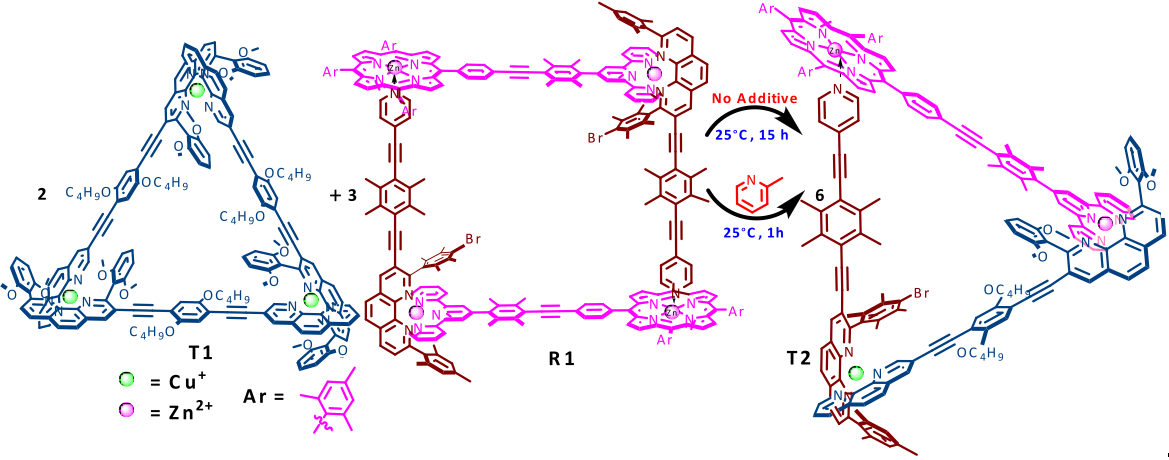
A popular self-assembly approach is to produce coordination compounds from transition metal salts with rigid organic ligands. Directional bonding around transition metal centres allows the production of predictable and controllable shapes. Michael Schmittel’s group at the University of Siegen have been exploring a newer approach. They prepared two assemblies, a 2-component triangle T1 and a 3-component rectangle R1. The transition metal “corner” arrangements in T1 and R1 are disfavoured, so if the two assemblies are combined the components re-shuffle to form a more favourable assembly- the 5-component triangle T2. The transformation occurs at room temperature, and can be completed in just 1 hour in the presence of a catalyst, which accelerates the re-shuffling by labilising the metal-ligand bonds.

Supramolecular splicing: Catalytic fusion of supramolecules: re-shuffling of a 2-component triangle and a 3-component rectangle to give a more favoured supramolecular 5-component triangle

Unlike previous examples, the conditions needed for the transformation are very mild. The authors compare the process to gene shuffling, the combination of dissimilar genes to form new genetic material. The strategy could be considered a first step towards the evolution of supramolecular architectures, and a great route to more complex supramolecular assemblies with higher information content.

The full communication can be downloaded here (free to access for a limited period).

Cally Haynes

Digg This
Reddit This
Stumble Now!
Share on Facebook
Bookmark this on Delicious
Share on LinkedIn
Bookmark this on Technorati
Post on Twitter
Google Buzz (aka. Google Reader)

Overcoat makes carbon quantum dots biocompatible

Quantum dots are currently being developed for a variety of applications, including as sensors and cellular tags. Semiconductor quantum dots are attractive for their high fluorescence quantum yields but the toxicity of some of the metals involved, such as cadmium, pose a problem for biological applications.

Carbon quantum dots (CQDs) offer an alternative however when transferred into aqueous solution they possess low quantum yields. The problem is how do you harness the higher fluorescence of CQDs prepared in an organic solvent for biological applications?

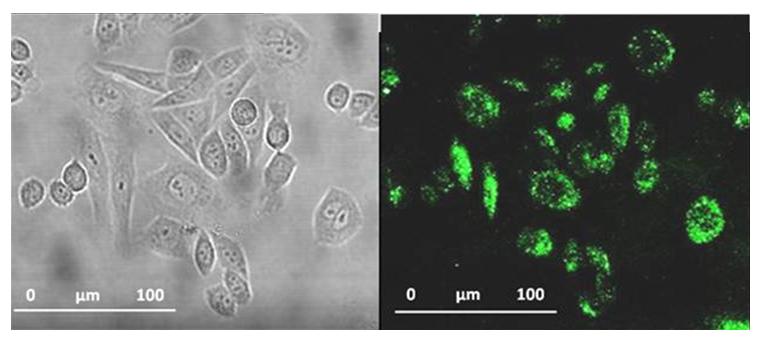
To answer this question John Callan and his team have employed an amphiphilic polymer to act as an overcoat and transfer agent for the CQDs. Surprisingly they found that the transfer actually improved the quantum yield rather than the normally expected repression when ligand exchange is used. These aqueous carbon quantum dots were taken up into cells and were found to be non-toxic.

Chinese Hamster Ovarian cells loaded with carbon quantum dots

The development of inexpensive and biocompatible quantum dots with an improved quantum yield holds great potential for a wide range of future biological applications.

To find out more, download the ChemComm article today (free to access for a limited period).

Digg This
Reddit This
Stumble Now!
Share on Facebook
Bookmark this on Delicious
Share on LinkedIn
Bookmark this on Technorati
Post on Twitter
Google Buzz (aka. Google Reader)

High yielding catenane synthesis? Surely not!

Rapid thermally assisted donor–acceptor catenation

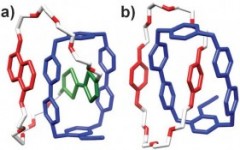
The X-ray crystal structures of two azide-functionalised catenanes

Entropy is not a friend of the macrocyclic chemist because creating large cyclic molecules by tying together several building blocks creates a high thermodynamic hurdle to cross. Nature has been forming these types of molecules for many millions of years and has provided inspiration for chemists to overcome these synthetic challenges. Perhaps purely for the academic interest, work began on investigating if it was possible to interlock two of these cyclic molecules together and form what is known as a catenane. Imagine a pot of spaghetti cooking and think of the strands tumbling around in the boiling water. Now imagine trying to tie all the ends together at the same time. Most will form individual rings but statistically a small number of those rings will be linked together. Conceptually this sounds easy but the reality is not so straight forward. A secondary problem is that only very small amounts of the linked rings are formed which means most of the starting material is wasted.

As interest in these curious molecules grew their potential application as switches for molecular electronics and sensors became apparent. However, if these applications were ever to be realised the cost of their formation would need to be feasible on a commercial scale. Macrocyclic chemists dream of yields over 50%, yet most chemists would be embarrassed to report a yield like this! However, we must remember that these reactions are inherently unfavourable so to achieve respectable yields we need to ‘stack the deck in our favour’ and try to make the interlocking of the rings more favourable.

Deceptively simple but incredibly effective ways of using what are commonly thought of as weak interactions have been used to hold the two fragments together, making the subsequent formation of the interlocked rings (rather than two separate rings) much more likely.  In a recent report in Chemical Communications, Fraser Stoddart and co-workers at Northwestern University, Texas A&M University and the King Abdullah City for Science and Technology report a significant development in catenane synthesis whereby yields of almost 90% are possible. As almost quantitative conversions are now being reported the commercial application of these molecules, which has for so long been discussed, moves another step closer.

Rapid thermally assisted donor–acceptor catenation
Albert C. Fahrenbach, Karel J. Hartlieb, Chi-Hau Sue, Carson J. Bruns, Gokhan Barin, Subhadeep Basu, Mark A. Olson, Youssry Y. Botros, Abdulaziz Bagabas, Nezar H. Khdary and J. Fraser Stoddart
Chem. Commun., 2012,48, 9141-9143
DOI: 10.1039/C2CC34427K

Digg This
Reddit This
Stumble Now!
Share on Facebook
Bookmark this on Delicious
Share on LinkedIn
Bookmark this on Technorati
Post on Twitter
Google Buzz (aka. Google Reader)

Lab-in-a-syringe approach to separating biomarkers from blood samples

Scientists in China have developed a novel method to prepare ordered mesoporous silica fibres. The fibres can enrich endogenous peptides in under three minutes with a lab-in-syringe approach. The technique does not need electrical devices such as a centrifugal machine or vortex shaker.

The team says that the lab-in-syringe approach could be applied to separation sciences and it could be used in drug delivery, catalysis, and sensor and optical devices.

Electrospinning-based synthesis of highly ordered mesoporous silica fiber for lab-in-syringe enrichment of plasma peptides
Gangtian Zhu, Xiao-Shui Li, Xiao-Meng Fu, Juan-Yuan Wu, Bi-Feng Yuan and Y.-Q. Feng
DOI: 10.1039/C2CC34761J

Digg This
Reddit This
Stumble Now!
Share on Facebook
Bookmark this on Delicious
Share on LinkedIn
Bookmark this on Technorati
Post on Twitter
Google Buzz (aka. Google Reader)

Cheaper dye-sensitised solar cells

Scientists in Germany and Switzerland have used metal-free plastic cathodes to replace expensive transparent conducting oxide-coated electrodes in dye-sensitised solar cells.

The team says that a record metal-free plastic cathode cell performance of 4.22% can be achieved at full sun, which is 27% less than the standard value of platinised transparent conducting oxide-coated electrodes, but at a fraction of the cost.

Towards flexibility: Metal free plastic cathodes for Dye sensitized solar cells
Shahzada Ahmad, Elisa Dell’Orto, Jun-Ho Yum, Florian Kessler, Mohammad Khaja Nazeeruddin and Michael Gratzel
DOI: 10.1039/C2CC35038F

Digg This
Reddit This
Stumble Now!
Share on Facebook
Bookmark this on Delicious
Share on LinkedIn
Bookmark this on Technorati
Post on Twitter
Google Buzz (aka. Google Reader)

Making light work of hydrogel formation

UK scientists have developed a new way to make hydrogels using light. The hydrogels could be used in a range of applications from cell culture to biosensors.

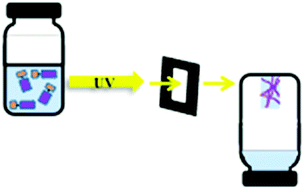
Graphical abstract: Dipeptide hydrogelation triggered via ultraviolet lightDave Adams, at the University of Liverpool, and colleagues made the hydrogels from dipeptide conjugates using UV light to trigger the gelation. Unlike previous light-activated gelations, the team used a photoacid generator (a molecule that is photolysed by light to produce an acid) to lower the pH of the gelator solution below the apparent pKa of the gelators, resulting in gelation.

The team showed that they could pattern the hydrogel using a photomask. The patterned channels of gels could be used in microfluidics, biosensors and synthetic biomaterials, the team suggest.

Read more about this research in Adams’ ChemComm communication, free to access for a limited period.

Also of interest:
Chem Soc Rev critical review: Supramolecular gels formed from multi-component low molecular weight species

Digg This
Reddit This
Stumble Now!
Share on Facebook
Bookmark this on Delicious
Share on LinkedIn
Bookmark this on Technorati
Post on Twitter
Google Buzz (aka. Google Reader)

Highlights from themed issues on ionic liquids

Ionic liquids ChemComm web themed issueCrystal engineering with ionic liquids CrystEngComm CollectionInterfaces of ionic liquids PCCP Themed issue

The field of ionic liquids has seen phenomenal growth in recent years, with the topic spanning a variety of disciplines across the chemical sciences. The recent themed issues from ChemComm, PCCP and CrystEngComm showcase some of the latest developments from a range of scientific subjects utilising the unique properties of ionic liquids.

Highlights from these themed issues include the articles below, which are free to download until the 24th August. You can also access the full themed issues by clicking on the buttons above.

CrystEngComm journal cover imageIonic liquids as crystallisation media for inorganic materials Ejaz Ahmed, Joachim Breternitz, Matthias Friedrich Groh and Michael Ruck, CrystEngComm, 2012, 14, 4874-4885

Ionic liquids in confined geometries Susan Perkin, Phys. Chem. Chem. Phys., 2012, 14, 5052-5062

Fluorescence monitoring of ionic liquid-facilitated biopolymer mobilization and reorganization Luke M. Haverhals, Laura M. Nevin, Matthew P. Foley, E. Kathryn Brown, Hugh C. De Long and Paul C. Trulove, Chem. Commun., 2012, 48, 6417-6419

Hofmeister effects of ionic liquids in protein crystallization: Direct and water-mediated interactions Magdalena Kowacz, Abhik Mukhopadhyay, Ana Luísa Carvalho, José M. S. S. Esperança, Maria J. Romão and Luís Paulo N. Rebelo, CrystEngComm, 2012, 14, 4912-4921

Influence of the ionic liquid/gas surface on ionic liquid chemistry Kevin R. J. Lovelock, Phys. Chem. Chem. Phys., 2012, 14, 5071-5089

ChemComm cover imageOptically responsive switchable ionic liquid for internally-referenced fluorescence monitoring and visual determination of carbon dioxide Shubha Pandey, Sheila N. Baker, Siddharth Pandey and Gary A. Baker, Chem. Commun., 2012, 48, 7043-7045

Supramolecular architectures of symmetrical dicationic ionic liquid based systems Haregewine Tadesse, Alexander J. Blake, Neil R. Champness, John E. Warren, Pierre J. Rizkallah and Peter Licence, CrystEngComm, 2012, 14, 4886-4893

New insights into the interface between a single-crystalline metal electrode and an extremely pure ionic liquid: slow interfacial processes and the influence of temperature on interfacial dynamics Marcel Drüschler, Natalia Borisenko, Jens Wallauer, Christian Winter, Benedikt Huber, Frank Endres and Bernhard Roling, Phys. Chem. Chem. Phys., 2012, 14, 5090-5099

An elegant access to formation and vaporization enthalpies of ionic liquids by indirect DSC experiment and “in silico” calculations Sergey P. Verevkin, Dzmitry H. Zaitsau, Vladimir N. Emel’yanenko, Christoph Schick, Saivenkataraman Jayaraman and Edward J. Maginn, Chem. Commun., 2012, 48, 6915-6917

PCCP journal cover imageIonic liquid-mediated epitaxy of high-quality C60 crystallites in a vacuum Yoko Takeyama, Shingo Maruyama, Hiroki Taniguchi, Mitsuru Itoh, Keiji Ueno and Yuji Matsumoto, CrystEngComm, 2012, 14, 4939-4945

Proton transfer and polarity changes in ionic liquid–water mixtures: a perspective on hydrogen bonds from ab initio molecular dynamics at the example of 1-ethyl-3-methylimidazolium acetate–water mixtures—Part 1 Martin Brehm, Henry Weber, Alfonso S. Pensado, Annegret Stark and Barbara Kirchner, Phys. Chem. Chem. Phys., 2012, 14, 5030-5044

Direct visualization of solution morphology of cellulose in ionic liquids by conventional TEM at room temperature Nan Luo, Yuxia Lv, Dexiu Wang, Jinming Zhang, Jin Wu, Jiasong He and Jun Zhang, Chem. Commun., 2012, 48, 6283-6285

If you’re interested in ionic liquids, why not take a look at the recent cross-journal promotion Incredible ionic liquids: an article collection.

You can keep up to date with all the latest developments across the chemical sciences by signing up to your favourite journal e-alerts or following them on twitter!

Digg This
Reddit This
Stumble Now!
Share on Facebook
Bookmark this on Delicious
Share on LinkedIn
Bookmark this on Technorati
Post on Twitter
Google Buzz (aka. Google Reader)

Luminogenic materials have a bright future

Luminogenic materials are a hot topic of research due to their potential applications in biotechnology and memory systems. But most luminogenic materials undergo aggregation-caused quenching (ACQ) in the solid state. This is when the dye molecules near each other aggregate and form species that weaken the material’s emission.

Ben Zhong Tang and his team have been researching materials that instead exhibit aggregation-induced emission (AIE). This makes the preparation of solid state luminogens much simpler as aggregation increases the activity. Unfortunately, there are few AIE-active emitters in the longer wavelength region, which is of interest for biotechnology applications.

Tang’s team have addressed this oversight by developing a novel luminogen which couples the AIE property of tetraphenylethene and the longer wavelength activity of a hemicyanine dye. The emission properties of the resultant crystals can be readily tuned by the solvent molecules in the solution they are grown from.

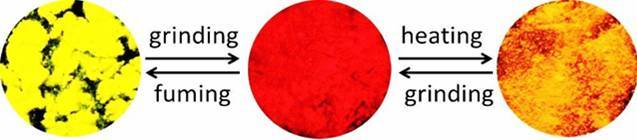
Crystochromism of the novel luminogen

Most interestingly, the prepared luminogen shows crystochromism: a strong yellow emission in its thermodynamically stable crystalline form and a red colour in its metastable amorphous form. These changes are fully reversible, with grinding, heating or fuming causing the change in the luminogen’s crystallinity.

To find out more, download the ChemComm article today.

Digg This
Reddit This
Stumble Now!
Share on Facebook
Bookmark this on Delicious
Share on LinkedIn
Bookmark this on Technorati
Post on Twitter
Google Buzz (aka. Google Reader)

pHantastic developments in lysosomal storage disease research

Lysosomes are cellular organelles that contain enzymes which break down cellular waste, a bit like stomachs. They have an internal pH of 4.8 and maintain this acidic pH (compared to the cytosol, pH 7.2) by pumping protons across the membrane. Changes in lysosomal pH can indicate the onset of disease.  In fact, elevated lysosomal pH has been noted in several lysosomal storage diseases. This group of around 50 rare, inherited, metabolic disorders result in symptoms such as seizures, deafness and/or blindness.

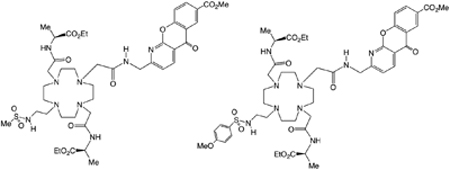
Now David Parker and colleagues at the University of Durham have designed responsive, low molecular weight probes which can permeate the target organelle and report the pH using a ratiometric signal. The probes could help evaluate the impact of drugs created to treat lysosomal storage diseases.

The team made europium and terbium complexes of two structurally related ligands that contain a sulfonamide moiety which acts like a switch, reversibly binding to the lanthanide and changing the metal coordination environment. The change is signalled by variation of emission spectral form and relative intensity and also modulates the circular polarisation of luminescence as the local helicity at the metal centre switches.  

Testing in a range of cell lines and altering the pH of the cellular and intracellular environment, the researchers developed an emission intensity ratio method using lanthanide luminescence which can be used to assess lysosomal pH variation for the first time.

Find out more by reading their ChemComm communication, free to download for a limited period.

Also of interest:
Times have changed since David Parker wrote his first ChemComm on a typewriter. He discusses his research path, chemical prostitution and targeted devastation in his ChemComm interview.

Digg This
Reddit This
Stumble Now!
Share on Facebook
Bookmark this on Delicious
Share on LinkedIn
Bookmark this on Technorati
Post on Twitter
Google Buzz (aka. Google Reader)