Archive for the ‘Hot Articles’ Category

Coordinating nature and photochemistry to create hydrogen

When we look to our future energy resources, the need to realise new means of renewable energy is immediately obvious. Much research is being carried out around the world into the development of systems that can generate energy – from H2 to biofuels to solar fuels – all of which place great importance on high efficiency and sustainability.

Looking at the world around us for inspiration, the obvious candidate is the photosynthetic process, where visible light is employed to convert CO2 and H2O into chemical energy. This process involves the transport of electrons through a complex series of intricately aligned porphyrin-related and protein biomolecules. We can explore the development of a system that mimics the behaviour of natural systems, with respect to the relay of electrons along a series of molecules, or, alternatively, we can take the components in these systems and exploit their properties in combination with other electronically-active but non-natural molecules.

Upon photoexcitation of [Ru(bpy)3]2+, electron transfer through a ferredoxin scaffold to a cobaloxime catalyst facilitates the production of hydrogen.It is the latter approach which Lisa Utschig and her team from Argonne National Laboratory, near Chicago in the US, employed to generate a molecular system capable of photocatalysing the production of hydrogen. In their biohybrid system, the photosensitiser ruthenium(II) tris(bipyridine), ferredoxin (a water-soluble electron transfer protein), and cobaloxime (a cobalt(II)-based catalyst), were combined to generate a miniature reaction center that mimics those which occur in biological systems. However, the Utschig group’s system has a smaller molecular weight, which allows for characterisation of the electronic processes that occur in the system.

Lisa and her colleagues found that the presence of ferredoxin in the catalytic system acted as a scaffold to stabilise the charge-separated state necessary for electron transfer and the desired production of H2. They also observed that the catalytic behaviour of the Ru(II)–Co(II) pair was only possible in the presence of ferredoxin, which acted to extend the lifetime of the otherwise transient Co(I), allowing the desired reaction to occur.

In order to fully understand and enhance the properties of the molecular systems developed to fulfil the increasing need for energy alternatives, we need to be able to probe the structure and processes that occur in the molecule; the use of smaller analogs to those that exist in nature offers a means by which to achieve this goal. The photoactivated catalyst discussed in this work is an important step forward in the development of an optimized system for use in solar fuel production.

Read this hot ChemComm article in full:
Aqueous light driven hydrogen production by a Ru–ferredoxin–Co biohybrid
S. R. Soltau, J. Niklas, P. D. Dahlberg, O. G. Poluektov, D. M. Tiede, K. L. Lulfort and L. M. Utschig
Chem. Commun., 2015, 51, 10628–10631
DOI: 10.1039/C5CC03006D

Biography

Anthea Blackburn is a guest web writer for Chemical Science. She hails originally from New Zealand, and is a recent graduate student of Northwestern University in the US, where she studied under the tutelage of Prof. Fraser Stoddart (a Scot. There, she exploited supramolecular chemistry to develop multidimensional systems and study the emergent properties that arise in these superstructures. When time and money allow, she is ambitiously attempting to visit all 50 US states.

Digg This
Reddit This
Stumble Now!
Share on Facebook
Bookmark this on Delicious
Share on LinkedIn
Bookmark this on Technorati
Post on Twitter
Google Buzz (aka. Google Reader)

How could a tree make tramadol?

Researchers in France, Switzerland and Cameroon are convinced that the African pin-cushion tree produces the well-known painkiller Tramadol and are determined to prove it. Back in 2013, a team led by neuroscientist Michel de Waard, of the Joseph Fourier University, claimed that significant quantities of the drug were present in the root bark extract of Nauclea latifolia, which has long been used by locals in West and Central Africa to treat pain and disease.

Last year another team, led by Michael Spiteller who is based at the Technical University of Dortmund, Germany, ran some tests of their own and cast doubt on these findings. Read the full article in Chemistry World»

N. latifol grows widely in Cameroon and is used by traditional healers to treat a wide variety of complaints. Image courtesy of Scott Zona / Wikipedia Commons (CC BY 2.0)


Read the original journal article in ChemComm – it’s free to read until 7th October:
Biomimetic synthesis of Tramadol
Florine Lecerf-Schmidt, Romain Haudecoeur, Basile Peres, Marcos Marçal Ferreira Queiroz, Laurence Marcourt, Soura Challal, Emerson Ferreira Queiroz, Germain Sotoing Taiwe, Thierry Lomberget, Marc Le Borgne, Jean-Luc Wolfender, Michel De Waard, Richard J. Robins and Ahcène Boumendjel 
DOI: 10.1039/C5CC05948H, Communication

Digg This
Reddit This
Stumble Now!
Share on Facebook
Bookmark this on Delicious
Share on LinkedIn
Bookmark this on Technorati
Post on Twitter
Google Buzz (aka. Google Reader)

Molecular Sierpinski triangles get stability upgrade

Metal–nitrile coordination bonds hold the structures together

Earlier this year we reported that scientists in China had built molecular Sierpiński triangles from small aromatic building blocks. Now, another team in China has constructed fractal triangles on the molecular scale and this time, they’re much more robust. Read more in Chemistry World»

You can read the original journal article in ChemComm – it’s free to access until 28th September:
On-surface construction of a metal–organic Sierpiński triangle
Qiang Sun, Liangliang Cai, Honghong Ma, Chunxue Yuan and Wei Xu 
Chem. Commun., 2015, Advance Article
DOI: 10.1039/C5CC05554G, Communication

Digg This
Reddit This
Stumble Now!
Share on Facebook
Bookmark this on Delicious
Share on LinkedIn
Bookmark this on Technorati
Post on Twitter
Google Buzz (aka. Google Reader)

Antifreeze polymer protects cells as they thaw

Researchers have synthesised a polymer that limits ice crystal growth in frozen red blood cells as they thaw. The polymer is set to pave the way for similar synthetic structures that mimic the properties of natural antifreeze proteins.

Antifreeze proteins have been a hot topic since they were first discovered in Antarctic fish in the 1960s. They have a wide range of potential applications in aerospace, the food industry and in biomedicine, where they are used in cryopreservation.

During cryopreservation, cells and tissues are stored at sub-zero temperatures and thawed before use. However, frozen cells can be damaged as they defrost. When ice melts, it can refreeze into larger crystals that puncture cells from the outside. This process, called recrystallisation, is especially damaging for organs and blood bags, which defrost over a long time. Read the full article in Chemistry World»


Read the original journal article in ChemComm:
Rational, yet simple, design and synthesis of an antifreeze-protein inspired polymer for cellular cryopreservation
Daniel E. Mitchell, Neil R. Cameron and Matthew I. Gibson 
Chem. Commun., 2015, 51, 12977-12980, DOI: 10.1039/C5CC04647E, Communication

Digg This
Reddit This
Stumble Now!
Share on Facebook
Bookmark this on Delicious
Share on LinkedIn
Bookmark this on Technorati
Post on Twitter
Google Buzz (aka. Google Reader)

More hot articles for July

We’ve selected a few more referee-recommended articles for you to enjoy this month – all free to download until the end of August:

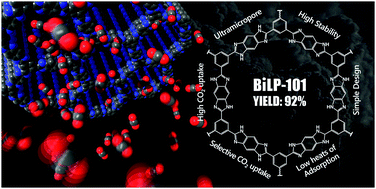
An ultra-microporous organic polymer for high performance carbon dioxide capture and separation
Ali Kemal Sekizkardes, Jeffrey T. Culp, Timur Islamoglu, Anne Marti, David Hopkinson, Christina Myers, Hani M. El-Kaderi and Hunaid B. Nulwala 
Chem. Commun., 2015, Advance Article, DOI: 10.1039/C5CC04656D, Communication

C5CC04656D GA


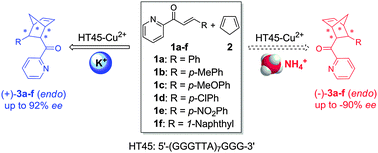
Higher-order human telomeric G-quadruplex DNA metalloenzyme catalyzed Diels–Alder reaction: an unexpected inversion of enantioselectivity modulated by K+ and NH4+ ions
Yinghao Li, Changhao Wang, Jingya Hao, Mingpan Cheng, Guoqing Jia and Can Li 
Chem. Commun., 2015, Advance Article, DOI: 10.1039/C5CC05215G, Communication

C5CC05215G GA


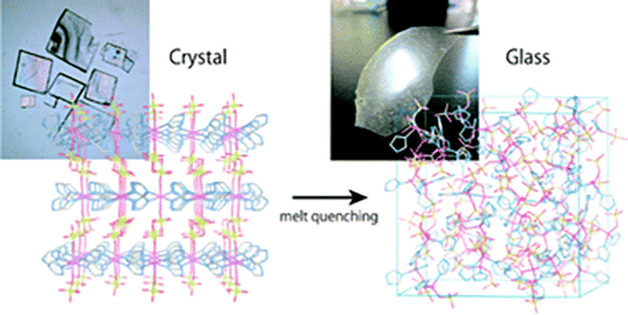
Glass formation via structural fragmentation of a 2D coordination network
D. Umeyama, N. P. Funnell, M. J. Cliffe, J. A. Hill, A. L. Goodwin, Y. Hijikata, T. Itakura, T. Okubo, S. Horike and S. Kitagawa 
Chem. Commun., 2015,51, 12728-12731, DOI: 10.1039/C5CC04626B, Communication

C5CC04626B GA


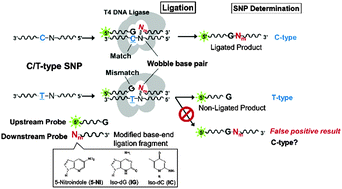
Highly-efficient T4 DNA ligase-based SNP analysis using a ligation fragment containing a modified nucleobase at the end
Eui Kyoung Jang, Munhee Yang and Seung Pil Pack 
Chem. Commun., 2015, Advance Article, DOI: 10.1039/C5CC03761A, Communication

C5CC03761A GA

Digg This
Reddit This
Stumble Now!
Share on Facebook
Bookmark this on Delicious
Share on LinkedIn
Bookmark this on Technorati
Post on Twitter
Google Buzz (aka. Google Reader)

Alkyne insertion imparts silicon stereochemistry

Scientists in Japan have reported a way of inserting alkynes into carbon–silicon bonds, also known as alkynylsilylation, that creates silicon stereogenic centres with high enantioselectivity.

The literature is littered with examples of alkyne insertion into carbon–silicon bonds to synthesise alkenylsilanes but until now, there has been limited progress in synthesising their alkynyl cousins. Now, Ryo Shintani and Kyoko Nozaki at the University of Tokyo have developed a successful rhodium-catalysed intramolecular method to achieve this. Read the full article in Chemistry World»


Read the original journal article in ChemComm:
Rhodium-catalyzed intramolecular alkynylsilylation of alkynes
Ryo Shintani, Hiroki Kurata and Kyoko Nozaki
Chem. Commun., 2015,51, 11378-11381
DOI: 10.1039/C5CC04172D, Communication

Digg This
Reddit This
Stumble Now!
Share on Facebook
Bookmark this on Delicious
Share on LinkedIn
Bookmark this on Technorati
Post on Twitter
Google Buzz (aka. Google Reader)

Fog-free film doesn’t dare to glare

Scientists in China have built a thin film that retains its antifogging properties even under an antireflective coating.

When water molecules in warm moist air condense on a cooler surface, tiny droplets form. On transparent surfaces – such as glasses, windows or screens – these droplets scatter light and fog the surface. Most antifogging materials are superhydrophilic compounds that spread the water molecules on the surface to stop droplets from forming and require the superhydrophilic layer to be on top. This imposes ‘significant difficulties and challenges when designing multifunctional thin films,’ explains Junhui He from the Chinese Academy of Sciences in Beijing. The problem is ‘that different functions generally act on their own and do not collaborate with each other. How to harmonise these functions in a single film is a big hurdle that scientists must span.’ Read the full article in Chemistry World to find out He’s solution»


Read the original journal article in ChemComm:
Antifogging antireflective thin films: does the antifogging layer have to be the outmost layer?
Xiaojie Zhang and Junhui He
Chem. Commun., 2015, Advance Article
DOI: 10.1039/C5CC04465K, Communication

Digg This
Reddit This
Stumble Now!
Share on Facebook
Bookmark this on Delicious
Share on LinkedIn
Bookmark this on Technorati
Post on Twitter
Google Buzz (aka. Google Reader)

Hot ChemComm articles for July

Here are some recent referee-recommeded ChemComm articles for you to enjoy – all free to download until 12th August:

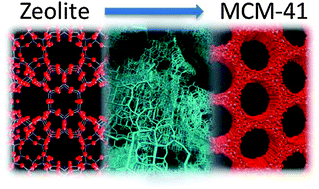
Mesostructured zeolites: bridging the gap between zeolites and MCM-41
Teerawit Prasomsri, Wenqian Jiao, Steve Z. Weng and Javier Garcia Martinez
DOI: 10.1039/C4CC10391B, Feature Article


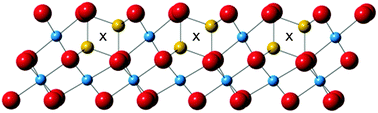
Titanium migration driven by Li vacancies in Li1−xTi2O4 spinel
A. Kitada, A. M. Arevalo-Lopez and J. P. Attfield
DOI: 10.1039/C5CC02800K, Communication


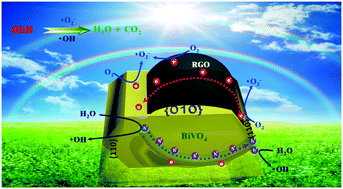
Rational design of a charge shunt: modification upon crystal facet engineering of semiconductor photocatalysts
Wenhui Feng, Sunxian Weng, Zuyang Zheng, Zhibin Fang and Ping Liu
DOI: 10.1039/C5CC02700D, Communication


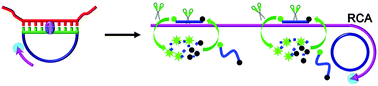
Ultrasensitive genotyping with target-specifically generated circular DNA templates and RNA FRET probes
Haoxian Zhou, Hui Wang, Chenghui Liu, Honghong Wang, Xinrui Duan and Zhengping Li
DOI: 10.1039/C5CC03738G, Communication


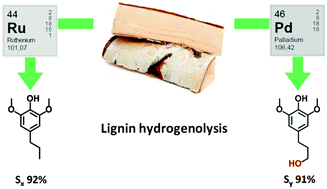
Tuning the lignin oil OH-content with Ru and Pd catalysts during lignin hydrogenolysis on birch wood
S. Van den Bosch, W. Schutyser, S.-F. Koelewijn, T. Renders, C. M. Courtin and B. F. Sels
DOI: 10.1039/C5CC04025F, Communication


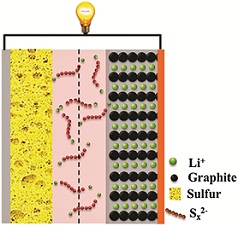
High Performance Li-ion Sulfur Batteries Enabled by Intercalation Chemistry
Dongping Lu, Pengfei Yan, Yuyan Shao, Qiuyan Li, Seth Ferrara, Huilin Pan, Gordon L Graff, Bryant Polzin, Chongmin Wang, Ji-guang Zhang, Jun Liu and Jie Xiao 
DOI: 10.1039/C5CC05171A, Communication


Digg This
Reddit This
Stumble Now!
Share on Facebook
Bookmark this on Delicious
Share on LinkedIn
Bookmark this on Technorati
Post on Twitter
Google Buzz (aka. Google Reader)

Space-like conditions give rise to metabolic precursors

Mimicking interstellar conditions, a team of scientists at NASA has synthesised complex organic molecules thought to be necessary for the origin of life.

Understanding how simple compounds gave rise to the complex organic molecules and metabolic processes we see in today’s biology is one of the greatest conundrums of modern scientific endeavour. Now, Karen Smith and co-workers at the NASA Goddard Space Flight Centre, US, allow us a peek into life’s molecular past with their latest research.


Read the full article in Chemistry World»

Read the original journal article in ChemComm:
Metabolic precursors in astrophysical ice analogs: implications for meteorites and comets
Karen E. Smith, Perry A. Gerakines and Michael P. Callahan 
Journal Article
Chem. Commun., 2015, Advance Article
DOI: 10.1039/C5CC03272E, Communication

Digg This
Reddit This
Stumble Now!
Share on Facebook
Bookmark this on Delicious
Share on LinkedIn
Bookmark this on Technorati
Post on Twitter
Google Buzz (aka. Google Reader)

Confronting the crystalline sponge

A research group in the US has successfully simplified a crystallographic technique that scientists, bar those behind the original technique, had struggled to get to grips with.

In 2013, Makoto Fujita’s group at the University of Tokyo in Japan unveiled a powerful tool that gave scientists the ability to analyse oils and liquids by x-ray crystallography, a seemingly impossible task. Upon incorporating these compounds into crystalline hosts, their molecules became ordered, and the compounds became susceptible to diffraction. Thus, armed with fresh insight, the method has provided the absolute structures of compounds where we’d previously been left in the dark. Read the full article in Chemistry World»


Read the orginal journal article in ChemComm:
The crystalline sponge method: MOF terminal ligand effects
Timothy R. Ramadhar, Shao-Liang Zheng, Yu-Sheng Chen and Jon Clardy 
Chem. Commun., 2015, Advance Article
DOI: 10.1039/C5CC03840E, Communication

Digg This
Reddit This
Stumble Now!
Share on Facebook
Bookmark this on Delicious
Share on LinkedIn
Bookmark this on Technorati
Post on Twitter
Google Buzz (aka. Google Reader)