Archive for the ‘Hot Articles’ Category

Hot ChemComm articles for December

Take a look at this selection of recently published referee-recommended articles – all are free to read* until 23 January.

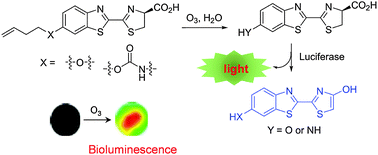
Highly sensitive and selective bioluminescence based ozone probes and their applications to detect ambient ozone
Younseok Nam, Beom Seok Kim and Injae Shin
DOI: 10.1039/C5CC08622A, Communication
C5CC08622A GA


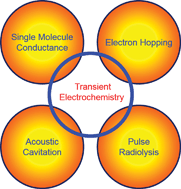
Transient electrochemistry: beyond simply temporal resolution
X.-S. Zhou, B.-W. Mao, C. Amatore, R. G. Compton, J.-L. Marignier, M. Mostafavi, J.-F. Nierengarten and E. Maisonhaute
DOI: 10.1039/C5CC07953E, Feature Article
C5CC07953E GA


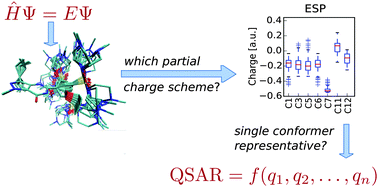
Robust molecular representations for modelling and design derived from atomic partial charges
A. R. Finkelmann, A. H. Göller and G. Schneider
DOI: 10.1039/C5CC07887C, Communication
C5CC07887C GA


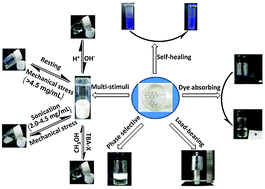
A novel multi-stimuli responsive gelator based on D-gluconic acetal and its potential applications
Xidong Guan, Kaiqi Fan, Tongyang Gao, Anping Ma, Bao Zhang and Jian Song
DOI: 10.1039/C5CC08615A, Communication
C5CC08615A GA


Enzyme encapsulation in zeolitic imidazolate frameworks: a comparison between controlled co-precipitation and biomimetic mineralisation
Kang Liang, Campbell J. Coghlan, Stephen G. Bell, Christian Doonan and Paolo Falcaro
DOI: 10.1039/C5CC07577G, Communication

C5CC07577G GA


Spotting and designing promiscuous ligands for drug discovery
P. Schneider, M. Röthlisberger, D. Reker and G. Schneider
DOI: 10.1039/C5CC07506H, Communication

C5CC07506H GA

*Access is free through a registered RSC account

Digg This
Reddit This
Stumble Now!
Share on Facebook
Bookmark this on Delicious
Share on LinkedIn
Bookmark this on Technorati
Post on Twitter
Google Buzz (aka. Google Reader)

Molecules, materials, medicines – the story of pharmaceutical cocrystals

Pharmaceutical cocrystals – cocrystals that contain a drug molecule – can improve the physicochemical performance of drugs, making the prescription you take on doctor’s orders more effective. The properties of any crystal are inherently dependent upon composition and crystal packing, so if you have control over these two things you have control over the physicochemical properties.

Following an explosion of interest and work in this area over the last decade, Michael Zaworotko and colleagues from the Department of Chemical and Environmental Sciences at the University of Limerick review the current state of the literature on pharmaceutical cocrystals.

They cover four areas: nomenclature, design using hydrogen-bonded supramolecular synthons, methods of discovery, and synthesis and development of pharmaceutical cocrystals as drug products. Usefully, they present seven recent case studies on the clinical improvements that can be observed.

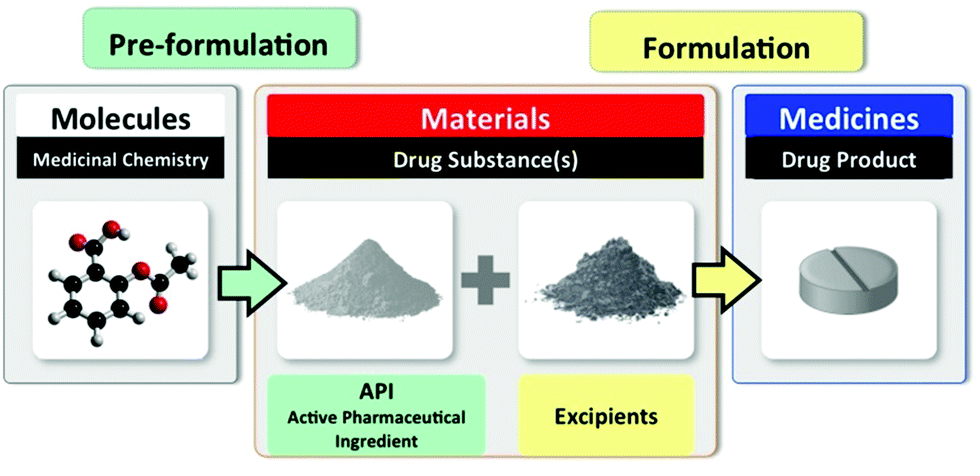
The three stages of early drug discovery and development: identify a molecule that is biologically active; create a material suitable for use in a drug product; formulate the material into a medicine with excipients.

A review in 2004 asked the question “Do pharmaceutical co-crystals represent a new path to improved medicines?” Zaworotko and colleagues, having reviewed the last decade of literature, can answer in the affirmative. To find out why the answer to this question is “yes” read this review today!

To read the details, check out the ChemComm article in full:

Pharmaceutical cocrystals: along the path to improved medicines
Naga Duggirala, Miranda Perry, Örn Almarsson and Michael Zaworotko
Chem. Commun., 2016, 52, Advanced Article
DOI: 10.1039/C5CC08216A

Digg This
Reddit This
Stumble Now!
Share on Facebook
Bookmark this on Delicious
Share on LinkedIn
Bookmark this on Technorati
Post on Twitter
Google Buzz (aka. Google Reader)

H2-free route to actinide hydrides

Scientists in the US have shown that phenylsilane is a safer and more convenient replacement for hydrogen gas when synthesising uranium and thorium hydrides.

Thorium and uranium are the most abundant actinoid elements. Although many stable thorium and uranium oxides and minerals are found in nature, the other actinoids are almost exclusively found in nuclear waste. Understanding actinoid chemistry has important practical applications in the nuclear industry but it is also fundamentally fascinating as the actinoid f electrons are so unlike those of the lanthanoids. Scientists need to make and study actinoid complexes with different oxidation states and with different ligands to understand their chemistry. Unfortunately, organometallic actinide chemistry can be quite challenging as organoactinide complexes will react – sometimes violently – with air or water, meaning that specialist equipment is needed to make and store them safely. Read the full article in Chemistry World»


Read the original journal article in ChemComm – it’s free to access until 23 December 2015:
Phenylsilane as a safe, versatile alternative to hydrogen for the synthesis of actinide hydrides
Justin K. Pagano, Jacquelyn M. Dorhout, Rory Waterman, Kenneth R. Czerwinski and Jaqueline L. Kiplinger 
DOI: 10.1039/C5CC06856H, Communication

Digg This
Reddit This
Stumble Now!
Share on Facebook
Bookmark this on Delicious
Share on LinkedIn
Bookmark this on Technorati
Post on Twitter
Google Buzz (aka. Google Reader)

Oral delivery of anticancer drug

Scientists in China have unveiled a way to deliver a platinum-based anticancer drug orally. The system, which works by protecting a prodrug from activation until it reaches the cancer cells, could help avoid the drug’s side effects.

The researchers incoporated an asplatin-cholesterol complex into biocompatible nanoparticles, which protect the drug from degrading before reaching the cancer cells

Platinum(IV)-based drugs are used to treat a range of cancers, often combined with other drugs. They are only reduced to the active platinum(II) drug once inside a cancer cell. Currently, healthcare workers administer platinum anticancer drugs through intravenous injections, which results in uncontrolled levels of the drug in the body and associated side effects. Administrating these drugs orally, however, would sustain an optimum concentration of the drug whilst boosting patient comfort and compliance. However, a downside is the prodrugs would be vulnerable to premature reduction into the active drug in the gastrointestinal tract. Read the full article in Chemistry World»


Read the original journal article in ChemComm – it’s free to read until 16 December:
Oral delivery of a platinum anticancer drug using lipid assisted polymeric nanoparticles
Qinqin Cheng, Hongdong Shi, Hai Huang, Zhiting Cao, Jun Wang and Yangzhong Liu 
Chem. Commun., 2015, Advance Article
DOI: 10.1039/C5CC07853A, Communication

Digg This
Reddit This
Stumble Now!
Share on Facebook
Bookmark this on Delicious
Share on LinkedIn
Bookmark this on Technorati
Post on Twitter
Google Buzz (aka. Google Reader)

Sharpening up super-resolution images by getting heavy

Single molecule super-resolution microscopy is the technique which takes advantage of the photoconversion of fluorescent probes and single molecule dyes to image cellular ultrastructures beyond the diffraction limit of light. The most common approach for this technique is to genetically fuse photoactivatable fluorescent proteins (PA-FPs) to the biomolecules of interest. However, PA-FPs do not emit as much light as organic dyes, which poses a problem since this technique relies heavily on the number of photons that are collected. If you can increase the amount of photons emitted, you can increase the amount collected, which leads to higher localization and ultimately a higher resolution image.

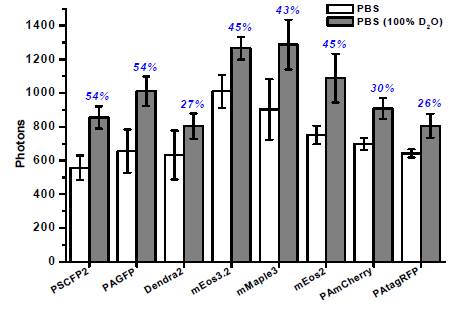
Bo Huang and colleagues from the Department of Pharmaceutical Chemistry at the University of California, San Francisco set out to investigate ways to make the PA-FPs brighter. It was previously shown that heavy water (D2O) increased the photon count from popular small molecule dyes1; would the same effect be seen in the PA-FPs? The answer was yes: as the heavy water component increased, the photon count also increased.

Photon counts seen from 8 fluorescent proteins in PBS and D2O PBS

One possible concern is that heavy water in live cells can slow down cell growth and even cause cell death. However, in real life this happens on significantly longer time-scales than it does in an experimental environment, therefore, any adverse effects on live cells would be minimal.
 
If you use PA-FPs in your work and you want to sharpen up your images then this paper is worth a read.
 
To find out the details, read the ChemComm article in full:
Heavy Water: A Simple Solution to Increasing Brightness of Fluorescence Proteins in Super-resolution Imaging
Wei Qiang Ong, Y. Rose Citron, Joerg Schnitzbauer, Daichi Kamiyama and Bo Huang
Chem. Commun., 2015, 51, Advance Article
DOI: 10.1039/C5CC04575D
 
1S. van de Linde, A. Loschberger, T. Klein, M. Heidbreder, S. Wolter, M. Heilemann and M. Sauer, Nat. Protoc., 2011, 6, 991
Digg This
Reddit This
Stumble Now!
Share on Facebook
Bookmark this on Delicious
Share on LinkedIn
Bookmark this on Technorati
Post on Twitter
Google Buzz (aka. Google Reader)

Hot ChemComm articles for October

Take a look at this selection of recently published referee-recommended articles – all are free to read* until 23 November.

Paper-based plasticizer-free sodium ion-selective sensor with camera phone as a detector
Xuewei Wang, Yu Qin and Mark E. Meyerhoff
DOI: 10.1039/C5CC06770G, Communication

C5CC06770G GA


Soil as an inexhaustible and high-performance anode material for Li-ion batteries
Xiaofei Hu, Kai Zhang, Liang Cong, Fangyi Cheng and Jun Chen
DOI: 10.1039/C5CC06394A, Communication

C5CC06394A GA


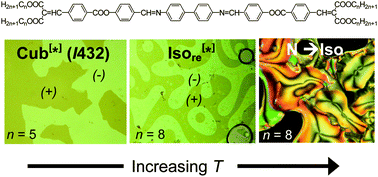
Spontaneous mirror symmetry breaking in a re-entrant isotropic liquid
Christian Dressel, Wolfgang Weissflog and Carsten Tschierske
DOI: 10.1039/C5CC06843F, Communication

C5CC06843F GA


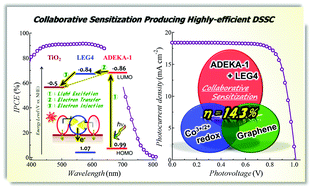
Highly-efficient dye-sensitized solar cells with collaborative sensitization by silyl-anchor and carboxy-anchor dyes
Kenji Kakiage, Yohei Aoyama, Toru Yano, Keiji Oya, Jun-ichi Fujisawa and Minoru Hanaya
DOI: 10.1039/C5CC06759F, Communication

C5CC06759F GA


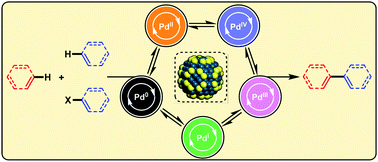
Catalytic C–H bond functionalisation chemistry: the case for quasi-heterogeneous catalysis
Alan J. Reay and Ian J. S. Fairlamb
DOI: 10.1039/C5CC06980G, Feature Article

C5CC06980G GA


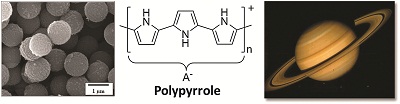
Space Science Applications for Conducting Polymer Particles: Synthetic Mimics for Cosmic Dust and Micrometeorites
Lee A Fielding, Jon K Hillier, Mark J Burchell and Steven P Armes
DOI: 10.1039/C5CC07405C, Feature Article


*Access is free through a registered RSC account

Digg This
Reddit This
Stumble Now!
Share on Facebook
Bookmark this on Delicious
Share on LinkedIn
Bookmark this on Technorati
Post on Twitter
Google Buzz (aka. Google Reader)

Connecting electrodes with light illuminates electrochemistry

Scientists in Australia have lit the path towards replacing wires in electrochemical devices by using visible light to create electrical currents on a stabilised silicon semiconductor electrode.

Electrodes in conventional devices must be connected to an external electrical circuit, often requiring a mesh of wires and bonding pads to produce an array of independently controlled electrodes. These components take up a vast amount of space on electronic chips, limiting the electrode density. Read the full article in Chemistry World»


You can read the original journal article in Chemical Science:
Connecting electrodes with light: one wire, many electrodes
Moinul H. Choudhury, Simone Ciampi, Ying Yang, Roya Tavallaie, Ying Zhu, Leila Zarei, Vinicius R. Gonçales and J. Justin Gooding
DOI: 10.1039/C5SC03011K, Edge Article

Digg This
Reddit This
Stumble Now!
Share on Facebook
Bookmark this on Delicious
Share on LinkedIn
Bookmark this on Technorati
Post on Twitter
Google Buzz (aka. Google Reader)

Electric switch makes helix change hands

Electric fields can switch both the net dipole moment and the helical handedness of helical supramolecular structures, according to a theoretical study by scientists in India.

Benzene-1,3,5-tricarboxamide (BTA) molecules self-assemble, by hydrogen bonding, into columnar structures with a macrodipole moment along their stacking direction. Each BTA molecule can form three hydrogen bonds by using oxygen atoms in the amide groups and the direction of these hydrogen bonds determines the direction of the dipole moment. Read the full article in Chemistry World»

Application of an electric field in the direction opposite to that of the macrodipole reverses the handedness of the structure


You can read the original journal article in ChemComm – it’s free to download until 14 October 2015:
External electric field reverses helical handedness of a supramolecular columnar stack
Karteek K. Bejagam, Chidambar Kulkarni, Subi J. George and Sundaram Balasubramanian�
DOI: 10.1039/C5CC05569E, Communication

Digg This
Reddit This
Stumble Now!
Share on Facebook
Bookmark this on Delicious
Share on LinkedIn
Bookmark this on Technorati
Post on Twitter
Google Buzz (aka. Google Reader)

Hot ChemComm articles for September

Take a look at this selection of recently published referee-recommended articles – all are free to read* until the end of September.

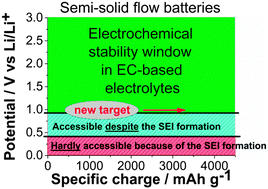
Solid electrolyte interphase in semi-solid flow batteries: a wolf in sheep’s clothing
E. Ventosa, G. Zampardi, C. Flox, F. La Mantia, W. Schuhmann and J. R. Morante 
DOI: 10.1039/C5CC04767F, Communication

C5CC04767F GA


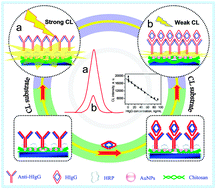
A new label-free strategy for a highly efficient chemiluminescence immunoassay
Zhanjun Yang, Yue Cao, Juan Li, Juntao Wang, Dan Du, Xiaoya Hu and Yuehe Lin 
DOI: 10.1039/C5CC05337D, Communication

C5CC05337D GA


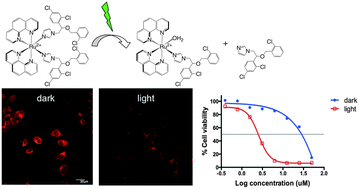
A luminescent ruthenium(II) complex for light-triggered drug release and live cell imaging
Nora Karaoun and Anna K. Renfrew 
DOI: 10.1039/C5CC05172J, Communication

C5CC05172J GA


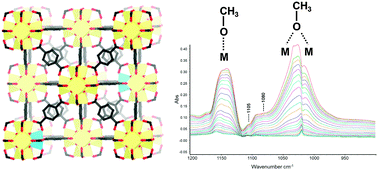
Tuning the properties of the UiO-66 metal organic framework by Ce substitution
Farid Nouar, Matthew I. Breeze, Betiana C. Campo, Alexandre Vimont, Guillaume Clet, Marco Daturi, Thomas Devic, Richard I. Walton and Christian Serre 
DOI: 10.1039/C5CC05072C, Communication

C5CC05072C GA


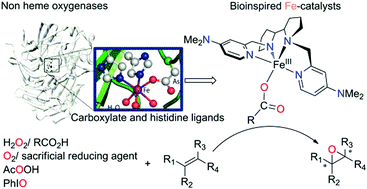
Biologically inspired non-heme iron-catalysts for asymmetric epoxidation; design principles and perspectives
Olaf Cussó, Xavi Ribas and Miquel Costas 
DOI: 10.1039/C5CC05576H, Feature Article

C5CC05576H GA


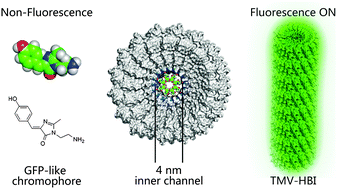
Confined chromophores in tobacco mosaic virus to mimic green fluorescent protein
Quan Zhou, Fengchi Wu, Man Wu, Ye Tian and Zhongwei Niu 
DOI: 10.1039/C5CC05751E, Communication

C5CC05751E GA 

*Access is free through a registered RSC account

Digg This
Reddit This
Stumble Now!
Share on Facebook
Bookmark this on Delicious
Share on LinkedIn
Bookmark this on Technorati
Post on Twitter
Google Buzz (aka. Google Reader)

Synthetic stomach membrane to minimise animal tests

The hydrogel successfully mimiced porcine gastric mucosa in mucoadhesion testing experiments

Scientists in the UK have made a synthetic surface that could replace animal tissues in liquid drug formulation tests.

‘Mucosal membranes like those in the nasal cavity, mouth, eyes, stomach, bladder and vagina are continuously being washed with biological fluids. The majority of drugs administered to these surfaces will get washed away, reducing drug absorption and efficiency of any therapy,’ explains Vitaliy Khutoryanskiy, from the University of Reading, who led the work. Read the full article in Chemistry World»


Read the original journal article in ChemComm – it’s open access:
Novel glycopolymer hydrogels as mucosa-mimetic materials to reduce animal testing
Michael T. Cook, Sarah L. Smith and Vitaliy V. Khutoryanskiy 
Chem. Commun., 2015, Advance Article
DOI: 10.1039/C5CC02428E, Communication

Digg This
Reddit This
Stumble Now!
Share on Facebook
Bookmark this on Delicious
Share on LinkedIn
Bookmark this on Technorati
Post on Twitter
Google Buzz (aka. Google Reader)