The Chemistry World team reports on a recently published RSC Advances article on the use of graphene in electrochemistry – “wonder material not so wonderful“.
Graphene – a sheet of graphite just one atom thick – is often claimed to be a wonder material, thanks to its superlative mechanical, thermal and electrical properties. But now a group of UK chemists is claiming that, in an electrochemical setting, graphene is not such a wonder material after all. Contrary to the widely held view, the chemists think graphene electrodes are mostly ineffective at transferring electrons, implying that graphene is a poor choice for sensing applications.
Craig Banks and others at Manchester Metropolitan University came to the conclusion after having performed electrochemical experiments with various electrodes. Some of these electrodes were coated in a single graphene layer, some were coated in a graphene multi-layer, and some were left uncovered. Carefully measuring the current passing through the electrodes while changing the applied voltage, Banks’s group discovered that electron transfer in graphene occurs mostly around its edges and at any defects. ‘Given its geometric size, this means that it is largely unreactive,’ says Banks.
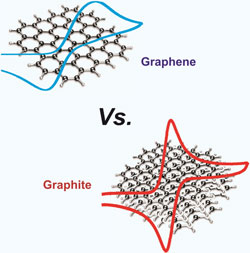
Chemists think that graphene electrodes are mostly ineffective at transferring electrons, implying that graphene is a poor choice for sensing applications
The chemists believe that graphene researchers generally modify electrodes in one of two ways: coating them with a single layer of graphene, which tends to block electron transfer, and coating them with a graphene multi-layer, which sometimes improves electron transfer. However, multi-layered graphene is more akin to graphite, say Banks’s group, and has more edges to supply electrons. What’s more, different underlying electrodes can have different responses to graphene coating. ‘Researchers in the field need to be more informed and consider that the electrode they are modifying is critical as well as the coverage of graphene,’ says Banks.
Alexander Balandin, a materials scientist specialising in graphene at the University of California at Riverside, US, thinks the results are important, and agrees that graphene coatings should be compared with graphite coatings in future electrochemical experiments. ‘At the same time, I would not jump too quickly to the conclusions and rule out graphene as the electrode material completely,’ he says. ‘It is known that depending on the graphene quality, exact number of the atomic planes, environment and functionalisation of its surface, graphene’s properties can vary a lot.’
In fact, for many applications graphene may still be a wonder material. The results of Banks’s group do not necessarily affect graphene’s potential uses as a transparent conductor for touch screens or as a heat sink, for example. And Banks points out that slow electron transfer in electrochemistry is sometimes an advantage. ‘Graphene [still] has huge potential in energy storage and generation applications,’ he says.
Jon Cartwright
The full article is free to access upon a simple registration process:
Electrochemistry of graphene: not such a beneficial electrode material?
Dale A. C. Brownson, Lindsey J. Munro, Dimitrios K. Kampouris and Craig E. Banks, RSC Adv., 2011, Advance Article, DOI: 10.1039/c1ra00393c
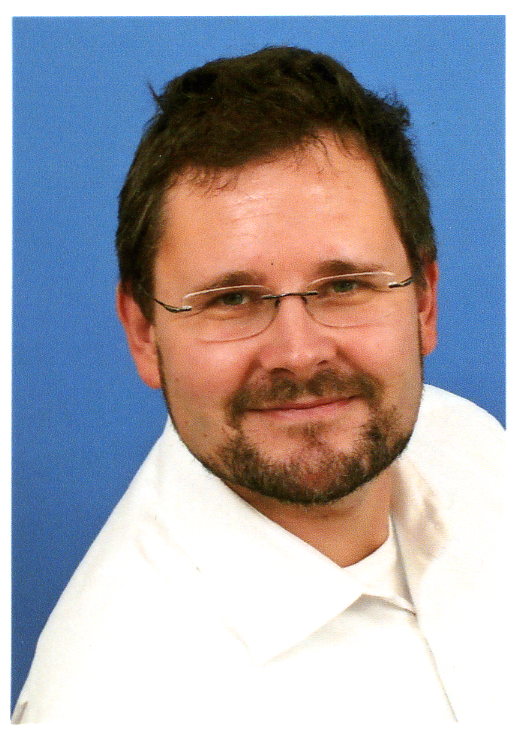
We’re delighted to welcome Professor Matthias Epple, from University of Duisburg-Essen, Germany, as an Associate Editor for RSC Advances. He will handle manuscripts in the areas of biomaterials, biomineralization and nanosciences.
Since obtaining his PhD in physical chemistry from the Technical University of Braunschweig in 1992, Professor Epple has worked at University of Washington (Seattle, USA), and the Universities of Hamburg and Bochum (Germany). In 2003, he was appointed chair of inorganic chemistry at the University of Duisburg-Essen, his current position.
His research interests are focused on the synthesis and biomedical application of inorganic materials (especially nanoparticles), and crystallisation phenomena and solid-state reactions. He is currently the President of the German Society for Biomaterials.
Professor Epple’s Editorial office is now open– and we look forward to receiving your submissions.
Want to find out more about RSC Advances? Use this link
Can hydrogenation reactions be performed in water? German scientists say: “Yes we can!”
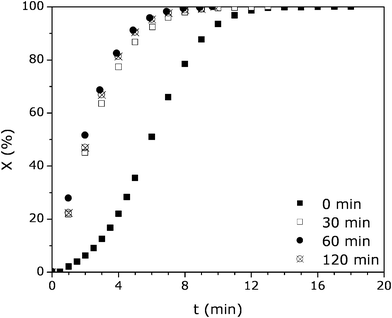
Often, water is seen as the “green solvent” of choice as it is non-flammable and non-toxic. However, organic chemists usually face issues with the solubility of the reactants in water. In this RSC Advances article, Schwarze et al. demonstrate the power of the surfactants in a hydrogenation reaction of prochical C–C, double bonds in itaconate, e.g. dimethyl itaconate.
The selectivity were comparable to when the same reaction were performed in methanol. The reaction rates however were slightly slower. This was due to the lower hydrogen solubility in the micellar aqueous systems. But the beauty of the reaction is that no notable catalyst deactivation occurred and the latter was recyclable with a turn-over number of >1000 in the aqueous micellar conditions .
In this publication, the authors also developed a model to predict the performance of micellar reaction systems. The partition coefficient of the substrates between the micelles and the continuous aqueous phase can be predicted using the Conductor-like Screening Model for Real Solvents (COSMO-RS).
If you want to find out more about this work, please read the full paper here*.
Rhodium catalyzed hydrogenation reactions in aqueous micellar systems as green solvents
M. Schwarze, J.S. Milano-Brusco, V. Strempel, T. Hamerla, S. Wille, C. Fischer, W. Baumann, W. Arlt and R. Schomäcker
RSC Adv., 2011, DOI: 10.1039/C1RA00397F, Advance Article
*Individuals can access the content by signing up for an RSC Publishing Personal Account. Existing institutional RSC journal subscribers, with registered IP, have automatic access. Other institutions can register for free access.
All RSC Advances articles published in 2011 and 2012 will be made free to access until December 2012. Please sign up to receive free access to the latest articles published in the journal.
Issue 2 has now been published online and consists of research from a wide spectrum of subject areas. Whether you are a materials scientist, biologist, physicist or medicinal chemist, you are guaranteed to find articles of relevance to your specialist interests.
Noteworthy articles include:
Two unique (4,5,6)-connected 2D CdII coordination polymers based on the 5-nitro-1,2,3-benzenetricarboxylate ligand
Lu-Fang Ma, Jian-Hua Qin, Li-Ya Wang and Dong-Sheng Li
RSC Adv., 2011, 1, 180-183
DOI: 10.1039/C1RA00119A
One-pot alkaline vapor oxidation synthesis and electrocatalytic activity towards glucose oxidation of CuO nanobelt arrays
Tetsuro Soejima, Hitomi Yagyu, Nobuo Kimizuka and Seishiro Ito
RSC Adv., 2011, 1, 187-190
DOI: 10.1039/C1RA00109D
The flow of magnetic nanoparticles in magnetic drug targeting
Sibnath Kayal, Dipankar Bandyopadhyay, Tapas Kumar Mandal and Raju V. Ramanujan
RSC Adv., 2011, 1, 238-246
DOI: 10.1039/C1RA00023C
The electrogenerated chemiluminescence detection of IS6110 of Mycobacterium tuberculosis based on a luminol functionalized gold nanoprobe
Jie Jiang, Ying Chai and Hua Cui
RSC Adv., 2011, 1, 247-254
DOI: 10.1039/C1RA00206F
Facile synthesis of 5-(alkylidene)thiophen-2(5H)-ones. A new class of antimicrobial agents
Tore Benneche, Gunnar Herstad, Marianne Rosenberg, Synnøve Assev and Anne Aamdal Scheie
RSC Adv., 2011, 1, 323-332
DOI: 10.1039/C1RA00254F
Take advantage of our automated subject classification to view articles that are most relevant to you.
To be notified of our latest issue published, please sign up to our e-mail alert today!
Over the coming months, members of the team will be at the following conferences where they will be happy to talk to you:
And look out for our eye-catching RSC Advances materials, appearing at a variety of conferences over the coming months.
From Argentina to New Zealand, Korea to USA, scientists around the world have shown their support for RSC Advances by submitting their work. Our first issue is online now and access is free.*
Communications, full papers and reviews are all represented in the mix that encompasses all the main areas of the chemical sciences. But finding the articles that are most relevant to you won’t be a problem: our sophisticated behind-the-scenes topic modelling classifies the content into one or more of twelve subject categories, accessible via the subject tab on the website.
Among the highlights in this issue:
Marcos Eberlin, who is one of RSC Advances’ Associate Editors, has demonstrated his support through publishing his work on charge-tagged N-heterocyclic carbenes.
Of the first issue Marcos commented: “Very nice collection indeed … The subject tab is superb!”
Plus, Editorial Board Chair Mike Ward and RSC Publishing Editor Sarah Ruthven share their aspirations for the journal in the Editorial.
Let us know what you think of this first issue by adding your comments below.
And to be alerted to each new issue of the journal, sign up for e-alerts today.
*Individuals can access the content by signing up for an RSC Publishing Personal Account. Existing institutional RSC journal subscribers, with registered IP, have automatic access. Other institutions can register for free access.
Watch the RSC Advances promotional video by clicking on the cover image or the link:
Submit your work today!
The first Advance Articles of our new journal RSC Advances are now published online – just 16 weeks since the news of the launch was released!
From Brazil to South Korea, Germany to USA, researchers have welcomed this new opportunity to publish with us by submitting articles in large numbers.
Read about templated carbon nanotube patterns, reforming of exhausts gas recirculation, N-heterocyclic carbenes, bioactive sugar amino acid motifs and more. But don’t worry about access: all the content is free until the end of 2012.
And to help you get straight to the subject areas that are most relevant to you, our sophisticated behind-the-scenes topic modelling has automatically classified the content into the most relevant of the twelve main subject categories on the RSC Advances website.
Issue 1 will be online very soon. Make sure you don’t miss it by signing up for the RSC Advances Table of Contents alert or newsletter today.
*The free access is available to all individuals who have signed up for an RSC Publishing Personal Account, and to all existing RSC customers with an IP address registered.
RSC Advances was pleased to sponsor the 20th International Conference on the Chemistry of the Organic Solid State (ICCOSS XX), held on the 25-30 June 2011 in Bangalore, India.
The conference gave a broad overview of the recent progress in all aspects of organic solid state chemistry and generated productive discussions. Professor T N Guru Row, Associate Editor for RSC Advances and one of the organisers of the conference, described the meeting as a great success and a great opportunity for well-respected national and international leaders in the field of organic solid states to get together to discuss the advances in this area.
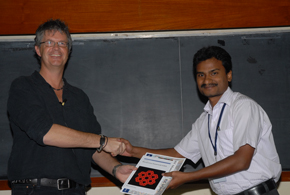
Professor Christer Aakeroy, Kansas State University, USA, and Associate Editor for our sister journal CrystEngComm, was the chair of the poster prize committee. The RSC Advances poster prizes were awarded to two young participants (see pictures below) at the conference namely:
RSC Advances congratulates the two poster prize winners.