Top 10 most-read Polymer Chemistry articles in April

This month sees the following articles in Polymer Chemistry that are in the top ten most accessed for April:

Thiol-ene “click” reactions and recent applications in polymer and materials synthesis 
Andrew B. Lowe  
Polym. Chem., 2010, 1, 17-36 
DOI: 10.1039/B9PY00216B  
 
Diels-Alder “Click” Reactions: Recent Applications in Polymer and Material Science 
Mehmet Atilla Tasdelen  
Polym. Chem., 2011, 2, 2133-2145 
DOI: 10.1039/C1PY00041A  

Functional block copolymer nanoparticles: toward the next generation of delivery vehicles 
Maxwell J. Robb, Luke A. Connal, Bongjae F. Lee, Nathaniel A. Lynd and Craig J. Hawker  
Polym. Chem., 2012, 3, 1618-1628 
DOI: 10.1039/C2PY20131C  

Conjugated polymer nanostructures for organic solar cell applications 
Jiun-Tai Chen and Chain-Shu Hsu 
Polym. Chem., 2011, 2, 2707-2722 
DOI: 10.1039/C1PY00275A  
 
Heteronucleobase-functionalized benzoxazine: synthesis, thermal properties, and self-assembled structure formed through multiple hydrogen bonding interactions 
Wei-Hsun Hu, Kai-Wei Huang and Shiao-Wei Kuo 
Polym. Chem., 2012, 3, 1546-1554 
DOI: 10.1039/C2PY20090B  

Biological surface modification by ‘thiol-ene’ addition of polymers synthesised by catalytic chain transfer polymerisation (CCTP) 
Stacy Slavin, Ezat Khoshdel and David M. Haddleton  
Polym. Chem., 2012, 3, 1461-1466 
DOI: 10.1039/C2PY20040F  

Cationic methacrylate polymers containing chiral amino acid moieties: controlled synthesis via RAFT polymerization 
Sonu Kumar, Saswati Ghosh Roy and Priyadarsi De  
Polym. Chem., 2012, 3, 1239-1248 
DOI: 10.1039/C2PY00607C  

Molecular design, synthesis and characterization of aromatic polythioester and polydithioester 
Daisuke Abe and Yuji Sasanuma  
Polym. Chem., 2012, 3, 1576-1587 
DOI: 10.1039/C2PY20118F  

A new polyfluorene bearing pyridine moieties: a sensitive fluorescent chemosensor for metal ions and cyanide 
Xiaoding Lou, Yi Zhang, Shuang Li, Daxin Ou, Zhaomin Wan, Jingui Qin and Zhen Li  
Polym. Chem., 2012, 3, 1446-1452 
DOI: 10.1039/C2PY20022H  

Thiol-Michael coupling chemistry: facile access to a library of functional exo-7-oxanorbornenes and their ring-opening metathesis (co)polymerization 
Meina Liu, Johannes van Hensbergen, Robert P. Burford and Andrew B. Lowe 
Polym. Chem., 2012, 3, 1647-1658 
DOI: 10.1039/C2PY20155K 

Why not take a look at the articles today and blog your thoughts and comments below.

Fancy submitting an article to Polymer Chemistry? Then why not submit to us today!

Digg This
Reddit This
Stumble Now!
Share on Facebook
Bookmark this on Delicious
Share on LinkedIn
Bookmark this on Technorati
Post on Twitter
Google Buzz (aka. Google Reader)

Author of the Week: John (Jung Kwon) Oh

John (Jung Kwon) Oh is currently appointed as a Canada Research Chair (CRC) Tier II in Nanobioscience and an Assistant Professor in the Department of Chemistry and Biochemistry at Concordia University in Montreal, Canada. With BSc and MSc from Hanyang University in Korea, he earned his PhD degree from the University of Toronto in the area of polymer chemistry and materials science under the supervision of Prof. Mitchell A. Winnik. He then completed his postdoctoral research at Carnegie Mellon University with Prof. Kris Matyjaszewski, learning atom transfer radical polymerization (ATRP). He has been employed at Korea Chemical Company in Korea and Dow Chemical Company in Michigan USA over 10 years.

The research in his laboratory at Concordia enables the design and processing of macromolecular nanoscale materials for biological and biomedical applications. The nanomaterials of interest consist of polymeric, organic, and inorganic materials as well as hybrids having unique structural, electronic, magnetic, and optical properties. They are prepared by well-defined synthetic organic methods, controlled polymer chemistry as well as by templating with supramolecular assemblies. In particular, his interests are the integration of nanostructured biomaterials with biomedicine to develop advanced bionanomaterials that can interface biological processes as well as to understand their biological functions. The current focus of his research is on the development of a variety of novel biomaterials for drug delivery, cellular imaging, and tissue engineering, including superparamagnetic nanogels, rapid thermoresponsive hydrogels, and self-assembled degradable block copolymer micelles

Currently, his group has seven graduate students and postdoctoral fellows. The students and postdoc in his laboratory who participate in the cutting-edge research program have the opportunity to gain a broad range of skills and knowledge in organic polymer chemistry, materials chemistry and science, and the domain of biology and biomedical engineering.

What was your inspiration in becoming a chemist?

My impression about synthetic chemistry is that a synthetic chemist is similar to a professional cook who can select appropriate and various ingredients to create new tastes. I have trained as polymer chemist and materials scientist in both industrial and academic settings. My strong desire is to integrate my synthetic skill sets with biology and biomedicine, developing new materials for biomedical research.

What was the motivation behind the research in your recent Polymer Chemistry paper? (DOI:10.1039/c2py20154b)

Toward the effective cancer-targeting drug delivery applications of amphiphilic block copolymers as multifunctional nanocarriers, the control of the release of encapsulated anticancer therapeutics is critical. My research group has focused on the new design of stimuli-responsive degradable self-assembled micelles, with different numbers and types of degradable linkages positioned at various locations. These micelles having topological variations should allow the determination of the structure-property relationship between morphological variance and stimuli-responsive degradation. Ultimately, the advanced knowledge can be leveraged into optimizing degradable micelles offering tunable release of encapsulated anticancer therapeutics inside cancer cells.

In which upcoming conferences may our readers meet you?

I regularly attend the ACS meeting in USA and will attend the 95th Canadian Chemistry Conference and Exhibition in Calgary in Canada.

How do you spend your spare times?

I walk with my wife and love to play tennis.

Which profession would you choose if you were not a scientist?

I loved and played baseball in my childhood. Because I was born in countryside in the city of Daejeon, Korea, I did not have an great opportunity to be a baseball player in my life. If I am given to a new life, I would be a professional baseball player.

Digg This
Reddit This
Stumble Now!
Share on Facebook
Bookmark this on Delicious
Share on LinkedIn
Bookmark this on Technorati
Post on Twitter
Google Buzz (aka. Google Reader)

Poster prize winners

Polymer Chemistry Congratulations to Adam J. Gormley, Inmaculada Conejos-Sánchez, Paula Ofek, Stefan Hoffmann & Corinna Fetsch for winning the Polymer Chemistry poster prizes at the 9th International Symposium on Polymer Therapeutics: From Laboratory to Clinical Practice.

The winning posters were titled:

  1. Laser guided delivery of polymer therapeutics to prostate tumors. (Adam J. Gormley)
  2. Targeting a rare amyloidotic disease with rationally designed polymer conjugates. (Inmaculada Conejos-Sánchez)
  3. Targeting siRNA to tumors and their stroma as a dual anticancer and anti-angiogenic therapy. (Paula Ofek)
  4. Tumour Targeted Delivery of Polymer Drug Conjugates with pH-Sensitive Release: Monitoring the Biodistribution of Carriers and Drug Model simultaneously by Multispectral Optical Imaging. (Stefan Hoffmann)
  5. Polypeptoids: a truly living polymerisation of biodegradable and synthetic highly versatile polymers (Corinna Fetsch)

Poster Prize winners

9th International Symposium on Polymer Therapeutics: From Laboratory to Clinical Practice was held in Valencia, Spain, 28th – 30th May, 2012.

To keep up-to-date with all the latest research, sign up for the journal’s e-alerts or RSS feeds or follow Polymer Chemistry on Twitter or Facebook.

Digg This
Reddit This
Stumble Now!
Share on Facebook
Bookmark this on Delicious
Share on LinkedIn
Bookmark this on Technorati
Post on Twitter
Google Buzz (aka. Google Reader)

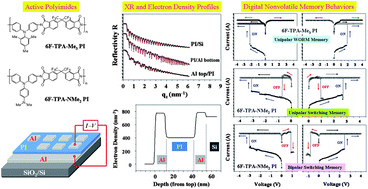
Paper of the Week: Programmable digital nonvolatile memory

Graphical abstract: Programmable digital nonvolatile memory behaviors of donor–acceptor polyimides bearing triphenylamine derivatives: effects of substituents

The world market for nonvolatile memory devices has grown rapidly as the demand for mobile devices has increased. The high-performance polymers based on aromatic polyimides (PIs) under development yield many advantages and several PIs have been introduced as the active materials in nonvolatile memory devices. The authors reported here the effects of substituents on the electrical memory characteristics of poly(4,4′-aminotriphenylene hexafluoroisopropylidenediphthalimide) (6F-TPA PI) analogs prepared from two different triphenylamine (TPA) derivatives. These PIs exhibited various types of memory behavior, namely, unipolar WORM and ON/OFF switching-type memory and bipolar ON/OFF switching type memory, depending on the incorporated substituents. The underlying switching mechanism was investigated, and the interfaces between the PI films and the metal electrodes in devices were examined.

Programmable digital nonvolatile memory behaviors of donor–acceptor polyimides bearing triphenylamine derivatives: effects of substituents by Taek Joon Lee, Yong-Gi Ko, Hung-Ju Yen, Kyungtae Kim, Dong Min Kim, Wonsang Kwon, Suk Gyu Hahm, Guey-Sheng Liou and Moonhor Ree Polym. Chem., 20123, 1276-1283.

To keep up-to-date with all the latest research, sign up for the journal’s e-alerts or RSS feeds or follow Polymer Chemistryon Twitter or Facebook.

Digg This
Reddit This
Stumble Now!
Share on Facebook
Bookmark this on Delicious
Share on LinkedIn
Bookmark this on Technorati
Post on Twitter
Google Buzz (aka. Google Reader)

Author of the Week: Anna Carlmark

Dr. Anna Carlmark received her PhD in polymer technology in 2004 from Fibre and Polymer Technology at KTH Royal Institute of Technology in Sweden, under the supervision of Prof. Eva Malmström. Between 2004-2007 she was employed as a researcher in several industries in Sweden (GE Healthcare AB, Gyros AB and SweTree Technologies AB) before she rejoined the group of Prof. Malmström in 2007 as an assistant professor in the division of Coating Technology at KTH. Her research focus is within the fields of controlled radical polymerization, the synthesis of complex macromolecular architectures, functional surfaces and (bio)fibre modifications. (http://www.kth.se/en/che/divisions/coating-technology)

 What was your inspiration in becoming a chemist?

Initially, I was really interested in biology, but in high school I stumble onto biochemistry which I thought was really fascinating as it explained so much about biological systems and even our own bodies. When I started university to goal was really to become a biochemist. Of course, I had no really insight into this field, and at the university I found myself much more drawn towards organic and polymer chemistry, and I found biochemistry quite tedious and boring. So I became a polymer chemist, which I have no regrets about!

What was the motivation to write this review? (DOI: 10.1039/C1PY00445J)

We (Prof Eva Malmström and I) have been working in the field of grafting cellulose by controlled radical polymerization for quite some time, actually 10 years this year, and we thought it was a nice idea to put a review together in this field. We had been talking about if for a couple of years, and so when I was invited to write a review for Polymer Chemistry it was perfect timing. I was very happy and honoured to receive the invitation!

Why did you choose Polymer Chemistry to publish your work?

Polymer Chemistry is a hot new journal that is really “up and coming”. The readers are well reflected in our research field and we thought it was the perfect choice for the review.

In which upcoming conferences may our readers meet you?

Unfortunately, I have no current plans to attend any conferences as I am having a baby in September. Usually I try to attend the ACS fall meetings, and in this case the earliest I will go will be in fall 2013.

How do you spend your spare times?  

I have two small children (ages 3 and 2) and a third on the way, so I keep myself pretty busy with the kids. We also have a country house where I love to go in the summer time. The Swedish archipelago is one of the most beautiful places in the world and a favourite place of mine, and I can warmly recommend a visit!

Which profession would you choose if you were not a scientist?

I considered becoming a nurse or physical therapist for a long time. I am very impressed with people working in medicine as I think they are true heroes. So if I was not a scientist, I think that is something that I would like to do.

Digg This
Reddit This
Stumble Now!
Share on Facebook
Bookmark this on Delicious
Share on LinkedIn
Bookmark this on Technorati
Post on Twitter
Google Buzz (aka. Google Reader)

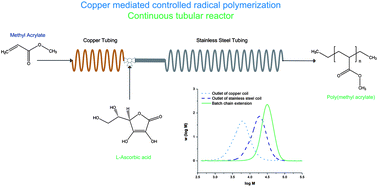
Paper of the Week: Copper mediated controlled radical polymerization in a continuous tubular reactor

Graphical abstract: Copper mediated controlled radical polymerization of methyl acrylate in the presence of ascorbic acid in a continuous tubular reactor

Single electron transfer-living radical polymerization (SET-LRP) has been recently proposed as a “variant” of the originally-developed atom transfer radical polymerization (ATRP). There has been very little research done, however, combining SET-LRP with reducing agents. In this view, Cunningham and co-workers reported an innovative design for a flow reactor for the continuous production of uniform polymer with high livingness using SET-LRP, improving upon the initial concept. Instead of using copper tubing to construct the entire reactor, a short copper coil was used to initiate polymerization and generate soluble copper species. The bulk of the reaction then took place in inert stainless steel tubing, using ascorbic acid as a reducing agent to drive the catalytic cycle and mediate the polymerization. Polymerizations were conducted at ambient temperature with 30 wt% DMSO as solvent, producing well defined living polymer at a steady state conversion of 78% for a residence time of 62 min. Chain extensions using outlet polymer solutions were well-controlled and proceeded to high conversion in a short period of time, with a final concentration of 10 ppm of residual copper. The results illustrate the significant potential of using a continuous tubular reactor with ascorbic acid as a reducing agent as an efficient means to scale-up production of well controlled polyacrylics and other multiblock copolymers.

Copper mediated controlled radical polymerization of methyl acrylate in the presence of ascorbic acid in a continuous tubular reactor by Nicky Chan, Michael F. Cunningham and Robin A. Hutchinson Polym. Chem., 20123, 1322-1333.

To keep up-to-date with all the latest research, sign up for the journal’s e-alerts or RSS feeds or follow Polymer Chemistryon Twitter or Facebook.

Digg This
Reddit This
Stumble Now!
Share on Facebook
Bookmark this on Delicious
Share on LinkedIn
Bookmark this on Technorati
Post on Twitter
Google Buzz (aka. Google Reader)

Author of the Week: Youliang Zhao

Dr. Youliang Zhao was born in Shuangfeng County, Hunan Province, China, in September 1975. He received B.Sc. (1997) and M.Sc. (2000) degrees from Xiangtan University and Ph.D. in July 2003 at Institute of Chemistry, the Chinese Academy of Sciences with Prof. Fu Xi. He went to Tokyo Institute of Technology in November 2003 and worked as a JSPS Postdoctoral Fellow with Prof. Akira Hirao. From November 2005 to August 2007, he was a postdoctoral research fellow with Dr. Sébastien Perrier at University of Leeds. He became a full professor at College of Chemistry, Chemical Engineering and Materials Science, Soochow University since August 2007. He has published more than 50 peer reviewed research papers in scientific journals primarily on synthesis of complex macromolecular architectures, hybrid materials and nanocomposites by polymerization techniques such as controlled radical polymerization (CRP), ring-opening polymerization (ROP) and living anionic polymerization (LAP) and their combination with highly efficient coupling reactions. He has been invited to give lectures on his research work in international conferences as well as in some research institutions. His research interests include synthesis and properties of stimuli-responsive inorganic-organic hybrid materials, graphene-polymer nanocomposites, and functional polymers involving dendrimers, block, star, graft and hyperbranched polymers.

Please follow the link for further information on Zhao’s research group: http://www.polymer.cn/ss/zhaoyouliang/index.html or http://chemistry.suda.edu.cn/index.aspx?lanmuid=69&sublanmuid=603&id=65

What was your inspiration in becoming a chemist?

I become a chemist because of my strong interest in chemistry. Our chemistry teachers in high school always encouraged us to do some interesting chemistry experiments, which fully inspired my curiosity. The undergraduate and graduate studies further underlay my background in polymer science. I am so lucky to become a chemist that I am able to design and synthesize novel compounds and polymers, which may have potential applications in materials science and technology.

What was the motivation to write this article? (DOI:10.1039/C1PY00396H)

The motivation of this article was to develop a versatile method to prepare suprapure multicomponent block copolymers and recycle the functional solid supports. In our previous study, three types of methods comprising Z-supported RAFT graft polymerization, radical-induced chain exchange reaction, and combination of RAFT polymerization and coupling reactions were used to synthesize well-defined homopolymers and block copolymers grafted onto silica particles although the solid substrates were not recycled. In this continuous study, tandem RAFT process and CuAAC afforded better-defined block copolymer grafted silica, de-grafting process and postmodification gave access to highly pure block copolymers with terminal functionalities, and clickable silica particles were efficiently recovered until all the surface functionalities were vanished. Our study affords a versatile and general approach for surface modification, synthesis of high-purity block copolymers and recycle of clickable solid substrate, which is of great importance for “green” syntheses and development of renewable resources. We have extended this method for the fabrication of functional graphene-polymer nanocomposites.

Why did you choose Polymer Chemistry to publish your work?

Polymer Chemistry is an excellent journal which publishes high quality manuscripts in polymer science. It is natural for me to publish our best results in this journal due to its good visibility.

In which upcoming conferences may our readers meet you?

I will be in Changchun, China, during 2-6 June at the International Symposium on Polymer Chemistry (PC2012). I attend IUPAC International Conference on Novel Materials and Synthesis (NMS) & International Symposium on Fine Chemistry and Functional Polymers (FCFP) regularly and will attend NMS-VIII & FCFP-XXII to be held in Xi’An, China in October this year.

How do you spend your spare times?

When I am free, I like travelling and reading.

Which profession would you choose if you were not a scientist?

Chances are given, I may want to be a historian since the complex history always attracts me. I may also want to be a writer because of my strong interest in poem, essay and novel.

Digg This
Reddit This
Stumble Now!
Share on Facebook
Bookmark this on Delicious
Share on LinkedIn
Bookmark this on Technorati
Post on Twitter
Google Buzz (aka. Google Reader)

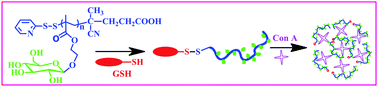
Paper of the Week: Glycopolymer–peptide bioconjugates with antioxidant activity

Graphical abstract: Glycopolymer–peptide bioconjugates with antioxidant activity via RAFT polymerization

Peptide/protein–polymer bioconjugates have attracted increasing interest as they have numerous potential applications in biotherapeutics, biotechnology, and nanotechnology. In their paper, Liu and co-workers employed reversible addition–fragmentation chain transfer radical (RAFT) polymerization to design poly(2-(2,3,4,6-tetra-O-acetyl-b-D-glucosyloxy)ethyl
methacrylate) (PAcGlcEMA) polymers end-functionalized with the tripeptide reduced glutathione (GSH). The resulting PGlcEMA-GSH bioconjugate exhibited high affinity for Concanavalin A and significant antioxidant activity.
The specific recognition of targeting glucose moieties and antioxidant ability of GSH make peptide–glycopolymer bioconjugate PGlcEMA-GSH a suitable candidate for antioxidant delivery systems, biomimetics and biodetection.

Glycopolymer–peptide bioconjugates with antioxidant activity via RAFT polymerization by Haiting Shi, Li Liu, Xiaobei Wang and Jingyi Li Polym. Chem., 20123, 1182-1188.

To keep up-to-date with all the latest research, sign up for the journal’s e-alerts or RSS feeds or follow Polymer Chemistryon Twitter or Facebook

Digg This
Reddit This
Stumble Now!
Share on Facebook
Bookmark this on Delicious
Share on LinkedIn
Bookmark this on Technorati
Post on Twitter
Google Buzz (aka. Google Reader)

Author of the Week – Dr. Mihaela C. Stefan

Dr. Mihaela C. Stefan is an Assistant Professor in the Department of Chemistry at University of Texas at Dallas. She received a BS in Chemical Engineering, and MS and Ph.D. degrees in Chemistry from Politehnica University Bucharest, Romania. She worked as a Postdoctoral Researcher in Krzysztof Matyjaszewski’s and Richard McCullough’s research groups at Carnegie Mellon University. She joined the Department of Chemistry at the University of Texas at Dallas in August 2007.  Since 2007 she has attracted 9 graduate students, 31 undergraduate students, and 3 summer high school student into her research lab.  Currently, 6 graduate students and 6 undergraduate students are working in her lab. She has published more than 40 peer-reviewed papers out of which 19 were published after joining UTD.

She received the NS&M Outstanding Teacher Award in 2009 and the Inclusive Teaching Diversity Award in 2012.  She is aslo a recipient of the Faculty Early Career Development (CAREER) award from NSF, which is given to junior faculty who exemplify the role of teacher-scholars through outstanding research, excellent education and the integration of education and research. Her research group is developing novel polymeric materials for organic electronics and for drug delivery applications.  The common theme on both research directions is the interdisciplinary training of students at the interface between organic/polymer chemistry and materials science.

For more information see here: http://www.utdallas.edu/~mci071000/

What was your inspiration in becoming a chemist?

My parents were chemists and I started to visit their labs when I was only 5-6 years old. At the initial stage I was fascinated with the colors in the lab as my mom used to show me titrations. Sometimes my mom would take me to work on Saturdays because she could not take me to the kindergarten on weekends. Going to work with my mom was so much better than going to kindergarten. When I had to decide for college I choose to study chemical engineering because traditionally back in my home country when you study chemistry you prepare for a teaching career. At that time teaching was something I would have not considered as a career choice.  Now teaching is such an important part of my work and I can never imagine my life without going in the classroom to teach.

What was the motivation to write this review? (DOI: 10.1039/C1PY00453K)

I wrote the review as an invited paper for the themed issue on New Methods of Polymer Synthesis. The review describes the synthesis of block copolymers of polythiophene by Grignard metathesis (GRIM) polymerization.  My group works on the development of novel semiconducting polymers for organic electronics applications. Whenever possible we use Grignard metathesis method because it is a living polymerization which allows the control of the molecular weights and functional end groups of the semiconducting polymers.

Why did you choose Polymer Chemistry to publish your work?

Polymer Chemistry is one of the leading journals in polymer science. This is my second paper to be published in Polymer Chemistry and both times I enjoyed the fast time to publication and the fair review process.

In which upcoming conferences may our readers meet you?

I will attend the International Conference on Science and Technology of Synthetic Metals ICSM 2012 which will be held on July 8-13 in Atlanta. I will also give an invited talk to the “Young Academic Investigators” Symposia organized by the Organic Division of ACS at the Fall 2012 ACS Meeting in Philadelphia.

How do you spend your spare times?

I do not have much spare time because we are trying to work hard to build a successful research group. However, when I have time to take a break from my work I like to read biographies. I love reading biographies of scientists and I always look to buy books. I also enjoy playing with my cats. In the future I hope to find some spare time to volunteer for a shelter as I love animals, especially cats.

Which profession would you choose if you were not a scientist?

I would probably have pursued a career as a cat veterinarian if I was not a scientist.

Digg This
Reddit This
Stumble Now!
Share on Facebook
Bookmark this on Delicious
Share on LinkedIn
Bookmark this on Technorati
Post on Twitter
Google Buzz (aka. Google Reader)

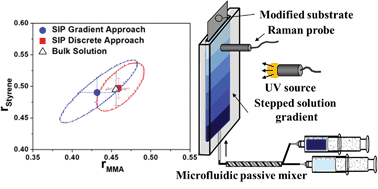
Paper of the Week: Measurement platform for monomer reactivity ratios

Graphical abstract: A robust and high-throughput measurement platform for monomer reactivity ratios from surface-initiated polymerization
Knowledge of monomer reactivity ratios provides the necessary insight to control and predict the monomer sequence; however, these kinetic parameters are often time-consuming and difficult to accurately measure. In their study, Beers and co-workers reported a robust approach to measure monomer reactivity ratios using surface-initiated copolymerization and XPS as a synthesis and characterization toolset. For the range of monomer pairs investigated, reactivity ratios obtained from the non-linear least squares evaluation of XPS copolymer composition data are reproducible and are in good agreement with bulk reactivity ratios obtained by traditional NMR analysis. Additionally, they have developed and demonstrated a high-throughput approach to measure reactivity ratios using a single substrate exhibiting a gradient in copolymer brush composition. The high-throughput approach significantly reduces the time and effort required to generate reliable and reproducible point estimates of reactivity ratios, and these values are in good agreement with values obtained from both the discrete statistical copolymer brush and classical bulk analytical methods.

A robust and high-throughput measurement platform for monomer reactivity ratios from surface-initiated polymerization by Derek L. Patton, Kirt A. Page, Emily A. Hoff, Michael J. Fasolka and Kathryn L. Beers Polym. Chem., 20123, 1174-1181.

To keep up-to-date with all the latest research, sign up for the journal’s e-alerts or RSS feeds or follow Polymer Chemistryon Twitter or Facebook

Digg This
Reddit This
Stumble Now!
Share on Facebook
Bookmark this on Delicious
Share on LinkedIn
Bookmark this on Technorati
Post on Twitter
Google Buzz (aka. Google Reader)