DOI: 10.1039/C0JM02225J
DOI: 10.1039/C0JM90123G
DOI: 10.1039/C0JM03542D
DOI: 10.1039/C0JM02827D
DOI: 10.1039/C0JM03483E
DOI: 10.1039/C0JM03132A
DOI: 10.1039/C0JM02913K
DOI: 10.1039/C0JM02850A
DOI: 10.1039/C0JM01645D
DOI: 10.1039/C0JM02279A
The Journal of Materials Chemistry themed issue on Chemically Modified Graphenes is now online. Rodney S. Ruoff introduces the themed issue with his editorial.
Vertical ZnO nanowires/graphene hybrids for transparent and flexible field emission is the article shown on the front cover. In the paper the authors report a transparent and flexible optoelectronic material composed of vertically aligned ZnO nanowires grown on reduced graphene/PDMS substrates.
( J. Mater. Chem., 2011, 21, 3432-3437)
The inside front cover highlights a Feature Article on Chemical doping of graphene by Hongtao Liu, Yunqi Liu and Daoben Zhu. (J. Mater. Chem., 2011, 21, 3335-3345)
If you found this issue interesting why not also read this web themed issue on Carbon Nanostructures?
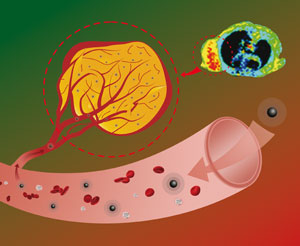
A new highly sensitive nanoparticle contrast agent for imaging in the body stays in the bloodstream longer and is better at targeting tumours than other nanoparticle contrast agents, say Chinese scientists.

The smaller nanoparticles stay in the bloodstream longer because they don’t accumulate in the liver as quickly as larger nanoparticles
Xintao Shuai from Sun Yat-Sen University, Guangzhou,and colleagues encapsulated individual – or nonclustered – superparamagnetic iron oxide nanoparticles inside micelles composed of folate and a polymer.
The team injected the nanoparticles into the veins of mice tails and followed their progress with magnetic resonance imaging (MRI). They found that the micelles increased the nanoparticles’ ability to show the bright and dark contrast between healthy and diseased tissue. The nanoparticles stayed in the bloodstream longer than larger nanoparticles because it took longer for them to accumulate in the liver. By introducing folate, the nanoparticles’ ability to target tumour cells was also increased.
To view the full Chemistry World article, please click here: Small and sensitive nanoparticles
Nonclustered magnetite nanoparticle encapsulated biodegradable polymeric micelles with enhanced properties for in vivo tumor imaging
Du Cheng, Guobin Hong, Weiwei Wang, Renxu Yuan, Hua Ai, Jun Shen, Biling Liang, Jinming Gao and Xintao Shuai, J. Mater. Chem., 2011
DOI: 10.1039/c0jm03783d
The front cover features Acid-directed synthesis of SERS-active hierarchical assemblies of silver nanostructures. This paper reports the acid-directed self-assembly of metal nanoparticles into large systems with complex structures, without the application of any polymer surfactant or capping agent. The team behind the research say that the addition of acid to induce formation of self-assembled structures can be a general synthetic platform to fabricate metal structures with complex morphologies. (J. Mater. Chem., 2011, 21, 2495-2501.)
Highlighted on the inside cover is Aqueous polyfluorene probe for the detection and estimation of Fe3+ and inorganic phosphate in blood serum. Reported in this paper is the synthesis of an anionic polyfluorene derivative, poly(9,9-bis(6′-sulfate)hexyl) fluorene-alt-1,4-phenylene sodium salt. This probe exhibits exemplary activity towards the selective detection of Fe3+ and phosphates under physiological conditions. (J. Mater. Chem., 2011, 21, 2502-2507.)
Mobility and photovoltaic performance studies on polymer blends: effects of side chains volume fraction by Getachew Adam, Almantas Pivrikas, Alberto M. Ramil, Sisay Tadesse, Teketel Yohannes, Niyazi S. Sariciftci and Daniel A. M. Egbe is the paper featured on the back cover. (J. Mater. Chem., 2011, 21, 2594-2600.)
![]()
The paper featured on the outside front cover is Self-assembly and charge transport properties of a benzobisthiazole end-capped with dihexyl thienothiophene units (Greg J. McEntee, Filipe Vilela, Peter J. Skabara, Thomas D. Anthopoulos, John G. Labram, Steve Tierney, Ross W. Harrington and William Clegg, J. Mater. Chem., 2011, 21, 2091-2097). The paper reports thin-film studies and OFEt characteristics for a rigid, planar conjugated molecule, BDHTT-BBT. The authors say that this material exhibits liquid crystal properties in its thin-film state.
Unique hexagonal non-close-packed arrays of alumina obtained by plasma etching/deposition with catalytic performance is the paper highlighted on the inside front cover. (Shuyan Gao, Naoto Koshizaki, Yue Li and Liang Li, J. Mater. Chem., 2011, 21, 2087-2090.) This paper reports a hexagonal-non-close-packed alumina array with hierarchical micro-/nano-structures fabricated by plasma etching/deposition that acts as a catalyt in ethyl acetoacetate isomerization.
The back cover showcases the work of David Muñoz-Rojas, Judith Oró-Solé, Omar Ayyad and Pedro Gómez-Romero (Shaping hybrid nanostructures with polymer matrices: the formation mechanism of silver–polypyrrole core/shell nanostructures; J. Mater. Chem., 2011, 21, 2078-2086). In the paper the team show that a polypyrrole matrix forming around suspended Ag2O particles in a pyrrole solution under hydrothermal conditions is key for the formation of tortuous Ag@PPy nanostructures.
You can read the whole issue here:
The one-pot synthesis of core/shell/shell CdTe/CdSe/ZnSe quantum dots in aqueous media for in vivo deep tissue imaging. Shohei Taniguchi, Mark Green, Sarwat B. Rizvi and Alexander Seifalian, J. Mater. Chem., 2011, DOI: 10.1039/C0JM03527K, Paper (Advance Article)
Water soluble, near infrared emitting CdTe/CdSe/ZnSe quantum dots have been synthesized in a simple one-pot procedure. The team of scientists based at King’s College London and University College London in the UK, say the emission wavelength could be tuned from 530 nm (original CdTe core) to 670 nm. To demonstrate the effectiveness the quantum dots were used in subcutaneous deep tissue monitoring.
Controllable synthesis of anisotropic elongated particles using microvalve actuated microfluidic approach. Qingquan Zhang, Shaojiang Zeng, Bingcheng Lin and Jianhua Qin, J. Mater. Chem., 2011, DOI: 10.1039/C0JM04033A (Advance Article)
The team from the Dalian Institute of Chemical Physics, China, showcase a method to synthesize anisotropic elongated particles via the combination of a droplet based microsphere synthesis and colloidal assembly in a microchannel. The team claim’s that the method is flexible and easy to operate and could find applications in rheological modifiers and drug delivery carrier design.![]()

Issue 6 of Journal of Materials Chemistry is now online. This issue features Platinum catalyzed growth of NiPt hollow spheres with an ultrathin shell by Qian Sun, Zheng Ren, Rongming Wang, Ning Wang and Xia Cao on the front cover. This paper explains how NiPt hollow spheres with an ultrathin shell were synthesized at room temperature and reports their catalytic properties. (J. Mater. Chem., 2011, 21, 1925-1930)
The back cover advertises the work of Davide Barreca, Alberto Gasparotto and Eugenio Tondello and their Highlight Metal/oxide interfaces in inorganic nanosystems: what’s going on and what’s next? (J. Mater. Chem., 2011, 21, 1648-1654).
The Feature Article on the outside front cover was Graphene: learning from carbon nanotubes. Liping Huang, Bin Wu, Gui Yu and Yunqi Liu, J. Mater. Chem., 2011, 21, 919-929.
The outside back cover highlighted the Feature Article Physical gels based on supramolecular gelators, including host–guest complexes and pseudorotaxanes by Yuji Suzaki, Toshiaki Taira and Kohtaro Osakada (J. Mater. Chem., 2011, 21, 930-938).
You can read the whole of issue 4 here. Issue 4, 2011 also feature 3 Hot Articles and a Hot Highlight:
Highlight: Gold–iron oxide nanoparticle chains scaffolded on DNA as potential magnetic resonance imaging agents
Hot Articles
Do you know someone who has made an exceptional contribution in the field of materials chemistry, helped to develop new materials with industry or pioneered new techniques for the benefit of materials research? The RSC Prizes and Awards recognise achievements by individuals, teams and organisations. There are over 60 Prizes and Awards available, covering all areas of the chemical sciences. Nomination is quick and easy using our online system and you can nominate yourself or a colleague. The closing date for nominations is 31 January 2011 so please don’t wait click on the link and find out more.