Archive for February, 2025

Functional gel materials – open call for submissions

Submit your work before 21 May 2025

Journal of Materials Chemistry C is pleased to announce an open call for papers for our upcoming themed collection on functional gel materials.

This themed collection centers on the materials chemistry of functional gels, with a particular focus on their applications in optics and electronics. Highlighting advances in ionogels, hydrogels, and related soft materials, the collection explores the chemical design, synthesis, and characterization of these gel materials, and their potential in devices such as actuators, sensors, and stretchable electronics. Emphasis is placed on the molecular interactions and structural properties that enable these materials to exhibit unique optical and electronic functionalities.
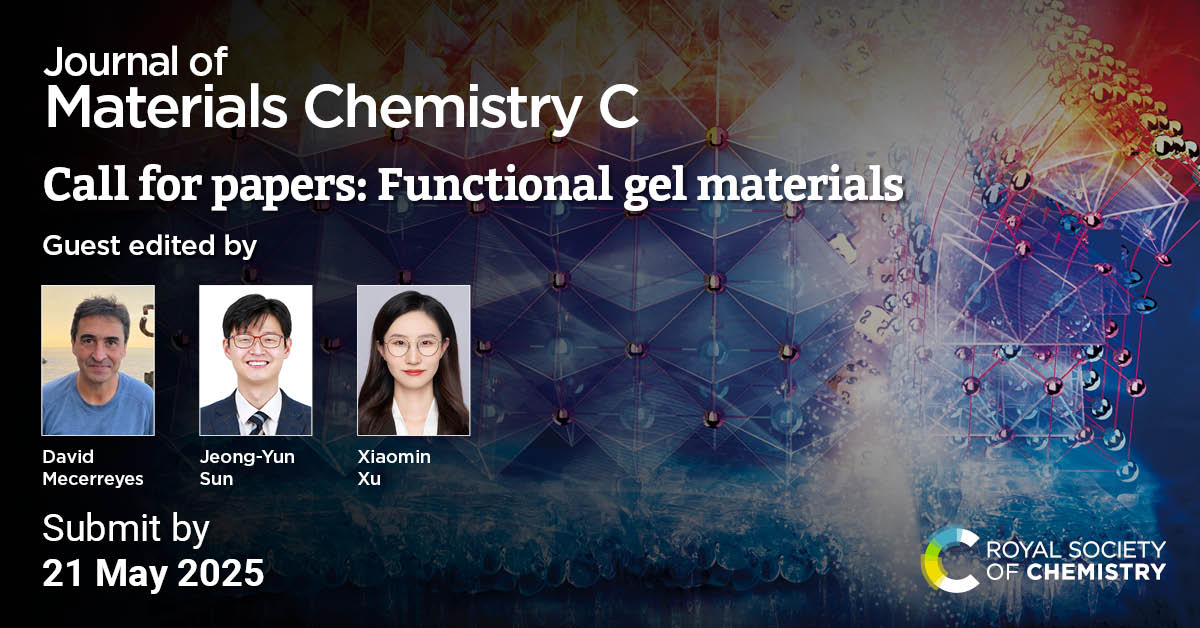
JMCC Open Call for Papers - functional gel materials. Submit by 21 May 2025.

Guest Edited by Professors David Mecerreyes (POLYMAT – University of the Basque Country, Spain), Jeong-Yun Sun (Seoul National University, South Korea) and Xiaomin Xu (Tsinghua University, China), this Journal of Materials Chemistry C collection aims to drive forward the development of next-generation technologies that rely on the integration of advanced gel materials.

Submission deadline 21 May 2025

The Editorial Office reserves the right to check suitability of submissions in relation to the scope of both the journal and the collection, and as such inclusion of accepted articles in the final themed collection is not guaranteed.

How to submit

Submissions to the journal should contain chemistry in a materials context and should fit within the scope of Journal of Materials Chemistry C. Please see the journal’s website for more information on the journal’s scope, standards, article types and author guidelines. This call for papers is open for Communications and Full papers.

When ready, please submit your article directly to the submissions platform for Journal of Materials Chemistry C where our editors will assess your submission. Please add a note in the ‘Comments to the Editor’ and ‘Themed collections’ sections of the submission mentioning this is a manuscript for the themed collection on ‘Functional gel materials’ and that it is in response to the ‘Open Call’.

All submissions will be subject to assessment against the journal’s usual scope and standards criteria and sent for peer review only if appropriate. Accepted articles will be published online as soon as they are ready and added to the web collection.

If you have any questions about the collection or the submissions process, please do contact the Editorial Office at materialsc-rsc@rsc.org and they will be able to assist.

Your institute may have a Read & Publish agreement in place with the Royal Society of Chemistry. This means that you may be able to publish gold open access for free in all the hybrid journals we publish – maximising the visibility and impact of your article to the broadest possible audience. Check here to find out more and to see if your institution has an R&P deal in place.

We look forward to receiving your submission!

Digg This
Reddit This
Stumble Now!
Share on Facebook
Bookmark this on Delicious
Share on LinkedIn
Bookmark this on Technorati
Post on Twitter
Google Buzz (aka. Google Reader)

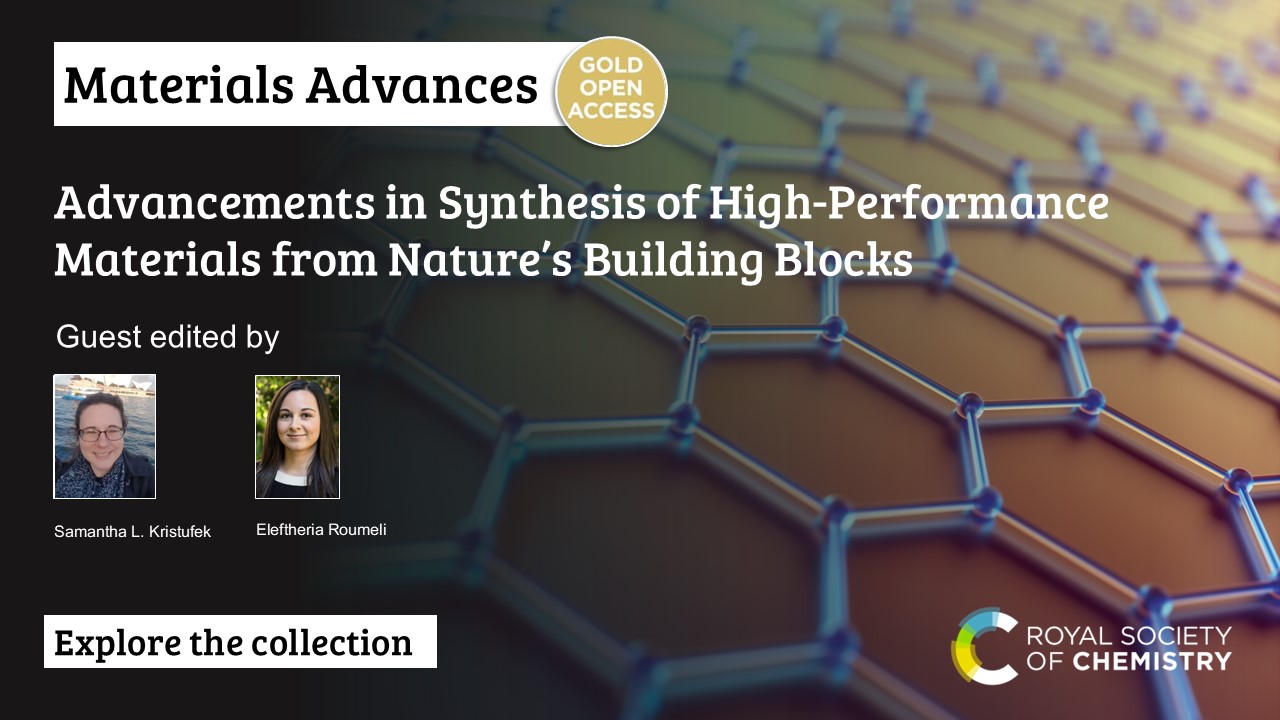
High-Performance Materials from Nature’s Building Blocks

Read the new collection in Materials Advances

We are delighted to share with you our collection focusing on the synthesis of high-performance materials from natural building blocks!

Guest Edited by Samantha L. Kristufek (Texas Tech University, USA) and Eleftheria Roumeli (University of Washington, USA)


A note from the Guest Editors:

“The collective efforts showcased in this themed collection underscore the multifaceted approaches being pursued to advance sustainable polymers.”


A small selection of the papers are featured below (all free to read):

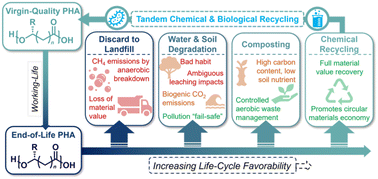
Polyhydroxyalkanoates in emerging recycling technologies for a circular materials economy
Ryan W. Clarke, Gloria Rosetto, Taylor Uekert, Julia B. Curley, Hyunjin Moon, Brandon C. Knott, John E. McGeehan and Katrina M. Knauer
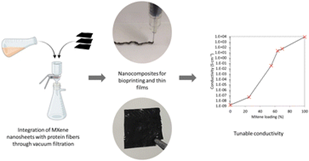
Conductive MXene nanosheets infused in protein fiber hydrogels for bioprinting and thin film electrodes
Mario Alfonso Arenas García, Slah Hidouri, Joshua M. Little, Daniel Modafferi, Xinxin Hao, Po-Yen Chen and Noémie-Manuelle Dorval Courchesne
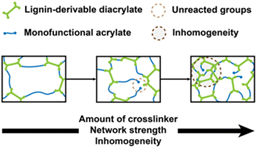
Engineering lignin-derivable diacrylate networks with tunable architecture and mechanics
Yu-Tai Wong and LaShanda T. J. Korley


We hope you enjoy reading the full themed collection here.


Did you know?

At Materials Advances, our themed collections are built by collaboration between our Guest Editors and expert Associate Editors. Our Guest Editors guide the scope and curate the contributions in our collections but all submissions are handled through peer review by our team of resident Associate Editors. This means that as an author you receive a consistent experience, and as a reader you can trust the quality of the science being presented.

If you have an idea for a topical collection in your research field, we’d love to hear from you! Get in touch here

Digg This
Reddit This
Stumble Now!
Share on Facebook
Bookmark this on Delicious
Share on LinkedIn
Bookmark this on Technorati
Post on Twitter
Google Buzz (aka. Google Reader)

Congratulations to the poster prize winners at the 2025 Materials for Medical Devices workshop

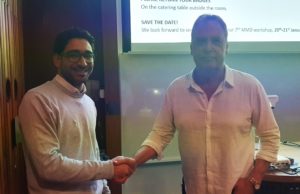
Journal of Materials Chemistry B and Materials Horizons were delighted to sponsor the poster prize awards at the 2025 Materials for Medical Devices workshop which took place at the University of Nottingham from 21-22 January 2025. Congratulations to our poster prize winners Antonis Stylianou and Qiran Du! Find out more about them below:

Antonis Stylianou

Antonis Stylianou, a PhD student at the University of Nottingham’s School of Pharmacy, is at the forefront of vaccine delivery innovation. Under the guidance of Dr. James E. Dixon, Dr. Maria Marlow, and Prof. Janet M. Daly, Antonis is developing mass-deployable, self-administered DNA vaccines using Microneedle Array Patches (MAPs).His research, supported by an EPSRC Industrial CASE studentship in collaboration with Nemaura Medical, aims to revolutionise global immunization strategies. The MAPs Antonis is developing consist of micro-projections under 1 mm in length, enabling painless self-administration of vaccines into the skin. This innovative approach has the potential to eliminate the need for cold-chain infrastructure and reduce dependence on healthcare professionals for vaccine administration. By addressing key challenges in MAP manufacturing and global vaccine accessibility, Antonis’s work represents a significant advancement in pandemic preparedness and vaccine technology. The impact of this research extends beyond technological innovation, with the potential to transform immunisation practices worldwide, particularly benefiting regions with limited healthcare infrastructure.

Antonis won a prize for his poster entitled, ‘Mass deployable self-administered DNA vaccines by Microneedle Arrays’

Qiran Du is currently a PhD student in Immunology since 2021 and a Research Associate at the University of Nottingham, UK. Qiran studied a BSc in Pharmacy at Ocean University of China from 2013-2017 before studying an MSc in Pharmaceuticals at Shanghai Jiao Tong University, China from 2017 – 2020. Qiran is fascinated by materials and their ability to modulate immune responses and how material controlled applications can be used in areas of wound healing and tissue regeneration to improve lives. 

Qiran won a prize for the poster entitled, ‘Elucidating the in vitro immune response to surgical meshes coated with immune-instructive polymer’


Digg This
Reddit This
Stumble Now!
Share on Facebook
Bookmark this on Delicious
Share on LinkedIn
Bookmark this on Technorati
Post on Twitter
Google Buzz (aka. Google Reader)