Archive for May, 2014

A good hair day for glowing nanoparticles

By raiding their local barber’s shop, scientists in China have found the ideal raw material for an emerging class of fluorescent nanoparticles.

The desirable optical properties, chemical inertness and biocompatibility of carbon dots has led researchers to explore their application in anti-counterfeiting fields and flat panel displays…

Interested? Read the full article at Chemistry World.

Photographs of carbon dot ink patterns under UV light

Photographs of carbon dot ink patterns under UV light

The original article can be read below:

Hair-Derived Carbon Dots toward Versatile Multidimensional Fluorescent Hybrid Materials
Si-Si Liu, Cai-Feng Wang, Chen-Xiong Li, Jing Wang, Li-Hua Mao and Su Chen
J. Mater. Chem. C, 2014, Accepted Manuscript
DOI: 10.1039/C4TC00636D

Digg This
Reddit This
Stumble Now!
Share on Facebook
Bookmark this on Delicious
Share on LinkedIn
Bookmark this on Technorati
Post on Twitter
Google Buzz (aka. Google Reader)

Henry Snaith wins the 2014 Journal of Materials Chemistry Lectureship

On behalf of the Journal of Materials Chemistry Executive Editorial Board we are delighted to announce Professor Henry Snaith is the winner of the Journal of Materials Chemistry Lectureship 2014.

Professor Snaith is the fifth winner of the Journal of Materials Chemistry Lectureship. The Journal of Materials Chemistry Executive Editorial Board chose Professor Snaith in recognition of the remarkable contribution he has made to the materials chemistry field.

This annual lectureship honours a younger scientist who has made a significant contribution to the field of materials chemistry.  Further details of the Lectureship, including the lecture location, will be announced in due course.

Also of interest: You can now read all three of the 2014 Emerging Investigators Issues of Journal of Materials Chemistry A, B and C, which highlight the work of emerging investigators across the field of materials chemistry. There are a mix of review-type articles, Communications and Full Papers, as well as Profile articles showcasing the authors.

Follow the latest journal news on Twitter @JMaterChem or go to our Facebook page.

Digg This
Reddit This
Stumble Now!
Share on Facebook
Bookmark this on Delicious
Share on LinkedIn
Bookmark this on Technorati
Post on Twitter
Google Buzz (aka. Google Reader)

Hot Article: A simple, low-cost CVD route to thin films of BiFeO3 for efficient water photo-oxidation

Hydrogen holds immeasurable promise in our search for alternative, sustainable, cleaner fuels. However, the simple, cheap production of hydrogen is still proving a problem. Water photolysis is a great way to achieve pure H2 and as O2 is the only side product it does not result in the harmful greenhouse gas emissions that arise from using hydrocarbons to produce H2. Unfortunately, the generation of H2 by water photolysis is challenging as the reaction that forms O2 is much slower than the H2 forming reaction. The use of an efficient photocatalyst can significantly improve the success of this process.

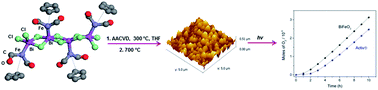
This paper by Moniz et al. details the development of just such a photocatalyst. In this work a bimetallic BiFeO3 catalyst is prepared using a novel method of Aerosol Assisted Chemical Vapour Deposition (AA CVD). This is the first time that this method has been used to prepare a photocatalyst of this type. The team go on to test this photocatalyst for the electrolysis of water using both UV and solar irridation and encouragingly, activity is confirmed for the BiFeO3 catalyst. Even more impressively the catalyst greatly outperforms both a commercially available photocatalyst (TiO2 Activ® glass) and another recently published photocatalyst (B-doped TiO2 films).

The novel synthetic methodology presented in this paper enables large area thin film deposition and as a result has potential for high volume applications in the future.

A simple, low-cost CVD route to thin films of BiFeO3 for efficient water photo-oxidation

Savio J. A. Moniz, Raul Quessada-Cabrera, Christopher S. Blackman, Junwang Tang, Paul Southern, Paul M. Weaver and Claire J. Carmalt,
J. Mater. Chem. A, 2014, 2, 2922-2927 C3TA14824F

H. L. Parker is a guest web writer for the Journal of Materials Chemistry blog. She currently works at the Green Chemistry Centre of Excellence, the University of York.

To keep up-to-date with all the latest research, sign-up to our

Digg This
Reddit This
Stumble Now!
Share on Facebook
Bookmark this on Delicious
Share on LinkedIn
Bookmark this on Technorati
Post on Twitter
Google Buzz (aka. Google Reader)

Hot Article: A highly luminescent chameleon: fine-tuned emission trajectory and controllable energy transfer

Luminescent materials are a part of our everyday life featuring in lighting, television screens, etc. The recent emergence of lanthanide-based metal-organic frameworks (Ln-MOFs) has illuminated the future development of new functional luminescent materials. Research into Ln-MOFs is still at its early stages but they have shown promise in the development of effective novel compounds.

This paper by Zhang et al. takes Ln-MOFs to the next level and presents the first example of mixed-lanthanide MOFs. The work combines Eu3+, Gd3+ and Tb3+ as co-doped ions on to one MOF framework. The co-doped Ln-MOF is capable of excitation-dependent mutual conversion between blue, white and yellow emission chromaticity…I am guessing this is where the rather whimsical title has come from.

This succinctly written communication gives a first look at the synthesis and testing of this exciting new Ln-MOF and gives an idea of where the research into Ln-MOFs might be heading in the future.

A highly luminescent chameleon: fine tuned emission trajectory and controllable energy transfer
Huabin Zhang, Xiaochen Shan, Zuju Ma, Liujiang Zhou. Mingjian Zhang, Ping Lin, Shengmin Hu, En Ma, Renfu Li and Shaowu Du
 J. Mater Chem. C, 2014, 2, 1367-1371. C3TC31624F

H. L. Parker is a guest web writer for the Journal of Materials Chemistry blog. She currently works at the Green Chemistry Centre of Excellence, the University of York.

To keep up-to-date with all the latest research, sign-up to our RSS feed or Table of contents alert.

Digg This
Reddit This
Stumble Now!
Share on Facebook
Bookmark this on Delicious
Share on LinkedIn
Bookmark this on Technorati
Post on Twitter
Google Buzz (aka. Google Reader)

Is it a bird? Is it a plane? Possibly, its Graphene the Wonder Material!

“Wonder material” they called it when it was discovered last decade and it started to be center of attention from 2010. To understand the reasoning behind calling graphene a wonder material, one need not be a rocket scientist. The beauty of this material is so conspicuous that it can fascinate anybody on the globe. Graphene is one the few materials in existence which is very thin, conductive, transparent and flexible at the same time. The wonder of this material’s thinness is so intriguing, that according to scientists, just ounce of graphene could cover 28 football fields. Only a single atom thick, Graphene could take electronics to the next level with much thinner, faster and cheaper components compared to the current silicon based electronics.

We all know the saying nothing is perfect, however researchers all over the globe are claiming that Graphene may not be perfect but it is close to perfect. The major challenges for making Graphene a game changer in electronics are control over chemical and physical properties by chemical functionalization and processing them upon up-scalable approaches.

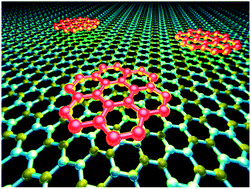
Graphene composite.
Investigators addressing these major challenges have explored the field of composites of graphene with organic semi-conductors and their findings are making graphene close to perfect if not perfect. A. Schlierf, P Samori and V.Palermo brilliantly reviewed the processes involved in modification of Graphene with organic semi-conductors in the article cited below. Combining the properties of organic semiconductors like well defined and tunable band gaps with the properties of graphene like flexibility, a dream material for the semi-conductor industry can be developed.  A. Schlierf, P Samori and V.Palermo, in this article, not only review the   modification of the graphene in solid, liquid and gases phases but also briefly summarize the electronic, magnetic and optical properties of the composite. This review gives precise insight into path graphene should be taken onto to make it perfect material for electronics.

Graphene-organic composites for electronics: optical and electronic interactions in vacuum, liquids and thin solid films
A. Schlierf, P. Samori and V. Palermo
J. Mater. Chem. C, 2014, 2, 3129-3143. DOI:10.1039/C3TC32153C

Padmanabh Joshi is a guest web writer for the Journal of Materials Chemistry blog. He currently works at the Department of Chemistry, University of Cincinnati.

To keep up-to-date with all the latest research, sign-up to our RSS feed or Table of contents alert.

Article link: http://xlink.rsc.org/?doi:10.1039/c3tc32153c
Digg This
Reddit This
Stumble Now!
Share on Facebook
Bookmark this on Delicious
Share on LinkedIn
Bookmark this on Technorati
Post on Twitter
Google Buzz (aka. Google Reader)

Endothelial cell thrombogenicity is reduced by ATRP-mediated grafting of gelatin onto PCL surfaces

One of the most promising areas of materials chemistry research is the creation of synthetic analogues of biological tissue. The development of such materials would reduce the need for transplants and their associated problems. For example, polymer-based, artificial vascular grafts are a promising candidate for use in bypass operations. Unfortunately, they increase the risk of increasing thrombus (blood clot) formation. This in turn can lead to risk of serious medical problems such as stroke, heart attack and pulmonary embolism.

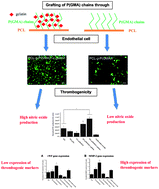
Researchers at Nanyang Technological University in Singapore have found that using functionalised polycaprolactone (PCL) can lead to reduced thrombogenicity. PCL itself is already widely used for in vivo applications although its hydrophobicity reduces its usefulness as an artificial blood vessel. Hydrophobic materials are also thought to be unsuitable because of their weak interactions with endothelial cells (ECs) – something commonly implicated in thrombus formation. To overcome these limitations, poly(glycidyl methacrylate) (PGMA) was grown from PCL surfaces via a graft-from living polymerisation. The side chains of the PGMA were then used to attach gelatine molecules. It was found that the gelatin coat decreased the hydrophobicity of the surface leading to improved EC adhesion and a corresponding reduction in thrombogenicity.

Endothelial cell thrombogenicity is reduced by ATRP-mediated grafting of gelatin onto PCL surfaces
Gordon Minru Xiong, Shaojun Yuan, Chek Kun Tan, Jun Kit Wang, Yang Liu, Timothy Thatt Yang Tan, Nguan Soon Tan and Cleo Choong
J. Mater. Chem. B, 2014, 2, 485-493.  DOI:10.1039/C3TB20760a

James Serginson is a guest web writer for the Journal of Materials Chemistry blog. He currently works at Imperial College London carrying out research into nanocomposites.

To keep up-to-date with all the latest research, sign-up to our RSS feed or Table of contents alert.

Digg This
Reddit This
Stumble Now!
Share on Facebook
Bookmark this on Delicious
Share on LinkedIn
Bookmark this on Technorati
Post on Twitter
Google Buzz (aka. Google Reader)