Archive for April, 2026

Open Call for Papers: Organic and Hybrid Photodetectors

Organic and Hybrid Photodetectors

Open Call for Papers until 1 December 2026

We are delighted to announce this open call for papers to contribute to a themed collection for Journal of Materials Chemistry C on Organic and Hybrid Photodetectors, guest edited by Professor Can Gao (Institute of Chemistry, Chinese Academy of Sciences, China), Professor Martin Heeney (King Abdullah University of Science and Technology (KAUST), Saudi Arabia), and Professor Peter Skabara (University of Glasgow, UK).

Scope

Organic and hybrid photodetectors have attracted increasing attention owing to their unique advantages such as mechanical flexibility, lightweight form factors, spectral tunability, and compatibility with low-cost solution processing. These features make them promising candidates for next-generation imaging, sensing, and optical communication technologies. Continuous progress in organic semiconductor, perovskite, quantum dot and 2D materials, device architectures, and photophysical understanding has significantly improved the performance of organic and hybrid photodetectors in terms of responsivity, detectivity, response speed, and spectral range. This Journal of Materials Chemistry C collection aims to highlight recent advances in materials design, device physics, and emerging applications of organic and hybrid photodetectors. 


Appropriate topics include, but are not limited to: 

  • Hybrid photodetectors combining organic semiconductors with perovskites, quantum dots, or 2D materials 
  • Design and synthesis of organic semiconductor materials for photodetection 
  • Structure–property relationships in organic and hybrid photodetector materials 
  • Photophysical processes including exciton generation, separation, and charge transport 
  • Interface engineering and energy level alignment in organic and hybrid photodetectors 
  • High-performance photodetectors with enhanced responsivity, detectivity, and response speed 
  • Broadband photodetection covering UV, visible, and near-infrared regions 
  • Flexible, stretchable, and wearable organic and hybrid photodetectors 
  • Organic and hybrid phototransistors and novel device architectures for photodetection 
  • Organic and hybrid photodetector arrays and imaging technologies 
  • Stability, scalability, and manufacturing strategies for practical organic and hybrid photodetectors applications 

Submit your high-quality research

This call for papers is open for the following article types:

  • Communications
  • Full papers

If you would like to contribute to this themed collection, you can submit your article directly to the online submission service for Journal of Materials Chemistry C. Please mention that this submission is a contribution to the Organic and Hybrid Photodetectors collection in the “Themed issues” section of the submission form and add a “Note to the Editor” that this is from the Open Call. The Editorial Office reserves the right to check suitability of submissions in relation to the scope of both the journal and the collection, and inclusion of accepted articles in the final themed issue is not guaranteed.

Please also note that all submissions will be subject to initial assessment and rigorous peer review to meet the usual high standards of Journal of Materials Chemistry C.

If you have any questions about the journal or the collection, then we would be happy to answer them.

Guest Editors

Professor Can Gao (Institute of Chemistry, Chinese Academy of Sciences, China)

Can Gao is currently an Associate Professor at the Institute of Chemistry, Chinese Academy of Sciences (ICCAS). She received her Ph.D. from the University of Melbourne, Australia, in 2019, and carried out postdoctoral research at ICCAS from 2020 to 2022. She joined ICCAS as an Assistant Professor and was promoted to Associate Professor in 2024. Her research interests mainly focus on the development of high mobility emissive organic semiconductors, their optoelectronic properties and their applications in organic light-emitting transistors. She has published more than 40 papers in Nat. Mater., Adv. Mater., Angew. Chem. Int. Ed., Chem. Soc. Rev. and other journals. She currently serves as a Managing Editor of Wearable Electronics. She has received funding from the National Natural Science Foundation of China, including the Young Scientists Fund (Class B and C) and the General Program, and is a recipient of the Beijing Nova Program.

Professor Martin Heeney (King Abdullah University of Science and Technology (KAUST), Saudi Arabia)

Martin Heeney is a Professor of Chemical Science at King Abdullah University of Science and Technology (KAUST). He is a graduate of the University of East Anglia and received his PhD from the same institution in 1999. Following an industrial postdoc, he joined Merck Chemicals in 2000, eventually becoming project leader for the organic electronics team. He made the move to academia in 2007, initially at Queen Mary University of London before moving to Imperial College in 2009 and KAUST in 2022. His research interests include the design, synthesis and characterisation of conjugated materials for a variety of applications. He has been named five times by Thomson Reuters as a HighlyCited researcher in the field of Materials Science, is a recipient of the RSC Corday-Morgan (2013) medal, the RSC Peter Day (2020) award and the Macro group UK medal (2020).

Professor Peter Skabara (University of Glasgow, UK)

Pete Skabara completed his PhD in 1994 under the supervision of Professor Martin Bryce at the University of Durham before taking up a Max-Planck Fellowship with Professor Klaus Müllen at the MPI for Polymer Research in Mainz.

His academic career began at Sheffield Hallam University in 1995, and he moved to the University of Manchester, before joining the University of Strathclyde. In 2018 he moved from Strathclyde to his present position as the Ramsay Chair of Chemistry at the University of Glasgow.

Research interests are in the field of organic semiconductors, which spans electronic and photonic devices and sensors, with an emphasis on synthesis and bulk properties, which are in turn driven by careful design and control of molecular architecture. His work on monodisperse, star-shaped conjugated macromolecules gained him a Royal Society Wolfson Research Merit Award and the RSC Peter Day Award. He has also held a Leverhulme Trust Fellowship and a Leverhulme/Royal Society Africa Award.

Digg This
Reddit This
Stumble Now!
Share on Facebook
Bookmark this on Delicious
Share on LinkedIn
Bookmark this on Technorati
Post on Twitter
Google Buzz (aka. Google Reader)

Welcoming Li-Zhu Wu as our new Editor-in-Chief

We are delighted to announce that Professor Li-Zhu Wu (Technical Institute of Physics and Chemistry, Chinese Academy of Sciences, China) has been appointed as the new Editor-in-Chief for Journal of Materials Chemistry A and Materials Advances

Li-Zhu Wu is a full Professor and Academician at the Technical Institute of Physics and Chemistry, Chinese Academy of Sciences. Her research focuses on photochemical synthesis and solar energy conversion, including artificial photosynthesis, visible light catalysis for organic transformation, photoinduced electron transfer, energy transfer and chemical reactions in supramolecular systems. Her awards include National Nature Science Fund for Distinguished Young Scholar of China, the 10th China Youth Science and Technology Award, the 7th Young Women Scientists award of China, a Certificate of Merit of the 3rd National Innovation Award, the 9th China Chemical Society-China Petroleum & Chemical Corporation Chemical Contribution Award. She was elected as a Member of Chinese Academy of Sciences in 2019, a Fellow of the World Academy of Sciences (TWAS) in 2021, a New Cornerstone Investigator in 2022.

Li-Zhu Wu has been an Associate Editor on Journal of Materials Chemistry A since 2017 and Materials Advances since it launched in 2020. We are delighted to continue working together with Professor Wu in her new capacity as Editor-in-Chief.

Having served as an Associate Editor for Journal of Materials Chemistry A since 2017 and for Materials Advances since its launch, I am excited to step into the role of Editor-in-Chief for both journals. It is a privilege to help steer their future direction and to continue supporting our diverse research community. These journals aim to provide a reliable platform for publishing the highest-quality work in materials research. I am honoured to collaborate with such a distinguished Editorial Board and the outstanding professional team in the RSC Editorial Office.


We invite you to discover the recent collection Guest Edited by Professor Li-Zhu Wu highlighting new developments in photofunctional materials and transformations, a cross-journal collection in Journal of Materials Chemistry A, Journal of Materials Chemistry C and ChemComm.

We are also delighted to share some of Li-Zhu’s latest publications at the RSC:

Oxygen vacancy-rich Pr6O11: unlocking superior catalytic support for efficient ammonia synthesis
C. Li, Y. Gong, Y. Yang, H. Lu, L. Wu and J. Wang, J. Mater. Chem. A, 2025, 13, 29306, DOI: 10.1039/D5TA03382A

Electronegativity-driven d-band center shifts in Ru–Ni alloys for low methane hydrogenolysis of polyolefin plastics
Q. Zhou, H. Li, S. Zhang, C. Leng, C. Li, Y. Wang, C. Ma, W. Wang, X. Fu, L. Zhu, T. Gao, C. Wang, L. Wu and Z. Li, J. Mater. Chem. A, 2026, 14, 7209, DOI: 10.1039/D5TA08263C

Kinetic-control difunctionalization of olefins to α-hydroxycarbonyls under catalyst-free conditions
H. Hou, Y. Cheng, X. Zhang, K. Zhang, H. Ren, K. Su, Z. Huang, B. Chen, C. Tung and L. Wu, Green Chem., 2025, 27, 10550, DOI: 10.1039/D5GC02308D

Achieving efficient blue room-temperature phosphorescence in cyclized aromatic amides via a hybridized local and charge-transfer state
Q. He, J. Guo, K. Zhang, Y. Chen, C. Tung and L. Wu, J. Mater. Chem. C, 2026, Advance Article, DOI: 10.1039/D5TC03923A

An acid–base responsive supramolecular drawstring with switchable fluorescence
X. Dong, L. Mao, Z. Zhang, Z. Li, S. Lei, X. Yan, C. Tung, L. Wu and H. Cong, J. Mater. Chem. C, 2026, Advance Article, DOI: 10.1039/D5TC04189A


Please join us in congratulating Professor Li-Zhu Wu on her new appointment. We invite you to submit your next article to Journal of Materials Chemistry A and Materials Advances.


Digg This
Reddit This
Stumble Now!
Share on Facebook
Bookmark this on Delicious
Share on LinkedIn
Bookmark this on Technorati
Post on Twitter
Google Buzz (aka. Google Reader)

Congratulations to the winners at Chem4Energy

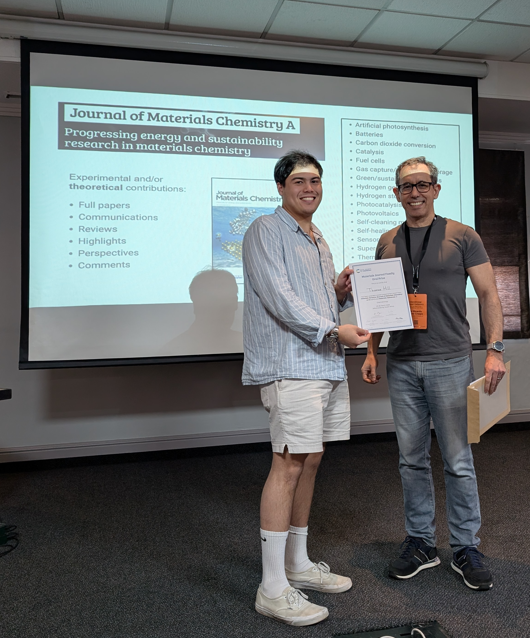
The RSC Materials journals (Materials Horizons, Journal of Materials Chemistry A, Journal of Materials Chemistry B, Journal of Materials Chemistry C, and Materials Advances) were proud to sponsor two oral prizes at Chem4Energy held from 23-26 March 2026 in Johannesburg, South Africa. Congratulations to Thomas Hill, Cardiff University, UK and Bongeka Ndwandwe, Rhodes University, South Africa for winning the oral prizes at the conference.

Thomas Hill, Cardiff University, UK

Presentation title: Exploring Structure-Reactivity Relationship on Plasmonically Active MOx Supported Clusters

Thomas Hill is a PhD student in chemistry at Cardiff University, where his research focuses on catalytic materials and sustainable energy processes. He is supervised by Richard Catlow and Graham Hutchings, and is affiliated with the UK Catalysis Hub and the CPLAS programme, a multidisciplinary initiative exploring light-driven energy conversion and plasmon-assisted catalysis.

Thomas completed his undergraduate degree in Chemistry at King’s College London, where he developed an interest in catalysis and materials chemistry. His current research uses computational approaches to explore the fundamentals of plasmonically enhanced catalytic systems.

Bongeka Ndwandwe, Rhodes University, South Africa

Presentation title: Tailoring photoresponsive azobenzene-perylene bisimide assemblies for efficient solar energy harvesting

Bongeka Ndwandwe is a PhD candidate in the Department of Chemistry at Rhodes University and the recent recipient of the Oral Presentation Award at the Chem4Energy Conference in Johannesburg, South Africa. Sponsored by the Royal Society of Chemistry, this award recognizes her excellence in communicating complex experimental research.

​Under the supervision of Dr. NF Molefe, Bongeka’s current research focuses on the fabrication of azobenzene-perylene bisimide assemblies designed to revolutionize solar energy harvesting. Her presentation highlighted her work in developing materials capable of broad-spectrum absorption, and efficient energy storage and on-demand release.

​A Rhodes University alumna, she also holds an MSc in Chemistry from the same institution. Her work continues to push the boundaries of sustainable energy solutions and optoelectronic materials.


Digg This
Reddit This
Stumble Now!
Share on Facebook
Bookmark this on Delicious
Share on LinkedIn
Bookmark this on Technorati
Post on Twitter
Google Buzz (aka. Google Reader)

Open Call for Papers: Rational Engineering of Functional Magnetic Nanoparticles

Rational Engineering of Functional Magnetic Nanoparticles

Open Call for Papers until 30 September 2026

We are delighted to announce this open call for papers to contribute to a themed collection for Journal of Materials Chemistry C on Rational Engineering of Functional Magnetic Nanoparticles, guest edited by Professor Davide Peddis (University of Genoa, Italy), Professor Yuko Ichiyanagi (Yokohama National University and Osaka University, Japan), Dr. Alejandro Gomez Roca (Catalan Institute of Nanoscience and Nanotechnology, Spain), and Professor Elin Winkler (Bariloche Atomic Center and Instituto Balseiro, Argentina).

Scope

Research on magnetic nanoparticles is a rapidly expanding field, driven by advances in the understanding of nanoscale phenomena and by the development of innovative fabrication methods that enable precise control over size, composition, and increasingly complex nanoarchitecture.

Since Néel’s pioneering work in the 1950s, key phenomena such as superparamagnetism, exchange bias, exchange spring behaviour, proximity effects have been discovered and extensively investigated. Together with progress in surface chemistry, functionalization and the synergy between the catalysis and magnetism opened new avenues for the design of advanced functional magnetic materials. These scientific developments have evolved in parallel with innovations in chemical and physical synthesis routes and state-of-the-art characterization techniques, enabling the rational engineering of nanoparticles with tailored structural, magnetic, and functional responses.

The field is inherently interdisciplinary, situated at the intersection of physics, chemistry, materials science, biochemistry, and medicine. Current research focuses not only on the development of materials with enhanced performance for advanced permanent magnets, imaging contrast agents, and magnetic data storage, but also on functional systems capable of dynamically interacting with their environment. Engineered magnetic nanoparticles are now widely explored as remotely controlled actuators capable of generating motion, force, and heat, opening new opportunities in biomedicine, soft robotics, sensing, energy technologies, and sustainable and circular systems.

This Special Issue Rational Engineering of Functional Magnetic Nanoparticles will feature invited contributions from leading experts and emerging researchers, as well as original research articles covering all aspects of magnetic nanoparticles, from the design, modelling, and fabrication of novel nanoarchitectures to their implementation in targeted technologies. We especially encourage submissions that showcase innovative research in the following areas:

  • Fundamentals and Theory
  • Design of Magnetic Nanoparticles
  • Advanced Characterization techniques
  • Advanced Magnetic Nanoparticles for Targeted Applications
  • Nanoarchitectures based on Magnetic Nanoparticles for Targeted Technologies
  • Magnetic Nanoparticles for Sustainable and Circular Technologies

Submit your high-quality research

This call for papers is open for the following article types:

  • Communications
  • Full papers

If you would like to contribute to this themed collection, you can submit your article directly to the online submission service for Journal of Materials Chemistry C. Please mention that this submission is a contribution to the Rational Engineering of Functional Magnetic Nanoparticles collection in the “Themed issues” section of the submission form and add a “Note to the Editor” that this is from the Open Call. The Editorial Office reserves the right to check suitability of submissions in relation to the scope of both the journal and the collection, and inclusion of accepted articles in the final themed issue is not guaranteed.

Please also note that all submissions will be subject to initial assessment and rigorous peer review to meet the usual high standards of Journal of Materials Chemistry C.

If you have any questions about the journal or the collection, then we would be happy to answer them.

Guest Editors

Professor Davide Peddis (University of Genoa, Italy)

Davide Peddis (PhD; 2007)  is a Full Professor of Physical Chemistry at the University of Genoa and Associate Researcher at CNR-ISM. He has held research positions in Italy and abroad, including Senior Scientist at the Vinča Institute (Belgrade), and visiting appointments in France, Sweden, and the USA. DP has authored over 230 peer-reviewed papers (h-index ~50) and seven book chapters; he contributed to more than 450 conference communications. His research focuses on magnetic nano-heterostructures, with emphasis on the interplay between structure, morphology, and physical properties, spanning fundamental magnetism and applications in biomedicine, catalysis, and energy. He has participated in 29 funded projects (5 as Principal Investigator, 12 as local PI, and 12 as key team member), managing ~€3 million in research funding.

Professor Yuko Ichiyanagi (Yokohama National University and Osaka University, Japan)

Yuko Ichiyanagi received her PhD (Applied Physics) at Yokohama National University in 1996. She has been a full professor since 2019 at Yokohama National University. She concurrently holds a visiting professor at Osaka University since 2017. She has been frequently invited to and chaired at international conference. Her recent main research interests are phase transition of magnetic nanoparticles and biomedical applications. Now she has published more than 120 papers and books, and has been serving as an international advisory committee member of some reputed conferences. She is a member of the editorial board of IEEE Magnetics Letters since 2018. She has served as a program committee member and session chair for many IEEE conferences. Prior to her academic position, she worked for a private company for three years, designing circuits, and contributing to the establishment of electronic equipment interference regulations in Japan (VCCI).

Dr. Alejandro Gomez Roca (Catalan Institute of Nanoscience and Nanotechnology, Spain)

Alejandro G. Roca is a Tenured Scientist at the Spanish National Research Council (CSIC) based at the ICN2. He previously conducted research in Spain (ICMM, INA‑UNIZAR, ICMA), the UK (University of York), Japan (Tohoku University), and the private sector. Dr. Roca has authored 57 peer‑reviewed publications (>4,300 citations, h‑index 30), edited two books, contributed two book chapters, and is co‑inventor on two patents. He has participated in 21 research projects, serving as Principal Investigator on five. His work focuses on the synthesis of magnetic nanoparticles for biomedical and energy applications and on the structural and magnetic characterization of nanostructures using laboratory, synchrotron, and neutron techniques. He has delivered 14 invited talks at international conferences and organized several scientific events. Dr. Roca has supervised doctoral and master’s students, contributed to academic teaching at the UAB, served on international evaluation panels, and is actively engaged in science outreach.

Professor Elin Winkler (Bariloche Atomic Center and Instituto Balseiro, Argentina)

Elin Winkler is a Researcher at National Council for Scientific and Technical Research (CONICET) and the National Atomic Energy Commission (CNEA) and a member of the Institute of Nanoscience and Nanotechnology (CNEA/CONICET) in Argentina. She is also an Adjunct Professor at the Balseiro Institute, which depends on the Universidad Nacional de Cuyo (UNCuyo) and CNEA.

She is co-author of 98 peer-reviewed publications (>3100 citations, h-index 30) and 4 book chapters. Her research focuses on the development of new nanostructured materials based on magnetic nanoparticles and study of their physicochemical properties to optimize their performance in applications such as environmental remediation, nanomedicine and energy.

She currently serves as Associate Editor of Journal of Materials Chemistry C and Materials Advances.

Digg This
Reddit This
Stumble Now!
Share on Facebook
Bookmark this on Delicious
Share on LinkedIn
Bookmark this on Technorati
Post on Twitter
Google Buzz (aka. Google Reader)