Archive for the ‘News’ Category

Drug release polymer triggered by ultrasound

Scientists from China and Canada have found that a drug-loaded shape memory polymer can be manipulated by ultrasound and that they can control when and how the drugs are released.

Shape memory polymers (SMPs) can be deformed and fixed into a temporary shape and then recover their original permanent shape under external stimuli such as heat, explains lead researcher Hesheng Xia from Sichuan University, Chengdu. ‘When a piece of polymer is placed in the body, it is subjected to heating at 37°C everywhere and the whole piece undergoes shape recovery,’ he says. Xia and co-workers directed an ultrasound beam on a selected area of a polymer, causing a local rise in temperature and triggering shape recovery only in that area. Xia adds that ultrasound has the advantage of easily penetrating body tissue.
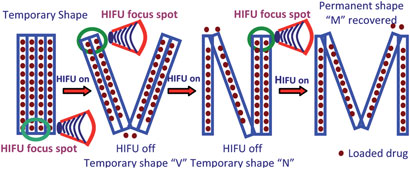
Schematic of the polymer changing shape and drug release

Using high intensity focused ultrasound (HIFU), the polymer was changed from its permanent M shape to a temporary I shape, then a V then an N and back to the M, releasing drugs with each change

Xia’s group loaded their SMP sample with a drug and folded it into a temporary ‘I’ shape. By directing the ultrasound onto different positions on the polymer, they could control its shape on demand, changing it from ‘I’ to ‘V’ to ‘N’ and back to the original ‘M’, releasing drugs with each shape change. They stopped the drug release by switching off the ultrasound. This caused a quick temperature drop, which allowed the polymer to adopt a stable intermediate shape.

Tao Xie, who works on shape memory polymers at the General Motors Research and Development Center, Michigan, US, was impressed that ultrasound controls the shape in a spatial and temporal manner, allowing selected regions of the polymer to be controlled on demand. He added that this would ‘significantly widen the application potential’.

Xia hopes that the switchable release of drugs from SMPs could be applied to polymer implants for minimally invasive surgery and that ultrasound may reduce infection risks. To minimise side effects, however, he says that the challenge will be to reduce the power and irradiation time of the ultrasound needed for the shape changes.

Spatial and temporal control of shape memory polymers and simultaneous drug release using high intensity focused ultrasound
Guo Li , Guoxia Fei , Hesheng Xia , Jianjun Han and Yue Zhao
DOI: 10.1039/C2JM30848G

Read the original Chemistry World article here

Digg This
Reddit This
Stumble Now!
Share on Facebook
Bookmark this on Delicious
Share on LinkedIn
Bookmark this on Technorati
Post on Twitter
Google Buzz (aka. Google Reader)

Video Interview: Seth Marder discusses the importance of materials to society

Seth Marder discusses the importance of materials chemistry to society with Liz Davies.

Photograph of Seth Marder

Watch the video interview on YouTube here:


If you’re interested to know more about how new materials could improve people’s lives you can read reports on:


Don’t forget to keep up-to-date with all the latest research you can sign-up for the Journal of Materials Chemistry RSS feed or Table of contents alert.

To keep up with the journal news you can Like us on Facebook or Follow us on Twitter.Follow Journal of Materials Chemistry on FacebookFollow Journal of Materials Chemistry on Facebook

Digg This
Reddit This
Stumble Now!
Share on Facebook
Bookmark this on Delicious
Share on LinkedIn
Bookmark this on Technorati
Post on Twitter
Google Buzz (aka. Google Reader)

2012 Journal of Materials Chemistry Lectureship- Nominations now open!

Do you know someone who deserves recognition for their contribution to the materials chemistry field?

Now is your chance to propose they receive the recognition they deserve.

We are pleased to announce that the 2012 Journal of Materials Chemistry Lectureship is now open for nominations. This annual lectureship honours a younger scientist who has made a significant contribution to the field of materials chemistry.

Liberato Manna, the winner of the 2011 lectureship, was chosen for his outstanding contribution to the field of inorganic nanotechnology.

Qualification
To be eligible for the Journal of Materials Chemistry Lectureship, the candidate should be in the earlier stages of their scientific career, typically within 10 years of attaining their doctorate or equivalent degree, and will have made a significant contribution to the field.

Description
The recipient of the award will be asked to present one Journal of Materials Chemistry lecture, at a conference decided upon by the recipient and the Editorial Office. The Journal of Materials Chemistry Editorial Office will provide the sum of £1000 to the recipient for travel and accommodation costs. The award recipient will be presented with the award at this lecture. They will also be asked to contribute a lead article to the journal and will have their work showcased on the back cover of the issue in which their article is published.

Selection
The recipient of the lectureshipwill be selected and endorsed by the Journal of Materials Chemistry Editorial Board.

Nominations
Those wishing to make a nomination should send details of the nominee including a brief C.V. (no longer than 2 pages) together with a letter supporting the nomination (no longer than 2 pages), to the Journal of Materials Chemistry Editorial Office by 11 May 2012. Please note that self-nomination is permitted.

Send a nomination here today: materials-rsc@rsc.org

Digg This
Reddit This
Stumble Now!
Share on Facebook
Bookmark this on Delicious
Share on LinkedIn
Bookmark this on Technorati
Post on Twitter
Google Buzz (aka. Google Reader)

J. Mater. Chem. paper featured in Science

Graphical abstract: Syntheses of nanostructured Cu- and Ni-based micro-assemblies with selectable 3-D hierarchical biogenic morphologiesA paper by Kenneth Sandhage and colleagues has been highlighted in the Editors’ Choice section of Science (A Layer-by-Layer Amplifier; subscription required). The paper describes a combined layer-by-layer surface amine amplification and electroless deposition process to convert 3-D nanostructured micro-assemblies into freestanding Cu-bearing or Ni-bearing structures.

… And here’s the full research paper:

Syntheses of nanostructured Cu- and Ni-based micro-assemblies with selectable 3-D hierarchical biogenic morphologies
Yunnan Fang, John D. Berrigan, Ye Cai, Seth R. Marder and Kenneth H. Sandhage, J. Mater. Chem., 2012, 22, 1305-1312

To keep up-to-date with all the latest research, sign up for the journal’s e-alerts or RSS feeds or follow Journal of Materials Chemistry on Twitter.

Digg This
Reddit This
Stumble Now!
Share on Facebook
Bookmark this on Delicious
Share on LinkedIn
Bookmark this on Technorati
Post on Twitter
Google Buzz (aka. Google Reader)

J. Mater. Chem. communication highlighted by ACS Noteworthy Chemistry

The communication by Guo-Ping Yong and colleagues described how purely organic radical materials can be used to generate stacking-induced white-light or blue-light phosphorescence. This article was selected as a hot article back in December. You can read the write up in ACS Noteworthy Chemistry here: Organic radicals efficiently emit phosphorescence

… And here is the original research article:

Communication: Stacking-induced white-light and blue-light phosphorescence from purely organic radical materials: Guo-Ping Yong, Yi-Man Zhang, Wen-Long She and Ying-Zhou Li, J. Mater. Chem., 2011, 21, 18520-18522

To keep up-to-date with all the latest research, sign up for the journal’s e-alerts or RSS feeds or follow Journal of Materials Chemistry on Twitter.

Digg This
Reddit This
Stumble Now!
Share on Facebook
Bookmark this on Delicious
Share on LinkedIn
Bookmark this on Technorati
Post on Twitter
Google Buzz (aka. Google Reader)

Journal of Materials Chemistry Issue 6 out now!

The latest issue of Journal of Materials Chemistry is now online. You can read the full issue here.


The outside front cover features an article on Dielectric behavior of self-assembled monolayers by Oktay Yildirim, Peter J. de Veen, Michiel G. Maas, Minh D. Nguyen, David N. Reinhoudt, Dave H. A. Blank, Guus Rijnders and Jurriaan Huskens.


JMC Issue 6 IFC
 

Three-dimensional tubular arrays of MnO2–NiO nanoflakes with high areal pseudocapacitance
 is the article highlighted on the inside front cover by Jinping Liu, Jian Jiang, Michel Bosman and Hong Jin Fan.


Issue 6 contains the following Feature articles:

Why not take a look at the articles today and blog your thoughts and comments below.

To keep up-to-date with all the latest research, sign up for the journal’s e-alerts or RSS feeds or follow Journal of Materials Chemistry on Twitter

Digg This
Reddit This
Stumble Now!
Share on Facebook
Bookmark this on Delicious
Share on LinkedIn
Bookmark this on Technorati
Post on Twitter
Google Buzz (aka. Google Reader)

Journal of Materials Chemistry Issue 5 out now!

The latest issue of Journal of Materials Chemistry is now online. You can read the full issue here.

JMC Issue 5 OFC


The outside front cover features an article on Peptide-based solids: porosity and zeolitic behavior by Rui Afonso, Adélio Mendes and Luís Gales.


The effect of protein shells on the antioxidant activity of protein-encapsulated platinum nanoparticles is the article highlighted on the inside front cover by Boi Hoa San, Sang Hyun Moh and Kyeong Kyu Kim.


Issue 5 contains the following Application and Feature articles:

To keep up-to-date with all the latest research, sign up for the journal’s e-alerts or RSS feeds or follow Journal of Materials Chemistry on Twitter

Digg This
Reddit This
Stumble Now!
Share on Facebook
Bookmark this on Delicious
Share on LinkedIn
Bookmark this on Technorati
Post on Twitter
Google Buzz (aka. Google Reader)

Journal of Materials Chemistry Issue 4 out now!

The latest issue of Journal of Materials Chemistry is now online. You can read the full issue here.

JMC Issue 4 OFCThe outside front cover features an article on Solution phase synthesis of carbon quantum dots as sensitizers for nanocrystalline TiO2 solar cells by Peter Mirtchev, Eric J. Henderson, Navid Soheilnia, Christopher M. Yip and Geoffrey A. Ozin.

Issue 4 contains the following Highlight and Feature articles:

To keep up-to-date with all the latest research, sign up for the journal’s e-alerts or RSS feeds or follow Journal of Materials Chemistry on Twitter

Digg This
Reddit This
Stumble Now!
Share on Facebook
Bookmark this on Delicious
Share on LinkedIn
Bookmark this on Technorati
Post on Twitter
Google Buzz (aka. Google Reader)

Journal of Materials Chemistry article featured in Chemistry World: Blood barrier gel aids medical analysis

US scientists have developed a separator gel that can form a permanent barrier between blood components when exposed to ultraviolet (UV) light, to keep cells and plasma apart for medical analysis.

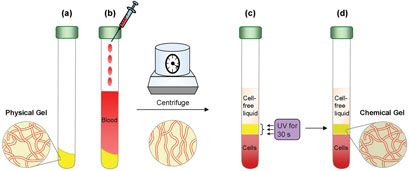
Blood separation with rigid gel

(a) The gel is placed at the bottom of a tube. (b) A blood sample is added. The tube is then placed in a centrifuge, where the gel is liquefied. Owing to its density, the liquefied gel flows to a position between the blood cells and plasma. (c) When centrifugation is stopped, the network is re-established and the gel recovers its solid character, forming a weak barrier between the blood layers. (d) The gel layer is irradiated with a UV lamp, converting the material into a hard, chemically crosslinked network, resulting in a rigid and permanent barrier

Blood tests typically only use the cell-free fraction of whole blood (serum or plasma), and it is common practice within blood sample tubes for these liquids to be separated from the blood cells by a separator gel. Separator gels are designed to reversibly liquefy during centrifugation. They have a density between that of the cells and solution components, so that they separate the components by flowing to a position between the layers during centrifugation. Following centrifugation, the gels stop flowing and remain as a soft barrier between the layers. However, the soft barrier can cause contamination, and leaks between the components and the gel can occur during sample transportation and storage. Interested to know more? Read the full article in Chemistry World here…

Read the paper from Journal of Materials Chemistry:

A new method for centrifugal separation of blood components: Creating a rigid barrier between density-stratified layers using a UV-curable thixotropic gel
Kunshan Sun, Hyuntaek Oh, Jane F. Emerson and Srinivasa R. Raghavan
J. Mater. Chem., 2012, Advance Article
DOI: 10.1039/C2JM14818H

To keep up-to-date with all the latest research, sign up for the journal’s e-alerts or RSS feeds or follow Journal of Materials Chemistry on Twitter

Digg This
Reddit This
Stumble Now!
Share on Facebook
Bookmark this on Delicious
Share on LinkedIn
Bookmark this on Technorati
Post on Twitter
Google Buzz (aka. Google Reader)

Congratulations to Tom White for winning a Journal of Materials Chemistry presentation prize

Congratulations to Tom White for winning a Journal of Materials Chemistry presentation prize at Nanostructured Surfaces.

His winning talk was titled “Development of Organic Spacer Layers for the Electronic Decoupling of Molecules from Metallic Substrates”.

 Photo of Philip Moriarty, Tom White, Christopher Baddeley

Left to right: Philip Moriarty, Tom White, Christopher Baddeley

Tom White is a PhD student at the Department of Chemistry, University of Warwick, UK, working in Giovanni Costantini’s research group. Nanostructured Surfaces was organised by the RSC Solid Surfaces Group and held in Burlington House, London, UK, on 9th December 2011.

To keep up-to-date with all the latest research, sign up for the journal’s e-alerts or RSS feeds or follow Journal of Materials Chemistry on Twitter.

Digg This
Reddit This
Stumble Now!
Share on Facebook
Bookmark this on Delicious
Share on LinkedIn
Bookmark this on Technorati
Post on Twitter
Google Buzz (aka. Google Reader)