Archive for the ‘Hot Articles’ Category

Pressure-cooking explosives!

Things are hotting up for ChemComm. The high-pressure, high-temperature explosive RDX  (1,3,5-trinitrohexahydro-1,3,5-triazine) is a widely used military explosive that can be compounded with mineral jelly or polymers to form plastic explosives. Colin Pulham from the University of Edinburgh and other collaborators from around the UK have structurally characterised RDX by using a combination of diffraction techniques and successfully recovered a sample at ambient pressure. 

 This kind of information can be used by scientists to explore aspects of energetic materials (propellants and explosives) that include; sensitivity to shock, heat, and friction; chemical decomposition mechanisms; energy transfer through the solid; detonation velocities; and testing the efficacy of theoretical modelling techniques.

Would you like to read more? Why not read the ChemComm article here, which is free to access until the end of August.

Digg This
Reddit This
Stumble Now!
Share on Facebook
Bookmark this on Delicious
Share on LinkedIn
Bookmark this on Technorati
Post on Twitter
Google Buzz (aka. Google Reader)

Penny drops for cancer research

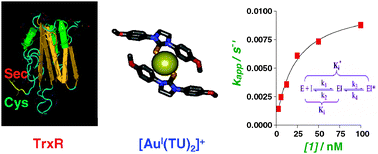
Coinage metal (gold, silver, copper) complexes with a thiourea component have shown significant cytotoxicities towards cancer cells and, in particular, the gold(I) thiourea complex exhibits a potent tight-binding inhibition of the anticancer drug target thioredoxin reductase.


 Chi-Ming Che and his colleagues at the University of Hong Kong and a collaborator at CNRS, in France, have published their findings in Chemical Communications – Why not read the article here, which is also free to access until the end of August.

Digg This
Reddit This
Stumble Now!
Share on Facebook
Bookmark this on Delicious
Share on LinkedIn
Bookmark this on Technorati
Post on Twitter
Google Buzz (aka. Google Reader)

Nanocage increases catalytic activity

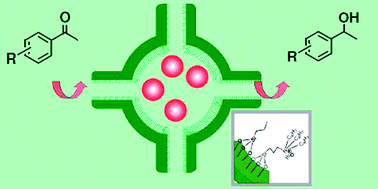
Can Li and his colleagues from Dalian Institute of Chemical Physics, in China, have created a desirable amphiphilic microenvironment within a nanocage that can encapsulate a ruthenium-based catalyst. This nanocage can be ten times more active than one with a hydrophobic environment, where the resulting high catalytic activity can be attributed to the increased ability of the reactants to accumulate inside the nanocage. The team believe that this is mainly due to the enhanced diffusion rates of reactants during the catalytic process.


To read more, why not access the article here, which is free for all to read until the end of August!

Digg This
Reddit This
Stumble Now!
Share on Facebook
Bookmark this on Delicious
Share on LinkedIn
Bookmark this on Technorati
Post on Twitter
Google Buzz (aka. Google Reader)

The elusive aromaticity

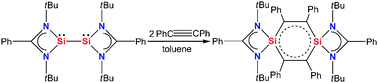
Herbert W. Roesky and his colleagues based at Universität Göttingen, in Germany, have discovered the first example of 1,4-disilabenzene that is room temperature stable. The compound was characterized by means of single crystal X-ray diffraction studies. Nucleus Independent Chemical Shift calculations showed that the compound also has some aromatic character.

  Would like to know more? Why not read the article here and better still it is free to access until the end of August!

Digg This
Reddit This
Stumble Now!
Share on Facebook
Bookmark this on Delicious
Share on LinkedIn
Bookmark this on Technorati
Post on Twitter
Google Buzz (aka. Google Reader)