Archive for the ‘Hot Articles’ Category

Graphene looks to doped superbenzene to overcome electronic hurdles

Building graphene from carefully-modified superbenzene segments has been proposed as a way to help graphene overcome a major stumbling block limiting its application in electronic devices – by opening its bandgap to make it a true semiconductor. 

Intrinsically, graphene is a semimetal with no bandgap. Boron nitride can afford graphene the electronic properties desired for atomically thin circuits. However, positioning these boron nitride-groups in just the right places to properly regulate electron flow through graphene is difficult. 


Read the full article in Chemistry World» 

Read the original article in ChemComm – it’s free to access until 11th March:
Synthesis, structure and properties of C3-symmetric heterosuperbenzene with three BN units
Xiao-Ye Wang, Fang-Dong Zhuang, Xin-Chang Wang, Xiao-Yu Cao, Jie-Yu Wang and Jian Pei  
Chem. Commun., 2015, Advance Article
DOI: 10.1039/C4CC10105G, Communication

Digg This
Reddit This
Stumble Now!
Share on Facebook
Bookmark this on Delicious
Share on LinkedIn
Bookmark this on Technorati
Post on Twitter
Google Buzz (aka. Google Reader)

Accessing Chiral Space with Visible Light

Researchers have made tremendous efforts to unlock stereoselective, catalytic organic transformations. In this recent ChemComm Feature Article, Professor Eric Meggers, one of the pioneers in the field of photoredox catalysis, provides a comprehensive review of the recent advances in asymmetric catalysis driven by visible light.

Asymmetric catalysis has been one of the most attractive yet challenging areas of organic chemistry for the synthesis of unique, biologically active natural products such as Taxol, Rapamycin, or Vinblastine that possess numerous stereocenters.
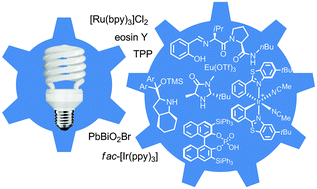
C4CC09268F gaRecently, visible light, a sustainable and affordable energy resource, gained substantial interest with its capability to selectively access chiral molecules from prochiral substrates without undesirable by-products. Transformations including aldehyde α-functionalization and [2+2] cycloadditions demonstrate the potential of visible light in the presence of a photosensitizer.

These photosensitizers are typically ruthenium or iridium complexes that can facilitate electron/energy transfer upon photoinduction. In most cases, a photoredox catalyst has to be coupled with a chiral co-catalyst to introduce stereocenters in the products.

Notable advances in the Meggers, Melchiorre, and MacMillan research groups have recently demonstrated that photoactivation can be achieved with a single chiral photosensitizer to provide products of high enantiomeric excess and good yield.

This inspirational review was just published in Chemical Communications as a Feature Article. I recommend reading “Asymmetric catalysis activated by visible light” (DOI: 10.1039/c4cc09268f) by Professor Eric Meggers to learn more about the recent advances with mechanistic details and his forecast for one of the rapidly-growing research topics in organic chemistry.

This article is free to access until 17th March.* Download it here:
Asymmetric catalysis activated by visible light
Eric Meggers �
Chem. Commun., 2015, Advance Article
DOI: 10.1039/C4CC09268F, Feature Article


Dr. Tezcan Guney is a guest web writer for Chemical Communications. Dr. Guney received his Ph.D. from the Department of Chemistry at Iowa State University with Prof. George Kraus, where he focused on the synthesis of biologically active polycyclic natural products and multifunctional imaging probes. Currently, he is a postdoctoral research scholar at the Memorial Sloan-Kettering Cancer Center in New York with Prof. Derek Tan, contributing to the efforts to access biologically active small molecules using the diversity-oriented synthetic approach.

*Access is free through a registered RSC account

Digg This
Reddit This
Stumble Now!
Share on Facebook
Bookmark this on Delicious
Share on LinkedIn
Bookmark this on Technorati
Post on Twitter
Google Buzz (aka. Google Reader)

Hot ChemComm articles for January

Here are some of the latest referee-recommended articles in ChemComm – all free to access for a  limited time:   

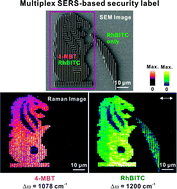
Multiplex plasmonic anti-counterfeiting security labels based on surface-enhanced Raman scattering
Yan Cui, In Yee Phang, Yih Hong Lee, Mian Rong Lee, Qi Zhang and Xing Yi Ling  
Chem. Commun., 2015, Advance Article
DOI: 10.1039/C4CC08596E, Communication
From themed collection 2015 Emerging Investigators   

c4CC08596E ga   


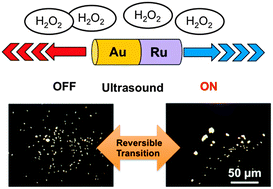
A tale of two forces: simultaneous chemical and acoustic propulsion of bimetallic micromotors
Wei Wang, Wentao Duan, Zexin Zhang, Mei Sun, Ayusman Sen and Thomas E. Mallouk  
Chem. Commun., 2015,51, 1020-1023
DOI: 10.1039/C4CC09149C, Communication   

C4CC09149C ga   


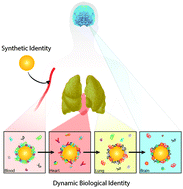
Nanoparticle–blood interactions: the implications on solid tumour targeting
James Lazarovits, Yih Yang Chen, Edward A. Sykes and Warren C. W. Chan  
Chem. Commun., 2015, Advance Article
DOI: 10.1039/C4CC07644C, Feature Article   

C4CC07644C ga   


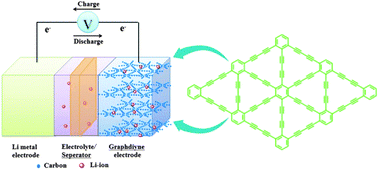
Bulk graphdiyne powder applied for highly efficient lithium storage
Shengliang Zhang, Huibiao Liu, Changshui Huang, Guanglei Cui and Yuliang Li  
Chem. Commun., 2015,51, 1834-1837
DOI: 10.1039/C4CC08706B, Communication   

C4CC08706B ga   


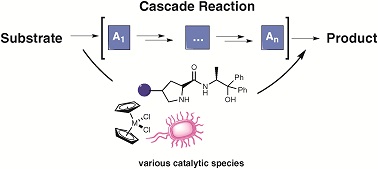
Cascade catalysis – strategies and challenges en route to preparative synthetic biology
Jan Muschiol, Christin Peters, Nikolin Oberleitner, Marko Mihovilovic, Uwe Bornscheuer and Florian Rudroff  
Chem. Commun., 2014, Accepted Manuscript
DOI: 10.1039/C4CC08752F, Feature Article
From themed collection Directed Evolution   

 c4cc08752f-ga


Virus-like particles as virus substitutes to design artificial virus-recognition nanomaterials
Sabine Sykora, Alessandro Cumbo, Gaël Belliot, Pierre Pothier, Charlotte Arnal, Yves Dudal, Philippe F.-X. Corvini and Patrick Shahgaldian  
Chem. Commun., 2015, Advance Article
DOI: 10.1039/C4CC08843C, Communication   

C4CC08843C ga   

Digg This
Reddit This
Stumble Now!
Share on Facebook
Bookmark this on Delicious
Share on LinkedIn
Bookmark this on Technorati
Post on Twitter
Google Buzz (aka. Google Reader)

Super-dipoles linked to chloroform’s outstanding solvent properties

Super-dipoles uncovered in chloroform by chemists in the UK could explain the solvent’s powerful ability to dissolve a large range of substances at high concentrations.

Chloroform is one chemistry’s most extensively used forms of liquid reaction media. However, as a suspected carcinogen, chloroform’s role in the extraction of natural products from plant materials, in NMR spectroscopy and as a reagent for chemical reactions underscores scientists’ aspirations to understand the science behind its remarkable properties.


Read the fulll article in Chemistry World»

Read the original journal article in ChemComm – it’s free to access until 25th February:
Polar stacking of molecules in liquid chloroform

J. J. Shephard, A. K. Soper, S. K. Callear, S. Imberti, J. S. O. Evans and C. G. Salzmann  
Chem. Commun., 2015, Advance Article
DOI: 10.1039/C4CC09235J, Communication

Digg This
Reddit This
Stumble Now!
Share on Facebook
Bookmark this on Delicious
Share on LinkedIn
Bookmark this on Technorati
Post on Twitter
Google Buzz (aka. Google Reader)

Organic synthons yield hyperbranched crop

Resembling a bundle of cereal stalks, this atomic force microscopy (AFM) image depicts the first ionic organic nanocrystals to have a sheaf-like structure. Ursula Mazur, of Washington State University, US, and colleagues grew the π-conjugated molecules from two electroactive porphyrin synthons: tetra(4-aminophenyl)porphyrin and tetra(4-sulfonatophenyl)porphyrin. These building blocks assembled themselves into branched structures – the higher the reaction temperature the longer and more numerous their branches.


Read the full article in Chemistry World»

Read the original journal article in ChemComm:
Hyperbranched Crystalline Nanostructure Produced from Ionic π-Conjugated Molecules
Ursula Mazur , K W Hipps, Jeremy R. Eskelsen and Kara J Phillips Chem. Commun., 2014, Accepted Manuscript
DOI: 10.1039/C4CC09288K, Communication

Digg This
Reddit This
Stumble Now!
Share on Facebook
Bookmark this on Delicious
Share on LinkedIn
Bookmark this on Technorati
Post on Twitter
Google Buzz (aka. Google Reader)

σ meets π for a hole lot of bonding

Researchers in India have provided experimental verification that a co-operative σ-hole and π-hole are responsible for holding the molecules of an isothiocyanate based peptide together in its crystal lattice, showcasing the importance of weak, but highly directional interactions in structure–activity relationships.

Understanding weak intermolecular interactions, like hydrogen bonding, π-stacking and ion– π -interactions, is vital to probing the relationship between structure and properties for pharmaceutically important molecules such as highly reactive organic isothiocyanates, which display anti-carcinogenic activity.


Read the full article in Chemistry World»

Read the original journal article in ChemComm – it’s free to download until 21st January 2015:

Observation of a reversible isomorphous phase transition and an interplay of “σ-holes” and “π-holes” in Fmoc-Leu-ψ[CH2-NCS]
Rumpa Pal, Govindappa Nagendra, M. Samarasimhareddy, Vommina V. Sureshbabu and Tayur N. Guru Row
Chem. Commun., 2015,51, 933-936
DOI: 10.1039/C4CC08751H, Communication

Digg This
Reddit This
Stumble Now!
Share on Facebook
Bookmark this on Delicious
Share on LinkedIn
Bookmark this on Technorati
Post on Twitter
Google Buzz (aka. Google Reader)

Novel optical trapping of aerosolised inhaler particles

The inhaler, or pressurised metered-dose inhaler (pMDI), is a well-known medical device commonly used to help people all over the world with conditions such as asthma. However little is known about the form and phase of particles ejected from the inhaler on their route from the inhaler to the lung. It is important to understand the way that the solid particles behave once they are discharged from an inhaler as the size of a particle affects where it is delivered in the respiratory tract, ultimately determining the efficacy of the treatment.

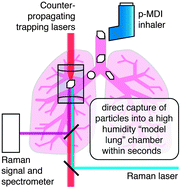
Experimental setup used to trap and study particles discharged from a Salamon® inhaler.

In a collaboration between the University of Cambridge, Imperial College London, the University of Birmingham and the Central Laser Facility in Oxford, Tong et al. have used an optical trap to stably suspend individual particles discharged from a Salamon® inhaler for the first time. After stably trapping the particles the authors were able to determine the phase of the particles by comparing them to both a solid crystalline sample and nebulised aqueous droplets of the drug used in the Salamon® inhaler (salbutamol sulphate). Particles were also trapped and studied after being passed through a humidity chamber designed to mimic the lungs.

When first dispensed from the inhaler the particles had analogous properties to the solid crystalline sample of the drug. As the particles were exposed to a higher humidity they became more spherical as they absorbed water from the environment around them. Particles trapped at a relative humidity >92% had properties very similar to that of nebulised aqueous droplets of the drug. This change in morphology of the particles was confirmed by a combination of Raman spectroscopy and brightfield images.

Tong et al. have been able to show that once released into the body the crystalline particles take up    water, causing the particles to increase in size and sphericity. This information will be of great aid in understanding and improving the efficiency of aerosol-based inhalation products.

To download the full article for free for a limited time* click the link below:

Rapid interrogation of the physical and chemical characteristics of salbutamol sulphate aerosol from a pressurised metered-dose inhaler (pMDI)
H.-J. Tong, C. Fitzgerald, P. J. Gallimore, M. Kalberer, M. K. Kuimova, P. C. Seville, A. D. Ward and F. D. Pope
DOI: 10.1039/c4cc05803h

*Access is through a registered RSC account – click here to register

Digg This
Reddit This
Stumble Now!
Share on Facebook
Bookmark this on Delicious
Share on LinkedIn
Bookmark this on Technorati
Post on Twitter
Google Buzz (aka. Google Reader)

Boron and beryllium finally shake hands

The first non-cluster bond between boron and beryllium has been reported by scientists in Germany.

10 years ago, few reactions existed where boron behaved as an nucleophile. That all changed with the advent of lithium diazaborolide in 2006, and boron has been partnering up with myriad main-group, transition metal and lanthanide elements ever since. However, despite beryllium sitting right next to boron in the periodic table, a classical two-centre/two-electron bond had never been reported between the two neighbours, until now.


Read the full article in Chemistry World»

Read the original journal article in ChemComm – it’s free to access until 6th January 2015:
Beryllium bis(diazaborolyl): old neighbors finally shake hands
T. Arnold, H. Braunschweig, W. C. Ewing, T. Kramer, J. Mies and J. K. Schuster  
Chem. Commun., 2015, Advance Article
DOI: 10.1039/C4CC08519A, Communication

Digg This
Reddit This
Stumble Now!
Share on Facebook
Bookmark this on Delicious
Share on LinkedIn
Bookmark this on Technorati
Post on Twitter
Google Buzz (aka. Google Reader)

Hot ChemComm articles for November

Here is a selection of the latest referee-recommended articles in ChemComm:

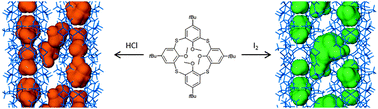
Diffusion of vaporous guests into a seemingly non-porous organic crystal
Simon A. Herbert, Agnieszka Janiak, Praveen K. Thallapally, Jerry L. Atwood and Leonard J. Barbour  
Chem. Commun., 2014,50, 15509-15512
DOI: 10.1039/C4CC07366E, Communication


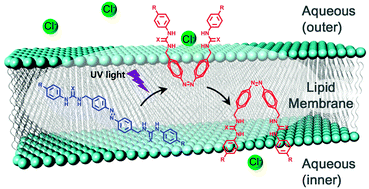
Azobenzene-based chloride transporters with light-controllable activities
Ye Rin Choi, Gyu Chan Kim, Hae-Geun Jeon, Jinhong Park, Wan Namkung and Kyu-Sung Jeong  
Chem. Commun., 2014,50, 15305-15308
DOI: 10.1039/C4CC07560A, Communication


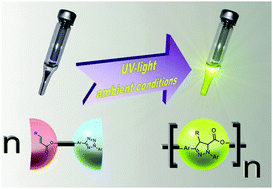
Fluorescent polymers from non-fluorescent photoreactive monomers
Jan O. Mueller, Dominik Voll, Friedrich G. Schmidt, Guillaume Delaittre and Christopher Barner-Kowollik  
Chem. Commun., 2014,50, 15681-15684
DOI: 10.1039/C4CC07792J, Communication


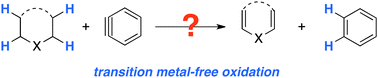
Is it possible to achieve a complete desaturation of cycloalkanes promoted by o-benzyne?
Francisco Cervantes-Navarro, Abel de Cózar, Fernando P. Cossío, María A. Fernández-Herrera, Gabriel Merino and Israel Fernández  
Chem. Commun., 2015, Advance Article
DOI: 10.1039/C4CC07311H, Communication


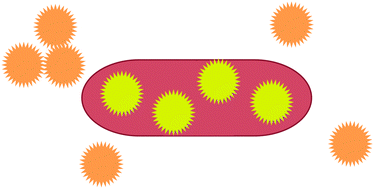
Thiol-modified gold nanoparticles for the inhibition of Mycobacterium smegmatis
Jennifer C. Gifford, Jamee Bresee, Carly Jo Carter, Guankui Wang, Roberta J. Melander, Christian Melander and Daniel L. Feldheim  
Chem. Commun., 2014,50, 15860-15863
DOI: 10.1039/C4CC06236A, Communication


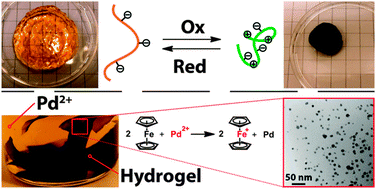
Redox-responsive organometallic hydrogels for in situ metal nanoparticle synthesis
B. Zoetebier, M. A. Hempenius and G. J. Vancso  
Chem. Commun., 2015, Advance Article
DOI: 10.1039/C4CC06988A, Communication

Digg This
Reddit This
Stumble Now!
Share on Facebook
Bookmark this on Delicious
Share on LinkedIn
Bookmark this on Technorati
Post on Twitter
Google Buzz (aka. Google Reader)

Aptamers and gold nanoparticles whisked up to spot influenza

Researchers in the UK have developed a new visual bioassay that can detect flu viruses by making them heavier.

Early diagnosis is fundamental to slowing viral outbreaks. The latest (since 2003) outbreak of avian flu from Asia resulted in millions of chickens being culled and, according to the World Health Organization, the death of 393 people. Many laboratory-based tests, such as viral culture assays and the polymer chain reaction (PCR), are incredibly sensitive and accurate. However, they are costly, time consuming and require specialist training, so are unsuitable for transition to the field. It is therefore vital to introduce simple, quick and cheap field tests to control the spread of diseases and guide preventative measures, especially in countries like Vietnam where livestock is still a backyard affair.

Gold nanoparticles are conjugated with aptamers. Binding to the virus forms a gold nanoshell on the viral envelope

 Read the full article in Chemistry World»

Read the original journal article in ChemComm:
Aptamer-based biosensors for the rapid visual detection of flu viruses
T. T. Le, B. Adamiak, D. J. Benton, C. J. Johnson, S. Sharma, R. Fenton, J. W. McCauley, M. Iqbal and A. E. G. Cass  
Chem. Commun., 2014,50, 15533-15536
DOI: 10.1039/C4CC07888H, Communication

Digg This
Reddit This
Stumble Now!
Share on Facebook
Bookmark this on Delicious
Share on LinkedIn
Bookmark this on Technorati
Post on Twitter
Google Buzz (aka. Google Reader)