
Archive for August, 2010

Latest news: Cram Lehn Pedersen Prize announced

The International Committee of the International Symposium on Macrocyclic and Supramolecular Chemistry (ISMSC) is pleased to announce the inauguration of a new annual international prize for young supramolecular chemists.

The Cram Lehn Pedersen prize, sponsored by ChemComm and named in honour of the winners of the 1987 Nobel Prize in Chemistry, will recognise significant, original and independent work in supramolecular chemistry.

Those who are within 10 years of receiving their PhD on 31st December 2010 are eligible for the 2011 award. The winner will receive £2,000 and free registration for the ISMSC meeting in Brighton. In addition to giving a lecture at ISMSC, the winner will be expected to give two additional research presentations in the country in which the ISMSC meeting is held during the same visit. These will be arranged in consultation with the Editor of Chemical Communications, the sponsor of the award.

Nomination Details

Please send your CV and list of publications (divided into publications from your PhD and post-doc and those from your independent work) or those of someone you wish to nominate to Prof. Roger Harrison (ISMSC Secretary) by 31st December 2010.

Digg This
Reddit This
Stumble Now!
Share on Facebook
Bookmark this on Delicious
Share on LinkedIn
Bookmark this on Technorati
Post on Twitter
Google Buzz (aka. Google Reader)

Getting tough with Teflon

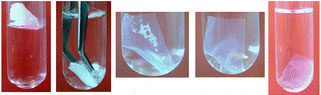
Scientists report a new methodology for surface modification of Teflon. The ease and efficiency of this approach and its rather robust character offer a number of interesting future perspectives.

 
Jean-Marc Vincent and his colleagues at the University Bordeaux, in France, have modified the Teflon membranes with a fluorophilic copper(II)-carboxylate complex. They believe that this may prove very useful towards developing passive samplers for the detection of contaminants of aquatic ecosystems, such as pharmaceutical compounds. The recycling of catalysts (modified by pyridyl tags or other groups that can bind to copper) and the purification of histidyl-tagged proteins are other examples of potential applications.


Interested to know more? Why not download and read the article today! It’s recently been published in ChemComm and will be freely available to all, until the end of September.

Fancy submitting your own exciting, high quality research to ChemComm? Then why not email us your suggestions or upload your submission via our website.


Digg This
Reddit This
Stumble Now!
Share on Facebook
Bookmark this on Delicious
Share on LinkedIn
Bookmark this on Technorati
Post on Twitter
Google Buzz (aka. Google Reader)

A pinch of salt

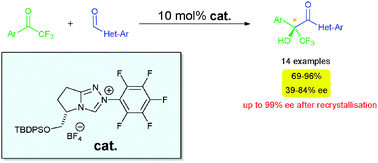
A novel chiral triazolium salt (derived from N-heterocyclic carbene) has shown to be a potent catalyst precursor for the asymmetric cross-benzoin reaction of aldehydes with ketones. Dieter Enders and his colleagues at RWTH Aachen University, in Germany have shown that several heteroaromatic aldehydes can react successfully with various aromatic trifluoroketones in good to excellent yields, with moderate to good enantioselectivities. This could be improved (up to 99% ee) by recrystallisation.

Direct observation of the reaction by NMR along with racemisation experiments showed that the product is formed under kinetic control.

Fancy reading more? Why not download and read Dieter Enders communication today! Its recently been published in ChemComm and will be free to access until the end of September.

Digg This
Reddit This
Stumble Now!
Share on Facebook
Bookmark this on Delicious
Share on LinkedIn
Bookmark this on Technorati
Post on Twitter
Google Buzz (aka. Google Reader)

Fourth ChemComm International Symposium

The Fourth ChemComm International Symposium will be held in Japan and Korea in September and October 2010. The symposium will focus on metal-oxygen species in bioinspired chemistry and will comprise two meetings each spanning two days:

  • 28-29 September 2010: ChemComm Symposium 2010, International House, Osaka, Japan
  • 01-02 October 2010: ChemComm Symposium 2010, Ewha Womans University, Seoul, Korea

ChemComm Editor Dr Robert Eagling  will be present at both meetings. For more information, including speaker lists, please see the symposia website.

Digg This
Reddit This
Stumble Now!
Share on Facebook
Bookmark this on Delicious
Share on LinkedIn
Bookmark this on Technorati
Post on Twitter
Google Buzz (aka. Google Reader)

Device turns water into fuel

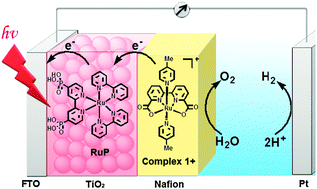
A photoelectrochemical device can successfully split water into oxygen and hydrogen, driven by the power of visible light. This offers a promising pathway to converting solar energy into a fuel, potentially solving the problems of future energy demand and related environmental issues.

 
The photoelectrochemical device consists of molecular ruthenium catalyst assembled via pH-modified Nafion on a dye-sensitized nanostructured TiO2 film as the anode, and platinum foil as the cathode.

Want to find out more? Why not read Licheng Sun and his colleagues article today, published in Chemical Communications, it is free to access until the 17th September (2010).

Digg This
Reddit This
Stumble Now!
Share on Facebook
Bookmark this on Delicious
Share on LinkedIn
Bookmark this on Technorati
Post on Twitter
Google Buzz (aka. Google Reader)

Catalytic chitosan aerogel

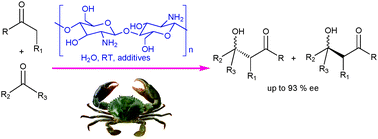
Aerogel microspheres of chitosan, an abundant biopolymer obtained from marine crustaceans, have been successfully applied to catalyze the asymmetric aldol reaction in water, providing the products in high yields and with good stereoselectivity (up to 93% ee) and recyclability (up to 4 runs). Yields were favourably affected by additives such as DNP and stearic acid. 


Alfredo Ricci, Françoise Quignard et. al., have published their findings in Chemical Communications. Why not read the article today, which is free to access until the 17th September (2010).


Digg This
Reddit This
Stumble Now!
Share on Facebook
Bookmark this on Delicious
Share on LinkedIn
Bookmark this on Technorati
Post on Twitter
Google Buzz (aka. Google Reader)

Powering ahead with lithium batteries

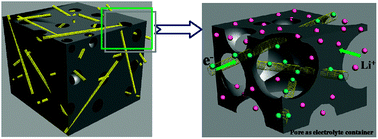
High-energy and high-powered lithium-ion batteries can be achieved when a high-performance multidimensional composite cathode is used.

The composite electrode structure is made up of highly-conductive 3D carbon nanotube (CNT) networks superimposed into interlaced porous LiFePO4 media via an in situ sol–gel process. Hierarchically structured composites based on porous LiFePO4 with CNT networks present significantly improved specific capacity and rate performance in comparison to unmodified porous LiFePO4 when used in lithium ion batteries.

This research has been carried out by Yingke Zhou, Zongping Shao and colleagues, at Nanjing University of Technology, in China along with a collaboration in Colorado. Why not read the article in full, published in Chemical Communications, it is free to access until the 17th September (2010).

Digg This
Reddit This
Stumble Now!
Share on Facebook
Bookmark this on Delicious
Share on LinkedIn
Bookmark this on Technorati
Post on Twitter
Google Buzz (aka. Google Reader)

Single-molecule magnet behaviour from lanthanides

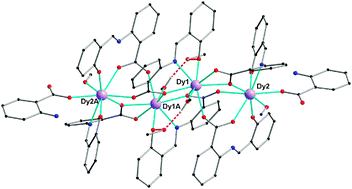
A linear dysprosium(III) compound shows single-molecule magnet (SMM) behaviour, opening up new avenues for investigating the relaxation dynamics of lanthanide aggregates.

Interestingly, there are fewer lanthanide SMMs developed than compared to transition metal-based ones, even though the relaxing rates are extremely sensitive to tiny distortions of the coordination geometry in lanthanide-systems. Therefore, there is a continuous need for the design of novel structures to enlarge the available database and thus improve our knowledge of the structure–property relationship of lanthanide-containing SMMs.

Jinkui Tang et. al., have published their findings in Chemical Communications, so why not read the article today? It is free to access until the 17th September (2010).

Digg This
Reddit This
Stumble Now!
Share on Facebook
Bookmark this on Delicious
Share on LinkedIn
Bookmark this on Technorati
Post on Twitter
Google Buzz (aka. Google Reader)

Gel free polymers

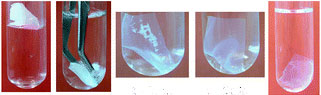
Stephen Rimmer and Richard England from Sheffield University, in the UK, have investigated the polymerisations of methyl methacrylate, styrene or N-isopropyl acrylamide in the presence of 1-phenyl(trimethylsiloxy)ethylene. It generates telechelic oligomers and chain end functionalized highly branched polymers, where the inclusion of a difunctional monomer also produces highly branched polymers that are free from gel.


Why not read the article today and let us know your thoughts by leaving some comments below. The article will be free to access until the 17th September.

Digg This
Reddit This
Stumble Now!
Share on Facebook
Bookmark this on Delicious
Share on LinkedIn
Bookmark this on Technorati
Post on Twitter
Google Buzz (aka. Google Reader)

Decorating carbon nanotubes

Acid-functionalized carbon nanotubes have been decorated with rhodium nanospheres using aluminum as a sacrificial substrate. Vijayamohanan Pillai and co-workers from the National Chemical Laboratory, in India, have discovered that the resulting heterostructure has a remarkable field emission than compared to smaller values that are obtained for the nanospheres and carbon nanotubes separately. It is hoped that this material may help towards the development of futuristic field emission devices.

Want to read more? Why not take a look at the article today, published in Chemical Communications, it is free to access until the 17th September.

Digg This
Reddit This
Stumble Now!
Share on Facebook
Bookmark this on Delicious
Share on LinkedIn
Bookmark this on Technorati
Post on Twitter
Google Buzz (aka. Google Reader)