

White light emitting organic nanoparticles can be made simply by encapsulating an orange-red emitting dye within a scaffold of blue light emitting nanoparticles, say scientists in Japan. The material could be suitable for applications in optoelectronics and bio-imaging, they claim.
Masayuki Takeuchi and colleagues at the National Institute for Materials Science, Tsukuba, made an oligofluorene derivative that self-assembled in solution to form stable colloidal nanoparticles. They tuned the nanoparticles’ bright blue fluorescence to white through fluorescence resonance energy transfer by encapsulating DCM, an orange-red emitting dye, within the nanoparticle assembly.
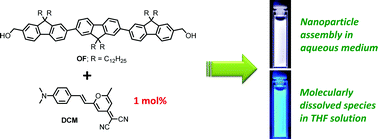
Download the Edge article and find out more about this work.
Do you have your own glowing research results? Submit them today to Chemical Science.


A friend of mine who subscribes to chemistry world, JAAS and a number of other RSC journals sent me a copy of a related article vie email. I must say this is an area that has developed tremendously and there are claims from a number of organisations that they have developed methods to yield particle size and chemical info from characterizing nanoparticles. Will be interesting to see developments
in related areas here. As always the RSC delivers.
(Report comment)
Thanks for your comments, science blogspot. I am glad you are happy with the way the RSC is disseminating science. All Chemical Science content is free to access to all until the end of the year so please check out the other great articles we are publishing and let us know your thoughts on those too. You can also subscribe to our e-alert at http://www.rsc.org/alerts to be notified when each issue is published.
(Report comment)