
 Cancer is a devastating disease which kills millions of people each year. Although treatment for cancer has come a long way, current treatment relies on using toxic chemotherapeutic drugs, which can also kill healthy cells causing terrible side effects for patients. Nanotechnology and nanvectors have emerged as a new strategy in cancer treatment, as they protect the drugs from premature degradation, and improve the pharmacodynamics of the drugs. However, very few nanovector-based drugs are currently available.
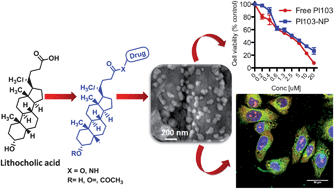
In this work, Sudipta Basu and co-workers, from Pune, India, have developed a novel nanovector from lithocholic acid (LA), a naturally occuring bile acid. The nanoparticles can self-assemble to develop supramolecular nanostructures, and are under 200 nm in size which is beneficial for targeting tumours by enhanced permeability and retention. The nanoparticles can hold the clinically approved cytotoxic drugs doxorubicin, paclitaxel and PI103, and release the active drugs in a controlled manner at pH 5.5. They can also be decorated with antibodies, aptamers or cell surface receptor targeting peptides, for tissue specific delivery of cytotoxic drugs.
Read the full article to find out more. It’s free to access for 4 weeks!
Novel self-assembled lithocholic acid nanoparticles for drug delivery in cancer, Sumersing Patil, Sohan Patil, Suhas Gawali, Shrikant Shende, Shraddha Jadhav and Sudipta Basu, RSC Advances, 2013, DOI: 10.1039/c3ra42994f