Archive for February, 2021

RSC Advances Science Communications: In the search of a tangible product for healthcare

Treatment for cancer and bacterial infections is challenging to approach due to various reasons such as the development of resistant and unwanted side effects. Development of new chemotherapeutic agents often ends up with a blunt end. Therefore, finding a new formulation and an effective delivery method for the currently available agents is a gold alternative.

Curcumin and zinc oxide nanoparticles (ZnO Nps) are such compounds that have enormous advantages. Of the potent bioactive metabolites that have been identified from plant sources, curcumin is one of the most-investigated safe chemical compounds. Research over the last two decades has shown it to be a potent anticancer and antimicrobial agent in cell- and animal studies. But inheritably, curcumin has low efficacy mainly due to the poor bioavailability, contributed to by its insolubility, instability, poor absorption, and rapid biotransformation. ZnO Np is a well-investigated biocompatible and apparently nontoxic nanomaterial that has shown promising anticancer and antimicrobial activity as well. In the article “Curcumin loaded zinc oxide nanoparticles for activity-enhanced antibacterial and anticancer applications”, different shapes of curcumin loaded ZnO Nps were investigated for their effectiveness and safety as an anticancer and antibacterial agent. The results indicate that curcumin loaded ZnO Nps are low toxic and a highly effective combination compared with their bare counterparts. Moreover, since nanoparticles show different absorption mechanisms through the gastrointestinal tract, it is a good alternative to mask compound which has low absorption capacity. In this study, other than the synergetic effect of curcumin loaded Nps, ZnO Nps act as a carrier system for curcumin, which has bioavailability issues.
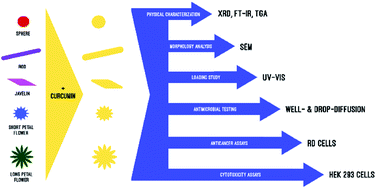
Graphical abstract: Curcumin loaded zinc oxide nanoparticles for activity-enhanced antibacterial and anticancer applications

Of particular note is the potential of this platform to act as an antibiotic-free formulation for use against infections caused by a range of different bacterial pathogens. Given the anticancer activity of the platform, it may prove to be of great use as an oncotherapy supplement, helping manage both the disease condition and opportunistic bacterial infections. The findings of this research open doors for different angles of curcumin and ZnO Np research. Therefore, the responsibility of the scientists is to use this finding to develop appropriate dosage foam for curcumin loaded ZnO Np.

I thank Dr. Ranga K. Dissanayake for his cordial responses.

Read the article:

Curcumin loaded zinc oxide nanoparticles for activity-enhanced antibacterial and anticancer applications

W. P. T. D. Perera, Ranga K. Dissanayake, U. I. Ranatunga, N. M. Hettiarachchi, K. D. C. Perera, Janitha M. Unagolla, R. T. De Silva and L. R. Pahalagedara. RSC Adv., 2020, 10, 30785–30795.


About the Web Writer:

Cristian M. O. Lépori is Doctor in Chemical Sciences and currently has a postdoctoral position at the Instituto de Física Enrique Gaviola, CONICET – Universidad Nacional de Córdoba, Argentina. He works in the area of green chemistry. He likes to plan, organize and carry out science dissemination activities. You can find him on Twitter at @cristianlepo.



RSC Advances Royal Society of ChemistrySubmit to RSC Advances today! Check out our author guidelines for information on our article types or find out more about the advantages of publishing in a Royal Society of Chemistry journal.

Keep up to date with our latest HOT articles, Reviews, Collections & more by following us on Twitter. You can also keep informed by signing up to our E-Alerts.

Digg This
Reddit This
Stumble Now!
Share on Facebook
Bookmark this on Delicious
Share on LinkedIn
Bookmark this on Technorati
Post on Twitter
Google Buzz (aka. Google Reader)

RSC Advances themed collection: Celebrating recent achievements in chemical science in Turkey

We are delighted to share with you our themed collection of recently published articles Celebrating recent achievements in chemical science in Turkey, Guest Edited by Fabienne Dumoulin (Acıbadem Mehmet Ali Aydınlar University) and Suna Timur (Ege University).

The collection features articles published in RSC Advances over the period 2018-2020 with at least one corresponding author being affiliated in Turkey. The selection matches many of the topics listed as national priorities (energy, environment, health) in their whole diversity, and reflects the dynamics of research teams.

Featured articles

Preparation, characterization, and thermal properties of novel fire-resistant microencapsulated phase change materials based on paraffin and a polystyrene shell
Berk Kazanci, Kemal Cellat and Halime Paksoy
RSC Adv., 2020. DOI: 10.1039/D0RA04093B

Recent developments in the synthesis of regioregular thiophene-based conjugated polymers for electronic and optoelectronic applications using nickel and palladium-based catalytic systems
Bibi Amna, Humaira Masood Siddiqi, Abbas Hassan and Turan Ozturk
RSC Adv., 2020. DOI: 10.1039/C9RA09712K

Green synthesis of silver nanoparticles: biomolecule-nanoparticle organizations targeting antimicrobial activity
Anupam Roy, Onur Bulut, Sudip Some, Amit Kumar Mandal and M. Deniz Yilmaz
RSC Adv., 2019. DOI: 10.1039/C8RA08982E

Read the full collection here

Meet the Guest Editors

Associate Professor Dr. Fabienne Dumoulin first started university studying biology, graduated in biochemistry and then completed her PhD in organic chemistry in Lyon, France in 2002. She is currently associate professor at Acıbadem Mehmet Ali Aydinler University in Istanbul,Turkey.

Her research focuses on the chemistry, properties and applications of phthalocyanines, mainly for photodynamic therapy. She has authored so far 85 research articles, three book chapters, and supervised many Master and PhD students. Fabienne has also been the recipient of several Young Scientist Awards: TUBA-GEBİP from the Turkish Academy of Sciences, BAGEP from the Bilim Akademisi and the Mustafa N Parlar Foundation of METU. She was elected officer of the executive committee of the European Society for Photobiology in 2015 and 2017, is an Associate Editor for RSC Advances and the Journal of Porphyrins and Phthalocyanines, and is a Member of the Royal Society of Chemistry.


Professor Suna Timur received her PhD degree in Biochemistry at Ege University in 2001. She is currently a full-time Professor in the Department of Biochemistry, at the same University.

Her research is focused on the integration of biomolecules and other species with micro and nanoplatforms to create novel functional bio-based surfaces. She has published more than 200 SCI articles, 4 book chapters and supervised 40 M.Sc and Ph.D thesis. Dr. Timur has also been the recipient of Young Scientist Awards; Encouragement Awards from TUBITAK and the Mustafa N Parlar Foundation of METU and FABED from Istanbul Technical University.


RSC Advances Royal Society of ChemistrySubmit to RSC Advances today! Check out our author guidelines for information on our article types or find out more about the advantages of publishing in a Royal Society of Chemistry journal.

Keep up to date with our latest HOT articles, Reviews, Collections & more by following us on Twitter. You can also keep informed by signing up to our E-Alerts.

Digg This
Reddit This
Stumble Now!
Share on Facebook
Bookmark this on Delicious
Share on LinkedIn
Bookmark this on Technorati
Post on Twitter
Google Buzz (aka. Google Reader)

RSC Advances Science Communications: For a safer earth for us and for the next generation

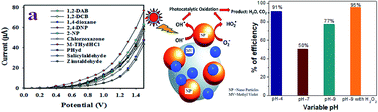
Current increasing demands for the effective photocatalytic system for the treatment of industrial effluent with low cost and highly effective tools influenced the use of systems based on TMO (tri-metal oxide) that work in both acidic and basic pH systems, and that combat resistance to multiple drugs in bacterial infections and cancer. To solve the global environmental problems and save people from carcinogenic exposure, work has been done to establish highly effective, highly reliable and sensitive electrochemical methods involving the I–V approach for the detection of toxins present in environmental samples as well as in food/drinks or in their containers.

Dyes are extensively used in the textile industry, and considerable amounts are discharged into natural water reservoirs without any treatment. To treat wastewater, many catalysts have been investigated. However, it is tough to find an effective and efficient system for the waste- effluent treatment. The TMO system reported in the article “Photocatalysis, photoinduced enhanced antibacterial functions and development of a selective m-tolyl hydrazine sensor based on mixed Ag∙NiMn2O4 nanomaterials” was designed to meet the current need of industrial waste water treatment problem world-wide. For industrial effluent, especially from fabric and other industries where huge amounts of dyes are used, a proper treatment system is needed. This TMO system is very effective and highly efficient for the treatment of industrial waste water, it can degrade dyes present in waste water naturally in presence of sunlight. In particular, Ag·NiMn2O4 TMO can degrade dyes in both acidic and basic medium (in a wide pH range) in presence of sunlight. So, this TMO is useful for the treatment of varieties of industrial waste water. Further, its activity can be boosted by the use of a catalytic amount of H2O2 (as catalyst booster).

Graphical abstract: Photocatalysis, photoinduced enhanced anti-bacterial functions and development of a selective m-tolyl hydrazine sensor based on mixed Ag·NiMn2O4 nanomaterials

Ag·NiMn2O4 TMO is highly effective against both Gram positive and Gram negative MDR (multi drug resistant bacteria). This result is very promising because it is highly challenging to kill both Gram positive and Gram negative bacteria with a single drug (compound). It is expected that this compound can be a promising sterilizing agent for numerous industrial uses.

The authors also reports on a highly reliable and sensitive electrochemical method involving the I–V approach for the detection of hydrazine. Hydrazine is used as an industrial raw material to produce pesticides, herbicides, insecticides, corrosion inhibitors, pharmaceutical intermediates, dyestuffs, antioxidants, explosives, catalysts, fuel cells and rocket fuel, and it is a carcinogenic compound. In this study, the development of an electrochemical sensor using Ag·NiMn2O4 TMO nanomaterial on glassy carbon electrode (GCE) was developed. The m-tolyl hydrazine chemical sensor was fabricated with GCE coated with the Ag·NiMn2O4 TMO nanomaterial. The stability of the sensor probe was implemented by applying conductive Nafion (5% in ethanol) as a chemical glue under ambient conditions.

Finally, various real samples (collected from various environmental sources) were analyzed to check the applicability as well as the validity of the chemical sensor probe. As a potential sensor, it is reliable due to its good reproducibility, rapid response, high sensitivity, working stability for long duration and efficiency in the analysis of real environmental samples. Therefore, this method introduces a new route to develop selective chemical sensors using TMO nanomaterials for safety in the environmental and healthcare fields.

The authors strongly believe that the TMO research will have a tremendous effect on current as well as upcoming health and environmental global issues. Specifically, for a sustainable environment, medical and other health care issues.

I thank Dr. Md Abdus Subhan for his cordial responses.

Read the article:

“Photocatalysis, photoinduced enhanced antibacterial functions and development of a selective m-tolyl hydrazine sensor based on mixed Ag∙NiMn2O4 nanomaterials”. Md Abdus Subhan, Pallab Chandra Saha, Md Anwar Hossain, M. M. Alam, Abdullah M. Asiri, Mohammed M. Rahman, Mohammad Al-Mamun, Tanjila Parvin Rifat, Topu Raihan A. K. Azad. RSC Adv., 2020, 10, 30603–30619.


About the Web Writer:

Cristian M. O. Lépori is Doctor in Chemical Sciences and currently has a postdoctoral position at the Instituto de Física Enrique Gaviola, CONICET – Universidad Nacional de Córdoba, Argentina. He works in the area of green chemistry. He likes to plan, organize and carry out science dissemination activities. You can find him on Twitter at @cristianlepo.


RSC Advances Royal Society of ChemistrySubmit to RSC Advances today! Check out our author guidelines for information on our article types or find out more about the advantages of publishing in a Royal Society of Chemistry journal.

Keep up to date with our latest HOT articles, Reviews, Collections & more by following us on Twitter. You can also keep informed by signing up to our E-Alerts.

Digg This
Reddit This
Stumble Now!
Share on Facebook
Bookmark this on Delicious
Share on LinkedIn
Bookmark this on Technorati
Post on Twitter
Google Buzz (aka. Google Reader)

January 2021 RSC Advances Reviews

New year, new review collection! Every month we will update our 2021 Reviews in RSC Advances collection to showcase all of the review articles published in RSC Advances in 2021. Don’t forget to come back next month to check out our latest reviews.

We hope you enjoy reading and as always, all of our articles are open access so you can easily share your favourites online and with your colleagues.

Explore the full collection!

Browse a selection of our January reviews below:

Minerals in biology and medicine
Oliver W. L. Carter, Yingjian Xu and Peter J. Sadler
RSC Adv., 2021, 11, 1939-1951
DOI: 10.1039/D0RA09992A

Organic dots (O-dots) for theranostic applications: preparation and surface engineering
Amin Shiralizadeh Dezfuli, Elmira Kohan, Sepand Tehrani Fateh, Neda Alimirzaei, Hamidreza Arzaghi and Michael R. Hamblin
RSC Adv., 2021, 11, 2253-2291
DOI: 10.1039/D0RA08041A

Antibiofilm peptides: overcoming biofilm-related treatment failure
Melanie Dostert, Michael J. Trimble and Robert E. W. Hancock
RSC Adv., 2021, 11, 2718-2728
DOI: 10.1039/D0RA09739J

A quantum chemical approach for the mechanisms of redox-active metalloenzymes
Per E. M. Siegbahn
RSC Adv., 2021, 11, 3495-3508
DOI: 10.1039/D0RA10412D

Recent developments and perspectives in the copper-catalyzed multicomponent synthesis of heterocycles
Jaleel Fairoosa, Mohan Neetha and Gopinathan Anilkumar
RSC Adv., 2021, 11, 3452-3469
DOI: 10.1039/D0RA10472H

Tin dioxide-based nanomaterials as anodes for lithium-ion batteries
Minkang Wang, Tianrui Chen, Tianhao Liao, Xinglong Zhang, Bin Zhu, Hui Tang and Changsong Dai
RSC Adv., 2021, 11, 1200-1221
DOI: 10.1039/D0RA10194J
RSC Advances Royal Society of ChemistrySubmit to RSC Advances today! Check out our author guidelines for information on our article types or find out more about the advantages of publishing in a Royal Society of Chemistry journal.

Keep up to date with our latest HOT articles, Reviews, Collections & more by following us on Twitter. You can also keep informed by signing up to our E-Alerts.

Digg This
Reddit This
Stumble Now!
Share on Facebook
Bookmark this on Delicious
Share on LinkedIn
Bookmark this on Technorati
Post on Twitter
Google Buzz (aka. Google Reader)

January 2021 HOT Articles

New year, new HOT article collection! Every month we will update our 2021 RSC Advances HOT Article Collection to showcase all of the articles selected by our reviewers and handling editors as HOT in 2021. Don’t forget to come back next month to check out our latest HOT articles.

We hope you enjoy reading and as always, all of our articles are open access so you can easily share your favourites online and with your colleagues.

Explore the full collection!

Browse a selection of our January HOT articles below:

β-Cyclodextrin: a supramolecular catalyst for metal-free approach towards the synthesis of 2-amino-4,6-diphenylnicotinonitriles and 2,3-dihydroquinazolin-4(1H)-one
Bijeta Mitra, Gyan Chandra Pariyar and Pranab Ghosh
RSC Adv., 2021, 11, 1271-1281
DOI: 10.1039/D0RA09562A

Ligand compatibility of salacinol-type α-glucosidase inhibitors toward the GH31 family
Fumihiro Ishikawa, Aiko Hirano, Yuuto Yoshimori, Kana Nishida, Shinya Nakamura, Katsuki Takashima, Shinsuke Marumoto, Kiyofumi Ninomiya, Isao Nakanishi, Weijia Xie, Toshio Morikawa, Osamu Muraoka and Genzoh Tanabe
RSC Adv., 2021, 11, 3221-3225
DOI: 10.1039/D0RA10038B

Transition metals enhance prebiotic depsipeptide oligomerization reactions involving histidine
Moran Frenkel-Pinter, Alyssa B. Sargon, Jennifer B. Glass, Nicholas V. Hud and Loren Dean Williams
RSC Adv., 2021, 11, 3534-3538
DOI: 10.1039/D0RA07965K

Self-ordered anodic porous alumina with inter-hole spacing over 1.5 μm
Takashi Yanagishita, Ryosuke Moriyasu, Takayuki Ishii and Hideki Masuda
RSC Adv., 2021, 11, 3777-3782
DOI: 10.1039/D0RA10269E

In situ electro-organic synthesis of hydroquinone using anisole on MWCNT/Nafion modified electrode surface and its heterogeneous electrocatalytic reduction of toxic Cr(vi) species
Mansi Gandhi, Desikan Rajagopal and Annamalai Senthil Kumar
RSC Adv., 2021, 11, 4062-4076
DOI: 10.1039/D0RA10370E


RSC Advances Royal Society of ChemistrySubmit to RSC Advances today! Check out our author guidelines for information on our article types or find out more about the advantages of publishing in a Royal Society of Chemistry journal.

Keep up to date with our latest HOT articles, Reviews, Collections & more by following us on Twitter. You can also keep informed by signing up to our E-Alerts.

Digg This
Reddit This
Stumble Now!
Share on Facebook
Bookmark this on Delicious
Share on LinkedIn
Bookmark this on Technorati
Post on Twitter
Google Buzz (aka. Google Reader)