Hot Article: Thiol–yne ‘click’ chemistry as a route to functional lipid mimetics

Thiol-yne chemistry is an efficient mechanism to synthesize A2B star polymers. In the latest Polymer Chemistry Hot Article, Daniel Savin and co-workers at University of Southern Mississippi, USA, report the synthesis and solution characterization of polypeptide-based stars that serve as lipid mimetic molecules.

Graphical abstract: Thiol–yne ‘click’ chemistry as a route to functional lipid mimetics

Using the thiol–yne convergent synthesis, the team envision a modular approach to functionalize proteins or oligopeptides with lipophilic chains that can imbed seamlessly into a cell membrane.

Fancy knowing more? Why not read the full article for free here:

Sandeep S. Naik, Justin W. Chan, Christopher Comer, Charles E. Hoyle and Daniel A. Savin, Polym. Chem., 2011, DOI: 10.1039/C0PY00231C

Digg This
Reddit This
Stumble Now!
Share on Facebook
Bookmark this on Delicious
Share on LinkedIn
Bookmark this on Technorati
Post on Twitter
Google Buzz (aka. Google Reader)

Video Interview: Filip Du Prez talks with Dave Haddleton

Watch the video interview of Filip Du Prez as he talks with Dave Haddleton about the use of click chemistry in polymer synthesis.

Filip Du Prez talks with Dave Haddleton about the use of click chemistry in polymer synthesis.

Click here to watch the whole video on YouTube

Digg This
Reddit This
Stumble Now!
Share on Facebook
Bookmark this on Delicious
Share on LinkedIn
Bookmark this on Technorati
Post on Twitter
Google Buzz (aka. Google Reader)

Interview with Eva Harth

Photograph of Eva HarthEva Harth talks to Marie Cote about chemistry as a way of expression, nanosponge technology and her love of colour and structures

What inspired you to become a scientist?
I always wanted to find out how things really worked and I was first interested in animals. Later on I became interested in more biological questions; I bought books on how cells and plants function. I found that chemistry is a very creative way of expression – artists can make paintings but chemists can make compounds, which is also a way to express yourself. It’s always novel and nearly never repetitive in a way. This is what I liked about it…

Read the full interview for free in Highlights in Chemical Biology

Digg This
Reddit This
Stumble Now!
Share on Facebook
Bookmark this on Delicious
Share on LinkedIn
Bookmark this on Technorati
Post on Twitter
Google Buzz (aka. Google Reader)

Polymer Chemistry, 2010, Issue 10 – Online!

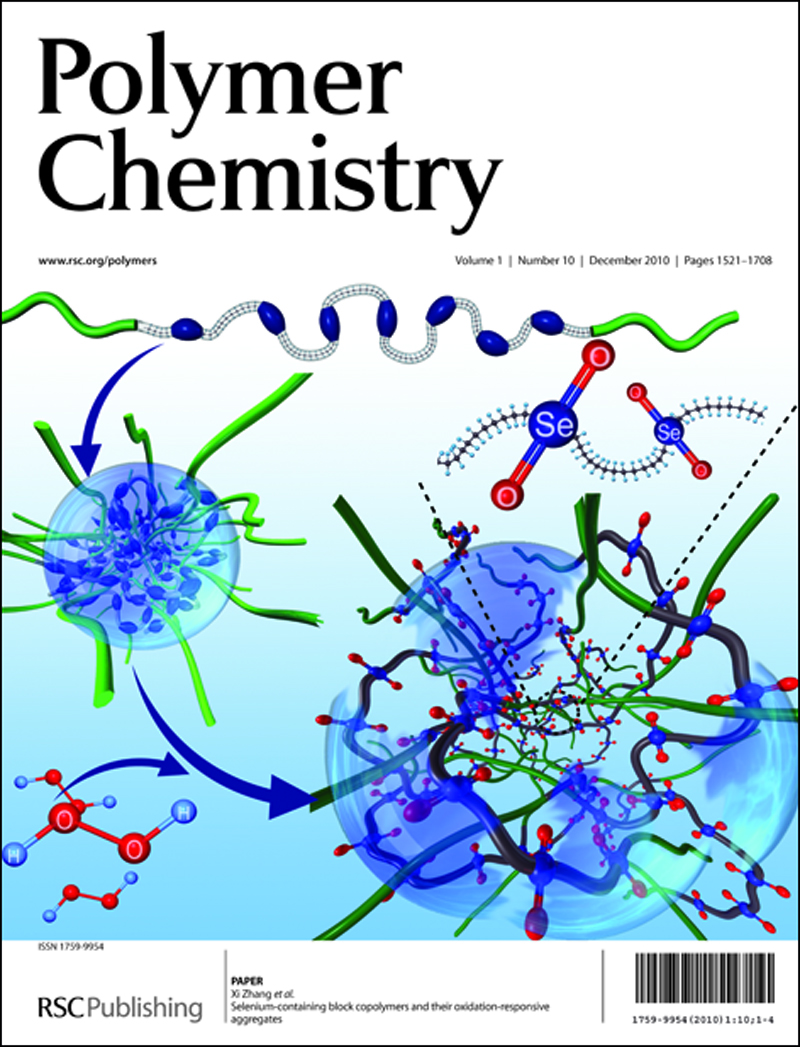
Selenium-containing block copolymers and their oxidation-responsive aggregates by Ning Ma, Ying Li, Huifeng Ren, Huaping Xu, Zhibo Li and Xi Zhang is the paper featured on the front cover of Polymer Chemistry issue 10.

The paper reports self-assembled responsive aggregates made from selenium-containing polymers. These polymer aggregates are more sensitive to oxidants than sulfur-containing analogues. The team hope this behavior could form the basis of a new drug delivery system.

The polymer is a selenium-containing amphiphilic block copolymer with a hydrophobic polyselenide block flanked by two hydrophilic poly(ethylene glycol) blocks.

Interested to know more? Why not read the full article for free: Selenium-containing block copolymers and their oxidation-responsive aggregates.

Digg This
Reddit This
Stumble Now!
Share on Facebook
Bookmark this on Delicious
Share on LinkedIn
Bookmark this on Technorati
Post on Twitter
Google Buzz (aka. Google Reader)

Hot Article: Thermoresponsive giant biohybrid amphiphiles

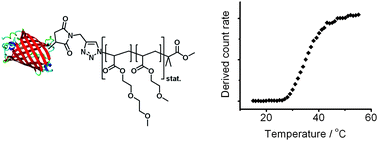
Jeroen Cornelissen and co-workers at Radboud University Nijmegen and the University of Twente created a series of thermoresponsive giant biohybrid amphiphiles.

Graphical abstract: Thermoresponsive giant biohybrid amphiphiles

The polymer component was a random copolymer of ethylene glycol methyl ether acrylate and methoxy ethoxy ethyl acrylate formed by atom transfer radical polymerisation.  The team linked the hydrophobic polymer to enhanced green fluorescent protein using a copper-catalysed azide–alkyne cycloaddition. Slow heating allows the giant amphiphiles to self-assemble into spherical micelles with a diameter of approximately 60 nm.

Interested to know more? Read the full article for free here: Christine Lavigueur, Jordi González García, Linda Hendriks, Richard Hoogenboom, Jeroen J. L. M. Cornelissen and Roeland J. M. Nolte, Polym. Chem., 2011, DOI:10.1039/C0PY00229A

Digg This
Reddit This
Stumble Now!
Share on Facebook
Bookmark this on Delicious
Share on LinkedIn
Bookmark this on Technorati
Post on Twitter
Google Buzz (aka. Google Reader)

ChemComm Emerging Investigator Lectureship

ChemComm is delighted to invite nominations for the very first ChemComm Emerging Investigator Lectureship. The lectureship, which will be awarded annually, will recognise an emerging scientist in the early stages of their independent academic career. Deadline for nominations: 28th February 2011. Visit the ChemComm blog for more information.

Digg This
Reddit This
Stumble Now!
Share on Facebook
Bookmark this on Delicious
Share on LinkedIn
Bookmark this on Technorati
Post on Twitter
Google Buzz (aka. Google Reader)

Polymer Chemistry poster prize winners at 6th International Symposium on Stimuli-Responsive Materials

Congratulations to Yohei Kotsuchibashi of Kagoshima University for winning the Polymer Chemistry poster prize at the 6th International Symposium on Stimuli-Responsive Materials.

The title of his winning poster was “Stimuli-Responsive Self-Assembly System That Can Form and Stabilize Nanoparticles at the Desired Size by Sample Mixing and Heating/Cooling of the Selected Block Copolymers”.

Photograph of Youhei Kotsuchibashi next to his winning poster

Yohei Kotsuchibashi works in Professor Takao Aoyagi’s group at Kagoshima University. The 6th International Symposium on Stimuli-Responsive Materials was held 26-27th October 2010 in Hattiesburg, USA.

Digg This
Reddit This
Stumble Now!
Share on Facebook
Bookmark this on Delicious
Share on LinkedIn
Bookmark this on Technorati
Post on Twitter
Google Buzz (aka. Google Reader)

Hot Article: Shape evolution control of phase-separated colloidal nanoparticles

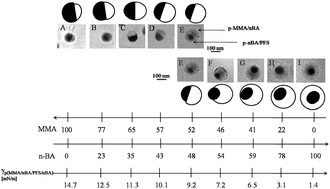
In the latest Polymer Chemistry Hot Article, Cathrin Corten and Marek Urban at the University of Southern Mississippi, USA, investigate the evolution of shape in colloidal particles. In the paper they study colloidal nanoparticle made from two phase-separated copolymers poly(methylmethacrylate) (p-MMA)/n-butylacrylate (nBA) and poly(nBA)/pentafluorostyrene (p-PFS).

Graphical abstract: Shape evolution control of phase-separated colloidal nanoparticles

These studies show for the first time that the synthesis of two distinct phase-separated copolymers within one colloidal nanoparticle allows control of the nanoparticle morphology by compositional and interfacial adjustments.

Interested to know more? Why not read the full article for free here: Cathrin C. Corten and Marek W. Urban, Polym. Chem., 2011, DOI:10.1039/C0PY00220H

Follow Polymer Chemistry on TwitterFind Polymer Chemistry on Facebook

Digg This
Reddit This
Stumble Now!
Share on Facebook
Bookmark this on Delicious
Share on LinkedIn
Bookmark this on Technorati
Post on Twitter
Google Buzz (aka. Google Reader)

Top Ten most-read Polymer Chemistry articles in September

The latest top ten most downloaded Polymer Chemistry articles

See the most-read papers of September 2010 here:

Tobias Kaufmann and Bart Jan Ravoo, Polym. Chem., 2010, 1, 371-387
DOI: 10.1039/B9PY00281B 
 
Jay A. Syrett, C. Remzi Becer and David M. Haddleton, Polym. Chem., 2010, 1, 978-987
DOI: 10.1039/C0PY00104J
 
Xiaowei Zhan and Daoben Zhu, Polym. Chem., 2010, 1, 409-419
DOI: 10.1039/B9PY00325H
 
Guang-Zhao Li, Rajan K. Randev, Alexander H. Soeriyadi, Gregory Rees, Cyrille Boyer, Zhen Tong, Thomas P. Davis, C. Remzi Becer and David M. Haddleton, Polym. Chem., 2010, Advance Article
DOI: 10.1039/C0PY00100G
 
Nicolas Sanson and Jutta Rieger, Polym. Chem., 2010, 1, 965-977
DOI: 10.1039/C0PY00010H
 
Andrew B. Lowe, Polym. Chem., 2010, 1, 17-36
DOI: 10.1039/B9PY00216B
 
Gijs J. M. Habraken, Maloes Peeters, Carin H. J. T. Dietz, Cor E. Koning and Andreas Heise, Polym. Chem., 2010, 1, 514-524
DOI: 10.1039/B9PY00337A
 
Ingo Dierking, Polym. Chem., 2010, 1, 1153-1159
DOI: 10.1039/C0PY00087F
 
R. K. Nagarale, Woonsup Shin and Pramod K. Singh, Polym. Chem., 2010, 1, 388-408
DOI: 10.1039/B9PY00235A
Digg This
Reddit This
Stumble Now!
Share on Facebook
Bookmark this on Delicious
Share on LinkedIn
Bookmark this on Technorati
Post on Twitter
Google Buzz (aka. Google Reader)

Hot Article: Cyclodextrin functionalized polymers as drug delivery systems

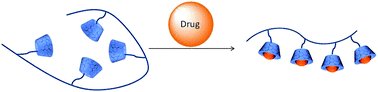
The hollow structure of cyclodextrins makes them promising hosts for drugs. By attaching polymers to the cyclodextrin ring scientists can create new materials to use as drug delivery systems. One advantage of attaching the polymer is that it allows the delivery properties to be tailored by modifying the polymer as well as the cyclodextrin host.

Graphical abstract: Cyclodextrin functionalized polymers as drug delivery systems

The review by Jiawen Zhou and Helmut Ritter, Heinrich-Heine University of Düsseldorf, Germany, focuses on the recent advances made with cyclodextrins in polymer chemistry and their applications in drug delivery systems. They discuss the opportunities for using click reactions to covalently attached polymer chains to cyclodextrins, and other examples for functionalizing cyclodextrin.

Fancy knowing more? Read the article for free here:

Don’t forget you can keep up to date with all the latest news in Polymer Chemistry by following us on Twitter or Finding us on Facebook

Follow Polymer Chemistry on TwitterFind Polymer Chemistry on Facebook

Digg This
Reddit This
Stumble Now!
Share on Facebook
Bookmark this on Delicious
Share on LinkedIn
Bookmark this on Technorati
Post on Twitter
Google Buzz (aka. Google Reader)